Secrecy is endemic within organizations, woven into the fabric of our lives at work. Yet, until now, we've had an all-too-limited understanding of this powerful organizational force. Secrecy is a part of work, and keeping secrets is a form of work. But also, secrecy creates a social order—a hidden architecture within our organizations. Drawing on previously overlooked texts, as well as well-known classics, Jana Costas and Christopher Grey identify three forms of secrecy: formal secrecy, as we see in the case of trade and state secrets based on law and regulation; informal secrecy based on networks and trust; and public or open secrecy, where what is known goes undiscussed. Animated with evocative examples from scholarship, current events, and works of fiction, this framework presents a bold reimagining of organizational life.
eBook - ePub
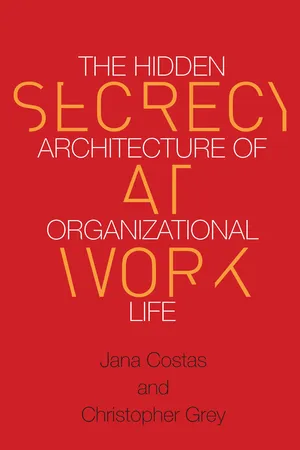
Secrecy at Work
The Hidden Architecture of Organizational Life
- 216 pages
- English
- ePUB (mobile friendly)
- Available on iOS & Android
eBook - ePub
About this book
Information
CHAPTER 1
Laying the Theoretical Foundations
IN HIS 1925 NOVEL THE TRIAL, Franz Kafka describes how after his unexpected arrest for an unspecified offence, Josef K. enters the secret world of the court system with its own laws, proceedings, and dynamics—a world that is unknown and nonsensical to him, yet at the same time increasingly absorbing. As Josef K. seeks to gather information and confront the court, he faces only closed doors: documents related to cases remain locked in the advocate’s drawer because “official secrets were involved.”1 The entire proceedings are “kept secret not only from the public but from the defendant too,”2 placing him in a continual state of worry, uncertainty, and distrust. Even within the “endless” hierarchical structure of the court, “beyond comprehension even of the initiated, court proceedings were in general kept secret from minor officials and only those higher up the hierarchy followed them.”3 Despite his various efforts, until the end this organizational world full of secrecy remains an absurd “theatre”4 to Josef K. that, however, takes complete control over him.
Kafka’s novel parallels the observations of the German sociologist Max Weber, who, writing at around the same time as Kafka, points to the prevalence of “official secrets” in bureaucracies. One can also read in Kafka’s novel the fear of the existence of a secret powerful elite working behind the scenes—such a link between secrecy and power underlies the writings of Elias Canetti. The Trial provides a powerful description of how, as theorized by Georg Simmel, another German sociologist and Kafka contemporary, a separate reality can be created through secrecy with boundaries between the initiated and outsiders. This entails the creation of a dramaturgical reality, as described in the writings of the American social psychologist Erving Goffman on social interactional practices.
So The Trial not only constitutes one example of how secrecy is deeply ingrained in our social and cultural imaginations; it also points to different aspects of its various theorizations in social science. These theorizations of secrecy are the focus of this chapter. We trace secrecy in the works of in particular, Max Weber, Elias Canetti, Georg Simmel, Erving Goffman, Michael Taussig, and Eviator Zerubavel. Although secrecy is not central in all these writings, together they provide complementary insights on the diverse nature of secrecy as well as its varied social dynamics, conditions, and consequences. We do not give a detailed discussion of the work of these authors but rather draw out the key insights from what they write about secrecy and also introduce some of the conceptual terminology we use. From this, we develop seven “foundations” that guide our subsequent analysis of organizational secrecy.
SECRETS AND POWER: BEYOND FUNCTIONALITY
Let us begin by turning to one of the foundational thinkers of the field of organization studies: Max Weber. In the seminal work Economy and Society he points briefly to the prevalence of secrecy in bureaucracy—one that cannot only be explained through secrecy’s immediate function of concealing information. As knowledge becomes the base of domination of bureaucratic organizations, Weber argues that there is a tendency among office holders to withhold knowledge from others. In a bureaucracy, knowledge is codified and stored in the form of documents that only organizational members have access to and thus can hide, leading to the rise of the “office secret”:
The concept of the “office secret” is the specific invention of bureaucracy, and few things it defends so fanatically as this attitude which . . . cannot be justified with purely functional arguments.5
According to “purely functional arguments,” a bureaucracy engages in secrecy to conceal valuable knowledge for strategic reasons. This is the case when there are external threats, such as war, foreign politics, or competition. Yet Weber also emphasizes that organizational actors’ motivation to hide knowledge often results from “pure power interests”; this goes “far beyond these areas of functionally motivated secrecy.”6
Following Weber, we can see that there is a connection between the formal documentation of knowledge and the invention of the “official secret.” The locking away of knowledge (the logic of arcanum) requires the possibility of documenting and codifying knowledge, as in the advocate’s drawer, described by Kafka, where all the secret documents remain hidden, or, more prosaically, government archives. This in turn can explain why, in the public eye, state bureaucracies, associated with the hoarding of documents, papers, and files, are often portrayed as epitomizing sites of secrecy—though Weber notes that secrecy can be equally ubiquitous in commercial organizations to which the public has even less access.7 Secrecy can also constitute a habituated response to outsiders. In situations of competition, conflict, and public encounters, it can assume strategic importance for organizations. Most important for our purposes is Weber’s insight that organizations are prone to keep secrets for the previous reasons and beyond the intrinsic functionality of doing so. This opens up a new and highly significant terrain of investigation. For if the interest in secrecy is not simply about concealing valuable knowledge for strategic purposes, what else is at stake?
Secrecy, Power, and the Powerful
One answer that Weber provides to this question concerns the striving for power, but he does so only in passing and we must look elsewhere for its elaboration. In fact, the connections between among secrecy, power, and the powerful goes back a long way. The Roman historian Tacitus drew attention to it through his notion of the arcana imperii. This carries a number of meanings ranging from the secret practices of the state and its rulers, the means of protecting a government, the sacred character of political knowledge to a mysterious and cultic aura of kingship and some kind of deceptive and manipulative Machiavellian conduct of the state.8 The principle that the ruler, the king, or the state can successfully function only under the veil of secrecy has greatly shaped the mode of governing throughout Western history. Although the revolutions in England and France and the subsequent rise of the democratic state have sought to counter this principle, secrecy still constitutes a widespread mode of governing today.9
Although not explicitly concerned with the arcana imperii, in Crowds and Power the Bulgarian-born polymath Elias Canetti also argues that “secrecy lies at the very core of power.”10 This is epitomized in the system of secrecy that typically surrounds dictatorships. Here we might think of the notoriously secretive nature of totalitarian regimes, with their networks of secret police and informers, their secret archives on citizens, control of information, and their proclivity for night-time arrests and the disappearing of opponents. More specifically, Canetti describes how rulers mobilize secrecy to shape their relation to subordinates as well as the relations between subordinates. They reveal certain secrets to others and observe the information flows so as to see whether those entrusted with secrets are reliable and loyal. The ways in which rulers use a system of secrecy to test loyalty, break and create ties with others is particularly well described by Canetti’s example of the last Persian king, Chosroes II:
If he [the king] knew that two of his courtiers were close friends and stood against all comers he closeted himself with one of them, told him as a secret that he had decided to have the other executed and forbade him under threat of punishment to reveal this to him. From then on he watched the behavior of the threatened man as he came and went in the palace, the colour of his face and his demeanor as he stood before him. If he saw that his behavior was in no way changed he knew that the first man had not betrayed the secret and he then took him even more into his confidence. . . . But if he saw that the threatened man was afraid and kept apart, or turned his face away, then he knew that his secret had been betrayed and thrust the offender from his favour.11
Through developing a system of secrets, rulers stand out as the only people with an overview of the situation and are thus uniquely in the position to make decisions. Canetti also describes how rulers try to remain opaque by refraining from sharing their opinions and intentions with others yet seeking to see through those others. In this way, the hierarchy between the rulers and the others is reinforced and produced. Here the workings of the logic of mysterium, that is, the creation of a certain awe and magic, can be in play too. In saying little and remaining silent, Canetti argues that outsiders attribute to the rulers that rulers conceal and hence know something that the outsiders do not know. If the taciturn ruler then says something, outsiders attach to this special importance. Thus by presenting themselves “a closed book,” the rulers’ words carry particular weight and in this way they are placed and place themselves above ordinary people.12
Although Canetti develops his insights in the context of dictatorships,13 Weber’s student Robert Michels and the American sociologist C. Wright Mills show how the interaction of power and secrecy also shape modern democracy. In his writing on Political Parties Michels notes that despite the democratic rule of the political party system, there is a small group of leaders in power over the masses. In a similar vein to Canetti, Michels describes how the leaders’ power is sustained through their ability to evoke an aura of mysteriousness and be “masters of the situation: [they] . . . are adepts in the art of employing digressions, periphrases, and terminological subtleties, by means of which they surround the simplest matter with a maze of obscurity to which they alone have the clue.”14 Under the veil of secrecy, Michels notes that the powerful group makes decisions without engaging with the public.
Such decision-making processes behind closed doors are also central in C. Wright Mills’s classic study The Power Elite. Mills shows that although this power elite greatly shapes the US government and its political decisions, such as those related to the atomic bomb, their influence remains largely hidden. Here we have a different intersection between power and secrecy: although in the dictatorial setting Canetti analyzes it is known who are the powerful and that they rule through a system of secrecy, in the democratic setting secrecy serves to hide the powerful people and their influence from public sight:
Many higher events that would reveal the working of the power elite can be withheld from public knowledge under the guise of secrecy. With the wide secrecy covering their operations and decision, the power elite can mask their intentions, operations, and further consolidation. Any secrecy that is imposed upon those in positions to observe high decision-makers clearly works for and not against the operations of the power elite.15
Rather than constituting a tool for exercising power, here secrecy provides a separate space, outside the public’s eye, for operating, maneuvering, and making decisions. In this way, power itself becomes disguised: “So long as power is not nakedly displayed, it must not be power. And of course you do not consider the difficulties posed for you as an observer by the fact of secrecy, official and otherwise.”16
Summary of Key Insights
The discussion of the arcana imperii and Canetti, Michels, and Mills provide explanations for Weber’s observation concerning secrecy’s significance beyond its immediate functionality of concealing information. They elaborate the link between secrecy and power, namely that power or more precisely positions of power are bolstered by, if not based on, secrecy. It is through the mysteriousness created by secrecy that rulers, kings, and statesmen can surround themselves with a certain sacredness that is otherwise reserved for the divine men, the priests and, of course, God. That secrecy can constitute a form of governing is apparent in the medieval notion of the secretary, namely the official person entrusted with secrets. Though it may no longer evoke any mystery, it is still prevalent in governments today, as exemplified in the US Secretary of State, or the job title of the most senior British civil servants, Permanent Secretary. Apart from the creation of a sacred and therefore somewhat untouchable position of those in power, secrecy can be used to test, manipulate, and keep others in check as well as to operate and make decisions without having to involve outsiders. As with Kafka’s descriptions of the secret court system, Canetti shows that those in power can seek to control and survey information flows (i.e., not allowing others to hide anything from them), while a system of secrecy surrounds them. But this is hardly the preserve of dictatorships. The same kind of information surveillance accompanied by secrecy has led to the current heated debates about governmental organizations such as the National Security Agency in the United States.
That secrecy provides a separate space to maneuver, make, and potentially manipulate decisions outside the gaze of the public explains the ethical concerns often raised by transparency advocates against secrecy.17 This separate space can bring about what Carl Schmitt terms the “state of exception,” wherein the actions of those in power are exempt from the rule ...
Table of contents
- Cover
- Copyright
- Title Page
- Epigraph
- Contents
- Acknowledgments
- Introduction: The Plan
- 1. Laying the Theoretical Foundations
- 2. Bricks and Mortar: From Organizing Secrecy to Secrecy as Organizing
- 3. Walls and Corridors: Organizing Formal Secrecy
- 4. Open and Closed Doors: Organizing Informal and Public Secrecy
- 5. The Hidden Architecture of Organizational Life
- Conclusion: Finishing Touches
- Notes
- Works Cited
- Index
Trusted by 375,005 students
Access to over 1.5 million titles for a fair monthly price.
Study more efficiently using our study tools.
Frequently asked questions
Yes, you can cancel anytime from the Subscription tab in your account settings on the Perlego website. Your subscription will stay active until the end of your current billing period. Learn how to cancel your subscription
No, books cannot be downloaded as external files, such as PDFs, for use outside of Perlego. However, you can download books within the Perlego app for offline reading on mobile or tablet. Learn how to download books offline
Perlego offers two plans: Essential and Complete
- Essential is ideal for learners and professionals who enjoy exploring a wide range of subjects. Access the Essential Library with 800,000+ trusted titles and best-sellers across business, personal growth, and the humanities. Includes unlimited reading time and Standard Read Aloud voice.
- Complete: Perfect for advanced learners and researchers needing full, unrestricted access. Unlock 1.5M+ books across hundreds of subjects, including academic and specialized titles. The Complete Plan also includes advanced features like Premium Read Aloud and Research Assistant.
We are an online textbook subscription service, where you can get access to an entire online library for less than the price of a single book per month. With over 1.5 million books across 990+ topics, we’ve got you covered! Learn about our mission
Look out for the read-aloud symbol on your next book to see if you can listen to it. The read-aloud tool reads text aloud for you, highlighting the text as it is being read. You can pause it, speed it up and slow it down. Learn more about Read Aloud
Yes! You can use the Perlego app on both iOS and Android devices to read anytime, anywhere — even offline. Perfect for commutes or when you’re on the go.
Please note we cannot support devices running on iOS 13 and Android 7 or earlier. Learn more about using the app
Please note we cannot support devices running on iOS 13 and Android 7 or earlier. Learn more about using the app
Yes, you can access Secrecy at Work by Christopher Grey,Jana Costas in PDF and/or ePUB format, as well as other popular books in Commerce & Comportement organisationnel. We have over 1.5 million books available in our catalogue for you to explore.