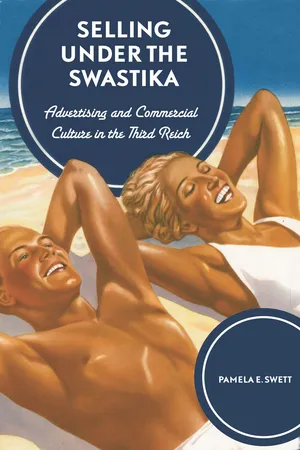
Selling under the Swastika is the first in-depth study of commercial advertising in the Third Reich. While scholars have focused extensively on the political propaganda that infused daily life in Nazi Germany, they have paid little attention to the role played by commercial ads and sales culture in legitimizing and stabilizing the regime. Historian Pamela Swett explores the extent of the transformation of the German ads industry from the internationally infused republican era that preceded 1933 through the relative calm of the mid-1930s and into the war years. She argues that advertisements helped to normalize the concept of a "racial community," and that individual consumption played a larger role in the Nazi worldview than is often assumed. Furthermore, Selling under the Swastika demonstrates that commercial actors at all levels, from traveling sales representatives to company executives and ad designers, enjoyed relative independence as they sought to enhance their professional status and boost profits through the manipulation of National Socialist messages.
eBook - ePub
Selling under the Swastika
Advertising and Commercial Culture in Nazi Germany
- 360 pages
- English
- ePUB (mobile friendly)
- Available on iOS & Android
eBook - ePub
About this book
Information
PART I
From Internationalism to “German Advertising”
CHAPTER ONE
Advertising in the Weimar Republic
Advertise and don’t despair!1
Writing in the first months of the Third Reich, Hanns F. J. Kropff, a leading German researcher in the science of advertising, began his book: “In a time in which the word ‘rational’ shines as a beacon of light on every wall, it is astounding that German ads in many cases are still ‘driven by emotions.’ The recognition of the utility of a system—in the highest sense of the orderly distribution and design of the advertisement—is still far from commonplace among all those who work [in the industry].”2 Kropff’s analysis, which began a treatise on the importance of psychology in effective ad design, went on to praise the work of American and British ad designers and included their work time and again in his 1934 text as examples of best practice for understanding human desires and motivations, for incorporating effective use of color and type, and researching market trends.3 Kropff serves as a useful example of the modernist strain in National Socialism. The best way to understand culture in Hitler’s society is not as a “beautiful illusion”—a mirage of light and color that bewitched the spectator, an orderly surface that masked irrationality.4 Rather, someone like Kropff speaks to the ease with which some thinkers moved from the rationalization of the Weimar era to the Nazi period, hopeful that Hitler’s regime would fulfill the promises of reform that had been in the air throughout the 1920s.
Kropff was certainly no friend of Weimar, but he believed the call for rationalization that marked the 1920s to be a path to economic success and professional standing for his discipline.5 Like others, he embraced the “experimenting, reordering, reconstructing” mission of National Socialism. It is this “spirit of renovation” that we see emerge out of debates in the republican era and develop more fully after 1933.6 We begin, therefore, with an analysis of German advertising and commercial culture in the 1920s and the sometimes collaborative, sometimes competitive, relationship between German advertisers and their Anglo-American counterparts, who led the way designing the “rational” ads that attracted Kropff. Most important, however, the chapter highlights the manner in which commercial actors debated the way forward during the Depression and the political turbulence that accompanied it. In addition to its uses righting the economy, some hoped that what they saw as an international language of ads could promote an understanding between nations that would cement the peace. Others became more protectionist at the end of 1920s and insisted that product promotion should not only highlight the importance of buying home-grown goods but should also represent “national character” in form and content. The chapter discusses these debates and concludes with the offensive of German advertisers like Kropff who adopted the nationalist line as a way to withstand the tumultuous 1920s and prepare a niche for their industry in the coming National Socialist era.
ADVERTISING IN THE 1920S: SUPPORTERS AND CRITICS
Germany had a long tradition of commercial advertising. The biannual Leipzig fair had been held since the Middle Ages, drawing exhibitors and attendees from all over the world. Of course, the fair predated the emergence of a German state by several hundred years, but the Germans claimed it as their own, and even boasted of hosting the European marketplace.7 By the second half of the 1920s, the Leipzig fair could in fact be seen, according to Victoria de Grazia, as the center of a new global economy—with regularly sponsored stands representing countries from all corners of the earth.8 But as de Grazia also argues, commercial fairs constituted only one of a growing number of advertising methods by the end of the nineteenth century. Posters, print advertisements and classifieds, shop window displays, branded collectibles such as match books and trading cards, and the verbal advertisements and demonstrations offered by company representatives, retailers, and door-to-door salespeople were taken for granted by most as part of daily life. As radio and film became popular media outlets, advertisements found their ways to those venues as well.
In many of these areas, German advertisers and businessmen were not world leaders. The sales tools that most Germans still upheld as the most respectable and dependable were those that had maintained the Leipzig fair as a potent force for hundreds of years: face-to-face meetings between manufacturers, wholesalers, and retailers, the ability to demonstrate the quality of wares and production methods in person, and contracts that were negotiated and signed on the spot. These strategies were far removed from the new mass marketing techniques that focused on investigations of consumer desires increasingly practiced in the United States, and to a lesser extent in Britain.
In the years following the First World War, German businesses did not readily embrace change. There were both practical (the ailing economy) and principled reasons (a distrust of imported practices) working against the adoption of new strategies, such as the introduction of customer surveys, the psychological study of consumer behavior, and the growth of full-service ad agencies to handle all aspects of the branding process. In fact, beyond the handful of branches of American and British agencies that opened in the mid- and late 1920s, the concept of the full-service advertising campaign handled by external experts did not really take hold until the 1960s. In the interwar period most German companies continued to handle their advertisements in-house. In 1930, a large retailer with five hundred men and women on its payroll was likely to employ twenty-five to thirty of them in the advertising of its wares.9 Indeed, only a handful of the most established brands had a well-developed image around which they could base an entire promotional program. Ideas for advertisements, according to Alexander Schug, simply flowed from the owners and sales staff to the office in charge of design, or were simply stolen from the advertisements of competitors.10 Satisfied customers were also fond of sending in letters with personal stories, poems, slogans, photographs, and jingles they recommended for use in ads. The motivations behind these suggestions seem to range from real emotional attachment to the brand, and a desire to see it thrive, to the hope that contributing a well-rhymed jingle might lead to remuneration. If the business did not have its own in-house ad department and did not work with a full-service agency or an independent ad designer, a draft of an idea would be sent directly to a graphic artist or printer. In all cases where full-service agencies were not employed, the company or retailer then relied on one of the many placement services [Annoncen-Expeditionen] to handle the business side of seeking out sites and placing advertisements.11
Unlike the American ad agencies that would handle the placement of ads in all media, German placement services tended to specialize in one format, such as print, radio, film, building exteriors, or billboards. Payment systems were also different in the respective countries. The ad agencies handled the whole account, charging one fee for the production of all materials plus an additional 15 percent for consultation and planning. German businesses seeking to advertise their wares and services were charged in a piecemeal fashion, but the total costs were far lower than working with one of the transplanted Anglo-American full-service agencies. The German businessman paid the graphic artists and printers individually for the advertisements they readied for placement, and then the placement services (of which a business might use several) received a commission for the number of ads “sold” to publishers or other media outlets, deals that often included rebates for the quantity of ad space purchased.12
There were a variety of reasons for the reluctance of some Germans to adopt new advertising methods. First, the whole concept of Propaganda, which was still often used interchangeably with the word for advertising [Reklame], had an unfavorable reputation throughout Europe, owing largely to the deceptions of state and military propagandists during the First World War. These negative connotations combined with older concerns that advertising was an unethical, almost shameful sales strategy—one that would only hurt the company’s reputation in the long run. A company’s goods should win new customers on word-of-mouth reputation alone; quality didn’t need to shout to gain attention.13 Second, per capita income in Germany showed no clear signs of growth between 1913 and 1947.14 Under such circumstances, it was hard for many business owners to invest heavily in new sales methods or even the old ones. The financial instability of the republic not only made it less likely for new investment in large-scale promotional efforts; some consumers also believed that advertising did little more than increase the price of the goods. Creating a brand-name product was therefore risky, not only because of the expense but also because it had the possibility of actually turning away some potential buyers.
Third, some advertisers and business owners accepted advertising as a strategy but wanted to conserve the uniquely German style of poster design. Before the war, prominent graphic artists such as Lucien Bernhard and Ludwig Hohlwein had created stark imagery that helped cement the logos and names of some of Germany’s first branded goods in the minds of consumers. Their eye-catching posters, characterized by brilliant colors, minimal text (often just the brand name), and stark imagery were internationally respected. And while this Plakatstil was on the decline in the 1920s, increasingly crowded out by cheaply made and placed print ads, many advertisers in Germany (and other parts of Europe) were unwilling to abandon the poster and its brash style completely out of respect for its aesthetic value and tradition of commercial success. Moreover, the international admiration enjoyed by German artists, including Oskar Kokoschka, Heinrich Zille, and Kurt Schwitters, who worked intermittently for advertisers to make ends meet in the unstable economic climate, reinforced the long-held belief among German business leaders that advertising was best left to the creative genius of the artist.
It is also worth remembering that advertising as a profession was less developed than we might expect in Germany in the 1920s, certainly in comparison with the United States. In addition to highly skilled artists that came and went, there was also an influx of young men and women entering advertising and related professions after the war. During the period of relative economic stability in the mid-1920s, and the concomitant growth of mass media and individual consumption, there were new jobs to be had in this sector. Either classroom training or workplace experience in sales, decorating, journalism, or graphic arts could lead someone toward a career in advertising. Without formalized professional standards of training, advertising was wide open to young urbanites from a variety of backgrounds.15 In Erich Kästner’s sardonic 1931 novel Fabian: The Story of a Moralist, the university-trained protagonist describes himself in the opening scene as “Fabian, Jacob, aged thirty-two, profession variable, at present advertising copywriter.” Later in the novel, when he is asked by a colleague what will happen if he loses his job writing advertisements for a cigarette company, he answers: “Do you think I’ve spent my life since the day I was confirmed making good publicity for bad cigarettes? When these people kick me out, I shall look for a new profession. One more won’t make much difference to me.”16
This lack of a uniform path into advertising meant that disseminating the theories of scientific selling was a slow process, but it also meant that marginalized groups, chiefly women and Jews, had a chance of making inroads into these new fields. Women first took up positions in store window decorating, for which their domestic skills were thought to be a useful foundation. They also had success entering ad departments as entry-level artists, creating sketches or painting in the final image according to a male artist’s directions.17 Over time some women moved up within ad departments or chose to work independently. Likewise, Jews did not find anti-Semitic barriers to be as difficult to hurdle as in more established professions. Jews from retailing families, in particular, likely found this an easy step to take. Youthful advertisers may have also had a slight advantage in their work. Other white-collar professions were also expanding, leading to greater purchasing power among this sector of young consumers, including the so-called new women. Employers of advertisers needed to take this fact seriously, one expert warned: “[The advertiser] will only hit the mark with these new, young consumers, if his ad speaks to them in a youthful tone!”18
While the poster tradition continued to find supporters in 1920s Germany, practitioners did incrementally turn their attention to the technical side of selling, thinking ever more seriously about the impact of color, lighting, size, and other aspects of form and content in their posters rather than artistic merit alone.19 The professional journal founded in 1921, Das Plakat [The Poster], changed its name in 1924 to Gebrauchsgraphik [Graphic Art], signaling the shifting emphasis toward a wider variety of media and more psychologically savvy design methods, even if the business side of advertising remained fairly constant.20 Alongside these financial, professional, and aesthetic challenges of the 1920s, anti-advertising sentiment was also fed by much older anti-Semitic stereotypes of the conniving, swindling Jewish merchant.21 While a prejudicial association between Jews and less-than-honorable sales practices was well ingrained throughout Europe, it gained renewed legitimacy at the start of the twentieth century when revived by leading German intellectuals who feared new forms of capitalism, which included mass production, department and chain stores, and, of course, ads. In his 1911 treatise The Jews and Modern Capitalism, the sociologist Werner Sombart claimed that the eighteenth-century practice of Jewish clothiers who “seized the passer-by by the arm and tried to force him to make purchases” had developed into the contemporary sales aim “to get hold of the customers.” Sombart targeted the sales practices of large brand-name firms such as AEG, a company that happened to have been founded by the Jewish Berlin patrician Emil Rathen...
Table of contents
- Cover
- Copyright
- Title Page
- Dedication
- Acknowledgements
- Contents
- Illustrations
- Abbreviations
- Introduction
- Part I: From Internationalism to “German Advertising”
- Part II: Branding for the Volksgemeinschaft
- Part III: Preparing for Victory and Surviving Defeat
- Notes
- Works Cited
- Index
Trusted by 375,005 students
Access to over 1.5 million titles for a fair monthly price.
Study more efficiently using our study tools.
Frequently asked questions
Yes, you can cancel anytime from the Subscription tab in your account settings on the Perlego website. Your subscription will stay active until the end of your current billing period. Learn how to cancel your subscription
No, books cannot be downloaded as external files, such as PDFs, for use outside of Perlego. However, you can download books within the Perlego app for offline reading on mobile or tablet. Learn how to download books offline
Perlego offers two plans: Essential and Complete
- Essential is ideal for learners and professionals who enjoy exploring a wide range of subjects. Access the Essential Library with 800,000+ trusted titles and best-sellers across business, personal growth, and the humanities. Includes unlimited reading time and Standard Read Aloud voice.
- Complete: Perfect for advanced learners and researchers needing full, unrestricted access. Unlock 1.5M+ books across hundreds of subjects, including academic and specialized titles. The Complete Plan also includes advanced features like Premium Read Aloud and Research Assistant.
We are an online textbook subscription service, where you can get access to an entire online library for less than the price of a single book per month. With over 1.5 million books across 990+ topics, we’ve got you covered! Learn about our mission
Look out for the read-aloud symbol on your next book to see if you can listen to it. The read-aloud tool reads text aloud for you, highlighting the text as it is being read. You can pause it, speed it up and slow it down. Learn more about Read Aloud
Yes! You can use the Perlego app on both iOS and Android devices to read anytime, anywhere — even offline. Perfect for commutes or when you’re on the go.
Please note we cannot support devices running on iOS 13 and Android 7 or earlier. Learn more about using the app
Please note we cannot support devices running on iOS 13 and Android 7 or earlier. Learn more about using the app
Yes, you can access Selling under the Swastika by Pamela E. Swett in PDF and/or ePUB format, as well as other popular books in History & Business History. We have over 1.5 million books available in our catalogue for you to explore.