Shades of Difference
eBook - ePub

Shades of Difference

Why Skin Color Matters

  1. 312 pages
  2. English
  3. ePUB (mobile friendly)
  4. Available on iOS & Android
eBook - ePub

Shades of Difference

Why Skin Color Matters

About this book

Shades of Difference addresses the widespread but little studied phenomenon of colorism—the preference for lighter skin and the ranking of individual worth according to skin tone. Examining the social and cultural significance of skin color in a broad range of societies and historical periods, this insightful collection looks at how skin color affects people's opportunities in Latin America, Asia, Africa, and North America.

Is skin color bias distinct from racial bias? How does skin color preference relate to gender, given the association of lightness with desirability and beauty in women? The authors of this volume explore these and other questions as they take a closer look at the role Western-dominated culture and media have played in disseminating the ideal of light skin globally. With its comparative, international focus, this enlightening book will provide innovative insights and expand the dialogue around race and gender in the social sciences, ethnic studies, African American studies, and gender and women's studies.

Frequently asked questions

Yes, you can cancel anytime from the Subscription tab in your account settings on the Perlego website. Your subscription will stay active until the end of your current billing period. Learn how to cancel your subscription.
No, books cannot be downloaded as external files, such as PDFs, for use outside of Perlego. However, you can download books within the Perlego app for offline reading on mobile or tablet. Learn more here.
Perlego offers two plans: Essential and Complete
  • Essential is ideal for learners and professionals who enjoy exploring a wide range of subjects. Access the Essential Library with 800,000+ trusted titles and best-sellers across business, personal growth, and the humanities. Includes unlimited reading time and Standard Read Aloud voice.
  • Complete: Perfect for advanced learners and researchers needing full, unrestricted access. Unlock 1.4M+ books across hundreds of subjects, including academic and specialized titles. The Complete Plan also includes advanced features like Premium Read Aloud and Research Assistant.
Both plans are available with monthly, semester, or annual billing cycles.
We are an online textbook subscription service, where you can get access to an entire online library for less than the price of a single book per month. With over 1 million books across 1000+ topics, we’ve got you covered! Learn more here.
Look out for the read-aloud symbol on your next book to see if you can listen to it. The read-aloud tool reads text aloud for you, highlighting the text as it is being read. You can pause it, speed it up and slow it down. Learn more here.
Yes! You can use the Perlego app on both iOS or Android devices to read anytime, anywhere — even offline. Perfect for commutes or when you’re on the go.
Please note we cannot support devices running on iOS 13 and Android 7 or earlier. Learn more about using the app.
Yes, you can access Shades of Difference by Evelyn Nakano Glenn in PDF and/or ePUB format, as well as other popular books in Social Sciences & Ethnic Studies. We have over one million books available in our catalogue for you to explore.

Notes

Chapter 1

Acknowledgments. The majority of the information contained in this chapter is drawn from the author’s other works. See, specifically, Edward Telles, “The Social Consequences of Skin Color in Brazil” (paper presented at the Colorism: Global Perspectives on How Skin Color Still Matters conference, Pennsylvania State University, University Park, PA, April 23, 2006); Edward Telles, “The Social Consequences of Skin Color in Brazil” (paper presented at the Colorism Conference, University of California, Berkeley, CA, December 20, 2005); Edward Telles, Race in Another America: The Significance of Skin Color in Brazil (Princeton: Princeton University Press, 2004).
1
Roberto Da Matta, “Notas sobre o racismo a brasileira,” in Multiculturalismo e Racismo: Uma comparação Brasil-Estados Unidos, ed. Jessé Souza (Brasília: Paralelo 15, 1997), 69–74. [O papel da ação afirmativa nos Estados Democráticos Contemporâneos (Brasília: Ministério da Justiça, 1996).]
2
From Stuart Hall, “Is Race a Floating Signifier?” The Sage Anniversary Lecture and the Hayard Lecture Goldsmiths College/Lewisham Council, 1996.
3
Marvin Harris and Conrad Kottack, “The Structural Significance of Brazilian Categories,” Sociologia 25 (1963), 203–208; Oracy Nogueira, Tanto Preto Quanto Branco: Estudos de Relações Racias (São Paulo: T.A. Queoroz, [1955] 1995).
4
James F. Davis, Who Is Black? One Nation’s Definition (University Park, PA: Pennsylvania State University Press, 1991).
5
Ibid.; Anthony Marx, Making Race and Nation: A Comparison of the United States, South Africa and Brazil (Cambridge: Cambridge University Press, 1998).
6
The Brazilian conception of race is thus similar to the situational or relational conception of ethnicity used by Frederick Barth. See Frederick Barth, ed., Ethnic Groups and Boundaries: The Social Organization of Culture Difference (Boston: Little, Brown, 1968). Also see Livio Sansone, “The New Politics of Black Culture in Bahia, Brazil,” in The Politics of Ethnic Consciousness, ed. Cora Govers and Hans Vermuellen (New York: St. Martin’s Press, 1997), 227–309; Peter Wade, Blackness and Race Mixture: The Dynamics of Racial Identity in Colombia (Baltimore: Johns Hopkins University Press, 1997).
7
The small number of Asians and indigenous peoples are generally classified outside the color continuum.
8
Nelson Silva, “Distância Social e Casamento Inter-Racial no Brasil,” Estudos Afro-Asiaticos 14 (1987), 54–84.
9
For a list of all these terms see “A Cor do Brasilero,” Folha de Sao Paulo, June 25, 1995, Caderno Especial, 5.
10
Harris and Kottack, 203–208; Rosa Pacheco, “A questão da cor nas relações raciais de um grupo de baixa renda,” Estudos Afro-Asiaticos 14 (1987), 85–97; Oracy Nogueira, Tanto Preto Quanto Branco: Estudos de Relações Racias (São Paulo: T.A. Queoroz, [1955] 1995); Livio Sansone, “Pai Preto, Filho Negro: Trabalho, Cor e Diferenças de Geração,” Estudos Afro-Asiáticos 25 (1993), 73–98; Thomas Stephens, Dictionary of Latin American Racial and Ethnic Terminology (Gainesville: University of Florida Press, 1989).
11
For more information on these definitions, see Stephens.
12
Pacheco, 85–97; Sansone, “Pai Preto, Filho Negro,” 73–98.
13
Although never incorporated as an official category, negro has a long history of use by civil societal organizations since the 1930s, with the Frente Negra Brasileira. Also, the Teatro Experimental do Negro was founded in 1940 “to raise black [negro] consciousness,” the first Congresso do Negro Brasileiro was held in 1950, the Associação Cultural do Negro was founded in 1954, and the Movimento Negro Unificado Contra Discriminação Racial (MNUCDR, later shortened to MNU) was organized in 1978.
14
Michael George Hanchard, Orpheus and Power: The Movimento Negro in Rio de Janeiro and Sao Paulo, Brazil, 1945–1988 (Princeton: Princeton University, 1994).
15
Despite the recommendations of the ministry of justice, census planners, in consultation with various experts and interested parties, and after survey testing various formats of the race question, decided to keep the same categories used in previous censuses.
16
Marvin Harris, “Racial Identity in Brazil,” Luzo-Brazilian Review 1 (1963), 21–28.
17
The survey did not ask respondents how many ancestors of each background they had, but merely whether they had any at all. Thus, although many white Brazilians claim to have African or indigenous ancestors, they are likely to have a relatively higher proportion of European ancestry than browns and blacks, confirming that race or color is defined mostly by appearance.
18
In a separate analysis, I found little difference by income in the proportion of whites claiming African ancestry.
19
Sergio P. J. Pena, “Retrato Molecular do Brasil,” Ciencia Hoje (April 2000), 17–25; Denise R. Carvalho-Silva et al., “The Phygeography of Brazilian Y-Chromosome Lineages,” American Journal of Human Genetics 68 (2001), 281–286.
20
Dark African Americans (medium brown, dark brown, and very dark) earn about 80 percent of what their brown counterparts (very light and light brown) earn...
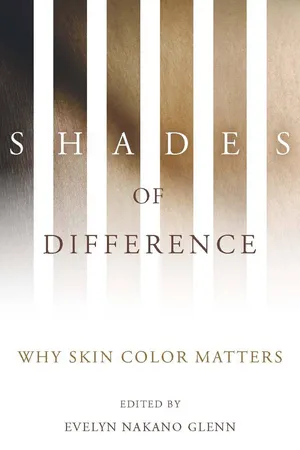
Table of contents

  1. Title Page
  2. Copyright Page
  3. Table of Contents
  4. Contributors
  5. Introduction - Economies of Color
  6. I The Significance of Skin Color - Transnational Divergences and Convergences
  7. II Meanings of Skin Color - Race, Gender, Ethnic Class, and National Identities
  8. III Consuming Lightness - Modernity, Transnationalism, and Commodification
  9. IV Countering Colorism - Legal Approaches
  10. Reference Matter
  11. Acknowledgments
  12. Notes
  13. Index