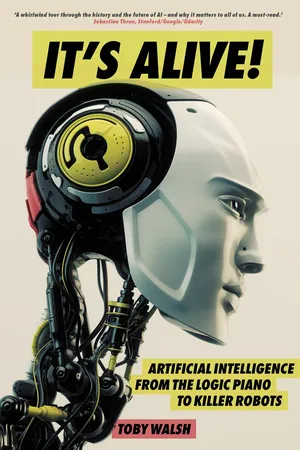
There are few other human inventions that are likely to have as large an impact on our lives as machines that can think... The steam engine liberated our muscles; the computer is set to liberate our minds. The development of Artificial Intelligence is an adventure as bold and ambitious as any that humans have attempted. And the truth is that thinking machines are already an indispensable part of our lives. Without them, Google couldn't answer your questions in a fraction of a second. Autonomous cars would exist only in science fiction. And your smartphone would be... just a phone. In countless ways, with every passing day, AI is shaping and reshaping our world.But where will AI technologies take us in the future? Will thinking machines destroy our jobs? Could their intelligence surpass our own? Could the rise of AI threaten the very existence of humanity?Leading researcher Toby Walsh takes us on a surprising and inspiring journey through the story of Artificial Intelligence – revealing how it is already transforming our societies, our economies and even ourselves – and makes ten fascinating predictions about what it will have achieved by the year 2050. 'A whirlwind tour through the history and the future of AI - and why it matters to all of us. A must-read.' —Sebastian Thrun, CEO of Udacity, a Google Fellow and VP, and a Research Professor at Stanford University.'Toby Walsh's story of how artificial intelligence evolved from the dreams of Alan Turing to a powerful technological force today is exciting, insightful and incisive. Will his predictions about how AI will change life as we know it in the coming decades prove equally dead-on? I, for one, would not bet against him!' —Henry Kautz, past President of the Association for the Advancement of Artificial Intelligence, and Founding Director of Institute for Data Science and Professor at University of Rochester ' It's Alive! addresses a broad range of issues in clear and refreshingly non-technical language that is suitable for readers who are looking to explore the subject without being scared off by too much scientific jargon.' —Chris Saliba, Books+Publishing Toby Walsh is one of the world's leading researchers in Artificial Intelligence, and has spent his life dreaming about and researching machines that might think. He is Professor of Artificial Intelligence at the University of New South Wales and leads a research group at Data61, Australia's Centre of Excellence for ICT Research. He has been elected a Fellow of the Association for the Advancement of AI for his contributions to the field, and has won the prestigious Humboldt Research Award.
- 320 pages
- English
- ePUB (mobile friendly)
- Available on iOS & Android
eBook - ePub
About this book
Trusted by 375,005 students
Access to over 1.5 million titles for a fair monthly price.
Study more efficiently using our study tools.
Information
PART I
AI’S PAST
AI’S PAST
1
THE AI DREAM
To understand where Artificial Intelligence is taking us, it helps to understand where it has come from, and where it is today. We can then start to extrapolate forward to the future.
Artificial Intelligence proper began in 1956, when one of its founding fathers, John McCarthy,1 proposed the name at the now famous Dartmouth Summer Research Project on Artificial Intelligence in New Hampshire.2 There’s arguably much wrong with the name McCarthy chose. Intelligence is itself a poorly defined concept. And putting the adjective artificial in front of anything never sounds very good. It opens you to countless jokes about Natural Intelligence and Artificial Stupidity. But for better or worse, we’re stuck now with the name Artificial Intelligence. In any case, the history of AI goes back much further – even before the invention of the computer. Humankind has been thinking about machines that might think, and how we might model thinking, for centuries.
THE PREHISTORY OF AI
Like many stories, this one has no clear beginning. It is, however, intimately connected to the story of the invention of logic. One possible starting point is the third century BC, when Aristotle founded the field of formal logic. Without logic, we would not have the modern digital computer. And logic has often been (and continues to be) seen as a model for thinking, a means to make precise how we reason and form arguments.
Besides some mechanical machines for calculating astronomical movements and doing other rudimentary calculations, humankind made little other progress towards thinking machines for the 2000 or so years following Aristotle. But, to be fair, even in the most advanced countries people had a few other problems on their plates, like war, disease, hunger and surviving the Dark Ages.
One standout was the thirteenth-century Catalan writer, poet, theologian, mystic, mathematician, logician and martyr, Ramon Llull.3 Some consider Llull to be one of the fathers of computing. He invented a primitive logic which could mechanically identify what he claimed were all possible truths about a subject. His, then, was one of the first logical and mechanical methods to produce knowledge. Llull’s ideas were, however, not greatly recognised in his time, though they are believed to have strongly influenced the next person in our story.
LET US CALCULATE
As the intellectual fog of the Middle Ages started to clear, our story accelerates. One of the standout figures who appeared was Gottfried Wilhelm Leibnitz.4 One of his most far-sighted intellectual contributions was his idea that much human thought could be reduced to calculations of some sort, and that such calculations could identify errors in our reasoning or resolve differences of opinion. He wrote: ‘The only way to rectify our reasonings is to make them as tangible as those of the Mathematicians, so that we can find our error at a glance, and when there are disputes among persons, we can simply say: Let us calculate [calculemus], without further ado, to see who is right.’5
Leibnitz proposed a primitive logic with which to perform such calculations. He imagined an ‘alphabet of human thought’, in which each fundamental concept was represented by a unique symbol. Computers are ultimately engines for manipulating symbols.6 Leibnitz’s abstraction is thus essential if digital computers are to ‘think’. The argument is as follows. Even though computers only manipulate symbols, if these symbols stand for fundamental concepts, as Leibnitz proposed, then computers can derive new concepts and thus perform human-like reasoning.
Around this time, we also come across a philosopher, Thomas Hobbes who laid another stone in the philosophical foundations of thinking machines.7 Like Leibnitz, Hobbes equated reasoning with computation. He wrote: ‘By reasoning, I understand computation … To reason therefore is the same as to add or to subtract.’8
Equating reasoning with computation, as both Leibnitz and Hobbes did, is a first step on the road to building a thinking machine. Even though the mechanical calculator had been invented a little before both Hobbes and Leibnitz were writing, it would take nearly two more centuries before someone tried to put reasoning by computation into practice.9
Another towering polymath to appear as the Dark Ages passed was René Descartes.10 He contributed an important philosophical idea that continues to haunt AI studies today: ‘Cogito ergo sum.’ That is, ‘I think therefore I am.’ These three Latin words elegantly associate thought with (human) existence. Reasoning backwards, we can conclude that if you don’t exist, you cannot think.11 Descartes’ idea, therefore, challenges the very possibility of thinking machines. Machines don’t exist like we do. They lack many special attributes that we associate with our existence: emotions, ethics, consciousness and creativity, to name just a few. And, as we shall see, many of these attributes have been raised as arguments against the existence of machines that think. For example, as machines are not conscious, they cannot think. Or, as machines are not creative, they cannot be said to think. We’ll return to these arguments shortly.
BOOLE AND BABBAGE
The next major player in our story doesn’t arrive for another two hundred years. George Boole was a self-taught mathematician.12 Despite having no university degree, he was appointed in 1849 as the first professor of mathematics at Queen’s College, County Cork, Ireland, based on a number of mathematical articles he had published in his spare time from his day job running a school. Boole’s university position, somewhat on the fringes of the academic world of the time, gave him the freedom to have some ideas that would be central to the development of computing, and to the dream of building thinking machines. Boole proposed that logic could be formalised by algebraic operations acting on two values: true or false, on or off, 0 or 1. Such ‘Boolean’ logic describes the operation of every computer today; they are really just sophisticated machines for processing streams of Boole’s 0s and 1s. While the importance of Boole’s ideas was recognised by few in his day, it is not a stretch to claim that he was the father of the current information age.
Boole, however, had greater ambitions for his logic that were even further ahead of their time. The title of his most complete work about his logic gives an idea of these goals: An Investigation of the Laws of Thought. Boole didn’t want simply to provide a mathematical foundation to logic, he wanted to explain human reasoning itself. In introducing this work, he wrote:
The design of the following treatise is to investigate the fundamental laws of those operations of the mind by which reasoning is performed; to give expression to them in the symbolical language of a Calculus, and upon this foundation to establish the science of Logic and construct its method … and, finally, to collect from the various elements of truth brought to view in the course of these inquiries some probable intimations concerning the nature and constitution of the human mind.
Boole never fully realised these ambitions. Indeed, his work was largely unrecognised in his day, and he was to die an untimely death ten years later.13 But even if Boole had not been in the academic backwater of Cork, he had no machine on which to automate these dreams.
Fascinatingly, two years before his death Boole met the next player in our story, Charles Babbage. This took place at the Great London Exposition, where the two great innovators are believed to have talked about Babbage’s ‘thinking engine’. It is tantalising to wonder what they might have dreamed up together if Boole had not died shortly after. Charles Babbage was a polymath: a mathematician, philosopher, inventor and engineer.14 He dreamed of building mechanical computers. Although he never succeeded, he is nevertheless considered by many to be the father of the programmable computer. His Analytical Engine was designed to be programmed using punched cards.
The idea that computers operate according to a program, and that this program can be changed, is fundamental to the capabilities of computers. Your smartphone can be loaded with new apps, programs that Steve Jobs or any of the other makers of smartphones probably never dreamed of. In this way, it can be many things at once: a calculator, a note taker, a health monitor, a navigator, a camera, a movie player and even (it’s sometimes hard to remember) a phone. This is an idea that Turing explored when proposing a general model for computing. A computer is a universal machine that can be programmed to do many different things. More subtly, computer programs can modify themselves. This capability is fundamental to the Artificial Intelligence dream. Learning appears to be a key part of our intelligence. If a computer is to simulate learning, it must have some way to modify its own program. Fortunately, it’s relatively easy to write a computer program that can modify itself. A program is just data, and that can be manipulated: think of the numbers in your spreadsheet, the letters in your word processor or the colours in your digital image. Computers can therefore learn to do new tasks – that is, to change their program to do tasks that they were not initially programmed to do.
THE FIRST PROGRAMMER
Working with Babbage was Augusta Ada King, Countess of Lovelace.15 She wrote a set of notes describing and explaining Babbage’s Analytical Engine for a wider audience. In these notes, she wrote what is generally considered the first computer program. Babbage was focused on the engine’s ability to perform numerical calculations, to compile astronomical and other tables. Lovelace, on the other hand, was able to dream about computers doing much more than mere number-crunching. She wrote that Babbage’s invention ‘might act upon other things besides number … the engine might compose elaborate and scientific pieces of music of any degree of complexity or extent’.
This idea was a century ahead of its time. Lovelace’s conceptual leap can be seen today in our smartphones, which manipulate sounds, images, videos and many other things besides numbers. However, she was also one of the first critics of Artificial Intelligence, dismissing the dream of building thinking machines that are creative. ‘The Analytical Engine has no pretensions whatever to originate anything,’ she wrote. ‘It can do whatever we know how to order it to perform. It can follow analysis; but it has no power of anticipating any analytical relations or truths.’
This idea – that if computers are not creative, then they cannot be intelligent – has been the subject of much debate. Turing discussed it in his seminal Mind paper. It is an argument I will return to shortly, but before I do, I want to reflect on Lovelace’s objection. The first person who thought about programming a computer – someone who was able to dream over a century ahead that computers would manipulate more than just numbers – was also highly sceptical about the final goal of making machines that think. It is not a simple dream. It is a dream that goes to the very heart of our position in the universe. Is there something that makes us special? Or are we also machines, just like our computers? The answer to these questions will ultimately change the way we think about ourselves. It threatens to change our position at the centre of things, as much as Copernicus’s realisation that the Earth goes around the Sun, or Darwin’s notion that we are descended from the apes.
One lesser-known figure who joins our story in the eighteenth century is William Stanley Jevons.16 He made numerous contributions to mathematics and economics. But we are interested in the ‘logic piano’ he invented in 1870, a mechanical computer that could solve logical puzzles involving up to four true/false decisions – or, to borrow the language of Boole’s logic, up to four variables that can take the value 0 or 1. In fact, Jevons built his piano to help teach logic. The original logical piano is still on display at the Museum of the History of Science in Oxford. The logic piano elegantly mechanises a small fragment of Boole’s logic. Its inventor wrote that ‘it will be evident that [the] mechanism is capable of replacing for the most part the action of thought required in the performance ...
Table of contents
- Cover Page
- About the Author
- Praise For It’s Alive!
- Title Page
- Copyright
- Dedication
- Contents
- Prologue
- Part I: Ai’s Past
- Part II: Ai’s Present
- Part III: Ai’s Future
- Epilogue
- Notes
- Bibliography
- Index
- Back Cover
Frequently asked questions
Yes, you can cancel anytime from the Subscription tab in your account settings on the Perlego website. Your subscription will stay active until the end of your current billing period. Learn how to cancel your subscription
No, books cannot be downloaded as external files, such as PDFs, for use outside of Perlego. However, you can download books within the Perlego app for offline reading on mobile or tablet. Learn how to download books offline
Perlego offers two plans: Essential and Complete
- Essential is ideal for learners and professionals who enjoy exploring a wide range of subjects. Access the Essential Library with 800,000+ trusted titles and best-sellers across business, personal growth, and the humanities. Includes unlimited reading time and Standard Read Aloud voice.
- Complete: Perfect for advanced learners and researchers needing full, unrestricted access. Unlock 1.5M+ books across hundreds of subjects, including academic and specialized titles. The Complete Plan also includes advanced features like Premium Read Aloud and Research Assistant.
We are an online textbook subscription service, where you can get access to an entire online library for less than the price of a single book per month. With over 1.5 million books across 990+ topics, we’ve got you covered! Learn about our mission
Look out for the read-aloud symbol on your next book to see if you can listen to it. The read-aloud tool reads text aloud for you, highlighting the text as it is being read. You can pause it, speed it up and slow it down. Learn more about Read Aloud
Yes! You can use the Perlego app on both iOS and Android devices to read anytime, anywhere — even offline. Perfect for commutes or when you’re on the go.
Please note we cannot support devices running on iOS 13 and Android 7 or earlier. Learn more about using the app
Please note we cannot support devices running on iOS 13 and Android 7 or earlier. Learn more about using the app
Yes, you can access It's Alive! by Toby Walsh in PDF and/or ePUB format, as well as other popular books in Computer Science & Artificial Intelligence (AI) & Semantics. We have over 1.5 million books available in our catalogue for you to explore.