Are you a feminist? Do you believe women are human beings and that they deserve all the same rights as men? If so, then you are a feminist . . .
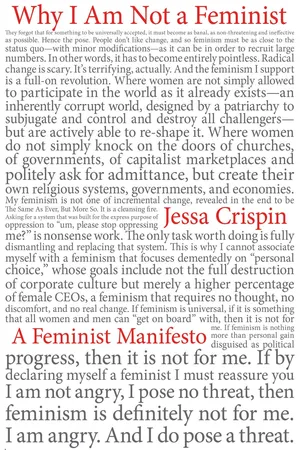
Or are you? Is it really that simple? Outspoken cultural critic Jessa Crispin says somewhere along the way, the movement for female liberation sacrificed meaning for acceptance, and left us with a banal, polite, ineffectual pose that barely challenges the status quo.
In this bracing, fiercely intelligent manifesto, she demands more: nothing less than the total dismantling of the system of oppression—and of what people currently think of as "feminism."
'The author's ferocious critique effectively reframes the terms of any serious discussion of feminism. You'll never trust a you-go-girl just-lean-in bromide again. Forget busting glass ceilings. Crispin has taken a wrecking ball to the whole structure.' —Kirkus starred review
'Feminists have, in fact, become polite insiders, and Crispin is here to show them how to punch their way out. A rallying manifesto; start swinging.' —Library Journal
'Crispin is telling us that we have to imagine something better in order to build it. Feminism as self-absorption, as an add-on label to a new lifestyle, has got us … where exactly? Where we are now. Stalled. Look how quickly we can go backwards. When did feminism get so small? When it became polite, unthreatening and marketable. Crispin blasts through all this by asking us to think big, properly scarily big.' —Suzanne Moore, Guardian
'The point of Why I Am Not a Feminist isn't really that Crispin is not a feminist; it's that she has no interest in being a part of a club that has opened its doors and lost sight of its politics—a club that would, if she weren't so busy disavowing it, invite Kellyanne Conway in….Crispin's argument is bracing, and a rare counterbalance; where feminism is concerned, broad acceptability is almost always framed as an unquestioned good.' —Jia Tolentino, New Yorker
'Why I Am Not a Feminist certainly pulls no punches; it is short, sharp and polemical, and will be a guaranteed conversation starter among feminists for the foreseeable future.' —Stephanie Convery, Guardian Australia
'Crispin is calling for a deeper, more humanist feminism, one worth marching for.' —Laura Adamczyk, AV Club
'Calls for a reinvestment in radical, even revolutionary thinking about what feminism can mean, and do.' —Elle
'The liberal horizon is hard to see past, and Crispin offers the young or emerging radical an optimistic glimpse of a world beyond non-transphobic vagina-feeling and inspiring TV.' —Helen Razer, Daily Review
'Why I Am Not a Feminist is a provocation, a hand grenade of a publication…' —Melissa Benn, New Statesman
- 176 pages
- English
- ePUB (mobile friendly)
- Available on iOS & Android
eBook - ePub
About this book
Trusted by 375,005 students
Access to over 1.5 million titles for a fair monthly price.
Study more efficiently using our study tools.
Information
1
The Problem with Universal Feminism
Every woman should be a feminist.” You hear this a lot now, online, in magazines, in conversation. And the thing is, these advocates of universal feminism insist, you probably already are! If you believe women should receive equal pay for equal work and have the right to make their own medical and family planning decisions, then you actually already are a feminist and you should “reclaim” the word.
The idea of universal feminism has entered popular culture like never before, after decades of female celebrities trying to distance themselves from the label so as not to appear unfriendly and unmarketable. The tide has turned. What was unfashionable has now become very fashionable. What was unmarketable is now a marketing strategy. Celebrities, musicians, actresses all proudly proclaim the word. It’s in our fashion magazines, it’s on our television shows, it’s in our music. Feminism is trending.
So we know that we should all be calling ourselves feminists now. What’s less clear is what exactly that accomplishes. Or even what, once we do reclaim the label, using the word, buying the appropriate t-shirts (like the $220 scarf from Acne Studios that reads “RADICAL FEMINIST,” or maybe the $650 sweater that says the same) and wearing them proudly in public, what exactly are we supposed to do then? And who, dare I ask, are we supposed to be taking the word back from?
Is it men who ruined the word for us? They spent a lot of time twisting the word around into an insult, creating panics about feminazi witches causing the downfall of society and conjuring up hurricanes and earthquakes from God’s wrath. No, it turns out having a right-wing preacher fling the word at you, trying to make you feel ashamed, just makes you prouder to accept it.
Instead, today women are asking women to reclaim the word feminist from other women. Today’s feminists accuse the actual feminists of ruining the movement’s good name and putting other women off from joining the cause.
Feminism was always a fringe culture, a small group of activists and radicals and weirdos who forced society to move toward them. It was not an overwhelming majority of women who became suffragettes, chaining themselves to fences, going on hunger strikes, breaking windows and throwing bombs. The overwhelming majority of women either didn’t care or wished the others would stop making such a fuss. It wasn’t an overwhelming majority of women who created a public life for women, organizing women-owned banks and businesses, creating a network of safe (though still illegal) abortion providers, fighting for women’s spaces in educational systems, and writing radical texts and manifestos. The overwhelming majority of women during the second wave just wanted a comfortable (married) life with a little more independence.
It was always a small number of radical, heavily invested women who did the hard work of dragging women’s position forward, usually through shocking acts and words. The majority of women benefited from the work of these few, while often trying to disassociate themselves from them.
But now there is a different dynamic between the radicals and the mainstream. Now the mainstream wants to claim the radical space for itself while simultaneously denying the work the radicals do. I hear the word feminazi coming from young feminists’ mouths today way more often than I have ever heard it coming from the mouths of right-wing men. And they’re using it in a similar way, to shame and disassociate themselves from the activists and revolutionaries. The most prominent feminist writers right now have twisted themselves in knots trying to distance themselves from their predecessors, willfully misrepresenting the work of women like Andrea Dworkin and Catherine MacKinnon and denying any association therewith. Dworkin’s “weaponised shame,” Laurie Penny wrote in a column at New Statesman without explaining how she has come to sum up Dworkin’s belief system as such, “has no place in any feminism I subscribe to.”
In order to make feminism palatable to everyone, they have to make sure no one is made uncomfortable by feminism’s goals; so the women who advocated for radical societal change are out. Making people uncomfortable was feminism’s whole point. In order for a person, or society, to make drastic changes, there has to be a mental or emotional cataclysm. One has to feel, strongly, the need for change before change will willingly be made. And a feminism where everyone is comfortable is a feminism where everyone is working for their own self-interest, rather than the interest of the whole. So, while feminism has become fashionable, the actual feminist work of creating a more equal society is as unfashionable as it has ever been.
Making feminism a universal pursuit might look like a good thing—or at the very least a neutral thing—but in truth it progresses, and I think accelerates, a process that has been detrimental to the feminist movement: the shift of focus from society to the individual. What was once collective action and a shared vision for how women might work and live in the world has become identity politics, a focus on individual history and achievement, and an unwillingness to share space with people with different opinions, worldviews, and histories. It has separated us out into smaller and smaller groups until we are left all by ourselves, with our concern and our energy directed inward instead of outward.
You might wonder, as you read your way through contemporary feminist literature: Why the emphasis on claiming the label? If a woman believes that she is deserving of equal pay for equal work, if she is pro-choice and votes accordingly, why should we care at all whether or not she self-identifies as a feminist?
There are legitimate reasons why a woman, even a woman who believes strongly in equality, would be reluctant to don the identity of feminist. Feminism has had its bleak moments—from the blind racism of some of its leaders, to feminists’ siding with Christian leaders in its anti-pornography campaign—and some women understandably have difficulty reconciling these failures with the value of the movement as a whole.
But instead of listening to why you are perhaps reluctant to adopt the identity of feminist, universal feminists, in their efforts to convert, will tell you what your reasons are. You must think, they insist, that all feminists are lesbians, don’t shave their legs, hate men, and refuse to become wives or mothers. You must think that in order to be a feminist you have to shave your head, make arts and crafts with your menstrual blood, and listen to folk music. They think the reason you have shied away from feminism is because of feminism’s image problem, and the source of this image problem is the radical feminists of the second wave.
If the goal is universality, then these feminists need to simplify the message to such a degree that the only people who would disagree with their pitch are religious freaks and hardcore misogynists. They don’t seem to realize that this simplification of feminism into something soft and Disneyfied is one reason women turn away.
And look, I get it, all you feminist missionaries. It is disappointing to find ourselves where we are. We are more than a hundred years into this revolution and it’s not just that the world remains resistant to women being in it (and it is). Women still face disproportionate amounts of discrimination and violence, and they somehow carry both the burden and the blame for that. If you get raped, it’s probably your fault. If you find yourself in an abusive relationship, it’s probably your fault. If you get passed up for promotion while male colleagues advance again and again, it’s probably your fault. And it’s not just that sexual assault rates remain high and prosecutorial success rates remain low, or that what society still values most about women are who they mothered and who they married rather than what they actually contributed to the world.
It is also that so many women themselves are resistant to embracing their own liberation, and in so being, seem to frustrate our own plans for progress.
Some women do refuse to call themselves feminist because the word is alienating to men. Women are still choosing to opt out of work and stay at home to raise children, and women are still taking pole-dancing classes, saying it is good exercise. Women are still painfully removing all of the hair from their bodies and pretending to be morons so as not to threaten their male suitors. They are still giving their money and attention to musicians who tell them they are worthless pieces of ass, now open your mouth bitch and take my dick. Women are still watching blockbuster films and aspiring to be the supportive wife or the sexy girlfriend who needs rescuing, rather than the one (man) saving the world. Women in Hollywood are still producing films where men save the world. They still love and support and marry wife-beaters, rapists, and misogynistic trolls. Women are still voting Republican.
What to do about our reluctant sisters? Many feminists think the answer is converting them to the feminist cause. And the first (and often last in the new age of shallow feminism) step in that conversion is accepting the label and identity. Rather than, you know, showing them that the world and their role in it is fucked.
First, we should acknowledge why it is important that women identify as feminist. I mean, important to feminists, not to the world. This has nothing to do with how women choose to live their lives or conduct themselves at work or with their families and communities. With feminism’s new focus on labels and identity, rather than on the philosophical and political content of the movement, what becomes most important are the things on the surface. Like using the right words, rather than the wrong words. (The fact that the right words keep changing does nothing to quell the anger that builds in Internet Feminism if you use the wrong words.) This is what happens when simply calling yourself a feminist can suddenly be counted as a radical act.
You see this regularly on feminist blogs and pseudo-feminist-friendly sites like BuzzFeed: lists of famous women who refuse to call themselves feminists. These women are listed periodically so that good feminists, properly labeled and identified, can ruefully shake their heads about the other women’s ignorance. In the comments, feminists will—instead of reading each woman’s reasoning for refusing the label, or understanding the different cultural contexts that older or international women might be coming from—use this public shaming to feel better about their own correct way of thinking and speaking and labeling. Bust magazine, back when it was a more outwardly feminist publication, used to ask each of their female interview subjects whether or not they identified as feminist. In 2005, the musician Björk said no, and that interview is still used in these online lists as of this year. Björk is a female artist often credited with being one of the most innovative and daring musicians of her generation, regardless of gender. She has collaborated with and supported women musicians, fashion designers, video directors. She has spoken frankly and openly in interviews about the difficulties of being a woman in a male-dominated industry. She has proven herself to be an exemplary human being and creator, and she is a tremendous role model for young aspiring musicians. If we understand that the problem feminists have with Björk has nothing to do with her actions and is only about her language and way of identifying herself, then we can recognize that this is about a feminist marketing campaign and not a philosophy.
Compare her to the shiny pop stars who have discovered the market for feminist girl power and who use the word loudly while displaying regressive ideas, images, and messages. The word feminist acts as a shield from criticism, and many of these women are celebrated as heroes. If you use the proper word, then all is forgiven. You get a free pass. If you do not use the proper word, this overshadows all the good work you have done in your life.
Why is the label, then, so important, if it is not about putting more interesting, complicated, brilliant women into the world? In a word: comfort.
If you are surrounded by people who agree with you, you do not have to do much thinking. If you are surrounded by people who identify themselves the same way you do, you do not have to work at constructing a unique identity. If you are surrounded by people who behave the same way you do, you do not have to question your own choices.
How do we come by new feminists, then, if that is what we need? Two ways. The first is by rebranding. Make feminism less threatening and more palatable. Create a way of showing women that no matter how they live their lives, they are already feminists, all they need to do is change their own labels.
In order to do this, we have to kill the dominant idea about what feminism is—and the image we all carry around about what feminism looks like comes to us from the second wave. It’s a lot of anger, a lot of body hair. In rejecting this version and refusing to put it into context, feminism helps to erase its own radical past. By trying to distance themselves from the bra-burning, hairy-armpitted bogeywoman, they disown and forget all the good this generation of women did.
It is therefore important to state publicly, as many current feminist writers have, that at certain points feminism “went too far.” All those scary women like Andrea Dworkin and Catherine MacKinnon, Shulamith Firestone and Germaine Greer—who are condemned by this younger generation of feminists much more often than they are read—become scapegoats as their work is willfully misunderstood and misrepresented in an attempt to convince readers and potential feminists of the universal feminists’ reasonableness. You can, they insist, still be a feminist and shave your legs, fuck men, consume misogynistic culture. Look, we’re doing it, we call ourselves feminists, you can too.
Next, create a friendlier version of feminism where political and sociological understanding of the pressures under which women attempt to live their lives is replaced with personal choice. For example, everything about our culture may be pushing women toward marriage—from romantic narratives in movies and television to health insurance policies and tax benefits granted by the government. And marriage has historically been a way to control women and reduce them to being property—the visuals in marriage ceremonies and the words of wife and husband are still heavy with this symbolic meaning. Yet, if you want to get married and you choose to get married, and you identify as feminist, then your getting married is automatically a feminist act.
Once feminism is transformed from a system with which we can interrogate our societies, our relationships, and our own lives, and imagine and create new ways of being, into a method of self-empowerment and self-improvement, then feminism can become universal. Almost any action or any person can now be labeled as feminist.
The second way to increase feminist ranks is to convince women that their lives will be better if they call themselves feminists. In this way, feminism becomes just another self-help system, another voice telling women they should be having better orgasms, making more money, increasing their happiness quotient...
Table of contents
- Cover Page
- Title Page
- Copyright
- Contents
- Introduction
- 1. The Problem with Universal Feminism
- 2. Women Do Not Have to Be Feminists
- 3. Every Option Is Equally Feminist
- 4. How Feminism Ended Up Doing Patriarchy’s Work
- 5. Self-Empowerment Is Just Another Word for Narcissism
- 6. The Fights We Choose
- 7. Men Are Not Our Problem
- 8. Safety Is a Corrupt Goal
- 9. Where We Go from Here
- Author’s Note
- About the Author
- Back Cover
Frequently asked questions
Yes, you can cancel anytime from the Subscription tab in your account settings on the Perlego website. Your subscription will stay active until the end of your current billing period. Learn how to cancel your subscription
No, books cannot be downloaded as external files, such as PDFs, for use outside of Perlego. However, you can download books within the Perlego app for offline reading on mobile or tablet. Learn how to download books offline
Perlego offers two plans: Essential and Complete
- Essential is ideal for learners and professionals who enjoy exploring a wide range of subjects. Access the Essential Library with 800,000+ trusted titles and best-sellers across business, personal growth, and the humanities. Includes unlimited reading time and Standard Read Aloud voice.
- Complete: Perfect for advanced learners and researchers needing full, unrestricted access. Unlock 1.5M+ books across hundreds of subjects, including academic and specialized titles. The Complete Plan also includes advanced features like Premium Read Aloud and Research Assistant.
We are an online textbook subscription service, where you can get access to an entire online library for less than the price of a single book per month. With over 1.5 million books across 990+ topics, we’ve got you covered! Learn about our mission
Look out for the read-aloud symbol on your next book to see if you can listen to it. The read-aloud tool reads text aloud for you, highlighting the text as it is being read. You can pause it, speed it up and slow it down. Learn more about Read Aloud
Yes! You can use the Perlego app on both iOS and Android devices to read anytime, anywhere — even offline. Perfect for commutes or when you’re on the go.
Please note we cannot support devices running on iOS 13 and Android 7 or earlier. Learn more about using the app
Please note we cannot support devices running on iOS 13 and Android 7 or earlier. Learn more about using the app
Yes, you can access Why I Am Not a Feminist by Jessa Crispin in PDF and/or ePUB format, as well as other popular books in Social Sciences & Feminism & Feminist Theory. We have over 1.5 million books available in our catalogue for you to explore.