It was the era of Hawke and Keating, Kylie and INXS, the America's Cup and the Bicentenary. It was perhaps the most controversial decade in Australian history, with high-flying entrepreneurs booming and busting, torrid debates over land rights and immigration, the advent of AIDS, a harsh recession and the rise of the New Right.It was a time when Australians fought for social change – on union picket lines, at rallies for women's rights and against nuclear weapons, and as part of a new environmental movement.And then there were the events that left many scratching their heads: Joh for Canberra … the Australia Card … Cliff Young.In The Eighties, Frank Bongiorno brings all this and more to life. He uncovers forgotten stories – of factory workers proud of their skills who found themselves surplus to requirements; of Vietnamese families battling to make new lives for themselves in the suburbs. He sheds new light on 'both the ordinary and extraordinary things that happened to Australia and Australians during this liveliest of decades'. The Eighties is contemporary history at its best. Shortlisted, 2016 Ernest Scott Prize 'Frank Bongiorno has successfully negotiated the minefield of Australia's political egos to write the definitive account of an inspired, infuriating decade.' —George Megalogenis'Meaty and entertaining … The Eighties reconjur[es] the full flavour of the time – the tackiness of its fraudsters and jailbird entrepreneurs, the cruelty of its economic fallout' —the Australian 'A rattling account, quick-cut and filmic, of contrasting, often overlapping, events: high and low culture, the big moments nestling in the finer longforgotten detail. And the detail here is the thing, a running authorial sleight of hand that salts a nimble, skipping narrative with enough fine-grained close-up to give the impression of a dense and exhaustive study without being tempted into the many digressions that detail might, in less disciplined hands, provoke.' —the Age 'A very impressive achievement of historical synthesis, written in lucid, fast-moving prose with an eye for the telling detail. This is fine writing for the decade that brought Australia fine dining.' —the Monthly 'My guide down the foggy ruins of time is a 1980s teenager who's now an ANU historian. His comprehensive tour is a canny mix of economic history and news headlines.' — Canberra Times Frank Bongiorno is associate professor of history at the Australian National University and author of the award-winning The Sex Lives of Australians. He has written for the Monthly, the Australian and Inside Story.
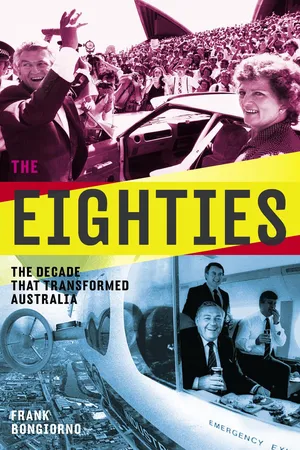
- 352 pages
- English
- ePUB (mobile friendly)
- Available on iOS & Android
eBook - ePub
About this book
Information
1
A Good Run
The people were worried about their future, but stubborn in clinging to the notion of the lucky country.
PAUL KELLY, THE HAWKE ASCENDANCY
In the Christian calendar, Ash Wednesday is a time of fasting that signals the beginning of Lent, the six-week period before Easter. In 1983 it fell on 16 February, a day of fierce heat across south-eastern Australia. A devastating drought and deep economic recession gripped the country.
In Sydney, the new leader of the Opposition Australian Labor Party (ALP), Bob Hawke, gave his party’s election campaign policy speech inside a packed and expectant Sydney Opera House. Hawke thought he was addressing the nation’s most pressing emergency: that posed by the recession. But there was a far more urgent and elemental crisis unfolding in the country’s south-east, as people feared not for their jobs but their lives, as bushfire choked or incinerated those in its path, as the advancing flames razed the tinder-dry landscape and visited destruction on homes and possessions – all in apparent mockery of the effort to subject the country to the templates of order, reason and progress.
But Hawke was a man who believed in order, reason and progress. At fifty-three, he had maintained a slim, even athletic physique. His luxuriant, well-tended head of dark wavy hair was already turning grey, as if to signal the growing distance between the boozy, aggressive and randy union leader of the 1970s, and the more mature, self-controlled, statesmanlike figure now bidding for the prime ministership. Journalists – most no doubt aware of Hawke’s philandering ways – still played up his charisma and sex appeal, even as they paid tribute to his discipline in having given up his heavy drinking. The arched, almost triangular eyebrows remained, as did the bad temper and habit of intimidation. His minders, however, had ensured that there would be no repetition of his furious on-screen explosion on the night he became leader, when he was asked by interviewer Richard Carleton if he was embarrassed at the blood on his hands. Indeed, when he delivered his speech at the Opera House, he read it so slowly, and his style was so subdued, that he ran out of time and had to skip much of the text. Peter Bowers in the Sydney Morning Herald noted the emergence of ‘the quiet persuader’.1 Hawke had already been active in Australian public life for a quarter of a century. He had spent the turbulent 1970s as president of the Australian Council of Trade Unions (ACTU), and the early 1980s as a member of parliament and shadow minister. Under this charismatic new leader, Labor was expected to return to office for the first time since 1975.
The man Hawke had tipped out of the leadership just a couple of weeks before, Bill Hayden, sat in the second row of the Opera House auditorium that day. A former Queensland policeman, Hayden had served the party as leader with doggedness, and in the 1980 election managed a swing of 4 per cent. But doubts had grown about his ability to win a federal election. Although Hayden had withstood a challenge to his leadership from Hawke in July 1982, his days appeared numbered after the ALP achieved a swing of a miserly 3.5 per cent at a by-election in the Victorian Liberal-held seat of Flinders late in 1982. Support for his leadership ebbed, and critically, the powerful NSW Labor Right faction had for some time wanted to replace him with Hawke.
But it was John Button, a Victorian and Labor leader in the Senate, who delivered the coup de grâce. In recent months Button, a Hayden supporter, had come to think of the Labor leader as having squandered his political opportunities. His performance in the media was poor; Hayden remained ‘an unrepentant bad communicator’.2 Button travelled to Brisbane on 6 January 1983 in an effort to persuade Hayden to stand down as leader. Hayden, however, dug in; Hawke, he said, was ‘a shallow man’. Button ‘did not disagree with this view’, and ‘did not think that many people in the Party did either’, but ‘there were a number of important attributes in politics’: ‘integrity’, ‘decency’ and ‘desire for social change’, on the one side; the ability to communicate and to command the confidence of voters on the other. Button’s implication was that while Hawke had both, Hayden was deficient in the latter. But Hayden refused to accept his time was up. He was an ‘existentialist’ who, like Macbeth, went into battle and ‘never asked for mercy … if he lost the next election, he would not ask for mercy either’. Button was unimpressed; what about all of those thousands in the ALP who were not existentialists, and would find cold comfort in such an attitude if Labor lost the next election? ‘I suppose that’s right,’ Hayden replied.3
Having failed in his mission, Button followed up with a decisive letter late in January 1983, reiterating his belief that Hayden could not win the next election. ‘You said to me that you could not stand down for a “bastard” like Bob Hawke’, Button wrote, but ‘[i]n my experience in the Labor Party the fact that someone is a bastard (of one kind or another) has never been a disqualification for leadership of the party’. The power of Button’s missive lay not only in that it came from a friend and supporter, but also that its author seemed as alive to Hawke’s weaknesses as he was to Hayden’s:
I am personally not one of those who believe that we can necessarily coast into office on the coat-tails of a media performer and winner of popularity polls. On the other hand I believe Hawke’s leadership would give us a better chance of success … even some of Bob’s closest supporters have doubts about his capacities to lead the party successfully, in that they do not share his own estimate of his ability.4
Among Labor politicians such as Button, who had witnessed at first hand the unravelling and then dismissal of the Whitlam government in 1975, there was now a hard pragmatism that rejected the party’s sentimental attachment to failed leaders, as well as its too-easy acceptance of honourable defeat. Malcolm Fraser, meanwhile, was planning an early election when Button wrote his letter on 28 January. The authority of his Liberal– National Party coalition government was ebbing away in the face of a faltering economy, the embarrassing exposure of tax evasion by many wealthy Australians, and a bitter, occasionally violent struggle in Tasmania over a proposal by the state Liberal government to build a dam in the south-west wilderness.
On 3 February, finally bowing to unrelenting internal party pressure, Hayden resigned as ALP leader during a meeting of the shadow cabinet. At the same time as Labor was dealing with the leadership issue in Brisbane, Fraser was in Canberra seeking from the governor-general a double dissolution of parliament, so that an election could be held on 5 March. Dubious that Labor would be able to manage a smooth leadership transition, Fraser expected that he would be facing Hayden, but the ALP called his bluff by pragmatically switching leaders.5 Hayden memorably told the media that he thought ‘a drover’s dog’ could lead the Labor Party to victory at the next election ‘the way the country is’.6 But with Bob Hawke’s ascent to the leadership, persistent doubts about the ALP’s ability to defeat Fraser melted away. The electoral and the psychological advantage passed decisively to Labor.
Hawke’s focus was on ending what he called ‘the politics of division, the politics of confrontation’.7 A Labor campaign slogan was ‘Bringing Australia Together’; he stressed a politics of consensus. Not everyone among Labor’s elite reacted favourably to Hawke’s plan for an election campaign based on ‘recovery, reconstruction and reconciliation’. The highly popular and successful premier of New South Wales, Neville Wran, thought he had stumbled on ‘a meeting of the fucking Hare Krishnas … Give them something to vote for. These greedy bastards want a quid in their pockets.’8 Hawke would not forget Wran’s ‘greedy bastards’; his campaign speech promised both income tax cuts and an end to the wage freeze imposed by the Fraser government.
Hawke evoked a sense of crisis in his speech, and to the extent that he outlined an economic policy, it was a cautious but unmistakable Keynesianism which aimed to reduce unemployment and lift demand through ‘controlled, responsible stimulation of the Australian economy’. A Hawke government would support centralised wage determination as part of its Prices and Incomes Accord with the union movement; this was a formal agreement signed before the election which committed the unions to wage restraint in return for government spending, such as on a new health insurance scheme to be called Medicare. Tariffs were to be maintained until the crisis in manufacturing had been overcome; government would offer industry ‘a necessary breathing space until steady growth is restored’. Hawke ended by invoking the memory of his hero, John Curtin, and the Second World War, the ‘time of Australia’s gravest crisis, when our very existence as a nation was at stake’, and the people had given Labor their support ‘to take Australia through to final victory’. He enjoined his audience to see the recession and the drought as ‘a very different kind of crisis’, but one that posed the same challenge: ‘to bring Australians together in a united effort until victory is won’.9
*
Even as thousands of enthusiastic Labor supporters left the Opera House on 16 February, a great tragedy was unfolding further south. Throughout the summer, there had been hundreds of bushfires in south-eastern Australia.10 On 8 February, when the Melbourne temperature soared beyond forty-three degrees, squally winds gathered about 50,000 tonnes of topsoil into a vast cloud of red and brown that formed in the parched Wimmera Mallee region in the morning, hitting Melbourne just before three o’clock. Day turned into night as the cloud deposited a thousand tonnes of dust on the city, the ferocious winds uprooting trees and unroofing homes.11
The religious-minded had long been used to regarding such phenomena as a warning from God. It is a pity that the belief in such omens had declined, for it might have better prepared people for 16 February. The day before Ash Wednesday in southern Victoria had been cloudy, with light rain and temperatures in the mid-twenties to low thirties. Perhaps these mild conditions, in the midst of the hottest, driest summer in living memory, bred complacency. The following morning, the skies in southern Victoria began clearing at around eight o’clock. Temperatures climbed, humidity dropped, and a strong north wind blew. Melbourne’s temperature again reached forty-three degrees. Combined with the fuel provided by a dry, brittle countryside, the conditions were ideally fitted for fires, and ninety-three were soon burning in Victoria alone.12 In South Australia, the commuter suburbs in the Adelaide Hills were fast developing into a raging fire zone, and large blazes also broke out in the Clare wine-growing district and the south-east near the Victorian border. Adelaide was soon covered in dust and smoke; radio broadcasts in Britain contained the alarming but fortunately false intelligence that 400 people had died and half the city had been destroyed; Australia House in London was flooded with inquiries from concerned relatives.13
Meanwhile, in Victoria, several large fires erupted during the afternoon – near Warrnambool in the Western District; in the Otway Ranges, extending to coastal towns such as Lorne, Anglesea and Aireys Inlet; at Macedon, an area already devastated by a fire on 1 February; and several places in the Dandenong Ranges. Apart from the Warrnambool fire, all were on the fringe between Melbourne and its hinterland, and they were driven south during the afternoon by the prevailing winds. But in the early evening, a strong south-westerly that had been making its way from South Australia during the day finally hit the country near Melbourne, kickstarting the fires’ most deadly phase. All but one death in Victoria occurred after the wind changed direction.14 Towns that had seemed safe were now suddenly threatened by fast-moving walls of fire and the balls of flame they deposited like grenades.15
One town that found itself confronted by the danger was Cockatoo: a small community in the Dandenong Ranges about fifty kilometres from Melbourne, a place of fibro and weatherboard homes, many previously holiday houses now owned by battling young families unable to afford a place closer to the city.16 Residents were surprised by a fire that seemed to appear out of nowhere on the rise above the town. Cockatoo was soon alight, with residents assembling pets, photographs and treasured belongings, bundling them into their cars and seeking refuge on safer ground. The roads quickly became choked with traffic, the chaos heightened by a cacophony of car horns, exploding fireballs and gas bottles, powerful winds and thick smoke. Not all could leave; about 120 children with their mothers and pets spent a terrifying evening inside the local kindergarten, covered with wet towels – towels that repeatedly dried out as a result of the extreme heat – as parents tried to shield them from the frightening scenes outside. The children remained surprisingly calm. With great courage, two men spent the evening sitting on the roof, hosing down the modern circular building of brick, steel and glass as it was surrounded by fire.17
The power cut out just after nine o’clock, the telephone went dead, and the smoke in the building became thicker every moment. Torches were not needed: the glow of the nearby fire ‘eerily lit the whole interior’.18 The adults debated whether to move some of the children from the overcrowded kindergarten to a nearby building. A mother of two told a journalist the following day: ‘I knew that any minute we would probably be incinerated and I just hoped that I would die first so I didn’t have to listen to their dreadful screams of pain and fear.’19 The fire passed without touching the building. But a couple engaged to be married in a few weeks who took refuge in a culvert were found dead the next day, their arms still around each another. At nearby Beaconsfield, twelve firefighters, including one woman, died after being trapped inside a ring of fire.
At Macedon a group of about 250 took refuge in a hotel. Like those in the Cockatoo kindergarten they survived, helped by firefighters who remained outside protecting the building with hoses. But at Kalangadoo in eastern South Australia, a 25-year-old man ran into trouble when his car became bogged during an effort to rescue his neighbours, a woman and her four young children. All perished. Another neighbourly effort at Greenhill in the Adelaide Hills was also in vain, when a burning man emerged from his home: ‘[T]here was nothing I could do. I touched him and his skin came off.’ Thousands of properties were destroyed, from the humblest seaside and mountain cottages to the stately homes that adorned Summit Road in the Adelaide Hills. Kym and Julie Bonython lost their home, valuable art and the country’s largest collection of jazz records.20 The Adelaide radio journalist Murray Nicol remained on air to give an eyewitness account of his own property burning. He won a Walkley Aw...
Table of contents
- Cover Page
- Title Page
- Copyright
- Contents
- Introduction: Stories of the 1980s
- Chapter 1: A Good Run
- Chapter 2: Keeping Afloat
- Chapter 3: ‘Vanishing Aussie’?
- Chapter 4: Power and Passion
- Chapter 5: The Deal-Makers
- Chapter 6: Taking Credit
- Chapter 7: New Pleasures, New Dangers
- Chapter 8: The Identity Card
- Chapter 9: The Crash
- Afterword: What Did It All Mean?
- Acknowledgments and Author’s Note
- Endnotes
- Credits
- Index
Trusted by 375,005 students
Access to over 1.5 million titles for a fair monthly price.
Study more efficiently using our study tools.
Frequently asked questions
Yes, you can cancel anytime from the Subscription tab in your account settings on the Perlego website. Your subscription will stay active until the end of your current billing period. Learn how to cancel your subscription
No, books cannot be downloaded as external files, such as PDFs, for use outside of Perlego. However, you can download books within the Perlego app for offline reading on mobile or tablet. Learn how to download books offline
Perlego offers two plans: Essential and Complete
- Essential is ideal for learners and professionals who enjoy exploring a wide range of subjects. Access the Essential Library with 800,000+ trusted titles and best-sellers across business, personal growth, and the humanities. Includes unlimited reading time and Standard Read Aloud voice.
- Complete: Perfect for advanced learners and researchers needing full, unrestricted access. Unlock 1.5M+ books across hundreds of subjects, including academic and specialized titles. The Complete Plan also includes advanced features like Premium Read Aloud and Research Assistant.
We are an online textbook subscription service, where you can get access to an entire online library for less than the price of a single book per month. With over 1.5 million books across 990+ topics, we’ve got you covered! Learn about our mission
Look out for the read-aloud symbol on your next book to see if you can listen to it. The read-aloud tool reads text aloud for you, highlighting the text as it is being read. You can pause it, speed it up and slow it down. Learn more about Read Aloud
Yes! You can use the Perlego app on both iOS and Android devices to read anytime, anywhere — even offline. Perfect for commutes or when you’re on the go.
Please note we cannot support devices running on iOS 13 and Android 7 or earlier. Learn more about using the app
Please note we cannot support devices running on iOS 13 and Android 7 or earlier. Learn more about using the app
Yes, you can access The Eighties by Frank Bongiorno in PDF and/or ePUB format, as well as other popular books in History & 20th Century History. We have over 1.5 million books available in our catalogue for you to explore.