It is perhaps commonplace to say that India is one of the world's richest and most enticing cultures. One thousand years have passed since Albiruni, arguably the first "Indologist", wrote his outsider's account of the subcontinent and two hundred years have passed since the inception of Western Indology. And yet, what this monumental scholarship has achieved is still outweighed by the huge tracts of terra incognita: thousands of works lacking scholarly attention and even more manuscripts which still await careful study whilst decaying in the unforgiving Indian climate.
In September 2009 young researchers and graduate students in this field came together to present their cutting-edge work at the first International Indology Graduate Research Symposium, which was held at Oxford University. This volume, the first in a new series which will publish the proceedings of the Symposium, will make important contributions to the study of the classical civilisation of the Indian sub-continent. The series, edited by Nina Mirnig, Péter-Dániel Szántó and Michael Williams, will strive to cover a wide range of subjects reaching from literature, religion, philosophy, ritual and grammar to social history, with the aim that the research published will not only enrich the field of classical Indology but eventually also contribute to the studies of history and anthropology of India and Indianised Central and South-East Asia.
eBook - ePub
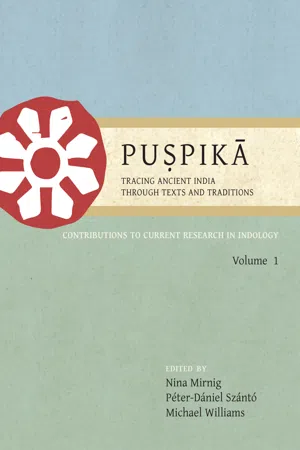
Puṣpikā: Tracing Ancient India Through Texts and Traditions
Contributions to Current Research in Indology, Volume 1
- 486 pages
- English
- ePUB (mobile friendly)
- Available on iOS & Android
eBook - ePub
Puṣpikā: Tracing Ancient India Through Texts and Traditions
Contributions to Current Research in Indology, Volume 1
About this book
Information
Subtopic
Ancient HistoryIndex
HistoryOne
Defining the Svara Bearing Unit in the śikṣāvedāṅga literature: Unmasking a veiled debate
§ 1 Defining the framework
A long-standing unspoken debate within the Sanskrit grammatical tradition concerns the definition of the nature of the Svara1 Bearing Unit [SBU], i.e. which part of a word bears the svara. The very label of “SBU” does not in fact correspond to any specific Sanskrit term, but is a caique - here used for the first time - from the highly controversial concept of Accent Bearing Unit [ABU]. The latter has been at the centre of Western Linguistic speculation at least since the 1930s,2 and its elaboration has substantially contributed to the reshaping of the overall interpretation of the architecture of the phonological component of grammar.3 Through the survey of various treatises, it will be shown that the Sanskrit grammarians have also been engaged in an effort to describe the characteristics of a specific set of linguistic entities and their relation to the svaras, a speculation which echoes the quest for the definition of the ABU and which has led to the formulation of different views.
However, before moving any further, it is essential to say a few words about the similarity that is postulated here between the SBU and the ABU. The very nature of the language speculation is in fact intrinsically manifold: it depends on the point of view of its composer, on the tools - both intellectual and technical - which have been used in its formulation, and on the aims which have been pursued.4 As a consequence, it should be asked whether the topic that will be treated here represents or does not represent the same problem for the Sanskrit and the Western traditions.
§ 1.1 Sanskrit as a common ground
As with any sort of language speculation, including both the Sanskrit and the Western linguistic traditions, the aim consists in formulating an interpretative and descriptive representation of its object by gathering general observations from a variety of (epi-)phenomena, i.e. by representing its grammar. Since this can be done either through comparisons with different languages, or through the analysis of a single language, although the Sanskrit grammatical tradition has no comparative interests, it is possible to compare its methodologies and achievements with those of the Western Linguistic tradition.5
Therefore, Sanskrit itself provides the common ground in which the two traditions can operate: on the one hand describing the characteristics of this language is the very aim of the Indian grammatical tradition and, on the other hand, Sanskrit represents – as any other language might do – a suitable field for testing the validity of the theoretical models provided by Western Linguistics.
Furthermore, although quite problematic in its definition, in particular within the Western tradition, the object under investigation is basically one, namely accentuation. As it will be shown in § 3, it is possible to state that the two traditions have gathered the same general observations while dealing with articulatory phenomena such as the modulation of the vibration of the vocal cords. A remarkable consequence of this common understanding can be seen in the fact that, according to both traditions, it is necessary to split words into minor subunits and to assign to them the property of being bearing units. In fact, just like some strands of the Western Linguistic tradition have divided words into minor units, i.e. units different from morphemes, like segments, syllables, or, more generally, prosodic constituents (see § 4), in the same way, the Sanskrit grammarians have dealt with varṇas and akṣaras in order to understand which part of a pada (“word”) bears the svaras (see § 5).
§1.2 Phonetics and phonology in the Sanskrit tradition
However, what seems to represent a common problem to which a similar answer has been provided should actually be embedded in two remarkably distinct systems concerning the overall architecture of (Sanskrit) grammar. As a matter of fact, the frameworks in which Sanskrit accentuation, or Sanskrit svaras (cf. § 3), have been analyzed are remarkably different from those of the Western tradition, and it would be rather naive to start our comparison without clarifying this point. In fact, Western Linguistics distinguishes two separate modules concerning how the grammatical architecture of a language deals with the sounds of the language itself, namely the phonetic component and the phonological component,6 whereas the Sanskrit tradition never operates – at least manifestly – within such a formal distinction.
Although within Western Linguistics the debate about where to draw the precise limit between phonetics and phonology is still open (cf. Purnell [2009]), it is possible to define phonetics as the study of the articulation and perception of the sounds that human beings use in speech, whereas phonology consists in the study of the sound patterns characterizing the overall properties of contrastive sound inventories, of the ...
Table of contents
- Cover
- Title Page
- Copyright
- Contents
- Preface
- Chapter 1: Defining the Svara Bearing Unit in the śiksāvedānga literature: Unmasking a veiled debate
- Chapter 2: Purānic transformations in Cola Cidambaram: The Cidambara- māhātmya and the Sūtasamhitā
- Chapter 3: Unfuzzying the fuzzy. The distinction between rasas and bhāvas in Bharata and Abhinavagupta
- Chapter 4: A contribution of Vedānta to the history of Mīmāmsā: Prakāśātman’s interpretation of “verbal effectuation” (śabdabhāvanā)
- Chapter 5: Married women and courtesans: Marriage and women’s room for manæuvre as depicted in the Kathā-sarit-sāgara
- Chapter 6: Towards a new edition of the corpus of Pallava inscriptions
- Chapter 7: Did Mīmāmsā authors formulate a theory of action?
- Chapter 8: Trajectories of dance on the surface of theatrical meanings: a contribution to the theory of rasa from the fourth chapter of the Abhinavabhāratī
- Chapter 9: Dravya as a Permanent Referent: The Potential Sarvāstivāda Influence on Patañjali’s Paspaśāhnika
- Chapter 10: Rituals in the Mahāsāhasrapramardanasūtra
- Chapter 11: The Lingodbhava Myth in Early Saiva Sources
- Chapter 12: Yantras in the Buddhist Tantras — Yamāritantras and Related Literature
- Chapter 13: Śaiva Siddhānta Śrāddha Towards an evaluation of the socio-religious landscape envisaged by pre-12th century sources
- Chapter 14: Constituents of Buddhahood as Presented in the Buddhabhūmisūtra and the 9th Chapter of the Mahāyānasūtrālamkāra: A Comparative Analysis
- Chapter 15: The ganacchandas in the Indian metrical tradition
- Chapter 16: Anātmatā, Soteriology and Moral Psychology in Indian Buddhism
- Chapter 17: Pāramārthika or apāramārthika? On the ontological status of separation according to Abhinavagupta
- Chapter 18: Thy Fierce Lotus-Feet: Danger and Benevolence in Mediaeval Sanskrit Poems to Mahisāsuramardinī-Durgā
- Chapter 19: Minor Vajrayāna texts II. A new manuscript of the Gurupañcāśikā
- Chapter 20: Can we infer unestablished entities? A Mādhva contribution to the Indian theory of inference
Trusted by 375,005 students
Access to over 1.5 million titles for a fair monthly price.
Study more efficiently using our study tools.
Frequently asked questions
Yes, you can cancel anytime from the Subscription tab in your account settings on the Perlego website. Your subscription will stay active until the end of your current billing period. Learn how to cancel your subscription
No, books cannot be downloaded as external files, such as PDFs, for use outside of Perlego. However, you can download books within the Perlego app for offline reading on mobile or tablet. Learn how to download books offline
Perlego offers two plans: Essential and Complete
- Essential is ideal for learners and professionals who enjoy exploring a wide range of subjects. Access the Essential Library with 800,000+ trusted titles and best-sellers across business, personal growth, and the humanities. Includes unlimited reading time and Standard Read Aloud voice.
- Complete: Perfect for advanced learners and researchers needing full, unrestricted access. Unlock 1.5M+ books across hundreds of subjects, including academic and specialized titles. The Complete Plan also includes advanced features like Premium Read Aloud and Research Assistant.
We are an online textbook subscription service, where you can get access to an entire online library for less than the price of a single book per month. With over 1.5 million books across 990+ topics, we’ve got you covered! Learn about our mission
Look out for the read-aloud symbol on your next book to see if you can listen to it. The read-aloud tool reads text aloud for you, highlighting the text as it is being read. You can pause it, speed it up and slow it down. Learn more about Read Aloud
Yes! You can use the Perlego app on both iOS and Android devices to read anytime, anywhere — even offline. Perfect for commutes or when you’re on the go.
Please note we cannot support devices running on iOS 13 and Android 7 or earlier. Learn more about using the app
Please note we cannot support devices running on iOS 13 and Android 7 or earlier. Learn more about using the app
Yes, you can access Puṣpikā: Tracing Ancient India Through Texts and Traditions by Nina Mirnig, Peter-Daniel Szanto, Michael Williams, Nina Mirnig,Peter-Daniel Szanto,Michael Williams, Michael Williams in PDF and/or ePUB format, as well as other popular books in History & Ancient History. We have over 1.5 million books available in our catalogue for you to explore.