The study of tree-rings (dendrochronology) provides a key resource for determining dates for archaeological and other contexts where wood/charcoal is present (and so cultural chronology), and for investigating past climate and environment. In the central and east Mediterranean region Peter Ian Kuniholm is synonymous with dendrochronology and dendroarchaeology. He led the creation of numerous tree-ring chronologies for the region (from forests, buildings, archaeological sites), and demonstrated the enormous potential and power of dendrochronology to a range of topics.
This rich collection of papers by an international authorship, deriving from a conference held at Cornell University in honor of Peter Kuniholm, provides wide-ranging and up-to-date discussions and assessments on a number of key topics concerning the chronology and environment of the central to east Mediterranean and Near East and the field of dendrochronology. This includes controversy - with a set of papers addressing the current debate over the dating of the great Santorini/Thera volcanic eruption in the mid second millennium BC; and famous sites and finds, including a report on the absolute dating of the extraordinary Uluburun ship of the late 14th century BC, and papers concerned with the dating and interpretation of important sites and topics such as Gordion, Akrotiri on Thera, the rise and fall of the Hittite empire, and the Anatolian Iron Age.
Other papers explore the history, scope and potential of dendrochronology in the Mediterranean region. The debate over what happened around AD536-540 gets a look in also, along with papers exploring the relevance of dendrochemical approaches to identifying past environmental events (such as major volcanic eruptions), and a review of work on timberline dynamics and climate change in Greece.
eBook - ePub
Tree-Rings, Kings and Old World Archaeology and Environment
Papers Presented in Honor of Peter Ian Kuniholm
- 336 pages
- English
- ePUB (mobile friendly)
- Available on iOS & Android
eBook - ePub
Tree-Rings, Kings and Old World Archaeology and Environment
Papers Presented in Honor of Peter Ian Kuniholm
About this book
Information
Subtopic
ArchaeologyIndex
Social SciencesAbsolute Age of the Uluburun Shipwreck: A Key Late Bronze Age Time-Capsule for the East Mediterranean
Abstract: By integrating radiocarbon and dendrochronological investigations, we can provide a high-resolution date in the later 14th century BC for the time of the last voyage of the extraordinary Late Bronze Age sailing vessel found wrecked at Uluburun near Kaş off the southern coast of Turkey: approximately 1320±15 BC. This shipwreck was in a remarkable state of preservation because it lay on a steep underwater slope at a considerable depth (42–52m, with some artefacts scattered to 61m). The ship’s cargo forms one of the largest and wealthiest assemblages known from the period, including a key link to the Amarna-period Egyptian Queen, Nefertiti. Our precise absolute dating provides an important chronological marker for the Amarna period in Egypt and across the Ancient Near East, resolving a number of areas of debate or contention in the scholarly literature.
1. Introduction
An important (and at present unique) ancient shipwreck was excavated between 1984 and 1994 in deep water at Uluburun, near Kaş, off the southern coast of Turkey, by the Institute of Nautical Archaeology (Bass 1986; 1987; Bass et al. 1989; Pulak 1988; 1998; 2001; 2005a; 2005b; 2008). The original vessel was around 15 m in length and would have carried some 20 tons of cargo (for a reconstruction, see Pulak 2005: 60 fig. 11; 2008: 293 fig. 94). Underwater excavation revealed an extraordinary assemblage of over 15,000 catalogued artefacts.
Raw materials recovered include about 10 tons of copper ingots, at least a ton of tin ingots, more than half a ton of terebinth resin in approximately two-thirds of the 150 Canaanite jars aboard, 175 ingots of glass, ebony logs, ostrich eggshells, elephant tusks, hippopotamus teeth, logs of African blackwood, and various other food, craft, or medicinal items. In addition to these raw materials, manufactured goods found on the wreck include a range of ceramics (Syro-Palestinian, Cypriot, and Mycenaean Greek), faience cups, copper alloy vessels, objects in ivory and gold, jewellery, and the earliest known examples of wooden writing boards (diptychs). The origin and destination of the ship have been actively sought within the world of the east Mediterranean, in the central Levantine coast and the Aegean, respectively (Pulak 1998; 2005c; 2008). The scale of wealth present suggests that this was perhaps an elite or royal shipment of cargo and that the ship was engaged in high-level exchange (e.g. Pulak 2005b; 2008, and, to some extent, Bachhuber 2006), along the lines of those to be inferred from the 14th-century BC Amarna letters recording royal diplomatic contact in the Ancient Near East between Egypt and other states and rulers (Moran 1992). Indeed, the wreck yielded a unique gold scarab bearing the cartouche of the Amarna-period Egyptian queen Nefertiti (Weinstein 1989), linking it directly to this general time period (and providing a terminus post quem—or date after which—for the shipwreck from during or after her reign).
The Uluburun ship represents an incredible time-capsule and has become a key source of evidence for study of numerous aspects of Bronze Age Mediterranean history, trade, interrelations at all levels, and especially for maritime interaction and technology (e.g. Bass 1986; 1987; 1991; 1998; Bass et al. 1989; Pulak 1998; 1999a; 2001; 2005; 2008; Wachsmann 1998: 303–307; Cleary and Meister 1999; Yalçın et al. 2005; Cucchi 2008; Welter-Schultes 2008). The high-resolution absolute dating of this shipwreck, and especially of its last cargo and voyage, would provide a key chronological marker-point for the synthesis of the history, archaeology, and art of the wider East Mediterranean region. In particular, given the rich international cargo, a precise date for the last voyage would have important implications for the dating of material culture across the region from Egypt to Greece, and it would provide a key test for the validity both of the long established conventional proto-historical and archaeological chronologies estimated for Egypt, Cyprus, and the Aegean, as well as various claims for radical alternatives made in recent decades.
2. Integrated tree-ring and radiocarbon dating of the Uluburun ship
This report presents a comprehensive, high-precision dating program to establish directly the approximate calendar age of the Uluburun ship, especially that of its last voyage. Previous suggestions (Kuniholm et al. 1996; Wiener 1998; Manning 1999: 344–345) of a possible direct dendrochronological date for some timbers aboard the ship have proved, with further examination and additional data and development of regional tree-ring sequences, to be without good dendrochronological support; these are hereby withdrawn (cf. Manning et al. 2001: 2535 n.38; Wiener 2003a: 244–245). A previous report of some initial radiocarbon wiggle-match work on timbers from the vessel (Newton et al. 2005; Newton and Kuniholm 2005) is much expanded here, and dates on a range of the short-lived sample material from the vessel’s last voyage are incorporated into a comprehensive dating model. For this project we developed an integrated research design to date the ship combining:
(i) | Radiocarbon wiggle-match dating (Bronk Ramsey et al. 2001; Galimberti et al. 2004) of several short tree-ring sequences from long-lived wood either comprising the ship’s timbers (specifically, its keel; for the ship’s hull construction, see Pulak 1999a; 1999b; 2003) or from aboard the ship (dunnage, or in one case perhaps an element of the ship), which set terminus post quem ranges for the final voyage of the ship; with |
(ii) | Radiocarbon dating of short- or shorter-lived materials or elements on board the ship when it sank. These materials include fittings or other functional components (wicker-work, a rope fragment made of grass from the Gramineae family) or actual cargo such as olive seeds, leaves, terebinth resin, and thorny burnet (a dense, spiny shrub native to central and eastern Mediterranean used as dunnage or bedding material between the hull and the cargo of copper ingots). These elements should set a very close terminus post quem for, or even in several cases theoretically date the year of, the last voyage of the ship. |
The sets of radiocarbon evidence are assessed within a comprehensive Bayesian analytical model (using the approach and software of OxCal: Bronk Ramsey 1995; 2001; 2008; 2009) in order to combine the known relative time-order of the sample materials with the radiocarbon ages obtained, and to yield the best dating estimates from the simultaneous resolution of the linked multiple dating probabilities. An interesting additional issue is that we may test the validity of conventional Egyptian chronology (the date range for Queen Nefertiti) against the combined tree-ring and radiocarbon evidence from the Uluburun ship (and vice versa).
3. The samples of short-lived materials
We obtained eight radiocarbon measurements on samples of short-lived cargo materials from the final use of the ship: Figure 1 (lower), Table 1 (Hd-23129, 23132, 23162, OxA-15022, 15024, 15026, 15025, 15065). These sample material types and dates vary a little, but should all date the final use period of the ship either to the year or within a few years at most (see further discussion in section 5 (ii) below). All ages obtained are broadly similar, with quality control provided both by: (i) the comparable findings of two different laboratories (Heidelberg and Oxford); and (ii) new measurements of known age German Oak run around the same time at Heidelberg and Oxford which show generally good agreement with each other, although a little older on average compared to the IntCal98/04 average values and indicating somewhat more curve amplitude (Figures 2, 3).
The data from these eight short-lived material samples can be combined together, consistent with the hypothesis that they could represent the same radiocarbon age at the 95% confidence level, to offer a more precise weighted average radiocarbon age estimate of 3086 ± 9 BP for the final cargo or last voyage (Ward and Wilson 1978) (see Figures 4 and 5). Without any other constraints, this weighted average radiocarbon age indicates a calendar date range with the current IntCal04 radiocarbon calibration curve (Reimer et al. 2004) and the OxCal calibration software v.4.0.5 (Bronk Ramsey 1995; 2001; 2008) of either about 1411–1369 Cal BC or about 1357–1315 Cal BC at 2σ (95.4% confidence): see Figure 4. The date range employing the previous IntCal98 (Stuiver et al. 1998) radiocarbon dataset is shown for comparison in Figure 5; IntCal98 employs similar underlying data for this period, but with a less sophisticated and less smoothed modelling. The bi-modal possible ranges reflect the shape of the radiocarbon calibration curve at this period (the record of past natural atmospheric radiocarbon derived for this time period from known-age tree-ring archives), in particular the pronounced short-term radiocarbon age inversion (a “wiggle”) in the region around 1325 BC (see Figure 2). The wiggle is even more apparent in the previous, less-smoothed IntCal98 calibration dataset (Figures 2, 5) and is also reported in contemporary Aegean tree-rings (Manning et al. 2003; 2005). This wiggle is furthermore even more apparent in recent measurements of absolutely dated German Oak (from Augsfeld, kindly provided by Michael Friedrich) made at Heidelberg and Oxford (Figure 3), both of which may indicate a slightly larger and somewhat longer inversion period (or plural wiggles) in the late 14th to early 13th centuries BC.
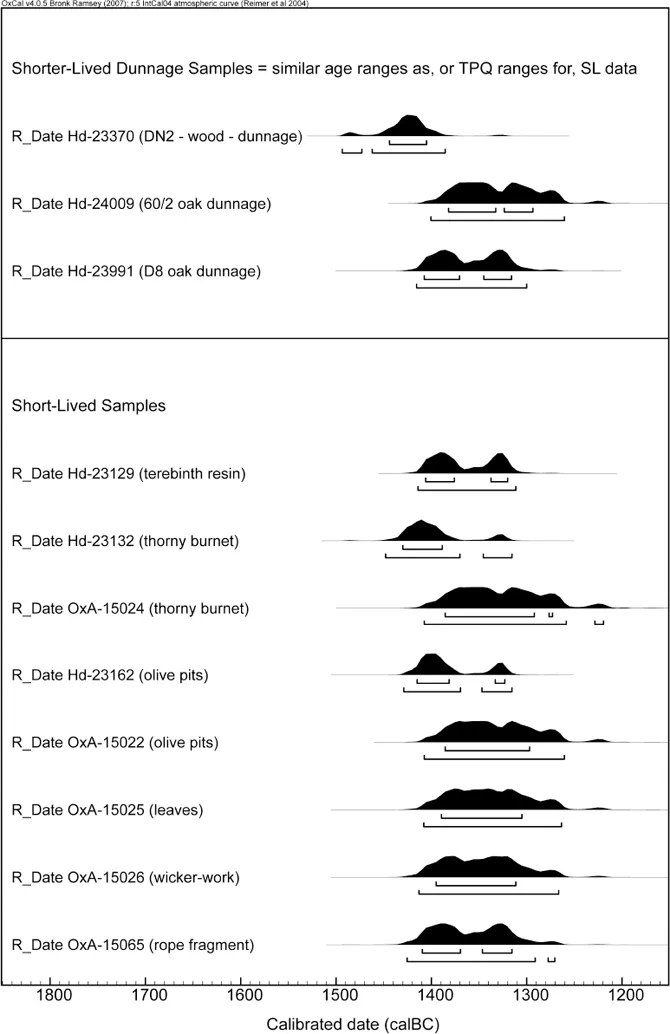
Figure 1: The individual calibrated calendar age probability distributions showing 1σ (68.2% probability) and 2σ (95.4% probability) ranges (upper and lower lines under each histogram respectively) for (i) (upper 3 histograms) 3 measurements on shorter-lived or short tree-ring sequence wood dunnage samples from the Uluburun ship, which should either be approximately the same age as, or set terminus post quem ranges for (perhaps very close in some cases), the ship’s last voyage and the shipwreck, and (ii) (lower 8 histograms) 8 measurements on short-lived samples from the Uluburun shipwreck—these samples should closely date the final voyage time interval (the same year or next year for samples like the leaves and olive seeds, and somewhere from the same year to the next couple or few years for the other samples). Calibration to calendar years employs the IntCal04 radiocarbon calibration dataset (Reimer et al. 2004) and the OxCal software (Bronk Ramsey et al. 1995; 2001; 2008) version 4.0.5.
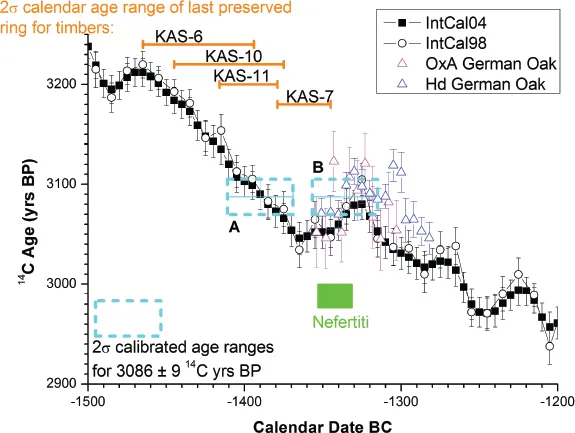
Figure 2: IntCal04 (Reimer et al. 2004), black squares, and IntCal98 (Stuiver et al. 1998), black hollow circles, radiocarbon calibration curves for the period 1500 to 1200 BC. 1σ (68.2% confidence) error bars shown. Note the inversion, or wiggle (to older radiocarbon ages), centred around 1325 BC (see further in Figure 3). The 2σ (95.4% confidence) calibrated calendar age ranges from IntCal04 for the weighted average 14C age of the 8 shor...
Table of contents
- Cover
- Title Page
- Copyright
- Contents
- Foreword
- Preface and Acknowledgments
- Contributors to the Volume
- Bibliography of Peter Ian Kuniholm
- Peter Kuniholm’s Dendro Time
- Perspective: Archaeology, History, and Chronology from Penn to the Present and Beyond
- Excursions into Absolute Chronology
- One Hundred Years of Dendroarchaeology: Dating, Human Behavior, and Past Climate
- The Absolute Dating of Wasserburg Buchau: A Long Story of Tree-ring Research
- Is there a Separate Tree-ring Pattern for Mediterranean Oak?
- Dendrochronological Research at Rosslauf (Bressanone, Italy)
- The Development of the Regional Oak Tree-ring Chronology from the Roman Sites in Celje (Slovenia) and Sisak (Croatia)
- Dendroclimatology in the Near East and Eastern Mediterranean Region
- A 924-year Regional Oak Tree-ring Chronology for North Central Turkey
- Dendrochronology on Pinus nigra in the Taygetos Mountains, Southern Peloponnisos
- Could Absolutely Dated Tree-ring Chemistry Provide a Means to Dating the Major Volcanic Eruptions of the Holocene?
- Dendrochemistry of Pinus sylvestris Trees from a Turkish Forest
- Neutron Activation Analysis of Dendrochronologically Dated Trees
- Third Millennium BC Aegean Chronology: Old and New Data from the Perspective of the Third Millennium AD
- Middle Helladic Lerna: Relative and Absolute Chronologies
- Absolute Age of the Uluburun Shipwreck: A Key Late Bronze Age Time-Capsule for the East Mediterranean
- How About the Pace of Change for a Change of Pace?
- Archaeologists and Scientists: Bridging the Credibility Gap
- Central Lydia Archaeological Survey: Documenting the Prehistoric through Iron Age periods
- The Chronology of Phrygian Gordion
- The End of Chronology: New Directions in the Archaeology of the Central Anatolian Iron Age
- The Rise and Fall of the Hittite Empire in the Light of Dendroarchaeological Research
- Aegean Absolute Chronology: Where did it go wrong?
- The Thera Debate
- Cold Fusion: The Uneasy Alliance of History and Science
- Santorini Eruption Radiocarbon Dated to 1627–1600 BC: Further Discussion
- Dating the Santorini/Thera Eruption by Radiocarbon: Further Discussion (AD 2006–2007)
- Thera Discussion
Trusted by 375,005 students
Access to over 1.5 million titles for a fair monthly price.
Study more efficiently using our study tools.
Frequently asked questions
Yes, you can cancel anytime from the Subscription tab in your account settings on the Perlego website. Your subscription will stay active until the end of your current billing period. Learn how to cancel your subscription
No, books cannot be downloaded as external files, such as PDFs, for use outside of Perlego. However, you can download books within the Perlego app for offline reading on mobile or tablet. Learn how to download books offline
Perlego offers two plans: Essential and Complete
- Essential is ideal for learners and professionals who enjoy exploring a wide range of subjects. Access the Essential Library with 800,000+ trusted titles and best-sellers across business, personal growth, and the humanities. Includes unlimited reading time and Standard Read Aloud voice.
- Complete: Perfect for advanced learners and researchers needing full, unrestricted access. Unlock 1.5M+ books across hundreds of subjects, including academic and specialized titles. The Complete Plan also includes advanced features like Premium Read Aloud and Research Assistant.
We are an online textbook subscription service, where you can get access to an entire online library for less than the price of a single book per month. With over 1.5 million books across 990+ topics, we’ve got you covered! Learn about our mission
Look out for the read-aloud symbol on your next book to see if you can listen to it. The read-aloud tool reads text aloud for you, highlighting the text as it is being read. You can pause it, speed it up and slow it down. Learn more about Read Aloud
Yes! You can use the Perlego app on both iOS and Android devices to read anytime, anywhere — even offline. Perfect for commutes or when you’re on the go.
Please note we cannot support devices running on iOS 13 and Android 7 or earlier. Learn more about using the app
Please note we cannot support devices running on iOS 13 and Android 7 or earlier. Learn more about using the app
Yes, you can access Tree-Rings, Kings and Old World Archaeology and Environment by Sturt W. Manning,Mary Jaye Bruce, Mary Jaye Bruce in PDF and/or ePUB format, as well as other popular books in Social Sciences & Archaeology. We have over 1.5 million books available in our catalogue for you to explore.