How creditors came to wield unprecedented power over heavily indebted countries—and the dangers this poses to democracy
The European debt crisis has rekindled long-standing debates about the power of finance and the fraught relationship between capitalism and democracy in a globalized world. Why Not Default? unravels a striking puzzle at the heart of these debates—why, despite frequent crises and the immense costs of repayment, do so many heavily indebted countries continue to service their international debts?
In this compelling and incisive book, Jerome Roos provides a sweeping investigation of the political economy of sovereign debt and international crisis management. He takes readers from the rise of public borrowing in the Italian city-states to the gunboat diplomacy of the imperialist era and the wave of sovereign defaults during the Great Depression. He vividly describes the debt crises of developing countries in the 1980s and 1990s and sheds new light on the recent turmoil inside the Eurozone—including the dramatic capitulation of Greece's short-lived anti-austerity government to its European creditors in 2015.
Drawing on in-depth case studies of contemporary debt crises in Mexico, Argentina, and Greece, Why Not Default? paints a disconcerting picture of the ascendancy of global finance. This important book shows how the profound transformation of the capitalist world economy over the past four decades has endowed private and official creditors with unprecedented structural power over heavily indebted borrowers, enabling them to impose painful austerity measures and enforce uninterrupted debt service during times of crisis—with devastating social consequences and far-reaching implications for democracy.
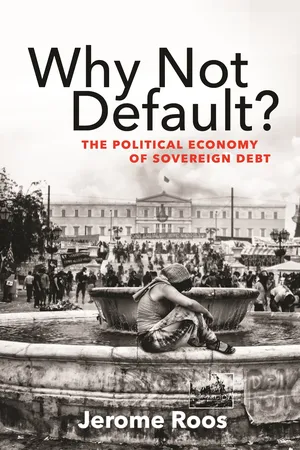
- 413 pages
- English
- PDF
- Available on iOS & Android
eBook - PDF
About this book
Information
Publisher
Princeton University PressYear
2019Print ISBN
9780691217437
9780691180106
eBook ISBN
9780691184937
Table of contents
- Cover
- Title Page
- Copyright Page
- Contents
- List of Tables, Figures, and Boxes
- Acknowledgments
- Introduction. The Sovereign Debt Puzzle
- PART I. THE THEORY OF SOVEREIGN DEBT
- PART II. A BRIEF HISTORY OF SOVEREIGN DEFAULT
- PART III. THE LOST DECADE: MEXICO (1982–1989)
- PART IV. THE GREAT DEFAULT: ARGENTINA (1999–2005)
- PART V. THE SPECTER OF SOLON: GREECE (2010–2015)
- Conclusion. Shaking Off the Burden
- Appendix. A Word on Methodology
- Notes
- References
- Index
Trusted by 375,005 students
Access to over 1.5 million titles for a fair monthly price.
Study more efficiently using our study tools.
Frequently asked questions
Yes, you can cancel anytime from the Subscription tab in your account settings on the Perlego website. Your subscription will stay active until the end of your current billing period. Learn how to cancel your subscription
No, books cannot be downloaded as external files, such as PDFs, for use outside of Perlego. However, you can download books within the Perlego app for offline reading on mobile or tablet. Learn how to download books offline
We are an online textbook subscription service, where you can get access to an entire online library for less than the price of a single book per month. With over 1.5 million books across 990+ topics, we’ve got you covered! Learn about our mission
Look out for the read-aloud symbol on your next book to see if you can listen to it. The read-aloud tool reads text aloud for you, highlighting the text as it is being read. You can pause it, speed it up and slow it down. Learn more about Read Aloud
Yes! You can use the Perlego app on both iOS and Android devices to read anytime, anywhere — even offline. Perfect for commutes or when you’re on the go.
Please note we cannot support devices running on iOS 13 and Android 7 or earlier. Learn more about using the app
Please note we cannot support devices running on iOS 13 and Android 7 or earlier. Learn more about using the app
Yes, you can access Why Not Default? by Jerome E. Roos in PDF and/or ePUB format, as well as other popular books in Economics & Economic History. We have over 1.5 million books available in our catalogue for you to explore.