
- 80 pages
- English
- ePUB (mobile friendly)
- Available on iOS & Android
eBook - ePub
About this book
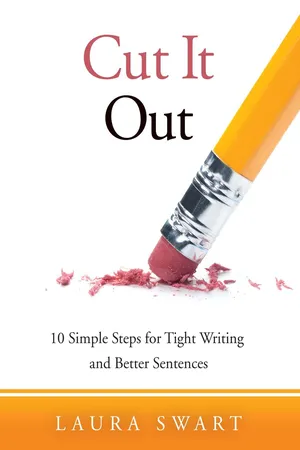
If your writing needs a pick-me-up, here's a triple espresso. You don't have to be a grammar whiz to improve your writing. This quick guide delivers maximum results with minimum pain.
If you're a student, Cut It Out will help you write better essays and earn higher grades. If you're a professional, Cut It Out will make you a stronger communicator in every facet of your written work.
Using uniquely Canadian vignettes, professional writing coach Laura Swart teaches you how to avoid the 10 most common writing errors, trim excess words from your sentences, and eliminate telltale signs of weak writing. Say goodbye to meandering prose, and say hello to powerful sentences and paragraphs.
Frequently asked questions
Yes, you can cancel anytime from the Subscription tab in your account settings on the Perlego website. Your subscription will stay active until the end of your current billing period. Learn how to cancel your subscription.
No, books cannot be downloaded as external files, such as PDFs, for use outside of Perlego. However, you can download books within the Perlego app for offline reading on mobile or tablet. Learn more here.
Perlego offers two plans: Essential and Complete
- Essential is ideal for learners and professionals who enjoy exploring a wide range of subjects. Access the Essential Library with 800,000+ trusted titles and best-sellers across business, personal growth, and the humanities. Includes unlimited reading time and Standard Read Aloud voice.
- Complete: Perfect for advanced learners and researchers needing full, unrestricted access. Unlock 1.4M+ books across hundreds of subjects, including academic and specialized titles. The Complete Plan also includes advanced features like Premium Read Aloud and Research Assistant.
We are an online textbook subscription service, where you can get access to an entire online library for less than the price of a single book per month. With over 1 million books across 1000+ topics, weāve got you covered! Learn more here.
Look out for the read-aloud symbol on your next book to see if you can listen to it. The read-aloud tool reads text aloud for you, highlighting the text as it is being read. You can pause it, speed it up and slow it down. Learn more here.
Yes! You can use the Perlego app on both iOS or Android devices to read anytime, anywhere ā even offline. Perfect for commutes or when youāre on the go.
Please note we cannot support devices running on iOS 13 and Android 7 or earlier. Learn more about using the app.
Yes, you can access Cut It Out by Laura Swart in PDF and/or ePUB format, as well as other popular books in Personal Development & Creative Writing. We have over one million books available in our catalogue for you to explore.
Information
Chapter 1
Manitoba Resurrection
strings of little words

Rule #1
Try not to use too many strings of little words because they really do add a lot of unnecessary clutter to your sentences.
Have you ever met someone who rants on and on and on but never says anything? Imagine what itās like to grade a paper that does the same thing. I can assure you, your professor would rather scrub toilets than read an essay that chatters like a magpie.
In rule #1, I used a strong word: clutter. But because it straggles behind a string of little words, itās invisible.
Strings are inventories of abstraction: try not to use too many; they really do add a lot. None of these words stirs the sensesāthe reader canāt see them or hear them, so she must work harder to unpack the sentence.
To improve the sentence, I can say something like this: Strings of little words clutter your sentences. Now the two interesting words come into view: strings and clutter.
Why, you ask, is cutting out a few little words such a big deal? Think about it. If you cut two words from every sentence of a ten-page essay, you eliminate about 250 excessesāand make more room for the content-rich words and phrases that intoxicate your professors.
Sample Reading
There is a tiny little wood frog that lives deep in the woods of Manitoba. The truth is, this little frog doesnāt really have any special attributes that would attract us to it, except for one small thing. Each spring, unbelievably, it is said to be resurrected from the dead. In the winter, when the outside temperatures drop and fall to below freezing, it doesnāt choose to bury itself in the mud and it doesnāt settle beneath the ice on the bottom of a frozen lake. Instead of this, it pretty much freezes to death in a hole in the ground. The wood frogās heartbeat and breathing slow down and after a period of time come to a stop. The water in its body very slowly crystallizes, and around 65 percent of it turns into ice. Its body temperature drops to a chilly ā1 °C to ā6 °C, and the frog becomes as hard and fragile as a piece of glass. Then, when the winter begins its long process of thawing out, the frog too begins to thawābut it thaws from the inside out, not from the outside in, as a lot of people would expect.
My Corrections
Step 1
I first want to cut out the unnecessary words. Reread the first two sentences, and pay attention to the words in bold.
There is a tiny little wood frog that lives deep in the woods of Manitoba. The truth is, this little frog doesnāt really have any special attributes that would attract us to it, except for one small thing. Each spring, unbelievably, it is said to be resurrected from the dead.
I can improve these sentences by cutting the following words:
⢠tinyāmeans the same thing as little
⢠the truth isāredundant: the context indicates that I am relating facts, not fiction
⢠reallyāis this word really necessary?
⢠that would attract us to itāstates the obvious; special attributes typically attract our attention
⢠unbelievably, it is said to beādilutes the most important idea: resurrection from the dead
The sentences now read like this:
There is a little wood frog that lives deep in the woods of Manitoba. This frog doesnāt have any special attributes except for one small thing. Each spring, it is resurrected from the dead.
Before I move on, I want to ensure that the sentences are clear; sometimes when you cut out extra words, errors pop up out of nowhere. In the example above, I deleted the phrase that would attract us to it, but I forgot to insert a comma after special attributes.
This frog doesnāt have any special attributes, except for one small thing. Each spring, it is resurrected from the dead.
Step 2
Next, Iāll underline the content-rich wordsāthose that convey meaningāto see if Iāve overlooked any unnecessary little words.
There is a little wood frog that lives deep in the woods of Manitoba. This frog doesnāt have any special attributes, except for one small thing. Each spring, it is resurrected from the dead.
If I juggle a few things around, Iāll have an impressive sentence:
Deep in the Manitoba wood lives the common wood frogāa mundane little frog, apart from a singular eccentricity: each spring, it is resurrected from the dead.
Notice that I cut out empty words like there, that, and this. I used the sensory words deep and dead to empower the beginning and end of the sentence, and I inserted a colon (:) to highlight the frogās defining feature: its resurrection from the dead.
The original word count in step 1 is 50; the final word count is 27. The rewrite says the same thing more conciselyāand, I think, more powerfully.
Step 3
Read the next few sentences of the paragraph.
In the winter, when the outside temperatures drop and fall to below freezing, it doesnāt choose to bury itself in the mud and it doesnāt sett...
Table of contents
- Cover
- Title Page
- Copyright Page
- Contents
- Introduction
- 1 Manitoba Resurrection
- 2 Okanagan Icewine
- 3 New Brunswick Fiddleheads
- 4 Halifax Gateway
- 5 Yukon Lights
- 6 Canmore Sisters
- 7 Prairie Sky
- 8 Montreal Bagels
- 9 Niagara Daredevils
- 10 Arctic Inukshuks
- Conclusion
- Glossary
- Inspirations
- About the Author