In order to better understand these issues, this multidisciplinary volume addresses such topics as: parental employment and parenting, paid labor and marital quality, the integration of work-family domains, childcare and child development, dating and mate selection at work, work stress and family violence, health consequences of work-family conflict, relationship roles among dual-earner couples, family determinants of job performance, gender differences in work-family demands and consequences, and work stressors and family functioning; among others. The chapters in this volume provide substantial insight into our understanding of the work-family interface, and provide meaningful directions for both future research and policy.
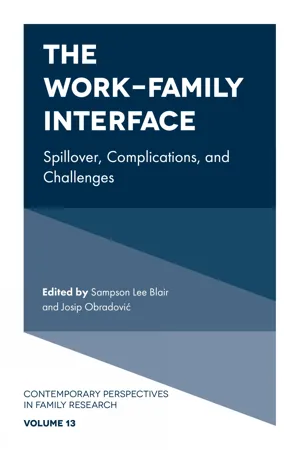
eBook - ePub
The Work-Family Interface
Spillover, Complications, and Challenges
- 420 pages
- English
- ePUB (mobile friendly)
- Available on iOS & Android
eBook - ePub
The Work-Family Interface
Spillover, Complications, and Challenges
About this book
Family researchers have long recognized the interconnected nature of work and family. Around the globe, there is a clear recognition that the paid labor experiences of individuals will affect their families and familial relationships, often in unanticipated ways. Likewise, family relationships and family structures can significantly influence the work experience of individuals. As experiences of both families and work vary considerably across cultures, and over time, the nature of the work-family interface continues to change. The work-family interface impacts not only adults within families, but also children, and the interwoven nature of work and family yields significant consequences for all family members and relationships.
Information
CHAPTER 1
STABILITY IN MOTHERS’ WORK HOURS IN EARLY CHILDHOOD AND CHILDREN’S ACHIEVEMENT IN KINDERGARTEN
ABSTRACT
Past studies suggest that full-time maternal employment may be negatively related to children’s cognitive development. Most studies measure maternal employment at one time point, while mothers’ work hours may not be stable during early childrearing years. Using data from the 2001 Early Childhood Longitudinal Study – Birth Cohort (N ≈ 6,500), the authors examine stability in mothers’ work hours across four waves when children are 9 and 24 months old, in preschool, and in kindergarten, mothers’ background characteristics associated to it, and its link to child cognitive development. Results show that the majority of mothers change work hours across the four waves. Analysis using multinomial logistic regression models suggests that mothers’ older age, fewer children, and higher household income are related to working full time at all four waves compared to varying work hours across the waves; more children and less than high school completion are related to staying home at all four waves; and mothers’ older age, being White, no change in partnership status, and holding a college degree are related to working part time at all four waves. Compared to mothers’ changing work hours, mothers’ stable work hours, full time or part time, at all four waves is related to children’s better reading, math, and cognitive scores in kindergarten, whereas mothers’ staying home at all four waves is negatively related to these scores. These associations disappear when background characteristics are controlled for in ordinary least squares regression models. These findings underscore the role of background characteristics in shaping both mothers’ stable employment and children’s cognitive development.
Keywords: Child cognitive development; gender; life course; maternal employment; work–family balance
Since the mid-1980s, the majority of US mothers of children under age 6 have been in the labor force at any given year (U.S. Bureau of Labor Statistics, 2010). The increase in mothers’ labor market attachment has led to concerns regarding its consequences for child development. A large volume of studies have produced inconsistent findings, suggesting that the effects of maternal employment on children may vary by work and family contexts (Goldberg, Prause, Lucas-Thompson, & Himsel, 2008; Waldfogel, 2002a). One of such contexts is the intensity of maternal employment or work hours. Reviews of the past studies have suggested that mothers’ full-time employment appears to be negatively related to children’s cognitive and behavioral development (Brooks-Gunn, Han, & Waldfogel, 2010; Waldfogel, 2002a), whereas mothers’ part-time employment is positively related to children’s achievement such as reading and math scores measured around kindergarten and early elementary school years (Goldberg et al., 2008).
This conclusion that maternal full-time employment can be negatively related to children’s developmental outcomes poses a question: How common is it for US mothers to work full time throughout their children’s early childhood? Studies that examined women born in the mid-1960s or earlier have shown that this is not common (Greenstein, 1995; Hynes & Clarkberg, 2005; Lu, Wang, & Han, 2017). Stable full-time employment is only possible when mothers have ample resources to balance work and child care responsibilities (Damaske & Frech, 2016). This is not surprising, given the lack of public policies in the United States to support parents to balance full-time employment with childrearing responsibilities (Bianchi, 2011; Moen, 2005). Although it is now often declared that employment is normative for mothers of young children in the United States (e.g., Glynn, 2016), it is unclear how common it is for more recent cohorts of mothers to work full time throughout several years when their children are young. Meanwhile, past research on the associations between maternal employment and children’s developmental outcomes has typically measured maternal employment at one time point. If a majority of mothers change their market work hours across their children’s early childhood years, measuring mothers’ work hours at one time point may not capture the reality of how much mothers work and how stable their work hours are during their children’s early childhood years. All in all, research is needed to reexamine how common it is for mothers with young children to work full time, part time, stay home continuously, or to change work hours over the period when their children are young, and how such maternal employment patterns are related to children’s achievement in kindergarten.
Using the four waves of the 2001 Early Childhood Longitudinal Study, Birth Cohort (the 2001 ECLS-B; N ≈ 6,5001), we first examine stability in mothers’ work hours across the four time points when their focal children were 9 months old, 24 months old, in preschool, and in kindergarten. We are interested in estimating distributions of mothers across the following four groups, indicating intensity and stability in their work hours: mothers who (a) worked full time (35 hours or more per week) at all four time points, (b) worked part time at all four time points, (c) did not work at all four time points, and (d) changed work hours at least once across the four time points. Second, we examine how mothers’ and children’s background characteristics are related to their odds of falling into one of the four groups of employment patterns. Third, we examine how the four groups of maternal employment patterns are related to children’s achievement in kindergarten measured by reading, math, and cognitive scores, while controlling for mothers’ background characteristics and child characteristics. Findings of the present analyses have important implications for understanding the role of (in)stability in mothers’ work hours during their children’s early childhood years and its link to children’s cognitive development.
BACKGROUND
Stability in Mothers’ Work Hours during Early Childrearing Years
Work–family scholars have long argued that paid work activities over the course of US adults’ lives are highly gendered (Bianchi, 2011; Presser, 1995). As Moen (2005) noted, the norm of continuous full-time work in the US workplace makes sense only when individuals have someone who can take over their family responsibilities. Without effective work–family policies, working for pay and raising children are incompatible for those who are primary caregivers of children (Presser, 1995). Despite increases in women’s educational attainment and occupational aspiration, women continue to shoulder primary child care responsibilities and adjust their paid work hours around their children’s needs (Bianchi, 2011). As a result, mothers’ paid work pathways tend to be “a patchwork of self-orchestrated time outs to care for children” (Moen, 2005, p. 200).
Empirical studies using data from older cohorts have shown support for this argument. A few longitudinal analyses have found that mothers typically change employment hours after a childbirth. Examining the 1972–1976 Panel Study of Income Dynamics, Moen (1985) reported that women’s employment is characterized by combinations of full-time and part-time work with periods of non-employment. Using data from the National Longitudinal Study of the High School Class of 1972, VandenHeuvel (1997) found that the majority of mothers were neither continuously in the labor force nor continuously out of the labor force during the 8–10 years following their first birth. She argued that mothers’ employment pathways cannot simply be categorized into a “[full-time] career” or a “homemaker” path, calling for the recognition of a “mosaic” of mother’s employment sequences following a birth.
Similar patterns have been found among women in the 1979 National Longitudinal Survey of Youth (NLSY79), who were born between 1957 and 1964, most of whom gave birth during the 1980s and the early 1990s (U.S. Bureau of Labor Statistics, 2017). Observing first-time mothers’ employment hours in the NLSY79 every three months until the end of the child’s fourth year, Greenstein (1995) reported that about a half of mothers were employed intermittently (51%), whereas only 9% were continuously employed full time, 19% were continuously employed part time, and 21% were continuously not employed. Also using the same data, Hynes and Clarkberg (2005) examined stability in employment status every 2 months from 12 months before and 24 months after a birth. They found that the majority of mothers (65%) showed substantial movement in and out of t...
Table of contents
- Cover
- Title
- Chapter 1. Stability in Mothers’ Work Hours in Early Childhood and Children’s Achievement in Kindergarten
- Chapter 2. Social and Cultural Context of Family Policy and the Employment of Mothers of Small Children. The Example of Poland
- Chapter 3. Lone Mothers’ Negotiation of Competing Employment and Parenting Demands in the Contemporary British Context of “Worker Citizenship”
- Chapter 4. Perceived Work–Family Balance and Engagement Behaviors of Fathers of Infants
- Chapter 5. Parental Involvement and Educational Performance among Taiwanese Adolescents: Comparing Dual-Earner and Single-Earner Families
- Chapter 6. A Longitudinal Examination of Work–Family Conflict among Working Mothers in the United States
- Chapter 7. Motivation for Night Work and Parents’ Work-To-Family Conflict and Life Satisfaction
- Chapter 8. Strategies for Balance: Examining How Parents of Color Navigate Work and Life in the Academy
- Chapter 9. Diabetes as a Consequence of Work–Family Conflicts and Gender Violence in México
- Chapter 10. Multi-faceted Household Dependency, Work–Family Conflict, and Self-Rated Health in Five High-Income Countries
- Chapter 11. For Better or For Worse: Nonstandard Work Schedules and Self-Rated Health across Marital Status
- Chapter 12. How Do Nurses Perceive Role-Taking and Emotional Labor Processes to Influence Work–Family Spillover?
- Chapter 13. Penalty for Success? Career Achievement and Gender Differences in Divorce
- Chapter 14. “I Really Don’t have a Career. I Just Work and I Like Doing My Work.”A Qualitative Study on the Meaning of Work for Low-Income Women from A Family Perspective
- Chapter 15. Telework and Work–Family Conflict across Workplaces: Investigating the Implications of Work–Family-Supportive and High-Demand Workplace Cultures
- Chapter 16. Evaluating Relational Factors as Possible Protective Factors for Work–Life Balance via a Linear Mixed Effects Model
- Chapter 17. What I Think You Think about Family and Work: Pluralistic Ignorance and the Ideal Worker Norm
- Index
Trusted by 375,005 students
Access to over 1.5 million titles for a fair monthly price.
Study more efficiently using our study tools.
Frequently asked questions
Yes, you can cancel anytime from the Subscription tab in your account settings on the Perlego website. Your subscription will stay active until the end of your current billing period. Learn how to cancel your subscription
No, books cannot be downloaded as external files, such as PDFs, for use outside of Perlego. However, you can download books within the Perlego app for offline reading on mobile or tablet. Learn how to download books offline
Perlego offers two plans: Essential and Complete
- Essential is ideal for learners and professionals who enjoy exploring a wide range of subjects. Access the Essential Library with 800,000+ trusted titles and best-sellers across business, personal growth, and the humanities. Includes unlimited reading time and Standard Read Aloud voice.
- Complete: Perfect for advanced learners and researchers needing full, unrestricted access. Unlock 1.5M+ books across hundreds of subjects, including academic and specialized titles. The Complete Plan also includes advanced features like Premium Read Aloud and Research Assistant.
We are an online textbook subscription service, where you can get access to an entire online library for less than the price of a single book per month. With over 1.5 million books across 990+ topics, we’ve got you covered! Learn about our mission
Look out for the read-aloud symbol on your next book to see if you can listen to it. The read-aloud tool reads text aloud for you, highlighting the text as it is being read. You can pause it, speed it up and slow it down. Learn more about Read Aloud
Yes! You can use the Perlego app on both iOS and Android devices to read anytime, anywhere — even offline. Perfect for commutes or when you’re on the go.
Please note we cannot support devices running on iOS 13 and Android 7 or earlier. Learn more about using the app
Please note we cannot support devices running on iOS 13 and Android 7 or earlier. Learn more about using the app
Yes, you can access The Work-Family Interface by Sampson Lee Blair, Josip Obradović, Sampson Lee Blair,Josip Obradović in PDF and/or ePUB format, as well as other popular books in Social Sciences & Marriage & Family Sociology. We have over 1.5 million books available in our catalogue for you to explore.