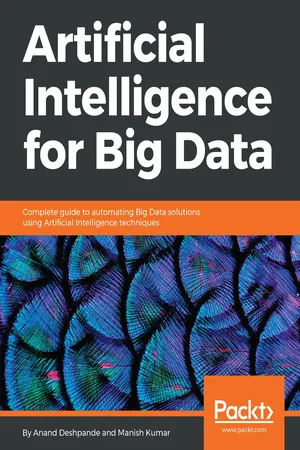
Artificial Intelligence for Big Data
eBook - ePub

Artificial Intelligence for Big Data

Complete guide to automating Big Data solutions using Artificial Intelligence techniques

  1. 384 pages
  2. English
  3. ePUB (mobile friendly)
  4. Available on iOS & Android
eBook - ePub

Artificial Intelligence for Big Data

Complete guide to automating Big Data solutions using Artificial Intelligence techniques

About this book

Build next-generation Artificial Intelligence systems with Java

Key Features

  • Implement AI techniques to build smart applications using Deeplearning4j
  • Perform big data analytics to derive quality insights using Spark MLlib
  • Create self-learning systems using neural networks, NLP, and reinforcement learning

Book Description

In this age of big data, companies have larger amount of consumer data than ever before, far more than what the current technologies can ever hope to keep up with. However, Artificial Intelligence closes the gap by moving past human limitations in order to analyze data.

With the help of Artificial Intelligence for big data, you will learn to use Machine Learning algorithms such as k-means, SVM, RBF, and regression to perform advanced data analysis. You will understand the current status of Machine and Deep Learning techniques to work on Genetic and Neuro-Fuzzy algorithms. In addition, you will explore how to develop Artificial Intelligence algorithms to learn from data, why they are necessary, and how they can help solve real-world problems.

By the end of this book, you'll have learned how to implement various Artificial Intelligence algorithms for your big data systems and integrate them into your product offerings such as reinforcement learning, natural language processing, image recognition, genetic algorithms, and fuzzy logic systems.

What you will learn

  • Manage Artificial Intelligence techniques for big data with Java
  • Build smart systems to analyze data for enhanced customer experience
  • Learn to use Artificial Intelligence frameworks for big data
  • Understand complex problems with algorithms and Neuro-Fuzzy systems
  • Design stratagems to leverage data using Machine Learning process
  • Apply Deep Learning techniques to prepare data for modeling
  • Construct models that learn from data using open source tools
  • Analyze big data problems using scalable Machine Learning algorithms

Who this book is for

This book is for you if you are a data scientist, big data professional, or novice who has basic knowledge of big data and wish to get proficiency in Artificial Intelligence techniques for big data. Some competence in mathematics is an added advantage in the field of elementary linear algebra and calculus.

Tools to learn more effectively

Saving Books

Saving Books

Keyword Search

Keyword Search

Annotating Text

Annotating Text

Listen to it instead

Listen to it instead

Deep Big Data Analytics

In the previous chapter, we established the fundamental theory of artificial neural networks (ANNs) and how they emulate human brain structure for generating output based on a set of inputs with the help of interconnected nodes. The nodes are arranged in three types of layers: input, hidden, and output. We understood the basic and mathematical concepts of how the input signal is carried through to the output layer and the iterative approach that ANNs take for training weights on neuron connections. Simple neural networks with one or two hidden layers can solve very rudimentary problems. However, in order to meaningfully utilize ANNs for real-world problems, which involve hundreds or thousands of input variables, involve more complex models, and require the models to store more information, we need more complex structures that are realized with large numbers of hidden layers. These types of networks are called Deep Neural Networks and utilizing these Deep Neural Networks for modeling the real data is termed deep learning. With the addition of nodes and their interconnections, the Deep Neural Networks can model unstructured input, such as audio, video, and images.
In this chapter, we will explore how deep learning can be utilized for addressing some important problems in big data analytics, including extracting complex patterns from massive volumes of data, semantic indexing, data tagging, fast information retrieval, and simplifying discriminative tasks such as classification. We are going to cover:
  • The building blocks of deep learning:
    • Gradient descent
    • Backpropagation
    • Non-linearities
    • Dropout
  • Specialized neural net architectures for structured data
  • Building data preparation pipelines
  • Hyperparameter tuning
  • Leveraging distributed computing for deep learning
The proposed examples will be implemented using the Deeplearning4j (DL4J) Java framework.

Deep learning basics and the building blocks

In the previous chapters, we established the fact that the machine learning algorithms generalize the input data into a hypothesis that fits the data so that the output, based on the new values, can be predicted accurately by the model. The accuracy of the model is a function of the amount of the input data along with variation in the values of the independent variables. The more data and variety, the more computation power we require to generate and execute the models. The distributed computing frameworks (Hadoop, Spark, and so on) work very well with the large volumes of data with variety. The same principles apply to ANNs.
The more input data we have along with variations, the more accurate the models can be generated, which requires more storage and computation power. Since the computation power and storage is available with the development of the big data analytics platforms (in-premise as well as on the cloud), it is possible to experiment with large neural networks with hundreds or thousands of nodes in the input layer, and hundreds or thousands of hidden layers. These types of ANNs are called Deep Neural Networks.
While these models are computationally heavy, they produce accurate results and get better with more data, unlike the traditional algorithms that plateau in terms of performance at some point. After the plateau point, even after adding more data, the model accuracy for traditional mathematical models does not increase by a great margin. The Deep Neural Networks perform better in terms of accuracy and reliability with increasing amount of data. The use of these multi-layered neural networks for hypothesis generation is generally termed deep learning. The difference between a Simple Neural Network and a Deep Neural Network can be depicted as follows:
Simple ANN versus Deep Neural Network
For supervised learning problems, the Deep Neural Networks have proven to provide encouraging results, especially when it comes to mapping some of the functions with high complexity levels. With sufficiently large datasets with labeled training examples, the Deep Neural Networks are able to train the connection weights so that there is no loss of intelligence and the model accurately represents the historical facts based on data, and at the same time has a level of generalization that suits most of the mission critical applications. Remember, the generic and common objective of all the learning methods is to minimize the cost function. The cost function value is inversely proportional to the model's accuracy.
Let us mathematically define the cost function for a Deep Neural Network. This is also termed the mean squared error function. This function will always be positive since it takes the square of the difference:
w: collection of all the weights in the network
b: all the biases
n: training data size (number of samples)
a: vector of outputs from the network corresponding to x as input value
Let's look at some of the methods of Deep Neural Networks learning.

Gradient-based learning

In the previous chapter, we primarily discussed the single hidden layer perceptron model or the simple neural networks, in that chapter we also introduced the concept of gradient descent. Gradient descent, as applicable to the Deep Neural Network, essentially means we define the weights and biases for the neuron connections so as to reduce the value of the cost function. The network is initialized to a random state (random weights and bias values...

Table of contents

  1. Title Page
  2. Copyright and Credits
  3. Packt Upsell
  4. Contributors
  5. Preface
  6. Big Data and Artificial Intelligence Systems
  7. Ontology for Big Data
  8. Learning from Big Data
  9. Neural Network for Big Data
  10. Deep Big Data Analytics
  11. Natural Language Processing
  12. Fuzzy Systems
  13. Genetic Programming
  14. Swarm Intelligence
  15. Reinforcement Learning
  16. Cyber Security
  17. Cognitive Computing
  18. Other Books You May Enjoy

Frequently asked questions

Yes, you can cancel anytime from the Subscription tab in your account settings on the Perlego website. Your subscription will stay active until the end of your current billing period. Learn how to cancel your subscription
No, books cannot be downloaded as external files, such as PDFs, for use outside of Perlego. However, you can download books within the Perlego app for offline reading on mobile or tablet. Learn how to download books offline
Perlego offers two plans: Essential and Complete
  • Essential is ideal for learners and professionals who enjoy exploring a wide range of subjects. Access the Essential Library with 800,000+ trusted titles and best-sellers across business, personal growth, and the humanities. Includes unlimited reading time and Standard Read Aloud voice.
  • Complete: Perfect for advanced learners and researchers needing full, unrestricted access. Unlock 1.4M+ books across hundreds of subjects, including academic and specialized titles. The Complete Plan also includes advanced features like Premium Read Aloud and Research Assistant.
Both plans are available with monthly, semester, or annual billing cycles.
We are an online textbook subscription service, where you can get access to an entire online library for less than the price of a single book per month. With over 1 million books across 990+ topics, we’ve got you covered! Learn about our mission
Look out for the read-aloud symbol on your next book to see if you can listen to it. The read-aloud tool reads text aloud for you, highlighting the text as it is being read. You can pause it, speed it up and slow it down. Learn more about Read Aloud
Yes! You can use the Perlego app on both iOS and Android devices to read anytime, anywhere — even offline. Perfect for commutes or when you’re on the go.
Please note we cannot support devices running on iOS 13 and Android 7 or earlier. Learn more about using the app
Yes, you can access Artificial Intelligence for Big Data by Anand Deshpande, Manish Kumar in PDF and/or ePUB format, as well as other popular books in Computer Science & Artificial Intelligence (AI) & Semantics. We have over one million books available in our catalogue for you to explore.