Develop, deploy, and streamline your data science projects with the most popular end-to-end platform, AnacondaAbout This Book• Use Anaconda to find solutions for clustering, classification, and linear regression• Analyze your data efficiently with the most powerful data science stack• Use the Anaconda cloud to store, share, and discover projects and librariesWho This Book Is ForHands-On Data Science with Anaconda is for you if you are a developer who is looking for the best tools in the market to perform data science. It's also ideal for data analysts and data science professionals who want to improve the efficiency of their data science applications by using the best libraries in multiple languages. Basic programming knowledge with R or Python and introductory knowledge of linear algebra is expected.What You Will Learn• Perform cleaning, sorting, classification, clustering, regression, and dataset modeling using Anaconda• Use the package manager conda and discover, install, and use functionally efficient and scalable packages• Get comfortable with heterogeneous data exploration using multiple languages within a project• Perform distributed computing and use Anaconda Accelerate to optimize computational powers• Discover and share packages, notebooks, and environments, and use shared project drives on Anaconda Cloud• Tackle advanced data prediction problemsIn DetailAnaconda is an open source platform that brings together the best tools for data science professionals with more than 100 popular packages supporting Python, Scala, and R languages. Hands-On Data Science with Anaconda gets you started with Anaconda and demonstrates how you can use it to perform data science operations in the real world.The book begins with setting up the environment for Anaconda platform in order to make it accessible for tools and frameworks such as Jupyter, pandas, matplotlib, Python, R, Julia, and more. You'll walk through package manager Conda, through which you can automatically manage all packages including cross-language dependencies, and work across Linux, macOS, and Windows. You'll explore all the essentials of data science and linear algebra to perform data science tasks using packages such as SciPy, contrastive, scikit-learn, Rattle, and Rmixmod.Once you're accustomed to all this, you'll start with operations in data science such as cleaning, sorting, and data classification. You'll move on to learning how to perform tasks such as clustering, regression, prediction, and building machine learning models and optimizing them. In addition to this, you'll learn how to visualize data using the packages available for Julia, Python, and R.Style and approachThis book is your step-by-step guide full of use cases, examples and illustrations to get you well-versed with the concepts of Anaconda.
eBook - ePub
Hands-On Data Science with Anaconda
Utilize the right mix of tools to create high-performance data science applications
- 364 pages
- English
- ePUB (mobile friendly)
- Available on iOS & Android
eBook - ePub
Hands-On Data Science with Anaconda
Utilize the right mix of tools to create high-performance data science applications
About this book
Information
Data Basics
In this chapter, we'll first discuss sources of open data, which includes the University of California at Irvine (UCI) Machine Learning Depository, the Bureau of Labor Statistics, the Census Bureau, Professor French's Data Library, and the Federal Reserve's Data Library. Then, we will show you several ways of inputting data, how to deal with missing values, sorting, choosing a subset, merging different datasets, and data output. For different languages, such as Python, R, and Julia, several relevant packages for data manipulation will be introduced as well. In particular, the Python pandas package will be discussed.
In this chapter, the following topics will be covered:
- Sources of data
- Introduction to the Python pandas package
- Several ways to inputting packages
- Introduction to the Quandl data delivery platform
- Dealing with missing data
- Sorting data, as well as how to slice, dice, and merge various datasets
- Introduction to Python packages: cbsodata and datadotword
- Introduction to R packages: dslabs, haven, and foreign
- Generating Python datasets
- Generating R datasets
Sources of data
For users in the area of data science and business analytics, one important issue is the source of data, or simply where to get data. When working at a company, the obvious source of data is one's own company, such as sales, cost of raw materials, the salary of managers and other employees, the related information of suppliers and clients, estimations of future sales, the cost of raw materials, and so on. It is a good idea to find some data for learning purposes, and this is especially true for full-time students.
Generally speaking, there are two types of data: public and private. Private or proprietary databases are quite expensive. A typical example is the Center for Research in Security Prices (CRSP) database, a financial database generated and maintained by the University of Chicago. This database has daily, weekly, monthly, and annual trading data for all stocks listed on stock exchanges in the US from 1926 onward.
The second type of data is public or free data. For users in various data science or business analytics programs, this type of data is more than enough. For example, the UCI offers many useful datasets for machine learning that can be used for testing and learning purposes. This offers great benefits to new learners in the area of data science. Later in the chapter, several lists of free data will be offered for learners in data science, economics, and finance and accounting.
UCI machine learning
The UCI maintains 413 datasets, as of 1/10/2018, for machine learning: http://archive.ics.uci.edu/ml/index.php. The following screenshot shows the top three downloaded datasets:

For the number one downloaded dataset called Iris, we have the following information:
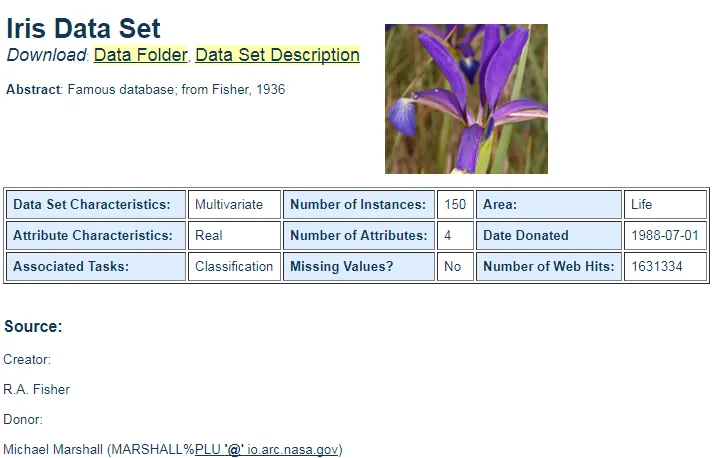
The beauty of these datasets is that they give quite detailed information such as the source, the creator or donator, a description, and even citations.
The following table shows several potential public data sources for users in the area of data science and business analytics:
| Name | Web page | Data types |
| UCI | http://archive.ics.uci.edu/ml/index.php | Data for machine learning |
| World Health Organization | http://www.who.int/en/ | Healthcare data |
| Amazon Web Services | https://aws.amazon.com/cn/datasets/?nc1=h_ls | Web usage |
| Data.gov (US Government Open Data) | https://www.data.gov/ | Agriculture, climate, consumer, and so on |
| GitHub | https://github.com/caesar0301/awesome-public-datasets | Many datasets offered by individuals |
| Open data network | https://www.opendatanetwork.com/ | Many useful datasets |
| Government health data | https://www.healthdata.gov/ | Healthcare-related datasets |
| Google public data | https://www.google.com/publicdata/directory | World development indicators |
Table 3.1: Potential sources of open data for data science and business analytics
After we go to https://www.data.gov/, we can see the following choices related to Agriculture, Climate, Consumer, Ecosystems, Education, and th...
Table of contents
- Title Page
- Copyright and Credits
- Dedication
- Packt Upsell
- Contributors
- Preface
- Ecosystem of Anaconda
- Anaconda Installation
- Data Basics
- Data Visualization
- Statistical Modeling in Anaconda
- Managing Packages
- Optimization in Anaconda
- Unsupervised Learning in Anaconda
- Supervised Learning in Anaconda
- Predictive Data Analytics – Modeling and Validation
- Anaconda Cloud
- Distributed Computing, Parallel Computing, and HPCC
- References
- Other Books You May Enjoy
Trusted by 375,005 students
Access to over 1.5 million titles for a fair monthly price.
Study more efficiently using our study tools.
Frequently asked questions
Yes, you can cancel anytime from the Subscription tab in your account settings on the Perlego website. Your subscription will stay active until the end of your current billing period. Learn how to cancel your subscription
No, books cannot be downloaded as external files, such as PDFs, for use outside of Perlego. However, you can download books within the Perlego app for offline reading on mobile or tablet. Learn how to download books offline
Perlego offers two plans: Essential and Complete
- Essential is ideal for learners and professionals who enjoy exploring a wide range of subjects. Access the Essential Library with 800,000+ trusted titles and best-sellers across business, personal growth, and the humanities. Includes unlimited reading time and Standard Read Aloud voice.
- Complete: Perfect for advanced learners and researchers needing full, unrestricted access. Unlock 1.5M+ books across hundreds of subjects, including academic and specialized titles. The Complete Plan also includes advanced features like Premium Read Aloud and Research Assistant.
We are an online textbook subscription service, where you can get access to an entire online library for less than the price of a single book per month. With over 1.5 million books across 990+ topics, we’ve got you covered! Learn about our mission
Look out for the read-aloud symbol on your next book to see if you can listen to it. The read-aloud tool reads text aloud for you, highlighting the text as it is being read. You can pause it, speed it up and slow it down. Learn more about Read Aloud
Yes! You can use the Perlego app on both iOS and Android devices to read anytime, anywhere — even offline. Perfect for commutes or when you’re on the go.
Please note we cannot support devices running on iOS 13 and Android 7 or earlier. Learn more about using the app
Please note we cannot support devices running on iOS 13 and Android 7 or earlier. Learn more about using the app
Yes, you can access Hands-On Data Science with Anaconda by Dr. Yuxing Yan, James Yan in PDF and/or ePUB format, as well as other popular books in Computer Science & Computer Science General. We have over 1.5 million books available in our catalogue for you to explore.