Apache Spark Deep Learning Cookbook
eBook - ePub

Apache Spark Deep Learning Cookbook

Over 80 recipes that streamline deep learning in a distributed environment with Apache Spark

  1. 474 pages
  2. English
  3. ePUB (mobile friendly)
  4. Available on iOS & Android
eBook - ePub

Apache Spark Deep Learning Cookbook

Over 80 recipes that streamline deep learning in a distributed environment with Apache Spark

About this book

A solution-based guide to put your deep learning models into production with the power of Apache Spark

Key Features

  • Discover practical recipes for distributed deep learning with Apache Spark
  • Learn to use libraries such as Keras and TensorFlow
  • Solve problems in order to train your deep learning models on Apache Spark

Book Description

With deep learning gaining rapid mainstream adoption in modern-day industries, organizations are looking for ways to unite popular big data tools with highly efficient deep learning libraries. As a result, this will help deep learning models train with higher efficiency and speed.

With the help of the Apache Spark Deep Learning Cookbook, you'll work through specific recipes to generate outcomes for deep learning algorithms, without getting bogged down in theory. From setting up Apache Spark for deep learning to implementing types of neural net, this book tackles both common and not so common problems to perform deep learning on a distributed environment. In addition to this, you'll get access to deep learning code within Spark that can be reused to answer similar problems or tweaked to answer slightly different problems. You will also learn how to stream and cluster your data with Spark. Once you have got to grips with the basics, you'll explore how to implement and deploy deep learning models, such as Convolutional Neural Networks (CNN) and Recurrent Neural Networks (RNN) in Spark, using popular libraries such as TensorFlow and Keras.

By the end of the book, you'll have the expertise to train and deploy efficient deep learning models on Apache Spark.

What you will learn

  • Set up a fully functional Spark environment
  • Understand practical machine learning and deep learning concepts
  • Apply built-in machine learning libraries within Spark
  • Explore libraries that are compatible with TensorFlow and Keras
  • Explore NLP models such as Word2vec and TF-IDF on Spark
  • Organize dataframes for deep learning evaluation
  • Apply testing and training modeling to ensure accuracy
  • Access readily available code that may be reusable

Who this book is for

If you're looking for a practical and highly useful resource for implementing efficiently distributed deep learning models with Apache Spark, then the Apache Spark Deep Learning Cookbook is for you. Knowledge of the core machine learning concepts and a basic understanding of the Apache Spark framework is required to get the best out of this book. Additionally, some programming knowledge in Python is a plus.
Frequently asked questions

Yes, you can cancel anytime from the Subscription tab in your account settings on the Perlego website. Your subscription will stay active until the end of your current billing period. Learn how to cancel your subscription.
No, books cannot be downloaded as external files, such as PDFs, for use outside of Perlego. However, you can download books within the Perlego app for offline reading on mobile or tablet. Learn more here.
Perlego offers two plans: Essential and Complete
  • Essential is ideal for learners and professionals who enjoy exploring a wide range of subjects. Access the Essential Library with 800,000+ trusted titles and best-sellers across business, personal growth, and the humanities. Includes unlimited reading time and Standard Read Aloud voice.
  • Complete: Perfect for advanced learners and researchers needing full, unrestricted access. Unlock 1.4M+ books across hundreds of subjects, including academic and specialized titles. The Complete Plan also includes advanced features like Premium Read Aloud and Research Assistant.
Both plans are available with monthly, semester, or annual billing cycles.
We are an online textbook subscription service, where you can get access to an entire online library for less than the price of a single book per month. With over 1 million books across 1000+ topics, we’ve got you covered! Learn more here.
Look out for the read-aloud symbol on your next book to see if you can listen to it. The read-aloud tool reads text aloud for you, highlighting the text as it is being read. You can pause it, speed it up and slow it down. Learn more here.
Yes! You can use the Perlego app on both iOS or Android devices to read anytime, anywhere — even offline. Perfect for commutes or when you’re on the go.
Please note we cannot support devices running on iOS 13 and Android 7 or earlier. Learn more about using the app.
Yes, you can access Apache Spark Deep Learning Cookbook by Ahmed Sherif, Amrith Ravindra in PDF and/or ePUB format, as well as other popular books in Computer Science & Artificial Intelligence (AI) & Semantics. We have over one million books available in our catalogue for you to explore.

Creating a Neural Network in Spark

In this chapter, the following recipes will be covered:
  • Creating a dataframe in PySpark
  • Manipulating columns in a PySpark dataframe
  • Converting a PySpark dataframe into an array
  • Visualizing the array in a scatterplot
  • Setting up weights and biases for input into the neural network
  • Normalizing the input data for the neural network
  • Validating array for optimal neural network performance
  • Setting up the activation function with sigmoid
  • Creating the sigmoid derivative function
  • Calculating the cost function in a neural network
  • Predicting gender based on height and weight
  • Visualizing prediction scores

Introduction

Much of this book will focus on building deep learning algorithms with libraries in Python, such as TensorFlow and Keras. While these libraries are helpful to build deep neural networks without getting deep into the calculus and linear algebra of deep learning, this chapter will do a deep dive into building a simple neural network in PySpark to make a gender prediction based on height and weight. One of the best ways to understand the foundation of neural networks is to build a model from scratch, without any of the popular deep learning libraries. Once the foundation for a neural network framework is established, understanding and utilizing some of the more popular deep neural network libraries will become much simpler.

Creating a dataframe in PySpark

dataframes will serve as the framework for any and all data that will be used in building deep learning models. Similar to the pandas library with Python, PySpark has its own built-in functionality to create a dataframe.

Getting ready

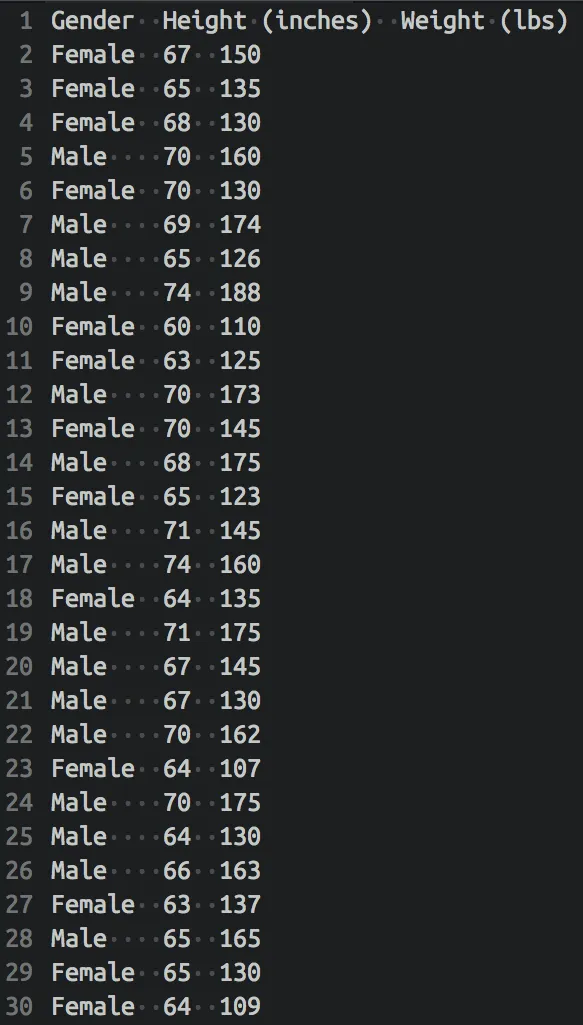
There are several ways to create a dataframe in Spark. One common way is by importing a .txt, .csv, or .json file. Another method is to manually enter fields and rows of data into the PySpark dataframe, and while the process can be a bit tedious, it is helpful, especially when dealing with a small dataset. To predict gender based on height and weight, this chapter will build a dataframe manually in PySpark. The dataset used is as follows:
While the dataset will be manually added to PySpark in this chapter, the dataset can also be viewed and downloaded from the following link:
https://github.com/asherif844/ApacheSparkDeepLearningCookbook/blob/master/CH02/data/HeightAndWeight.txt
Finally, we will begin this chapter and future chapters by starting up a Spark environment configured with a Jupyter notebook that was created in chapter 1, Setting up your Spark Environment for Deep Learning, using the following terminal command:
sparknotebook

How to do it...

When working with PySpark, a SparkSession must first be imported and initialized before any dataframe creation can occur:
  1. Import a SparkSession using the following script:
from pyspark.sql import SparkSession
  1. Configure a SparkSession:
spark = SparkSession.builder \
.master("local") \
.appName("Neural Network Model") \
.config("spark.executor.memory", "6gb") \
.getOrCreate()
sc = spark.sparkContext
  1. In this situation, the SparkSession appName has been named Neural Network Model and 6gb has been assigned to the session memory.

How it works...

This section explains how we create our Spark cluster and configure our first dataframe.
  1. In Spark, we use .master() to specify whether we will run our jobs on a distributed cluster or locally. For the purposes of this chapter and the remaining chapters, we will be executing Spark locally with one worker thread as specified with .master('local'). This is fine for testing and development purposes as we are doing in this chapter; however, we may run into performance issues if we deployed this to production. In production, it is recommended to use .master('local[*]') to set Spark to run on as many worker nodes that are available locally as possible. If we had 3 cores on our machine and we wanted to set our node count to match that, we would then specify .master('local[3]').
  1. The dataframe variable, df, is first created by inserting the row values for each column and then by inserting the column header names using the following script:
df = spark.createDataFrame([('Male', 67, 150), # insert column values
('Female', 65, 135),
('Female', 68, 130),
('Male', 70, 160),
('Female', 70, 130),
('Male', 69, 174),
('Female', 65, 126),
('Male', 74, 188),
('Female', 60, 110),
('Female', 63, 125),
('Male', 70, 173),
('Male', 70, 145),
('Male', 68, 175),
('Female', 65, 123),
('Male', 71, 145),
('Male', 74, 160),
('Female', 64, 135),
('Male', 71, 175),
('Male', 67, 145),
('Female', 67, 130),
('Male', 70, 162),
('Female', 64, 107),
('Male', 70, 175),
('Female', 64, 130),
('Male', 66, 16...

Table of contents

  1. Title Page
  2. Copyright and Credits
  3. Packt Upsell
  4. Foreword
  5. Contributors
  6. Preface
  7. Setting Up Spark for Deep Learning Development
  8. Creating a Neural Network in Spark
  9. Pain Points of Convolutional Neural Networks
  10. Pain Points of Recurrent Neural Networks
  11. Predicting Fire Department Calls with Spark ML
  12. Using LSTMs in Generative Networks
  13. Natural Language Processing with TF-IDF
  14. Real Estate Value Prediction Using XGBoost
  15. Predicting Apple Stock Market Cost with LSTM
  16. Face Recognition Using Deep Convolutional Networks
  17. Creating and Visualizing Word Vectors Using Word2Vec
  18. Creating a Movie Recommendation Engine with Keras
  19. Image Classification with TensorFlow on Spark
  20. Other Books You May Enjoy