- 192 pages
- English
- ePUB (mobile friendly)
- Available on iOS & Android
eBook - ePub
Myth and Materiality
About this book
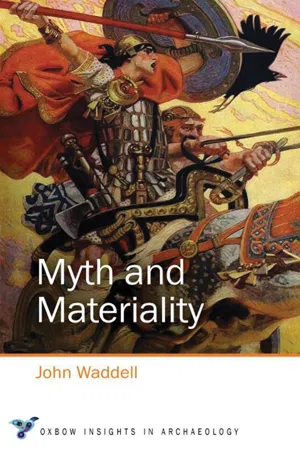
The aim of this book is to promote the thesis that myth may illuminate archaeology and that on occasion archaeology may shed light on myth. Medieval Irish literature is rich in mythic themes and some of these are used as a starting point. Some myths are of great antiquity and some were invented by contemporary authors. It is a challenging source, first explored in the author's earlier work Archaeology and Celtic Myth and this work will elaborate on some of the themes pursued there and introduce some new ones. Combining literary and archaeological evidence chapters deal with the construction of the past, illustrating how the Irish medieval world invented aspects of the past; the abuses of myth presented in later literature; the evidence for the survival of pagan beliefs and practices well into medieval times in Ireland; evidence to illustrate the key elements of the institution of sacral kingship, a consideration of sacred trees; mythology of the underworld and its archaeological expressions and the equine aspects of the myths attached to the Irish goddess Macha (linked to Navan Fort) and her Welsh counterpart Rhiannon. John Waddell brings a lifetimes experience of studying Irish history, Bronze Age archaeology and Celtic mythology in this personal and lively exploration of mythology and its archaeological expression.
Information
Subtopic
British HistoryIndex
HistoryTable of contents
- Cover
- Title
- Copyright
- Contents
- Acknowledgements
- List of Illustrations
- Introduction
- 1. The Invented Past
- 2. The Mythic Past
- 3. Sacral Kingship – The Mythology
- 4. Kings in Archaeology
- 5. The Otherworld
- 6. The Sacred Tree
- 7. The Ancestors of Epona
- Epilogue
- Notes
- References
Trusted by 375,005 students
Access to over 1.5 million titles for a fair monthly price.
Study more efficiently using our study tools.
Frequently asked questions
Yes, you can cancel anytime from the Subscription tab in your account settings on the Perlego website. Your subscription will stay active until the end of your current billing period. Learn how to cancel your subscription
No, books cannot be downloaded as external files, such as PDFs, for use outside of Perlego. However, you can download books within the Perlego app for offline reading on mobile or tablet. Learn how to download books offline
Perlego offers two plans: Essential and Complete
- Essential is ideal for learners and professionals who enjoy exploring a wide range of subjects. Access the Essential Library with 800,000+ trusted titles and best-sellers across business, personal growth, and the humanities. Includes unlimited reading time and Standard Read Aloud voice.
- Complete: Perfect for advanced learners and researchers needing full, unrestricted access. Unlock 1.5M+ books across hundreds of subjects, including academic and specialized titles. The Complete Plan also includes advanced features like Premium Read Aloud and Research Assistant.
We are an online textbook subscription service, where you can get access to an entire online library for less than the price of a single book per month. With over 1.5 million books across 990+ topics, we’ve got you covered! Learn about our mission
Look out for the read-aloud symbol on your next book to see if you can listen to it. The read-aloud tool reads text aloud for you, highlighting the text as it is being read. You can pause it, speed it up and slow it down. Learn more about Read Aloud
Yes! You can use the Perlego app on both iOS and Android devices to read anytime, anywhere — even offline. Perfect for commutes or when you’re on the go.
Please note we cannot support devices running on iOS 13 and Android 7 or earlier. Learn more about using the app
Please note we cannot support devices running on iOS 13 and Android 7 or earlier. Learn more about using the app
Yes, you can access Myth and Materiality by John Wadell in PDF and/or ePUB format, as well as other popular books in History & British History. We have over 1.5 million books available in our catalogue for you to explore.