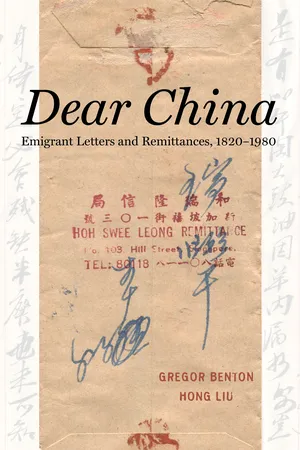
Qiaopi is one of several names given to the “silver letters” Chinese emigrants sent home in the nineteenth and twentieth centuries. These letters-cum-remittances document the changing history of the Chinese diaspora in different parts of the world and in different times.
Dear China is the first book-length study in English of qiaopi and of the origins, structure, and operations of the qiaopi trade. The authors explore the characteristics and transformations of qiaopi, showing how such institutionalized and cross-national mechanisms helped sustain families separated by distance and state frontiers and contributed to the sending regions’ socioeconomic development. Dear China contributes substantially to our understanding of modern Chinese history and to the comparative study of global migration.
- 304 pages
- English
- ePUB (mobile friendly)
- Available on iOS & Android
eBook - ePub
About this book
Information
1

The Genealogy of Qiaopi Studies
In recent years, histories of migration and overseas settlement have been increasingly written, in part, from migrants’ correspondence. Edited collections of migrants’ letters have appeared, particularly in the United States and Australia. However, this has been conspicuously less the case for some ethnic groups—in particular, non-white groups—than for others. Most of the better-known anthologies and studies written from letters concern richer, better-educated white emigrants.1
In China, however, curators have collected far more migrants’ letters, absolutely and proportionately, than anywhere else in the world, generally dwarfing the efforts of their non-Chinese counterparts, including in the European countries that have fed global white migration for the last few hundred years. This achievement is all the more surprising given that China was, until recently, very poor and is still a developing country. We know of no other developing nation that has assembled an archive anywhere near as big as China’s, even proportionately.
Why are the collections of white emigrants’ letters smaller, less representative, and less comprehensive than the Chinese archive? The difference is partly due to the efforts of Chinese archivists in collecting and preserving these materials, and to the fact that the outflow of migrants from China dwarfed that from most other countries throughout much of modern history.2 However, there are several other facilitating circumstances for China’s lead that are worth exploring as hypotheses in a comparative, cross-cultural perspective that may shed more general light on special features of Chinese social science and data collection. The hypotheses are as follows.
One hypothesis is that overseas Chinese seem, in certain periods, to have written home more often than other emigrants. From 1947 to 1949, Shantou alone received more than five million letters, including 140,000 in December 1947.3 In 1955, at the height of China’s isolation, officials estimated that half a million letters per month passed between families in South China and Chinese overseas, about the same volume, proportionately, as some comparable documented groups, but greater than many.4 This is an unexpected finding, since a far greater proportion of Chinese migrants than those of other nations were laborers, overwhelmingly without writing skills or the letter-writing habit.5 One obvious reason for the large number of letters to China is that the Chinese homeland tie remained more vibrant than that of emigrants who were less subject than Chinese to discriminatory treatment and exclusionary laws overseas, with their letters as its measure. This was especially true of the Chinese in North America, who, as Madeline Hsu noted, “eagerly returned the gaze of their qiaoxiang compatriots, in part because they faced such severe rejection in their lives overseas.”6 Studies of other emigrant groups suggest that those who wrote home were likely “to have a higher than average propensity to return,” while those who sank roots overseas wrote less often or stopped writing.7 Overseas Chinese, too, nativized abroad, but at a slower rate than other groups, chiefly because fewer Chinese women emigrated than women of other nationalities.
Another hypothesis is that the kin of Chinese emigrants have done more to preserve the letters because of the special value placed in China on the written word. This sacred regard for characters on paper was magnified by the families’ honoring of those engaged in enterprises of communal value, including going abroad on behalf of those left behind, and their keeping the tie documented.
Moreover, China’s dense kinship institutions and clan associations and its relatively intrusive system of local government in recent times are good at mobilizing the resources necessary for realizing a scheme like the Qiaopi Project. Chinese officials at the local level are also driven to do so by Marxist ideology, which favors “mass history.” The campaign to persuade families to make their qiaopi over to the authorities and to coax collectors into donating or copying them is waged in the local press and by researchers descending on the village to do “field work.”8 Emigrants’ families, the letters’ owners, are easier to identify in China than elsewhere. Today emigrants hail from all over China, but in the past most came from a handful of counties that specialized in emigration, whereas in metropolitan countries they were drawn from a wider spread of places. The emigrants’ communities in China are more rooted than elsewhere, and family papers are more likely to survive than in more mobile societies. In the People’s Republic, family members of overseas migrants and one-time migrants who return to China have a collective official status, that of “domestic Overseas Chinese,” which is registered in their personal files and makes them easier to trace.9 So their geographic concentration and higher visibility is another reason why letter caches have been easier to find in China.
Finally, a factor special to China is the revival in popularity of stamp collecting since Mao died in 1976. Today, China has twenty million philatelists, more than a third of the world’s total, and fifty thousand government-sponsored philatelic societies.10 Philatelists have held exhibitions both in China and abroad, where the price of qiaopi has shot up at auctions.11 Philatelists collect not just stamps but “covers” (franked addressed envelopes) and the correspondence they contain. The qiaoxiang are a treasure house of historic covers and their collectors an unusual ally of archivists seeking to hunt down emigrants’ correspondence. This development can be seen as a special application of the Chinese Communist tradition of “mass-based” investigation, a legacy of one of the “native” branches of China’s official historiography employed in the drive to collect qiaopi, whereby officials of local bureaus for overseas-Chinese affairs and village elders are mobilized to visit families and to put pressure on philatelists to make their finds publicly available to appropriate archives.12
Without the combination of market forces and official propaganda, it is doubtful whether qiaopi would have survived as a substantial historical resource. In the past, before they became saleable, not everyone accorded them equal respect. Some qiaopi were allowed to rot or crumble or to become food for grubs and termites. While few emigrants’ direct dependents or descendants would treat the qiaopi impiously, generational depth is a relative concept, more relevant in some classes and families than in others. Despite the adages about “brooks without a source” and pride in ancestry, Chinese families (as opposed to lineages) rarely tend to revere ancestors more than four generations above the living head.13 Over the years, millions of qiaopi were received in China, but only a small fraction survives. The rest, one must surmise, were thrown out after the sender’s death, probably during a New Year spring-clean. There are even reports of qiaopi being used for kindling during the famine of 1959–61, when firewood was in short supply.14
QIAOPI STUDIES AND THE RISE OF SOCIAL AND
REGIONAL HISTORY IN CHINA BEFORE 2013
REGIONAL HISTORY IN CHINA BEFORE 2013
The growing interest in the qiaopi collection reflects changing trends in scholarship in recent years, particularly in China but also in parts of Southeast Asia. The focus of the collection, on emigrant communities in the diaspora, at home and overseas, is a welcome confirmation of the turn in Chinese historiography and social studies since the 1970s away from the rigid class approach that once ruled these disciplines, as well as a turn toward a scholarship based on evidence rather than employed to illustrate general principles.
The Qiaopi Project mirrors major changes in attitudes in China and its qiaoxiang over the past years. Between 1949 and the 1980s, few Chinese worked on ethnic and migrant Chinese communities abroad or their reciprocators in the sending regions, partly because of the stigmatization, climaxing in the Cultural Revolution, of social groups with “foreign” ties. For a long time, most of the research on Chinese communities overseas was done by non-Chinese nationals (including some of Chinese descent), and for many years it was far smaller in volume than the worldwide research on the “white” role in the great migrations.15
The rise of Overseas Chinese studies in China after the 1970s was a major factor in the global transformation of this scholarship. This happened because China-based researchers paid greater attention to ties to the qiaoxiang, which they studied less from the top down than from the bottom up, from the grass-roots point of view of local associations and local families. This approach was in part a legacy of Communist China’s tradition of mass-based, “on-the-spot” investigation.16 Chinese scholars had better access than foreign researchers to local records in China, as well as the language skills necessary for reading them. Whereas non-Chinese scholars looked in on Chinese communities from the outside, as objects of research, studies by Chinese scholars had the potential to become subject-centered and to show empathy with emigrants, an exercise in “native anthropology” whereby researchers study communities with which they share ties, interests, and languages. All these factors combined to focus attention, largely for the first time, on the Chinese emigrant community’s own output, ranging from the publications and records of clan associations to correspondence from diaspora to hometown and back.
As the restrictions on scholarship in China fell away in the 1980s, new methods of study and new attitudes were popularized. Scholarship became not only more diverse but more local as monolithic models weakened in all spheres. This localism interacted with the strengthening of regional identities as the Chinese economy also “localized.” Economic growth in the qiaoxiang and the strengthening of contacts with overseas Chinese created a material base for the funding of new regional studies in which the overseas Chinese role was often paramount. This paved the way to a new approach to migration studies in China that looked beyond class to the mentalities that drive emigrants. It also helped shift the attention of students of migration from the nation-state and the provinces, which had long been the dominant framework of its construction, to its deepest and most fundamental level, in villages, lineages, and families.17
These trends coincided with the emergence of new directions in Western ethnic and migrant studies. In the 1970s scholars increasingly rejected the view of ethnicity as a closed and static property reflecting cultural inheritance, and identified it instead as an outcome of the interplay of context and ethnic interaction, in which migrants and natives use the contrasts that arise in the course of everyday interethnic contact as markers of their own ethnic self-identification. Identity came to be viewed not as static but as protean, ethnic boundaries not given but constructed. So the emphasis switched from culture to identity, engendering a new interest in the active agency of the creative subject with its narratives and imaginings. In the 1990s transnational studies emerged, with its focus not on the emigrant group in isolation but on its interactions with the diaspora and the homeland.18 These new trends were imported to China by Chinese returning from abroad and by the non-Chinese researchers that began arriving in China in ever greater numbers in the 1980s and 1990s. Both trends jibed with the switch in China to a radically new view of ethnic and migrant Chinese, not as inert things or a descriptive category but as makers of their own history.
This new Chinese research not only brings new and previously unexplored issues into focus but will enrich the voluminous literature that has emerged in the West since the 1990s on transnational Chinese migration. Most of this literature lacks an international and comparative angle, as do the studies that have appeared in China written from Chinese archives. Many Western studies on Chinese emigration and overseas settlement are based on statistical data, chiefly economic and demographic, derived from official sources and viewing emigrants from an etic perspective—from the outside and above. The new Chinese research is into history from below, an emic perspective on the “people without history,” and its focus on transnational as well as domestic networks goes beyond the conventional nation-state paradigm and helps further a new approach to ethnic and migration studies based on the idea of “inbetweenness”—the real...
Table of contents
- Title Page
- Copyright
- Contents
- List of Maps and Tables
- Foreword by Wang Gungwu
- Acknowledgments
- Introduction
- 1. The Genealogy of Qiaopi Studies
- 2. The Structure of the Qiaopi Trade and Transnational Networks
- 3. The Qiaopi Trade as a Distinctive Form of Chinese Capitalism
- 4. Qiaopi Geography
- 5. Qiaopi and Modern Chinese Economy and Politics
- 6. Qiaopi, Qiaoxiang, and Charity
- 7. Qiaopi and European Migrants’ Letters Compared
- Conclusions
- Appendix: Selected Qiaopi and Huipi Letters
- Glossary
- Notes
- References
- Index
Trusted by 375,005 students
Access to over 1.5 million titles for a fair monthly price.
Study more efficiently using our study tools.
Frequently asked questions
Yes, you can cancel anytime from the Subscription tab in your account settings on the Perlego website. Your subscription will stay active until the end of your current billing period. Learn how to cancel your subscription
No, books cannot be downloaded as external files, such as PDFs, for use outside of Perlego. However, you can download books within the Perlego app for offline reading on mobile or tablet. Learn how to download books offline
Perlego offers two plans: Essential and Complete
- Essential is ideal for learners and professionals who enjoy exploring a wide range of subjects. Access the Essential Library with 800,000+ trusted titles and best-sellers across business, personal growth, and the humanities. Includes unlimited reading time and Standard Read Aloud voice.
- Complete: Perfect for advanced learners and researchers needing full, unrestricted access. Unlock 1.5M+ books across hundreds of subjects, including academic and specialized titles. The Complete Plan also includes advanced features like Premium Read Aloud and Research Assistant.
We are an online textbook subscription service, where you can get access to an entire online library for less than the price of a single book per month. With over 1.5 million books across 990+ topics, we’ve got you covered! Learn about our mission
Look out for the read-aloud symbol on your next book to see if you can listen to it. The read-aloud tool reads text aloud for you, highlighting the text as it is being read. You can pause it, speed it up and slow it down. Learn more about Read Aloud
Yes! You can use the Perlego app on both iOS and Android devices to read anytime, anywhere — even offline. Perfect for commutes or when you’re on the go.
Please note we cannot support devices running on iOS 13 and Android 7 or earlier. Learn more about using the app
Please note we cannot support devices running on iOS 13 and Android 7 or earlier. Learn more about using the app
Yes, you can access Dear China by Gregor Benton,Hong Liu in PDF and/or ePUB format, as well as other popular books in Storia & Storia cinese. We have over 1.5 million books available in our catalogue for you to explore.