![]()
Dick Traum and David Cordani
01
ABOUT DAVID & DICK
DAVID’S STORY:
Family and Persistence
The power of a well-meaning, extended community, connected by common beliefs and commitments, has certainly been a driving force in my life. My appreciation of a supportive community goes back to my youth.
When I was a young boy in Waterbury, Connecticut, my family lived with my paternal grandparents, so I grew up with the equivalent of two sets of parents. We were a close-knit family and I never wanted for anything. We also had nine relatives – aunts, uncles, cousins – living on our street, and we all looked out for each other. Everybody worried about everybody. And everybody took care of everybody. For me, the sense of community around the extended family unit was a part of my DNA.
That didn’t make my teen years easy, though. I was never a great athlete, but I was always scrappy. I was the overweight kid (being overweight then wasn’t as common among children as it is today). I was the last kid to make the basketball team, and even then, I spent most of my time sitting at the end of the bench. I stewed over that a bit. I wanted to be in the game and worked hard in practice to earn even a few minutes of playing time!
The experience taught me a lot about aspirational goal-setting, though as a boy, I certainly didn’t call it that.
The truth is, I didn’t like to sit at the end of the bench. I wanted more and I wanted to be better. Maybe this was the beginning of my ambition – both personal and professional. I just knew I did not want to sit on the sidelines – not there, not anywhere. So, I worked hard in practice to become a valuable player on the court, and my attitude was scratch, claw and get better every day. I made the team. And from there, whenever I achieved a goal, I set my sights on the next goal. I was always willing to ask for help from the talented and committed people around me, and I found that doing the hard work enabled me to reach my goal.
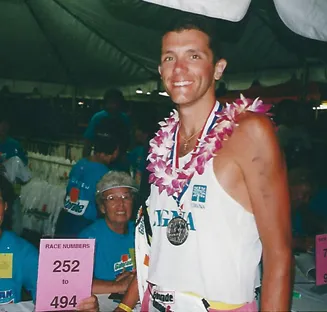
David Cordani at the 1995 Ironman Hawaii
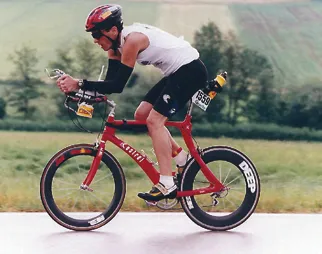
David Cordani at the 1999 Ironman Germany
As the work began paying dividends, I embraced physical activity in a passionate way. I started running in college to lose weight, and I played a lot of intramural basketball. I lost weight, but I wound up injuring my knees. Well, that was discouraging – until one day, after several visits to the doctor, I watched the annual Hawaiian Ironman World Championship on television in which athletes swim 2.4 miles, bike 112 miles and run a marathon (26.2 miles) in that order and without a break. In a moment of what others may have seen as self-delusion, given my knees, I said, “I want to do that someday.” Then, despite doctor’s orders, I started running again.
One problem, though. In 1991, which happened to be the same year I joined Cigna, I couldn’t even run a single mile. But I wanted to do better, and I recommitted myself. I started to build my distance capacity, running races, marathons and triathlons – first, at shorter distances referred to as “sprint triathlons,” and then eventually, Olympic-scale triathlons. Three years later, when I was 28, I ran my first half-Ironman. Or tried to.
After an outstanding swim and a great bike ride, I under estimated the size and impact of the half-marathon distance that followed. Before I knew it, I was under hydrated and under nutritioned, and at mile four, with more than nine miles to go, I blew up in an epic way.
Total dehydration.
Total dysfunction.
Then I pulled off one of the dumbest stunts ever known to Iron-mankind.
I walked into the woods, found a patch of grass and fell asleep (yes, you read that right), arguably the worst thing to do when you’re dehydrated, dysfunctional and losing your sensibilities. Fortunately, I woke up, got back onto the course, and walked – turning a 4:45 estimated finish time into a six-hour journey. Bent over with exhaustion, I said to myself, “I will never compete in another half-Ironman. And the Ironman? Total pipe dream.”
By the time I drove the three painful hours home, I had sorted through the things I had done wrong. I underestimated the magnitude of the event. I didn’t ask other competitors for their help or insights in my practice and preparation. And when all the signals were screaming at me to adjust along the way, I missed every one of them. I blew through all the indicators.
Others would later explain how the heat and humidity caused my body to act differently than it did normally, and they told me about the importance of hydration and nutrition en route. (I still think that’s the most underestimated part of any endurance event.)
This setback – my greatest failure among the well-in-excess of 125 triathlons I’ve ever attempted – became my best learning. I had to do better. With the support of other triathletes, I prepared again. I finally completed a half-Ironman less than one year later, and went on to complete the Hawaiian Ironman in 1995 – the very race that motivated me to get off my couch.
Of note is that in Hawaii, I saw athletes who were in far superior condition, curled up in a ball on the roadside and in the lava fields. Dehydration, lack of nutrition: I had seen that before!
These were crucial lessons – ones I continue to return to time and again. When I work with athletes today, I teach them about the importance of having a community and extended family around you, watching for signals that you need help, and making adjustments and keeping your eyes open for indicators along the way.
As I look back, I had set a goal even though one could argue I had no “right” to set such a high goal. You see, I had never been an accomplished swimmer, cyclist or distance runner. There was no rationale that supported why my attempt at my first half-Ironman could possibly be successful. I realized how falling short of a goal can be a harsh reminder of the value of having a solid plan in place that enables you to get there.
Fortunately I was surrounded by a supportive community of like-minded people who strengthened my resolve. Failure under those circumstances would never be an option. So, building and maintaining a foundational community – the family dynamic, whether through blood relatives or “acquired” family – have always been foremost in my mind.
DICK’S STORY:
Achievement, Spirit and the Joy of Giving
I’ve witnessed that ‘special sauce’ that compels people to act. It’s the feeling of self-actualization that drives our achievements. I’ve seen mountain climbers forging a crevasse to conquer a summit and Ironman participants drawing from every last ounce of energy to reach the finish line. I strongly believe we all have an innate instinct – a quiet, internal voice – that speaks to us, and drives us. I think of it as our spirit.
My own spirit of achievement started very early. At age three, I built a great giant block building. Later I collected the largest number of books for donations at Hunter College Elementary School in New York. By my early teens, I had earned the Most Valuable Player track and field award in a seventh- and eighth-grade competition and medaled as a ninth-grader in a high school wrestling tournament.
Perhaps the largest jolt came in my junior year at the Horace Mann School in New York when I wrestled a world-class competitor who had placed in the Olympic trials the year before. After being taken down and almost pinned during the first period, I bridged and turned him over on his back. This was my greatest physical effort ever, and I was amazed that this world-class athlete was almost helpless on his back. The crowd was screaming and cheering for me from the sidelines – something I had never experienced before. What a buzz! On the school spirit scale, this was a 10.
The first period was over and the referee never called it a pin, although even today I recall that many sitting in the stands thought he should have. I ultimately lost the match to a better opponent, but I felt like a hero.
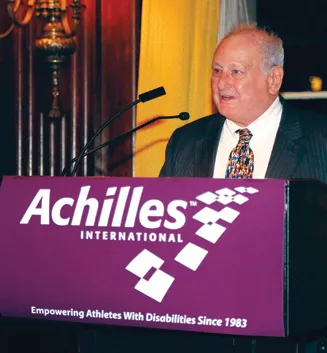
Dick Traum speaking at Achilles event
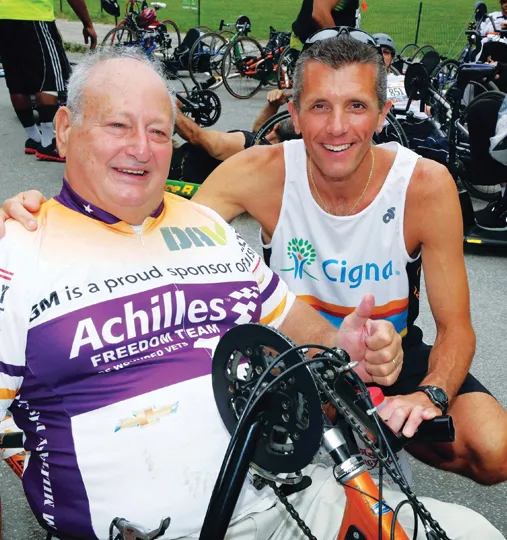
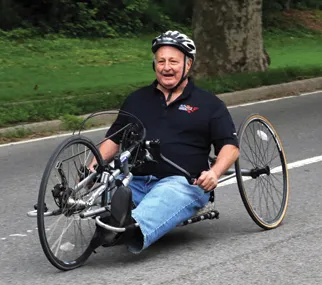
Dick Traum riding handcycle
That was one example of a key lesson I’ve learned about myself throughout my life. First, I really enjoy achieving. I associate success with the affection I receive from it. Moreover, at a very young age when I collected those books for donation, I learned about the joy of giving. Again, I associate it with the positive interactions that resulted.
This was, perhaps, the genesis of how David McClelland’s theory of needs influenced my life. A famed American 20th-century psychologist, McClelland spent much of his career working on his acquired-needs theory, and how our needs are shaped by our lifetime experiences. McClelland classified our needs into three categories: achievement, affiliation and power. For me, at an early age, the need to achieve was clearly a driving force in my life.
But life sometimes has other plans for us.
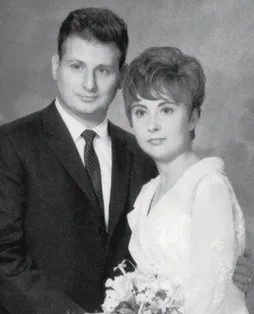
Dick and Betsy Traum on wedding day
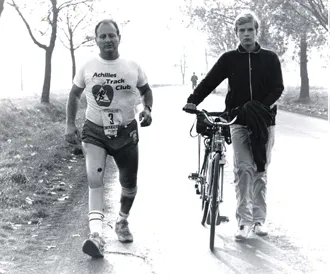
Dick Traum becomes first amputee to finish 100km ultra-event, Poland, 1980s
We all have a road-not-taken tale to tell, and sometimes we have no control over the storyline. When I was 24, my fiancée and I drove out of New York to meet her friends in Philadelphia. I remember it well: Sunday, May 30, 1965. Memorial Day weekend. On the spur of the moment, we decided to stop for gas on the New Jersey Turnpike near Camden, N.J., rather than wait until we reached Philadelphia. In the words of Robert Frost, that has made all the difference.
My fiancée went to the ladies’ room and I stood behind the car while it was getting fueled. A second car pulled up behind me and as the driver tried to open his right front door, it became stuck. His car, still in drive, began moving toward me. The driver slammed on the pedal. But it was the gas pedal instead of the brake. He hit me so hard that the impact broke the radiator on his Chrysler and moved my car, which was in park, several feet. Six days later, my crushed right leg was amputated above the knee. My left leg and my life were saved. The surgeon told me that I was dead for about 30 seconds. He also said that if I had been over 40, I would not have survived.
But I did survive and learned a great lesson at age 24: Life isn’t forever. During my rehabilitation period, I had lots of time to think. I recall a man’s life expectancy was around 73 years. So, in theory, at 24, roughly one-third of my life already had passed.
If you consider the 73 years a male of my generation was expected to live, my first third comprised...