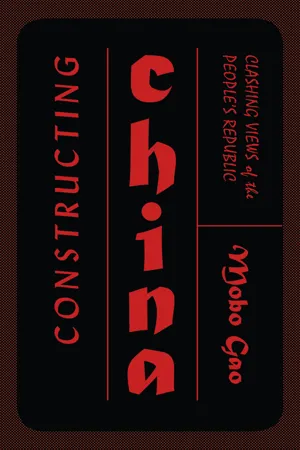
From fear and anxiety, to celebration, China's rise has provoked a variety of responses across the world. In light of this phenomenon, how are our understandings of China produced? From West to East, Mobo Gao interrogates knowledge production; rejecting the supposed objectivity of empirical statistics and challenging the assumption of a dichotomy between the Western liberal democracy and Chinese authoritarianism. By examining issues such as the Chinese Neo-Enlightenment and neoliberalism, national interest vested in Western scholarship, representations of the Great Leap Forward and the Cultural Revolution, and the South China Sea, the book asks: how is contemporary China constructed? By dissecting the political agenda and conceptual framework of commentators on China, Gao provocatively urges those not only on the Right, but also on the Left, to be self-critical of their views on Chinese politics, economics and history.
- 304 pages
- English
- ePUB (mobile friendly)
- Available on iOS & Android
eBook - ePub
About this book
Information
1
Scholarship, National Interest and Conceptual Paradigm
INTRODUCTION
Scholarship is not only historically complex but also contingent upon national interest, geopolitics and, no less significantly, upon a conceptual and intellectual paradigm at any specific time and space. The conceptual paradigm that frames CCP-led China as a totalitarian or dictatorial regime (Ringen 2016b) is still prevalent today. The Chang and Halliday claim (2005) that Mao was an evil monster who killed 70 million Chinese with pleasure is just one extreme example.
Not surprisingly, many serious scholars on China don’t take Chang and Halliday seriously (Benton and Lin Chun 2009), but the “true” knowledge produced by Chang and Halliday has spread far and wide, and has been taken seriously not only, reportedly, by US President George W. Bush but also the last Governor of Hong Kong Chris Patten, who was later to be honored as the chancellor of Oxford University. One of the most credible media outlets, the BBC, applauded the book; the broadsheet paper The Australian listed Chang and Halliday’s book as a 2005 Book of the Year; and journalist Nicolas Rothwell declared that “reading the book about the twentieth century’s most bloodstained dictator was a litmus event” and that he “cannot recall finishing a book that inspired in me such sharp feeling of nausea, horror and despair” (Rothwell 2005: R5). One of the book’s reviewers calls it “a work of unanswerable authority” and claims that Mao “is comprehensively discredited from beginning to end in small ways and large, a murderer, a torturer, an untalented orator, a lecher, a destroyer of culture, an opium profiteer, a liar” (Hensher 2005). “China’s Monster, Second to None” is the title of a reviewer of Chang and Halliday in the authoritative New York Times (Kakutani 2005). Another authoritative Western media outlet, the German Der Spiegel, endorsed Chang and Halliday, as did the influential British political commentator William Hutton (Hutton 2005) and the veteran London School of Economics scholar Michael Yahuda (2005).
The book by Chang and Halliday as a history or biography of Mao is a fraud (Gao 2008). But why do so many intelligent and clever people endorse such a blatantly flawed book? The answer lies not only in national interests, transnational interests and the leftovers of Cold War discourse, but also in the “truths” of the social sciences and humanities that are in fact constructed narratives. Those who position themselves for certain national and transnational interests tend to believe in certain kinds of stories. It is the interaction of cerebral inclination with certain stories that formulates a conceptual paradigm that frames scholarship.
HARARI, TRUMP, NATIONALISM AND GLOBALISM
In his TED Talk, Yuval Noah Harari (2017) declares that twentiethcentury Left versus Right politics is outdated and that now it is globalism versus nationalism. Harari argues, I think rightly, that all the major problems today are global, such as climate change, genetic engineering and unemployment—not due to Chinese migrant workers, but due to robots. Therefore nationalism will not work. Referring to the phenomenon of the current US President Donald Trump’s constant utterances of “untruth,” Harari argues that there is no such thing as post-truth in the era of Trump, because there have never been truths that are not constructed and there have never been truths that are not confined to human understanding at any specific time and space. As evidence Harari refers to the Bible. The only difference now as opposed to the past, is that the truth, or untruth in the Trump era, is not told by the established elite who think they naturally have the epistemological right to knowledge, but by a vulgar and unintellectual buffoon who can do this against all global gravity because of modern technology. Not very much unlike Mao during the CR, Trump avoided the normal taken-forgranted intellectual and media hierarchy by going straight to address “the masses” via Twitter.
However, it appears that the very clever buffoon is not a globalist but a nationalist, at least according to his utterances. This is the problem: while the solutions to all of the major issues require a globalist approach, especially in the powerful and domineering knowledge-producing West, issues seem to be more nationalist. It is an irony, not expected by many even a couple of years ago, that China under the leadership of Xi Jinping is even called upon to lead the world globally on climate change. Hasn’t the Chinese government been accused of using nationalism to boost its legitimacy by almost all of the commentators almost all ofthe time?
US SCHOLARS AND US NATIONAL INTEREST
The most recent US think tank cum academic report on how to deal with China is a good case study of how scholarship is intertwined with national interest (Schell and Shirk 2017). The report was a result of a large undertaking involving many prominent US scholars including Orville Schell, Susan Shirk, Thomas J. Christensen, Elizabeth C. Economy, Andrew J. Nathan, David Shambaugh as well as Jeffrey A. Bader, David M. Lampton, Douglas H. Paal., J. Stapleton Roy and Michael D. Swaine, though the latter group were not listed as authors of the report. On top of that there are a number of think tank specialists who used to be in important US government positions such as Charlene Barshefsky, the former US trade representative, and the chief trade negotiator and principal trade policymaker for the US, Kurt M. Campbell, a former assistant secretary of state for East Asian and Pacific affairs, and Winston Lord, a former US ambassador to China.
The project also involved many prominent external experts including Joseph S. Nye Jr. and Roderick MacFarquhar of Harvard University; Henry M. Paulson from the Paulson Institute; Mickey Kantor of Mayer Brown, Barry Naughton and Peter Cowhey from the University of California, San Diego; Wendy Cutler from the Asia Society Policy Institute; Jeffrey I. Kessler of WilmerHale; Dennis Blair of the Sasakawa Peace Foundation, USA; Graham Webster of Yale University Law School; Harold J. Newman, Asia Society trustee; Kenneth Jarrett at the US Chamber of Commerce in Shanghai; and Alan Beebe of AmCham China.
Of the long-term issues—energy and climate change, global governance, Asia Pacific regional security, North Korean nuclear threat, maritime disputes, Taiwan and Hong Kong, human rights, defense and military relations, trade and investment relations—considered by the Task Force project, the report makes six major recommendations as priorities for the Trump administration:
1. North Korea: give up nuclear capabilities or face sanctions.
2. Prioritize US commitment to its allies, Japan and South Korea, and revival of the Trans-Pacific Partnership (TPP).
3. Trade with China: focus on job losses because of China, unfair trading and the need to “level the playing field.”
4. South and East China Seas: China is assertive, the US should remain territorially neutral but maintain freedom of navigation plus an active US presence in the area, and should ratify the UN Convention on the Law of the Sea.
5. “Respond to Chinese Civil Society Policies that Harm US Organizations, Companies, Individuals, and the Broader Relationship,” such as severely restricting (and in some cases block) US think tanks, non-governmental organizations, media outlets, and Internet companies from operating freely in China.
6. Take over leadership of the climate change issue.
In the context of what I aim to do in this chapter, there are a number of interesting points about the report’s recommendations. To start with, let us look at the North Korean issue. Surely, North Korea will not launch a nuclear war with either South Korea, Japan or the US. The only rationale that one can think of is that North Korea wants to have nuclear weapons and launching facilities as a deterrent. It is North Korea that is afraid of aggression. Therefore, all the US and its allies need to do to maintain peace is to make a firm commitment that they would not invade North Korea unless and until North Korea makes the first move in aggression. It is very much in the media of the “international community” to support the US policy on North Korea by portraying its leader as a mad person, a crazy lunatic who certainly does not know what North Korea’s national interest is.
When the Task Force project was in progress there was no envisioning of another mad man who would oppose the TPP in the name of the US national interest. Trump actually got elected on the promise of getting rid of the TPP. So does that mean Trump and his supporters do not know what the US national interest is? In fact the then seemingly more promising presidential candidate, Hillary Clinton, also disowned TPP, at least orally in her election campaign. To blame US unemployment on China is one of the most attractive slogans of the Trump team. One wonders why the elite in this group, the elite for which Trump and his supporters are supposed to have contempt for, share this sentiment with the latter. For most Chinese, and probably most people in developing countries, there has never been “a level playing field” for them. If and when they can gain a point or two in the law of the jungle it is the result of their sheer hard work and possibly avenging determination. The rules have been made by the developed countries in global organizations like the World Trade Organization (WTO), the International Monetary Fund and the World Bank, and it took China more than ten years to negotiate with the US to enter the WTO; one major member of this report was the chief US representative in these long and hard negotiations. One of the most stringent conditions for a developing country have been imposed on China’s entrance to the WTO. Now the report claims that the field is not level. One should be reminded of what happened in the late nineteenth century in the “new continent”: the Chinese gold diggers could manage to dig out some gold in the mines that had been mined and abandoned by the white miners. The white miners were very upset and screamed “the Chinks steal our gold.” Clearly the truth can be framed differently and knowledge can be produced according to one’s interests.
Equally interesting is how the rise of China pushed the US to change the rules of the game, when one reads recommendation four: it was of US national interest to ignore the UN Convention on the Law and Sea until China asserted its claim of sovereignty over the SCS. Finally, there is an urge for the US to take over the leadership on climate change. It does take some leadership globally to solve the issue of climate change, as argued by Harari in his TED Talk. However, China has not claimed to hold the leadership position on this or on any other issue. Most of the time since Deng Xiaoping has been in power, China has been trying to figure out what the Big Brother wants. Surely, a recommendation of a multilateral and more collaborative approach to climate change would have been better.
Another point is the question of who funded the project and why. The Task Force that produced this report involved a number of institutions, including the Center on US–China Relations founded in 2006 based in New York; the 21st Century China Center established in 2011 at the University of California, San Diego; the Annenberg Retreat at Sunnylands, also known as the “Camp David of the West,” a non-profit foundation which convenes leaders in southern California and other locations for high-level meetings to address serious issues facing the nation and the world, including the 2013 summit between President Obama and President Xi of the PRC and the 2016 US-ASEAN leaders summit; the Carnegie Corporation of New York; the Henry Luce Foundation; the Janet and Arthur Ross Foundation; and Harold and Ruth Newman. The institutions involved, and the individual contributors, are a mixture of academic and think tank centers, an indication of how the production of knowledge is not something concerning the ivory towers of scholarship anymore, if it was ever the case.
What also has to be noticed is the acknowledgment of the hospitality shown by “our friends at Oxford University, in particular Rana Mitter at the China Centre and Timothy Garton Ash at St. Antony’s College.” Appreciation of “the Japanese and South Korean consulates in New York City and their respective embassies in Washington, DC for … fact-finding missions to Tokyo and Seoul” is also acknowledged. The absence of any “Chinese” academic or Chinese involvement in the project is understandable on the basis that this is not a task force that provides recommendations on how to engage with China but how to deal with China. The preface of the report states that one assumption is “inherent in this report—that it is in the national interest of the US to strive, if possible, for stable and mutually beneficial relations with China, and to maintain an active presence in the Asia-Pacific region.” How do you have mutually beneficial relations with China to maintain peace and stability in the region if you don’t engage with China? This question is perhaps answered by the wording “if possible.” In other words, if China doesn’t contravene US national interest then there will be peace and stability. The authors of this report are already making concessions for the sake of peace if you compare them with Robert Kagan (Kagan 2017), whose Foreign Policy article headline is “Backing Into World War III: America Must Check the Assertive, Rising Powers of Russia and China Before It’s Too Late.”
This Task Force project and its recommendations are worthy of study for two main reasons. The first reason is that there is a tangible shift in conceptualization of how to deal with China. In other words, new knowledge needs to be and is being produced. The second reason is that it reveals how closely scholarship is related to what is perceived and conceived to be the national interest. Only the naïve Chinese anti-Maoist and anti-Communist “liberals” still hang on to the story of universal truth beyond national interest, as will be demonstrated in later chapters.
NATIONAL INTEREST AND MEARSHEIMER
It has either been taken for granted or specifically argued that US national interest in particular and Western interest in general serves the interest of the international community. Western hegemony is interpreted as maintaining international rule-based order and providing a public good. This is biblical knowledge of the post-World War II world. In the words of Pei Minxin, a US scholar of Chinese background, popular among the Western media because of his neoliberal critique of China, the West has the capacity to maintain the international rule-based order and provide global public goods (Pei 2017). Globalism is Americanism, which is good for everyone, as this shrewd metaphor exemplifies: Freedom’s McDonald Golden Arch Gate flattens the globe. This epistemological truth is articulated strongly by Mearsheimer, the US realist international relations scholar:
It is often said that the international relations (IR) scholarly community is too American-centric and needs to broaden its horizons. I disagree. In the mid-1970s, Stanley Hoffmann called IR an “American social science.” That label was appropriate then, and it is still appropriate today especially with regard to all the important ideas and theories that dominate discourse in our discipline. This situation is not likely to change significantly anytime soon and for entirely legitimate and defensible reasons. Indeed, students inside and outside of the United States seem to read the same articles and books and for the most part employ the same concepts and arguments … I feel intellectually more at home in Beijing than Washington … So, when I speak in China—where there is a deep fascination with American IR theories—I sometimes start my talks by saying, “It is good to be back among my people.” And I do not speak one word of Chinese, although I do speak the same language as my Chinese interlocutors when we talk about the basic realities of international politics. (Mearsheimer 2016)
These fascinating and candid remarks provide enough information for three important points: there is an almost innate assumption that globalism is Americanism; the US dominates the production and consumption of knowledge and is the key to truth; and finally, the Chinese scholarship community is not immune to it.
THE SOAS INCIDENT AND KNOWLEDGE PRODUCTION
The School of Oriental and African Studies (SOAS) of London University hit the headlines in early 2017 when journalists discovered that students, backed by many of their lecturers, had set up a campaign to “Decolonise Our Minds” by transforming the curriculum. The gist of this campaign is that students of Oriental and African studies should study the philosophies and literary cannons of Oriental and African countries as well as that of Western European countries. The event made news headlines because the students dared to suggest decentering the works of Kant, Locke and Smith. That would be the end of the world as we know it.
“They Kant Be Serious!” spluttered the Daily Mail headline in its most McEnroe-ish tone. “PC students demand white philosophers including Plato and Descartes be dropped from university syllabus.” “Great thinkers too male and pale, students declare,” trumpeted the Times. The Telegraph, too, was outraged: “They are said to be the founding fathers of Western philosophy, whose ideas underpin civilized society. But students at a prestigious London university are demanding that figures such as Plato, Descartes and Immanuel Kant should be largely dropped from the curriculum because they are white” (Malik 2017).
What SOAS academics and students in fact argued was that Enlightenment thin...
Table of contents
- Cover
- Title
- Copyright
- Contents
- List of Abbreviations
- Acknowledgements
- Introduction
- 1. Scholarship, National Interest and Conceptual Paradigm
- 2. China, What China?
- 3. Chinese? Who are the Chinese?
- 4. Intellectual Poverty of the Chinese Neo-Enlightenment
- 5. The Coordinated Efforts in Constructing China
- 6. Why is the Cultural Revolution Cultural?
- 7. Why is the Cultural Revolution Revolutionary? The Legacies
- 8. Clashing Views of the Great Leap Forward
- 9. National Interest and Transnational Interest: The Political and Intellectual Elite in the West
- 10. Geopolitics and National Interest I: China’s Foreign Policy and Domestic Politics
- 11. Geopolitics and National Interest II: The South China Sea Disputes
- Bibliography
- Index
Trusted by 375,005 students
Access to over 1.5 million titles for a fair monthly price.
Study more efficiently using our study tools.
Frequently asked questions
Yes, you can cancel anytime from the Subscription tab in your account settings on the Perlego website. Your subscription will stay active until the end of your current billing period. Learn how to cancel your subscription
No, books cannot be downloaded as external files, such as PDFs, for use outside of Perlego. However, you can download books within the Perlego app for offline reading on mobile or tablet. Learn how to download books offline
Perlego offers two plans: Essential and Complete
- Essential is ideal for learners and professionals who enjoy exploring a wide range of subjects. Access the Essential Library with 800,000+ trusted titles and best-sellers across business, personal growth, and the humanities. Includes unlimited reading time and Standard Read Aloud voice.
- Complete: Perfect for advanced learners and researchers needing full, unrestricted access. Unlock 1.5M+ books across hundreds of subjects, including academic and specialized titles. The Complete Plan also includes advanced features like Premium Read Aloud and Research Assistant.
We are an online textbook subscription service, where you can get access to an entire online library for less than the price of a single book per month. With over 1.5 million books across 990+ topics, we’ve got you covered! Learn about our mission
Look out for the read-aloud symbol on your next book to see if you can listen to it. The read-aloud tool reads text aloud for you, highlighting the text as it is being read. You can pause it, speed it up and slow it down. Learn more about Read Aloud
Yes! You can use the Perlego app on both iOS and Android devices to read anytime, anywhere — even offline. Perfect for commutes or when you’re on the go.
Please note we cannot support devices running on iOS 13 and Android 7 or earlier. Learn more about using the app
Please note we cannot support devices running on iOS 13 and Android 7 or earlier. Learn more about using the app
Yes, you can access Constructing China by Mobo Gao in PDF and/or ePUB format, as well as other popular books in Politics & International Relations & International Relations. We have over 1.5 million books available in our catalogue for you to explore.