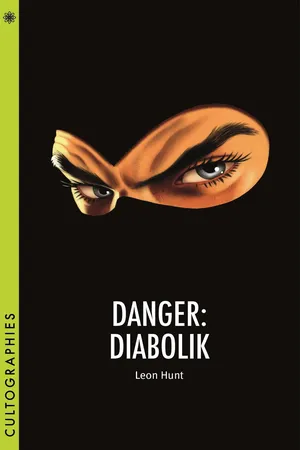
Danger: Diabolik (1968) was adapted from a comic that has been a social phenomenon in Italy for over fifty years, featuring a masked master criminal—part Fantômas, part James Bond—and his elegant companion Eva Kant. The film partially reinvents the character as a countercultural prankster, subverting public officials and the national economy, and places him in a luxurious and futuristic underground hideout and Eva in a series of unforgettable outfits. A commercial disappointment on its original release, Danger: Diabolik's reputation has grown along with that of its director, Mario Bava, the quintessential cult auteur, while the pop-art glamour of its costumes and sets have caught the imagination of such people as Roman Coppola and the Beastie Boys.
This study examines its status as a comic-book movie, including its relation both to the original fumetto and to its sister-film, Barbarella. It traces its production and initial reception in Italy, France, the U.S., and the UK, and its cult afterlife as both a pop-art classic and campy "bad film" featured in the final episode of Mystery Science Theatre 3000.
eBook - ePub
Danger: Diabolik
About this book
Information
Subtopic
Film et vidéo1
FROM FUMETTO NERO TO ‘WILD AND KOOKY CAPE-OPERA’: PRODUCTION, PROMOTION, INITIAL RECEPTION
From 1968 the era of Diabolik begins! The mysterious, audacious, cunning, invincible hero with his magnificent girlfriend. (Italian press ad)
On 4 May 1965, an article in the Rome newspaper Il giornale d’Italia announced that ‘Il momento dei fumetti’ (the moment of comics) had arrived (Patrizio 1965: 9). The arrival of a new filone (a cycle or trend) was discerned in the announcement of three productions – the producer Tonino Cervi was preparing Diabolik, while Dino De Laurentiis and Ducio Tessari respectively were set to make Barbarella and Mandrake the Magician. Tessari’s Mandrake would never come to fruition, and De Laurentiis would later attempt (unsuccessfully) to lure Federico Fellini to Hollywood to film it. The other two projects would be made back-to-back two years later, both arriving on screen in 1968, but it would be a very different version of Diabolik from the one Cervi was planning.
As if to reinforce the impression that the masked thief and the intergalactic sex bomb were umbilically linked from the start, Diabolik and Barbarella were both created in 1962, both part of rather different emergent ‘adult’ comic book cultures. Jean-Claude Forest’s Barbarella, ‘a cross between Flash Gordon and a Brigitte Bardot movie’ (Sabin 1993: 189), was initially serialised in the French V-Magazine before being collected as a graphic album in 1964. It would later be translated into Italian in Linus magazine, a vehicle for auteur-driven comics, while its broader influence in Italy would be felt in a comic book filone devoted to sexually active heroines with increasingly lubricious names. Diabolik, a far tamer affair, was nevertheless the first Italian comic per adulti and the filone it generated – the fumetti neri (black comics), as the press dubbed them – provoked considerable controversy for its violence, cruelty and sexual titillation.
Diabolik was created by the Milanese Angela Giussani (1922–1987), wife of publisher Gino Sansone; she was soon joined by her sister Luciana (1928–2001) as co-writer. ‘I wanted to make gialli for people who could barely read,’ Angela would explain (Curti 2016: 97). The (possibly apocryphal) story goes that she found a discarded Fantômas novel on a train, which gave her the idea of an Italian iteration of the French pulp villain created by Pierre Souvestre and Marcel Allain; the cowled master criminal, the multiple disguises, the perpetually frustrated pursuing police Inspector (Fantômas’s nemesis Juve would become Diabolik’s Ginko). Early stories even borrowed the French setting because they wanted the threat of the guillotine hanging over il re del terrore (the King of Terror), later establishing the geographically non-specific Clerville as Diabolik’s nefarious playground. But inspiration also came from where she found the novel. Diabolik was published in a format that could easily be read on public transport (a 12x17cm pocket format that it still adheres to today) – crime, murder, mystery and thrills consumed during the commute to work. The name had two possible derivations. ‘Diabolic’ was the name of a character in a 1957 giallo novel Uccidevano di notte (They Killed By Night) by Italo Fasan, initially published under the pseudonym ‘Bill Skyline’ and then re-issued the following year under his own name as Diabolic. ‘Diabolich’ had also been the pseudonym used in a series of anonymous letters sent to the police regarding the murder of a Turin factory worker in 1958 (see Gaspa 2012: 32). The name was clearly in the air – the comic mystery thriller Totò Diabolicus was released a few months ahead of the first issue. But the chosen spelling in the comic would strike a chord – ‘il fattore K’ (the K factor) became one of the defining features of the cycle, with Diabolik followed by Kriminal, Satanik, Sadik, Zakimort and Demoniak. The artwork on the first issue was so amateurish that when it was re-issued the following year, new artwork (itself little more than competent) was commissioned. Moreover, the early stories were highly derivative, lifting episodes and storylines virtually intact from the Fantômas novels, such as sending a disguised and drugged substitute to the guillotine in Diabolik’s place in ‘L’arresto di Diabolik’ (First series no. 3 1963). However, that same issue introduced one of the ways in which Diabolik stood apart from his Parisian predecessor. It featured the first appearance of Eva Kant, initially as wicked as the titular master criminal (‘She’s diabolical like me’, muses a clearly smitten Diabolik).3 But Eva quickly became a softening influence, curbing his crueller instincts and, at the same time, gradually becoming as central to the storylines as he was. Diabolik himself evolved into a combination of Fantômas and James Bond – the cowl and disguises of the former, the virile looks and technological modernity of the latter.4 While 007 had his Aston Martin, Diabolik had his black E-type Jaguar, which performed increasingly audacious tricks while evading the police. The Bond films informed the Diabolik comics of the mid-to-late 1960s, particularly Thunderball, with its underwater action, Adolfo Celi villain and pre-credits jetpack escape – Diabolik would don a jetpack and helmet in ‘La morte di Ginko’ (Anno IV no. 16 1965).5
In 1964, the fumetti neri exploded into a full-blown cycle, with the first publication of Kriminal, Satanik, Fantax/Fantasm and Mr X, with Sadik, Zakimort, Spettras, Demoniak and Jnfernal (sic) debuting the following year. Several of these upped the stakes in terms of violence and titillation, such as the scantily clad and curvaceous women who populated the work of writer Max Bunker/Luciano Secchi and artist Magnus/ Roberto Raviola (Kriminal, Satanik). The Giussanis held back from such excesses, placing a growing emphasis on romance as a central component of the comic. A backlash against the fumetti neri began in the press in 1965, followed by a trial in Milan that led to the prosecution of several publishers in 1967. This is an important part of the context for il momento dei fumetti. Comics were big news because of their visible shift in Europe towards an adult readership, because pop art had given the medium a rather ambivalent cultural capital (simultaneously important and ephemeral) and because of the controversy aroused by the fumetti neri. A film of Diabolik must have seemed like a no-brainer for an ambitious producer like Tonino Cervi, the head of Italy Film, who bought the rights from the Giussanis’ publishing company Astorina for 20 million lire (Curti and Di Rocco 2014: 23). But the King of Terror was to face an even tougher challenge than that posed by his indefatigable nemesis, Inspector Ginko.
PRIMO COLPO: THE CERVI-HOLT DIABOLIK
Cervi was no stranger to prestige, his productions including Antonioni’s Il deserto rosso (1964) and the multi-director episode film Boccaccio ’70 (1962), but observed in interviews that he had enjoyed more critical than commercial success (Minuzzo 1965: 11). Diabolik was seemingly designed to rectify that, while also being more affordable than his preferred project, Flash Gordon. Cervi referred to Diabolik as ‘a modern Fantômas’ (ibid.), and the original Lord of Terror had returned to the screen the previous year in the first of a trio of comic adventures, Fantômas (1964). Cervi had a very particular conception of the character and, like De Laurentiis after him, wanted to tone down the violence and cruelty. Diabolik would be a sophisticate who read Freud and Nietzsche. A much-quoted line of dialogue would supposedly have him say, ‘I’m waiting for James Bond so that I can show him up’. Moreover, he would only kill other criminals and steal from the rich. ‘In a certain sense,’ claimed Cervi, ‘Diabolik is a social executioner’ (Dessy 1965: 13). This notion of Diabolik as an outsider-rebel would be picked up by the De Laurentiis-Bava Diabolik, albeit as less of a cultural sophisticate than a countercultural prankster.
The film was an Italian/French/Spanish co-production with a budget of 500 million lire and a shooting schedule that included shooting in Italy, Spain, Mexico and the US. Dino De Laurentiis’ main involvement was as distributor, but he also provided a 70 million lire advance (Curti and Di Rocco 2014: 23). Cervi initially placed an ad in the comic (‘L’artiglio del demonio’, Anno IV no. 9, 1965) seeking an unknown to play the lead. The requirements for the part were entirely physical – ‘handsome and masculine face – clear eyes – minimum height 1.8 metres – athletic build’. Was this mainly a publicity stunt or did Cervi really think that the cowl might allow an unknown to play the role? In any case, he was soon aiming rather higher. Alain Delon was announced as the preferred choice: ‘Alain Diabolik’ was the headline of a story in Big magazine (Dessy 1965), accompanied by a still of the French heartthrob wearing a balaclava in Mélodie en sous-sol (1963). But Cervi settled instead for Jean Sorel – essentially a more affordable Delon – and he was announced as the lead in late July of 1965. For the part of Eva, Cervi had wanted Virna Lisi, seemingly perfect for the role of an elegant blonde originally modelled on Grace Kelly’s character in Hitchcock’s To Catch a Thief (1955). When she proved to be unavailable, he made a rather less obvious choice, Elsa Martinelli, who was dressed and made up to look even less like her comic book counterpart than she did already.
The director assigned to the film was Seth Holt, a capable genre director whose filmography included two stylish thrillers for Hammer. A Taste of Fear (1960) was shaped by some of the same influences that would be found in many Italian gialli, most noticeably Clouzot’s Les Diaboliques (1955), and he had just completed The Nanny (1965) with Bette Davis. The latter is worth bearing in mind, given some of the stories in the Italian press regarding his slow pace – one called him ‘the tortoise director’, claiming that he took a month and a half to shoot eight minutes of film (Anon. 1966a: 43) – and problems created by his drinking. Holt is known to have been an alcoholic, and Diabolik was not the last of his films to be abandoned – two years later, Monsieur Lecoq met a similar fate. But there is no evidence that his drinking had troubled the films he made for Hammer (although he died during his third film for them, Blood from the Mummy’s Tomb (1971)). As the production ran aground, the press reported clashes between ‘the phlegmatic Englishman’ and the ‘Italian in trouble’ (Anon. 1966b: 42). Rumours abounded, from lack of money, Cervi trying to force Holt to quit in order to claim the insurance, and a drunk Holt refusing to speak to the actors (Sorel allegedly corroborated the latter). According to Curti and Di Rocco (2014: 25), it was De Laurentiis who intervened, shutting the production down on the grounds of the supposed poor quality of the footage he had seen. The French and Spanish distributors withdrew amidst recriminations, not least from Jean Sorel, who threatened legal action, feeling that it was he, not James Bond, who had been shown up.
Like any lost or abandoned film, the Cervi-Holt Diabolik continues to fascinate, to assume a romantic aura that would almost certainly not exist if the film had been completed, or if it was possible to see the jettisoned footage. Judging by Curti and Di Rocco’s invaluable account (2014), the script promised little more than a paracinematic curio. Diabolik flies through the air with the aid of a jetpack-like device (2014: 27), while Inspector Ginko is entirely absent, and there seems to be little evidence of the sophistication Cervi and Sorel talked about. While some of the stills of Martinelli, wearing a black plastic raincoat and knee-length boots and holding a gun in a 007-style pose, suggests an action-oriented take on the character, this isn’t supported by Curti and Di Rocco’s account of the script.6 One aspect of the comic, however, that seems stronger in the Cervi-Holt Diabolik than the De Laurentiis-Bava one is the titular character’s penchant for disguises and the technology he uses to execute them – pull-on latex masks, rather than the wig, glasses and false beard that John Philip Law briefly uses, the latter more reminiscent of René Navarre’s easily-seen-through disguises in Louis Feuillade’s silent Fantômas serials. What the two versions seemingly have in common is a greater emphasis on eroticism than the comic ever exhibited, to the extent of actual nudity in the Cervi-Holt film. But if the script suggests that De Laurentiis performed a mercy killing, the surviving black and white stills (the actual film was being shot in colour) have taken on a cultish existence of their own. They have a dreamy quality that could be mistaken for a lost Feuillade serial or even a surrealist take on the character. While he looks less impressive in the mask than John Philip Law (who claims to have won over Bava with his ability to arch his eyebrows in the right manner), Sorel cuts a suave figure without it. If the script wasn’t quite selling the idea of a sophisticated gentleman-thief, photos of the actor without cowl and bodysuit indicate that Sorel certainly was. The Italian press were noticeably less interested in John Philip Law than they had been in Sorel, shifting their attention to Marisa Mell as Eva. Martinelli, on the other hand, seems miscast on every level, not helped by a bizarre and unflattering black fright wig seemingly designed to mirror the widow’s peak of her partner. However, Anna Battista (2012b) discerns a not inappropriate resemblance to Irma Vep, the catsuit-clad criminal played by Musidora in Louis Feuillade’s silent serial Les Vampires (1915), itself another iteration of the Fantômas narrative which Feuillade had already adapted. One might also detect a touch of Modesty Blaise in some of the stills.
SECONDO COLPO: THE DE LAURENTIIS-BAVA DIABOLIK
Both the re-launched Diabolik and Barbarella were co-productions between Dino De Laurentiis Cinematografica (Rome) and Marianne Productions (Paris). The Franco-Italian cinematic relationship was a particularly strong one – between 1950 and 1965, there were 764 co-productions between the two countries (Wagstaff 1998: 76). French-Italian co-productions embody a ‘soft’ or what Mette Hjort calls affinitive transnationalism, ‘the tendency to communicate with those similar to us’ when choosing international partners (2010: 17). Diabolik’s comic book source might be seen as Franco-Italian in essence, while there are scenes in Barbarella that wouldn’t look out of place in a Bava film (the sinister biting dolls, the labyrinth). Paramount’s role as distributor was first announced in L’araldo dello spettacolo on February 7 1967 as part of their programme for 1967–69, and they provided some of the funding for the film. But their publicity campaign suggests that this was slightly less familiar territory for them.
Diabolik’s cult reputation is inextricable from that of Mario Bava. Peter Hutchings suggests that the elevation of Bava largely took place after his death, particularly when his films became available on home media, but also paralleling developments in ‘cult, paracinematic and trash-based’ approaches to film studies (2016: 80). But Bava by this point already had a reputation amongst French film critics, as we shall see when looking at the film’s reception. Hutchings rightly observes, however, that the ‘cult’ Bava (Bava the outsider auteur) tends to obscure the way he is ‘more obviously situated within a particular industrial context’ (2016: 81). Alberto Pezzotta (2013) is wary of a purely auteurist approach for similar reasons in his book on the director. The industrial context of Diabolik is harder to ignore than in some other Bava films because it is well known that the higher budget and a producer with his own vision of the film brought certain pressures to bear on a director who, while he probably held little expectation of final cut – more often, a variety of cuts – usually seemed to at least be accustomed to a degree of autonomy on set as long as he met certain commercial requirements. According to John Philip Law, Bava and De Laurentiis had rather different conceptions of the film. The producer wanted ‘a cosmopolitan super-production for family viewing, with an elegant, worldly thief, something like Raffles’, while the director envisioned ‘a dark, violent, very Italian film. In th...
Table of contents
- Cover
- Series Page
- Title Page
- Copyright
- Contents
- Acknowledgements
- Introduction: Diabolik, chi sei?
- 1. From fumetto nero to ‘wild and kooky cape-opera’: Production, promotion, initial reception
- 2. ‘Uh-oh – it’s getting groovy!’: The cult afterlife of Danger: Diabolik
- 3. Fantômas all’italiana: Analysis
- 4. Genius of Crime: The place of the film
- Notes
- Bibliography
- Index
Trusted by 375,005 students
Access to over 1.5 million titles for a fair monthly price.
Study more efficiently using our study tools.
Frequently asked questions
Yes, you can cancel anytime from the Subscription tab in your account settings on the Perlego website. Your subscription will stay active until the end of your current billing period. Learn how to cancel your subscription
No, books cannot be downloaded as external files, such as PDFs, for use outside of Perlego. However, you can download books within the Perlego app for offline reading on mobile or tablet. Learn how to download books offline
Perlego offers two plans: Essential and Complete
- Essential is ideal for learners and professionals who enjoy exploring a wide range of subjects. Access the Essential Library with 800,000+ trusted titles and best-sellers across business, personal growth, and the humanities. Includes unlimited reading time and Standard Read Aloud voice.
- Complete: Perfect for advanced learners and researchers needing full, unrestricted access. Unlock 1.5M+ books across hundreds of subjects, including academic and specialized titles. The Complete Plan also includes advanced features like Premium Read Aloud and Research Assistant.
We are an online textbook subscription service, where you can get access to an entire online library for less than the price of a single book per month. With over 1.5 million books across 990+ topics, we’ve got you covered! Learn about our mission
Look out for the read-aloud symbol on your next book to see if you can listen to it. The read-aloud tool reads text aloud for you, highlighting the text as it is being read. You can pause it, speed it up and slow it down. Learn more about Read Aloud
Yes! You can use the Perlego app on both iOS and Android devices to read anytime, anywhere — even offline. Perfect for commutes or when you’re on the go.
Please note we cannot support devices running on iOS 13 and Android 7 or earlier. Learn more about using the app
Please note we cannot support devices running on iOS 13 and Android 7 or earlier. Learn more about using the app
Yes, you can access Danger: Diabolik by Leon Hunt in PDF and/or ePUB format, as well as other popular books in Médias et arts de la scène & Film et vidéo. We have over 1.5 million books available in our catalogue for you to explore.