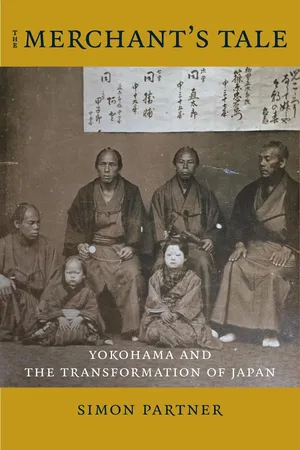
In April 1859, at age fifty, Shinohara Ch?emon left his old life behind. Ch?emon, a well-off farmer in his home village, departed for the new port city of Yokohama, where he remained for the next fourteen years. There, as a merchant trading with foreigners in the aftermath of Japan's 1853 "opening" to the West, he witnessed the collapse of the Tokugawa shogunate, the civil war that followed, and the Meiji Restoration's reforms. The Merchant's Tale looks through Ch?emon's eyes at the upheavals of this period.
In a narrative history rich in colorful detail, Simon Partner uses the story of an ordinary merchant farmer and its Yokohama setting as a vantage point onto sweeping social transformation and its unwitting agents. Ch?emon, like most newcomers to Yokohama, came in search of economic opportunity. His story sheds light on vital issues in Japan's modern history, including the legacies of the Meiji Restoration; the East Asian treaty port system; and the importance of everyday life—food, clothing, medicine, and hygiene—for national identity. Centered on an individual, The Merchant's Tale is also the story of a place. Created under pressure from aggressive foreign powers, Yokohama was the scene of gunboat diplomacy, a connection to global markets, the birthplace of new lifestyles, and the beachhead of Japan's modernization. Partner's history of a vibrant meeting place humanizes the story of Japan's revolutionary 1860s and their profound consequences for Japanese society and culture.
- English
- ePUB (mobile friendly)
- Available on iOS & Android
eBook - ePub
About this book
Information
Subtopic
19th Century HistoryIndex
History1 OUT OF THIN AIR (1859–1860)

FIGURE 1.1 The route from Kōshū to Edo and Yokohama. Map prepared by author
ON THE KŌSHŪ HIGHWAY
If we could travel back in time to April 3, 1859, we might see two travelers walking briskly along the Kōshū Kaidō highway absorbed in animated conversation. They are carrying packages strapped to their backs, wrapped in large pieces of indigo cloth knotted at the chest and waist. They wear conical hats to ward off sun and rain, and, like most travelers on the road, they wear simple straw sandals on their feet. Their cotton robes are hitched above the knees for ease of movement and to protect them from the mud of the road; their legs are tightly wrapped in cotton leggings.
Woodblock prints of Japan’s five major highways (the Tōkaidō, Nakasendō, Nikkō Kaidō, Kōshū Kaidō, and Ōshū Kaidō) allow us to imagine the appearance and surroundings of these travelers. On either side of the wide, well-swept dirt road farmers are busy puddling rice fields in preparation for the spring planting, pruning their fruit trees and mulberry bushes, or pulling heavy wooden plowshares through the fallow wheat and cotton fields. The road is lined in some places with mature pine trees, in others with wooden stalls offering goods and refreshments to the passersby: a cup of tea poured over rice and sucked down sitting on a low wooden bench, straw sandals at a few mon for the pair, a bag of dried fruits, or a handful of roasted chestnuts. In the distance on all sides is a ring of mountains, those in the foreground green with tea and mulberry fields, the high mountains behind still white with snow. To the south, towering over them all like a god in the land of giants is the massive white cone of Mount Fuji.
Our travelers’ names are Gorōemon and Chūemon. The suffix “-emon” was originally a marker of rank reserved for the court aristocracy in Kyoto, but over time the urban and rural classes appropriated it, and by now it was in common use among farmers, merchants, and townsmen. The same is true of the travelers’ shaved heads and topknots: they were originally the style of the warrior class but are now almost universal—the exceptions being monks and the very poor—differing only in the degree of grooming. Well-tended men like Chūemon have their hair dressed once or twice a week, shaving their scalp smooth and oiling their hair before fastening it in a tight knot on the crown.
These men are not young. Chūemon is fifty, a considerable age for an era in which the average life expectancy is still in the thirties. “Compared with the world of the Buddhas, a man’s fifty years are but a dream.”1 But Chūemon is still very much in the flow of life. His deeply tanned face is a little lined, a little weather-beaten. But it is a handsome face, delicate featured with a small upturned nose, high cheekbones, and large, well-shaped ears. He is a trim, spare man, with fine, long-fingered hands. His age and his self-confidence give him a certain dignity, in spite of his simple traveling clothes.

FIGURE 1.2 Keisai Eisen, Kōnosu, from the series Sixty-Nine Stations of the Kiso Kaidō (ca. 1835–1840). Courtesy of Richard Kruml, http://www.japaneseprints-london.com/
For farmers like Chūemon, this is a busy time of year. The spring silkworm-rearing season is about to begin, cotton and wheat are going into the ground, and the paddies must be prepared for the May rice planting. The slack season is in the winter, a time when people who can afford it go on trips to hot springs or to visit relatives in Edo.
But Chūemon is leaving his son to manage the farm. He has an important mission that requires his presence elsewhere. Chūemon, a provincial farmer from the mountain-ringed province of Kōshū, is on his way to Edo, the capital of the Tokugawa shoguns, to request permission to open a shop in a town that does not yet exist, to begin trading with foreigners who might never arrive, in a language he does not understand or speak, and in commodities for which there is no proven demand.
Who is this man, and what has set him off on this surprising mission?
Chūemon’s village, Higashi-Aburakawa, was one of hundreds that sprawled across the Kōshū tableland, a small but heavily populated and strategically important region in the mountains west of the shogunal capital. Although the region is surrounded by mountains, it offers benign conditions for agriculture. At an elevation of only a thousand feet, its soil is enriched by the volcanic minerals and abundant water resources of the turbulent mountains. Encircled as it was, it trapped sunshine and heat, giving it a longer growing season than most regions and lending it to the cultivation of warm-weather crops such as fruit and cotton. Kōshū was also one of the leading silk-producing districts in Japan. “What did you receive as souvenirs from Kōshū?” went a local folk song, “Striped silk and dried grapes.”2
In the 1850s, the villages in the western part of the tableland, including Higashi-Aburakawa, specialized in cotton, while those to the east grew mulberry for silkworm cultivation. Fruit cultivation, including grapes, apples, persimmons, pomegranates, peaches, and pears, was carried out in specialized clusters of villages. Kōshū’s famous grapes, for example, were grown in villages near the highway post station of Katsunuma.3 In addition, farmers grew a variety of other commercial crops, including tobacco, nuts, and vegetables, as well as rice, grains, and vegetables for home consumption.
This land had close ties to Edo and to the shogunate. Until the sixteenth century Kōshū was the stronghold of the powerful Takeda family, whose most famous leader, Takeda Shingen, was a contender for national hegemony. However, in 1575 Shingen’s son Katsuyori was crushed by Oda Nobunaga and Tokugawa Ieyasu, and since the turn of the seventeenth century the Tokugawa family had ruled Kōshū province. In spite of its violent beginning, their rule was for the most part benevolent. As a directly controlled territory of the Tokugawa shogunate, Kōshū was governed by three daikan, or governors. The Isawa daikan had jurisdiction over the area surrounding Kōfu, which included Higashi-Aburakawa.
Higashi-Aburakawa was a village of forty families, situated in the crook of two rivers, the Fuefuki and its tributary, the Aburakawa. The entire village was no more than one hundred acres in extent. Like much of the Kōfu basin, the district was prone to flooding when the snows melted and the rainy season came in early summer. Even in the 1950s, Chūemon’s great-great-grandson Shinohara Yukio recalls having had to paddle to school in a boat when the roads were inundated. But the rivers also brought abundant irrigation and the promise of fertile soil and good crops.
This was perhaps the kind of community that Francis Hall had in mind when he wrote in 1865 of the prosperous villages of the Edo hinterland, villages where “there were no signs but those of peaceful industry and content, each hamlet to all intents a little republic by itself, knowing little and caring less for the outside world; to whom a change of rulers or revolution in the State would have no significance as great as the death of their own nanooshi or headman—people who know no oppression because they feel none, whose lives have fewer disturbing elements, perhaps, than any other people on whom the sun in its daily revolution falls.”4
But appearances could be deceptive. In Higashi-Aburakawa, as in most villages of the Kantō and surrounding areas, the benefits of the land were hardly shared by all. In Higashi-Aburakawa, seven families controlled 72 percent of all the village’s agricultural production, while twenty-six families had between them just 12 percent. Unable to feed themselves from their land, these marginal families survived by hiring themselves out for day labor, sending their children into service, and finding whatever employment they could to feed those they could not send away. The most prosperous families, on the other hand, had enough to live a comfortable life, to educate their children, to travel, to experiment with new agricultural methods, or invest in new business opportunities. These were the families that Chūemon grew up with: the Okamura family, who were Chūemon’s in-laws (he had married the daughter of Okamura Kanpei); the Komazawa family, whose heir, Buzaemon, was one of Chūemon’s closest friends and collaborators; and the wealthy Yamashita family, whose heir, Matsujirō, was to be one of Chūemon’s close business associates.
Chūemon’s own family, the Shinohara, was not the wealthiest in the village. Their five acres of land put them in the ranks of the haves, but at least four other families had greater holdings. But their landholdings and associated business activities did lend them status as a part of the local elite—the gōnō class, that group of wealthy farmers who were to play such an influential role in the political and economic life of Japan for the rest of the nineteenth century. As a member of this class, Chūemon had political obligations and privileges: his family was one of the designated nanushi (headmen) of the village. This hereditary position rotated in Higashi-Aburakawa between families, and the Shinoharas usually took the position in alternate years. Chūemon’s membership in the gōnō class also made him a part of a densely connected network of men of similar background throughout the region. These were men whose ties transcended village boundaries. As a class they socialized, they intermarried, they studied together and implemented agricultural and other reforms, and together they invested their surplus capital in an increasingly vigorous regional network of commercial enterprise.
Although firmly grounded in agriculture, the economy of the Kōshū region had become highly commercialized over the past century. The region’s agricultural abundance, its position on the periphery of the Kantō Plain, and its long-standing ties to the shogunal administration all made it a natural supplier to the rapidly growing consumer market in Edo. After the devastating wars of the sixteenth century, Edo had become the political center of the regime of the Tokugawa family of shoguns. As a political measure, all Japan’s daimyo—feudal lords—were required to reside in Edo in alternate years, and their wives and children were required to live there permanently. This concentration of Japan’s wealthiest barons and their samurai retainers generated growing demand for the artisans and commercial houses that supplied their needs. By the mid-eighteenth century, Edo was among the biggest cities in the world, with a population of more than one million and a vibrant urban consumer culture.
Kōshū supplied Edo and the regional centers that grew up around it with agricultural staples such as rice and wheat, as well as with specialty products like grapes, tobacco, cotton, and silk. By the mid-nineteenth century, most farmers with access to mulberry gained extra income by cultivating silkworms. Some would add a little extra value at home by unspooling the cocoons and reeling silk thread. Some even produced woven silk cloth. Many sold their cocoons to the commercial houses of Kōfu and other local towns, where an industry had grown up spinning and weaving silk and cotton. The final product was shipped down the Kōshū highway to the silk market in Hachiōji on the Kantō Plain or directly to one of the licensed silk wholesalers in Edo. As a result of these developments, many farming families made more income fro...
Table of contents
- Cover
- Series List
- Title Page
- Copyright
- Dedication
- Contents
- List of Tables and Illustrations
- Notes on the Text
- Acknowledgments
- Introduction
- 1. Out of Thin Air (1859–1860)
- 2. Years of Struggle (1860–1864)
- 3. Prosperity (1864–1866)
- 4. Transformation (1866–1873)
- Conclusion: The Power of a Place
- Tables
- Notes
- Bibliography
- Index
Trusted by 375,005 students
Access to over 1.5 million titles for a fair monthly price.
Study more efficiently using our study tools.
Frequently asked questions
Yes, you can cancel anytime from the Subscription tab in your account settings on the Perlego website. Your subscription will stay active until the end of your current billing period. Learn how to cancel your subscription
No, books cannot be downloaded as external files, such as PDFs, for use outside of Perlego. However, you can download books within the Perlego app for offline reading on mobile or tablet. Learn how to download books offline
Perlego offers two plans: Essential and Complete
- Essential is ideal for learners and professionals who enjoy exploring a wide range of subjects. Access the Essential Library with 800,000+ trusted titles and best-sellers across business, personal growth, and the humanities. Includes unlimited reading time and Standard Read Aloud voice.
- Complete: Perfect for advanced learners and researchers needing full, unrestricted access. Unlock 1.5M+ books across hundreds of subjects, including academic and specialized titles. The Complete Plan also includes advanced features like Premium Read Aloud and Research Assistant.
We are an online textbook subscription service, where you can get access to an entire online library for less than the price of a single book per month. With over 1.5 million books across 990+ topics, we’ve got you covered! Learn about our mission
Look out for the read-aloud symbol on your next book to see if you can listen to it. The read-aloud tool reads text aloud for you, highlighting the text as it is being read. You can pause it, speed it up and slow it down. Learn more about Read Aloud
Yes! You can use the Perlego app on both iOS and Android devices to read anytime, anywhere — even offline. Perfect for commutes or when you’re on the go.
Please note we cannot support devices running on iOS 13 and Android 7 or earlier. Learn more about using the app
Please note we cannot support devices running on iOS 13 and Android 7 or earlier. Learn more about using the app
Yes, you can access The Merchant's Tale by Simon Partner in PDF and/or ePUB format, as well as other popular books in History & 19th Century History. We have over 1.5 million books available in our catalogue for you to explore.