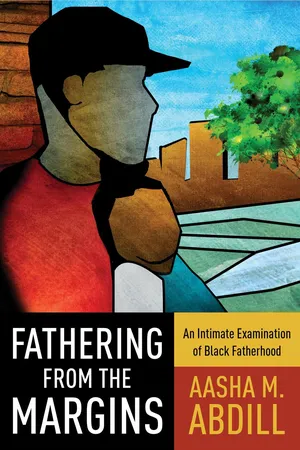
Despite a decade of sociological research documenting black fathers' significant level of engagement with their children, stereotypes of black men as "deadbeat dads" still shape popular perceptions and scholarly discourse. In Fathering from the Margins, sociologist Aasha M. Abdill draws on four years of fieldwork in low-income, predominantly black Bedford-Stuyvesant, Brooklyn, to dispel these destructive assumptions. She considers the obstacles faced—and the strategies used—by black men with children.
Abdill presents qualitative and quantitative evidence that confirms the increasing presence of black fathers in their communities, arguing that changing social norms about gender roles in black families have shifted fathering behaviors. Black men in communities such as Bed-Stuy still face social and structural disadvantages, including disproportionate unemployment and incarceration, with significant implications for family life. Against this backdrop, black fathers attempt to reconcile contradictory beliefs about what makes one a good father and what makes one a respected man by developing different strategies for expressing affection and providing parental support. Black men's involvement with their children is affected by the attitudes of their peers, the media, and especially the women of their families and communities: from the grandmothers who often become gatekeepers to involvement in a child's life to the female-dominated sectors of childcare, primary school, and family-service provision. Abdill shows how supporting black men in their quest to be—and be seen as—family men is the key to securing not only their children's well-being but also their own.
- English
- ePUB (mobile friendly)
- Available on iOS & Android
eBook - ePub
About this book
Trusted by 375,005 students
Access to over 1.5 million titles for a fair monthly price.
Study more efficiently using our study tools.
Information
Subtopic
African American StudiesIndex
Social SciencesCHAPTER ONE
Misunderstood
The Significance of Race and Place in Understanding Black Fatherhood
At the center of Brooklyn’s Bedford-Stuyvesant community is the New Bed-Stuy Boxing Center, which has been there ever since I can remember. Although I have peered into its dark interior many times, I have never gone inside. To the eyes of a child, it always seemed private and a little dangerous—a place where only men entered. Above the boxing center is a childcare center. Every weekday, little feet run to the entrance at the side of the building to go upstairs to school. Although the boxing and the childcare centers could not be physically closer, the two worlds are far apart socially. Or so we once thought. This book reexamines the perceived distance between two social worlds. One world consists of low-income black men, solitary figures connected only to each other; the other world consists of low-income black children in urban America, “fatherless” offspring connected primarily to their single mothers.
Over the last fifty years, statistical trends on family structure have corroborated the view that few children in low-income black communities live with their fathers. Indeed, the percentage of children living with fathers has steadily declined since the 1980s (Coles 2009), and though this trend crosses racial and socioeconomic lines, low-income black biological fathers are much less likely to live with their children than are other fathers (Eggebeen 2002). Thus, a snapshot of a low-income black community flooded with fathers accompanied by their children seems paradoxical. Nonetheless, a walk around the Bed-Stuy community today will reveal such a picture.

On any given day in Brooklyn’s Bedford-Stuyvesant community, an observant walker will pass by men with their children, pushing strollers, holding little hands, or buying chips and a “quarter water” from the corner store.1 At first the observer is likely to be slightly surprised as she tries to reconcile this observation with what she has come to believe about black fathers in urban neighborhoods—namely, that not many of them are involved as parents. Upon asking old men sitting on crates in front of the park, the staff at neighborhood childcare centers, and even the fathers themselves about the increasing presence of fathers in public, she hears, “Now that you mention it, I have noticed more men with their children, but …”
Despite the growing body of evidence in scholarly literature that black men are as likely—and in some cases more likely—to be involved with their children when controlling for residence, the public continues to think of black fathers as absent and uninvolved. In December 2013, a report published by the Centers for Disease Control and Prevention (CDC) based on data from 2006 to 2010 found that involvement of fathers in various childcare activities was similar across races. In certain activities, rates for black fathers rose above those of white and Hispanic fathers. Although the report’s leading author played down the higher levels of involvement among black men (Tanner 2013), many newspaper articles and blogs zeroed in on the racial implications of the findings, pointing out that they defied stereotypes. Comments posted by readers in response to the findings were a mixed bag, but many expressed surprise, disbelief, or suspicion regarding the findings. On the other hand, a considerable number of people stated that the study was long overdue and proved what they already knew from personal experience.2
Why is there a huge discrepancy between what scholars studying families have known for at least a decade and what the average individual believes to be true? What explains the variations in people’s perception of the validity of the CDC study? An immediate explanation lies in the media’s long-standing production of stereotypical images of absentee, deadbeat, and lazy black fathers (Coles and Green 2010; Edin and Nelson 2013). While we now know that residence is a poor construct for measuring involvement, many older scholarly works that significantly influenced the discourse on the fathers of black families relied on the nonresidential status of black men as confirmation of the absence of father-child relationships in black communities. Based on residential data from the 1960s, Moynihan ([1965] 1981) predicted that if black men were not given employment opportunities, their families would be forced to assume a matriarchal structure that would contribute to a “tangle of pathology.” As Moynihan noted,
In essence, the Negro community has been forced into a matriarchal structure which, because it is so out of line with the rest of the American society, seriously retards the progress of the group as a whole, and imposes a crushing burden on the Negro male and, in consequence, on a great many Negro women as well. There is, presumably, no special reason why a society in which males are dominant in family relationships is to be preferred to matriarchal arrangement. However, it is clearly a disadvantage for a minority group to be operating on one principle, while the great majority of the population, and the one with the most advantages to begin with, is operating on another. This is the present situation of the Negro. Ours is a society which presumes male leadership and rewards it. A subculture, such as that of the Negro American, in which this is not the pattern, is placed at a distinct disadvantage.…
Obviously, not every instance of social pathology afflicting the Negro community can be traced to the weakness of the family structure.… Nonetheless, at the center of the tangle of pathology is the weakness of the family structure. Once or twice removed, it will be found to be the aberrant, inadequate, or anti-social behavior that it did not establish, but now serves to perpetuate the cycle of poverty and deprivation. (29–30)
While Moynihan’s argument emphasized the negative impact of unemployment on black men and their families, it also adhered to the gendered cultural norms of family roles.
Even at a time when women had long since entered the labor market, Moynihan, like much of American society, could still not envision a world in which the father’s contribution to the family was not fundamentally economic in kind. This American doxa3 left black men in an especially precarious position. Given the ideological assumption that fathers were, first and foremost, employed men, how could black families survive, let alone overcome the consequences of poverty? The division of labor in American families left little room for decoupling gender from household roles. Constrained by hegemonic masculine ideology, men were generally not encouraged to take on familial roles deemed feminine, such as nurturer and caretaker. Yet they were also structurally locked out of the breadwinning role; this was Moynihan’s cautionary tale. Thus, black men were left without a role to play in their families. Structural inequality limited their economic provision while cultural ideology constrained their caretaking.
The inability of many black men to assume the role of provider in the household may have pushed many to the edge of the household unit. Yet these relationships were not always completely severed, as we may have been led to believe, informed by the pervasive images of absent and deadbeat fathers in black communities. Just as black men have been forced to teeter at the edge of society but have managed to exist both inside and outside mainstream culture, so too have many of them learned to teeter at the edge of their families. We have learned a little about the various strategies that black men adopt in their roles as workers (Newman 1999; Sullivan 1989; Williams and Kornblum 1985) and students (Ferguson 2000; Fordham and Ogbu 1986). We have learned a lot about their strategies with women (Anderson 1992, 1999; Hannerz 1969; Liebow 1967; Stack 1974), but we have paid relatively little attention to the varying strategies they employ with their families and children.
WHAT WE KNOW FROM THE ACADEMIC LITERATURE
The growing trend of fathers not living with their children may arguably be one of the factors driving the surge of research in the areas of fatherhood and fathering practices over the last twenty years. Modern American society has gradually come to grips with the realization that its families are less likely to assume the traditional nuclear form—that is, with employed fathers and stay-at-home mothers. Instead, families are taking on ever more complex and variable forms, such as single-parent households, blended stepfamilies, and same-sex partnerships (Stacey 1990). Family forms have also become more mutable, often varying in structure over the course of a child’s life.
Residential status may appear to be a simple measurable construct, but it proves to be more complex due to frequently changing household compositions—the results of divorce or separation—over the course of a child’s life. Measuring residential status among poor families with unmarried parents poses additional challenges, as these men often divide their time between multiple residences (Coley 2001, 745). While there is some indication that black fathers may be better at navigating the challenges of living away from the home and maintaining involvement with children, nonresidence is a formidable barrier to sustaining an emotional attachment between father and child that often begins at the “magic moment” of a child’s birth (McLanahan et al. 2003). Although paternal involvement generally drops sharply after a cohabiting relationship ends, such a decline is less dramatic among African American fathers (Edin, Tach, and Mincy 2009). Researchers claim that these trends suggest that the fathering role outside of marriage may be more strongly institutionalized in the black community and that black fathers may have better coping mechanisms or models in place to deal with nonresidential fatherhood.
Paternal residence is only one way of measuring father involvement—one whose flaws and limitations have often been noted in scholarship (Coles and Green 2010; Mott 1990). Although black fathers are much more likely to be nonresident than white or Hispanic fathers, they visit their children more often and maintain involvement longer than nonresident white fathers (Coley and Chase-Lansdale 1999; Huang 2006; King 1994). There is also some evidence that within the category of married men, black fathers are more likely to be involved in childcare duties and household chores than their white counterparts (Ahmeduzzaman and Roopnarine 1992; Landry 2000).
There is uncertainty about whether black fathers have always been as involved with their children as fathers of other races, or if their involvement has been increasing. This uncertainty can be attributed to the fact that academic study of fathers, in general, is of fairly recent origin (Goldberg, Tan, and Thorsen 2009), and academic study of black fathers has been even more limited. Additionally, household composition may not always be reported truthfully in low-income households due to fears about eligibility for welfare and other benefits. A study of urban African American families found a 23 percent discrepancy rate between daughters’ and mothers’ reports of the residency status of the father or father figure (Coley 2001, 745).
Academically, much of what we know about black men has come from qualitative work. Qualitative studies of the black community documented how men who could not perform the breadwinner role abandoned all roles or offered negligible support to their families (Clark 1965; Liebow 1967; Rainwater 1970). In addition to being locked out of employment opportunities, these men found that roles of a primarily domestic nature were also untenable. Unemployed black men could not contribute to their families in a socially acceptable manner, and black women were obligated to assume the roles of both provider and caretaker.
Attempts to zero in on the roles of black men in the lives of their children focus on relatively small subsets, such as single custodial fathers or married fathers who remain the heads of their households (Coles 2009; Connor and White 2006). Hamer (2001) addresses the nonresidential circumstances of many black fathers, but her study, like the ones on married men and single custodial fathers, does so outside a community context. Hamer’s adoption of an ecological framework to approach her analysis allows a rich and grounded analysis of fathering behaviors and strategies among black men. The interview method, however, of eighty-eight black fathers from across the United States constrains her ability to uncover ecological explanations at a community level. Ethnographies and community studies are appropriate for situating black fathers and their relationships with their children within an ecological framework that allows us to understand fathering relationships within their dynamic environment.
There is a rich tradition of ethnographic studies on families in urban black communities. Many classic studies identified fathers as largely absent or peripheral to tasks such as childcare and household work (Clark 1965; Hannerz 1969; Liebow 1967; Martin and Martin 1978; Rainwater 1970). Liebow documented in detail fathers who had abandoned their roles, and in one chapter, entitled “Fathers Without Children,” depicted the average relationship between fathers and their children as severed. Liebow notes, “Looking at the spectrum as a whole, the modal father-child relationship for these streetcorner men seems to be one in which the father is separated from the child, acknowledges his paternity, admits to financial support irregularly, if at all, and then only on demand or request. His contacts with the child are infrequent, irregular, and of short (minutes or hours) duration” (1967, 78). Many ethnographers mention fathers as being around sporadically, but do not elaborate in detail on what sporadic fathering relationships involve.4 Stack (1974) offers a version of the sporadic relationship between men and their children and found that the father’s relationship to the child was secondary to the child’s relationship with the mother. Stack gives men and their kin credit for their caretaking role, and presents a harmonious picture of mothers who see the fathers of their children as friends, whom they recruit for help when necessary.5 Stack’s ethnography does not fully discuss what happens when fathers are not seen by mothers as friends, but as enemies or obstacles. Both men and women in the Flats, the community where Stacks conducts her ethnographic research, accept the peripheral nature of men to their families including the second-degree relationship between fathers and their children.
Portrayals of black men as distant from families and separate from their children were easily confirmed for ethnographers by the urban landscape. Seeing the men loitering on the corner or in front of buildings, classic and contemporary ethnographers documented them as they frequently existed in public, painting simple pictures of them either on their own or with other men. As Liebow observed, however, there is a wide range of relationships between a man and his biological children: “The spectrum of father-child relationships is a broad one, ranging from complete ignorance of the child’s existence to continuous, day-by-day contact between father and child. The emotional content of the relationships ranges from what, to the outside observer, may seem on the father’s part callous indifference or worse, all the way to hinted private intimacies whose intensity can only be guessed at” (1967, 73).
Many urban ethnographies present a community landscape in which fathers and children are seldom seen together.6 Nonetheless, the presented landscape of a black urban community usually confirmed a dearth of father-child relations among local residents. As Anderson (1992) noted, “To visit certain streets of Northton is to see a proliferation of small children and women, with fathers and husbands largely absent or playing their roles part time” (129). Anderson (1999) portrays a similar setting: “The summer streets are populated by these children and sometimes their mothers, grandmothers, older sisters, and female cousins” (28).
Behind closed doors, and cloaked in the privacy of family life, fathers and mothers negotiate their responsibilities in the family. Financial provision, childcare management, and household chores are all subject to bargaining and are influenced by both practical necessity and beliefs regarding family roles. Families whose economic circumstances do not enable them to follow the prescribed roles that they value are forced to eschew these principles and negotiate roles that suit their practical needs. This ongoing and often contentious process of negotiation is not easily accessed by those outside the family. If privately negotiated roles do not match public expectations, one option is to hide private roles from public eyes. Liebow alludes to how paternal behaviors may go unseen: “Since father and child are seldom together outside the home, it is in the home that casual gestures bespeaking paternal warmth and tenderness are most likely to occur” (1967, 80).
Valentine (1978) documented that men often actively hid with their family’s assistance, which contributed to public perception of these men being absent from households:
A feature of family organization that is often cited as especially characteristic of Black people and Black Communities is the female-headed household. In Blackston we found such households not to be very common. For reasons related to welfare eligibility, such households are often over-reported to welfare workers and other official collectors of statistics. Work, welfare, and hustling must be combined in order to secure a minimum level of income for poor Black families. Welfare is not available legally to mothers and children who have an employed or employable male in the household. Therefore men in Blackston avoid being reported to the welfare departments and are often “missing” when outsiders compile official records, take surveys, or complete censuses. Women and children help to hide the men who are often working, hustling, avoiding the draft, or anxious to avoid officia...
Table of contents
- Cover
- Title Page
- Copyright
- Dedication
- Contents
- Acknowledgments
- 1. Misunderstood: The Significance of Race and Place in Understanding Black Fatherhood
- 2. Men with Children: The Changing Landscape of Urban Fatherhood
- 3. In and Out: The Poses and Performances of Black Fathers
- 4. Something Between All and Nothing: Strategies for Keeping Hold of Family
- 5. The Black Maternal Garden: Maternal Gatekeeping in the Context of Grandmothers and Community Mothers
- 6. A Woman’s World: Finding a Place in the Matriarchal Urban Village
- 7. Conclusion: Black Men as Family Men
- Appendix: A Reflection on Methods
- Notes
- References
- Index
Frequently asked questions
Yes, you can cancel anytime from the Subscription tab in your account settings on the Perlego website. Your subscription will stay active until the end of your current billing period. Learn how to cancel your subscription
No, books cannot be downloaded as external files, such as PDFs, for use outside of Perlego. However, you can download books within the Perlego app for offline reading on mobile or tablet. Learn how to download books offline
Perlego offers two plans: Essential and Complete
- Essential is ideal for learners and professionals who enjoy exploring a wide range of subjects. Access the Essential Library with 800,000+ trusted titles and best-sellers across business, personal growth, and the humanities. Includes unlimited reading time and Standard Read Aloud voice.
- Complete: Perfect for advanced learners and researchers needing full, unrestricted access. Unlock 1.5M+ books across hundreds of subjects, including academic and specialized titles. The Complete Plan also includes advanced features like Premium Read Aloud and Research Assistant.
We are an online textbook subscription service, where you can get access to an entire online library for less than the price of a single book per month. With over 1.5 million books across 990+ topics, we’ve got you covered! Learn about our mission
Look out for the read-aloud symbol on your next book to see if you can listen to it. The read-aloud tool reads text aloud for you, highlighting the text as it is being read. You can pause it, speed it up and slow it down. Learn more about Read Aloud
Yes! You can use the Perlego app on both iOS and Android devices to read anytime, anywhere — even offline. Perfect for commutes or when you’re on the go.
Please note we cannot support devices running on iOS 13 and Android 7 or earlier. Learn more about using the app
Please note we cannot support devices running on iOS 13 and Android 7 or earlier. Learn more about using the app
Yes, you can access Fathering from the Margins by Aasha M. Abdill in PDF and/or ePUB format, as well as other popular books in Social Sciences & African American Studies. We have over 1.5 million books available in our catalogue for you to explore.