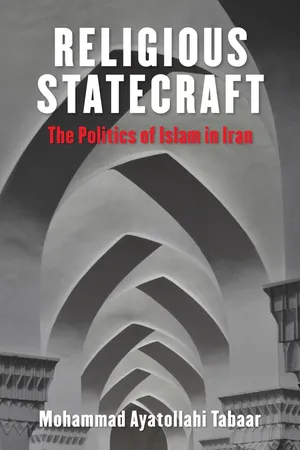
Since the 1979 revolution, scholars and policy makers alike have tended to see Iranian political actors as religiously driven—dedicated to overturning the international order in line with a theologically prescribed outlook. This provocative book argues that such views have the link between religious ideology and political order in Iran backwards. Religious Statecraft examines the politics of Islam, rather than political Islam, to achieve a new understanding of Iranian politics and its ideological contradictions.
Mohammad Ayatollahi Tabaar traces half a century of shifting Islamist doctrines against the backdrop of Iran's factional and international politics, demonstrating that religious narratives in Iran can change rapidly, frequently, and dramatically in accordance with elites' threat perceptions. He argues that the Islamists' gambit to capture the state depended on attaining a monopoly over the use of religious narratives. Tabaar explains how competing political actors strategically develop and deploy Shi'a-inspired ideologies to gain credibility, constrain political rivals, and raise mass support. He also challenges readers to rethink conventional wisdom regarding the revolution, Ayatollah Khomeini, the U.S. embassy hostage crisis, the Iran-Iraq War, the Green Movement, nuclear politics, and U.S.–Iran relations. Based on a micro-level analysis of postrevolutionary Iranian media and recently declassified documents as well as theological journals and political memoirs, Religious Statecraft constructs a new picture of Iranian politics in which power drives Islamist ideology.
- English
- ePUB (mobile friendly)
- Available on iOS & Android
eBook - ePub
About this book
Information
Subtopic
Middle Eastern HistoryIndex
HistoryONE
The Factional Causes and Religious Consequences of Politics
How can we explain “religious” politics without either essentializing or bypassing religion? Scholarship on religion and politics tends to vacillate between these two extremes. Essentialists and primordialists ascribe to religious actors a set of fixed theological and overpredictive characteristics that determine their behavior,1 while rationalists focus on strategic interests and view ideology as a “poor predictor” of action.2 The first group explains political outcomes in terms of the actors’ religious doctrines; the inflexibility of religious doctrines leads to radical actions. These studies in general focus on the causal role of religion in the security arena. The second group examines internal political upheavals and religious transformations—particularly the ideological “moderation” of actors—in the context of party politics. They posit that doctrinal changes are a contingent byproduct of the electoral process.
In many of these studies, religious ideology is either a mover or an accidental product of politics. The first considers doctrine as exogenously induced; the second views it as endogenous to electoral politics. The essentialists are concerned with political theology as an independent variable but do not account for observable ideological shifts: political theology consists of long-held static beliefs rather than interpretations that can change in short order. Many rationalists, on the other hand, address it as an outcome of behavioral change. Absent in the literature is a micro-level causal analysis of theological shifts. This theophobia has led to a number of shortcomings. Falling into one-dimensional spectrums and binaries such as radical/moderate, social scientists often study religious ideologies as unitary and unidirectional. They do not account for the collection of contradictory attributes that religious discourse can possess.
This book studies religion and politics by studying both religion and politics instead of fixating on one at the expense of the other. It aims to explain how elites strategically construct religious doctrines in an uncertain environment. It focuses on religion not as an independent variable, nor a constitutive factor, nor an accidental outcome, but as a strategic construct with which political actors strive to capture the state.
I use an “extreme” case whose politics have been deeply imbued with religious ideology for the last half century. As an “instance of a class of events,”3 Iran is often employed by social scientists to demonstrate the resurgence of religion and its undeniable role in international politics. Because it is an “Islamic” state led by “God’s representative on earth,” Iran can provide us with a unique analytical edge to study the role of religion in politics. Therefore, it should be the least likely case in which religious doctrines alter. Yet religious discourse in Iran has taken a variety of quietist, revolutionary, statist, reformist, pragmatic, and ultraconservative turns. These narratives have emerged or faded in direct response to inter- and intra-elite rivalries during the 1979 revolution, the post-revolutionary civil wars, the Iran–Iraq War, the reform era, the Green Movement, the nuclear negotiations, the conflicts in Iraq and Syria, etc.
This chapter lays out my argument on the strategic construction and deployment of religious doctrines by political elites, which has been a dominant yet overlooked feature of Iranian politics since the revolution. I introduce a factional level of analysis and argue that political actors, be they incumbents or challengers, employ a diverse range of religious ideologies to capture the state through various means, including generating mass mobilization and preventing elite defections. I begin with an overview of the literature on the role of religion in politics before examining the rationalist and constructivist explanations of ideological change.
Religion: A Sticky Model or a Plastic Tool?
Religion may be considered divine and immutable, but its interpretation is fluid and subject to human susceptibility to fear and greed. Religious symbols and narratives may solve what Max Weber called the masses’ “problem of meaning,”4 but they can also help elites overcome the collective action problem.5 These “cultural subsystems” may be a “blueprint” for action as well as a “model of” and “model for” reality.6 They can also be manipulated by elites who seek to challenge the givenness of one political order and give meaning to another. In other words, religious ideology is what elites make of it.
This tension between the devout yet utility-maximizing masses and the elites has shaped much of the primordialist, constructivist, and rationalist studies of religion and ethnicity in recent decades. Going beyond “thick description,” scholars have endeavored to wed nonmaterial factors with positivist methodology to arrive at generalizable conclusions. Ann Swidler analyzes culture as a “tool kit” and an independent variable that shapes action.7 David Laitin looks at how an externally imposed hegemony determines which cultural subsystems, including religion, will be politically salient and thus used instrumentally by elites.8 Lisa Wedeen conceptualizes culture as meaning-making practices that “produce observable political effects” such as compliance.9 Sheri Berman traces how different “programmatic beliefs” resulted in diverging institutions and polities in Europe after World War I.10 Even scholars who ignored ideational factors were forced to make theoretical adjustments in reaction to real-world events. Theda Skocpol, facing criticism in the aftermath of the Iranian Revolution of 1979—the very year her book, States and Social Revolutions, was published—struggled to explain why her theory could not account for an urban-based movement that toppled a strong state whose fifth-mightiest army in the world remained intact.11 Although Skocpol had initially dismissed any role for ideology, she later conceded that “Islam was both organizationally and culturally crucial to the making of the Iranian Revolution against the Shah.”12
In the four decades since the Iranian Revolution and more recently, particularly after the September 11 attacks in 2001, a new wave of studies has emerged to examine the “resurgence” of religion. Many scholars and policymakers have sought to account for the role of ideology but have gone to the other extreme, perceiving religious actors (from the Islamic Republic of Iran to the Islamic State of Iraq and Syria) as primarily driven by doctrines and dedicated to replacing the international order with their own divine outlook. They argue that religious groups pursue interests and goals constitutively different from those the rest of the world has seen. These scholars strive to unearth the roots of each group’s actions from its doctrinal claims and theological rhetoric to explain its resilience and success. In other words, what scholars claim is often similar to what these groups claim about themselves.
Even rationalist and institutionalist studies often view actors as constrained or motivated by institutionalized doctrines. Daniel Philpott posits that institutional differentiation and long-held political theology are the two independent variables that explain why some actors resort to violence while others pursue democratic goals.13 Monica Toft argues that civil wars in the Muslim world are particularly violent because “Islam has Jihad.”14 Elites outbid each other by manipulating the built-in violent elements of religion; thus, “religion often leads to uncompromising demands.”15 Despite their differences, these explanations take ideational factors as exogenous. Political elites use ideas that are available to them rather than crafting their own. There is an inherent limitation in “available” ideas, this literature postulates: “[e]ven given some liberty in translation over time, religious texts and interpretations circumscribe the conduct of followers in important ways.”16
These works focus on the restrictive and yet explanatory power of culture, religion, or ideology—how they produce different institutions or regime types, contribute to their survival, or mobilize the masses. But few scholars have traced the ideational implications and consequences of these phenomena. If religion was a cause of the Iranian Revolution and later contributed to one of the longest wars of the twentieth century with Iraq, did the revolution and war themselves shape Islamic narratives as well? Were the leaders of the revolution aware of the political utility of Islam? If yes, how did this self-awareness play into the Iranian politics during the revolution and war? Just as scholars are cognizant of the power of ideas, so are the actors on the ground.
It is precisely this reflexive step that many scholars do not account for: the agential power of political actors who intentionally develop and deploy ideas despite the limitations of their cultural toolkits and religious blueprints, as well as any structural or path-dependent obstacles. As Laitin points out, actors—particularly during times of crisis—move away from ready-made cultural tools toward strategic calculations.17 In other words, increased “uncertainty breeds rationality”18 and induces further ideological shifts. Consider Iranian activists, such as Ali Shariati and Ayatollah Khomeini, who turned Shi’a Islam from a passive and quietist religion to a revolutionary ideology in the 1970s. Of the Twelve Shi’a Imams, only one revolted against an oppressive ruler in the seventh century. The rest (with the exception of the Hidden Imam, who is presumed to be in occultation19 since 941 A.D.) remained silent and even made peace with an unjust caliph. Yet Iranian Islamists turned the anomaly (Imam Hossein’s uprising) into a rule, providing a revolutionary reading of Islam that appealed to the population at large in 1979. It is this level of analysis that forces us to study ideas as a variable shaped by goal-oriented actors to bring about structural transformations. In contrast to what Berman demonstrates in the post–World War I European cases20—in which ideas predict actors’ choices even when the political environment shifts—ideational factors did not automatically dictate actors’ choices in Iran. Rather, ideologies themselves changed in response to the available strategic options and were effectively deployed to generate the desired institutional outcomes.
Ideationist theories become even more problematic when analyzing the post-Khomeini order, both internally and internationally. They do not adequately explain why Khomeini’s disciples split and arrived at diametrically opposed ideological destinations. Why did the radical Islamists who occupied the U.S. embassy and brought down the nationalist Provisional Government in 1979 become avid proponents of democracy and rapprochement with the United States two decades later? Why did the conservatives who initially advocated more pragmatic foreign and economic policies later adopt their radical leftist rivals’ anti-Americanism? Some scholars’ responses to these questions often revolve around intellectual learning processes at critical junctures as a result of new experiences.21 Social constructivists maintain that elites’ preferences are driven by their ideational exposures,22 asserting that it is the content of their cognitions, exogenous to material features, that influence their actions. Political actors’ cognitive systems remain stable even when their material interests change. Iranian radicals matured after the revolution, learned from the negative experience of the Iran–Iraq War, and transformed after the collapse of the Soviet Union and the “end of history,” so the argument goes. They went back to school, studied liberal philosophy, delved into a democratic literature, and thus put aside their revolutionary excesses, emerging as reformists. But several empirical questions remain unanswered. What explains the variation in the learning processes? All political factions were exposed to similar aforementioned systemic experiences (i.e., the Iran–Iraq War) and ideas—why did only some “learn” while others did not? In fact, the conservatives “un-learned” and “un-moderated,” even though they were immersed in the same political environment. While in some cases ideas may predict an actor’s choices even when the political environment shifts,23 I argue that actors also craft specific ideas targeting the available choices, particularly when circumstances on the ground change. The same actors develop dissimilar ideas when positioned in a different environment. In other words, the strategic options available to political actors in a given context predict their ideological dispositions.
Ideationist and Rationalist Explanations of “Moderation”
In recent years, rationalist scholars of ethnic politics have incorporated analytical tools from the constructivist literature to study ethnicity as a consequence, not a cause, of political violence. Rejecting primordialist views, they argue that while ethnicity has no explanatory power for ethnic violence, the social construction of ethnicity does. Bringing constructivism into a rational choice framework, James Fearon and David Laitin point out a path in which intergroup rivalry may lead to redefining the boundaries and content of the ethnicity and the construction of antagonistic ethnic identities.24 In this context, the construction of ethnic identity is merely strategic. Similarly, Stathis Kalyvas shows how incumbent states encourage rebel defections by manipulating and adding new political dimensions to ethnic identities. He focuses on the “identity consequences of civil war” and demonstrates the “multidirectional empirical prediction (i.e., toward both hardening and softening of ethnic identities).”25
This framework has yet to penetrate the study of religion and politics, particularly of the Middle East. Ironically, in his own work on religious parties, Kalyvas adheres to a strict rationalist perspective to explain what he considers a unidirectional and accidental outcome: religious “moderation.” Referring to the European Christian Democrats in the nineteenth century, he argues that in reaction to electoral and nonelectoral institutional constraints, religious parties generally tend to move ...
Table of contents
- Cover
- Series List
- Title Page
- Copyright
- Dedication
- Contents
- Preface
- Introduction: The Politics of Islam
- 1. The Factional Causes and Religious Consequences of Politics
- 2. A Shi’a Theory of the State
- 3. The “Islamic” Revolution
- 4. Institutionalizing Velayat-e Faqih
- 5. The Hostage Crisis: The Untold Account of the Communist Threat
- 6. Religion and Elite Competition in the Iran–Iraq War
- 7. The Metamorphosis of Islamism After the War
- 8. The Factional Battle Over Khomeini’s Velayat-e Faqih
- 9. Media, Religion, and the Green Movement
- 10. Historical Revisionism and Regional Threats
- 11. The Domestic Sources of Nuclear Politics
- Conclusion
- Notes
- Index
Trusted by 375,005 students
Access to over 1.5 million titles for a fair monthly price.
Study more efficiently using our study tools.
Frequently asked questions
Yes, you can cancel anytime from the Subscription tab in your account settings on the Perlego website. Your subscription will stay active until the end of your current billing period. Learn how to cancel your subscription
No, books cannot be downloaded as external files, such as PDFs, for use outside of Perlego. However, you can download books within the Perlego app for offline reading on mobile or tablet. Learn how to download books offline
Perlego offers two plans: Essential and Complete
- Essential is ideal for learners and professionals who enjoy exploring a wide range of subjects. Access the Essential Library with 800,000+ trusted titles and best-sellers across business, personal growth, and the humanities. Includes unlimited reading time and Standard Read Aloud voice.
- Complete: Perfect for advanced learners and researchers needing full, unrestricted access. Unlock 1.5M+ books across hundreds of subjects, including academic and specialized titles. The Complete Plan also includes advanced features like Premium Read Aloud and Research Assistant.
We are an online textbook subscription service, where you can get access to an entire online library for less than the price of a single book per month. With over 1.5 million books across 990+ topics, we’ve got you covered! Learn about our mission
Look out for the read-aloud symbol on your next book to see if you can listen to it. The read-aloud tool reads text aloud for you, highlighting the text as it is being read. You can pause it, speed it up and slow it down. Learn more about Read Aloud
Yes! You can use the Perlego app on both iOS and Android devices to read anytime, anywhere — even offline. Perfect for commutes or when you’re on the go.
Please note we cannot support devices running on iOS 13 and Android 7 or earlier. Learn more about using the app
Please note we cannot support devices running on iOS 13 and Android 7 or earlier. Learn more about using the app
Yes, you can access Religious Statecraft by Mohammad Ayatollahi Tabaar in PDF and/or ePUB format, as well as other popular books in History & Middle Eastern History. We have over 1.5 million books available in our catalogue for you to explore.