Wu Zhao (624–705), better known as Wu Zetian or Empress Wu, is the only woman to have ruled China as emperor over the course of its 5,000-year history. How did she—in a predominantly patriarchal and androcentric society—ascend the dragon throne? Exploring a mystery that has confounded scholars for centuries, this multifaceted history suggests that China's rich pantheon of female divinities and eminent women played an integral part in the construction of Wu Zhao's sovereignty.
Wu Zhao deftly deployed language, symbol, and ideology to harness the cultural resonance, maternal force, divine energy, and historical weight of Buddhist devis, Confucian exemplars, Daoist immortals, and mythic goddesses, establishing legitimacy within and beyond the confines of Confucian ideology. Tapping into powerful subterranean reservoirs of female power, Wu Zhao built a pantheon of female divinities carefully calibrated to meet her needs at court. Her pageant was promoted in scripted rhetoric, reinforced through poetry, celebrated in theatrical productions, and inscribed on steles.
Rendered with deft political acumen and aesthetic flair, these affiliations significantly enhanced Wu Zhao's authority and cast her as the human vessel through which the pantheon's divine energy flowed. Her strategy is a model of political brilliance and proof that medieval Chinese women enjoyed a more complex social status than previously known.
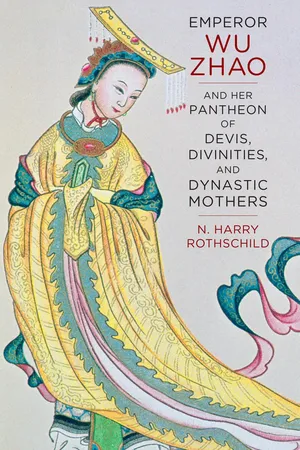
eBook - ePub
Emperor Wu Zhao and Her Pantheon of Devis, Divinities, and Dynastic Mothers
- English
- ePUB (mobile friendly)
- Available on iOS & Android
eBook - ePub
Emperor Wu Zhao and Her Pantheon of Devis, Divinities, and Dynastic Mothers
About this book
Information
Topic
Theology & ReligionSubtopic
Chinese History
PART I
Goddesses of Antiquity
SEEKING TO DISCERN LARGER POLITICAL PRINCIPLES in another place and time, historian William McNeill observes that “a successful revolution must invent or revive its own myths. Stability, predictability, control are otherwise impossible.”1 While McNeill’s observations are drawn from Western societies in the modern era, the principles he delineates might be profitably applied to Wu Zhao’s rule in the late seventh century: She could not simply invent an entirely new paradigm of political authority divorced from precedent; she could and did, however, creatively draw on a vast cultural repertoire of existing mythologies. She amassed prophecies and obscure myths connected to female deities, initially to buttress her position as empress and grand dowager and later to legitimize her new dynasty and validate her unique rule as a female emperor.
Wu Zhao was fortunate to have a large storehouse of goddess myths to draw upon. Susan Mann asserts that for a traditional culture that was ostensibly patriarchal, China possessed a wide-ranging, variegated repository of myths and folklore concerning womanhood.2 In her study of Chinese mythology, Anne Birrell remarks that ancestral goddesses like Nüwa and the divinity of the Luo River were “more mythologically significant in terms of their function and role” than their male counterparts. She notes that these female divinities play a variety of different culture-shaping parts: creator, nature spirit, local tutelary spirit, mother or consort of a god, harbinger of disaster, donor of immortality, bringer of punishment, and dynastic founder.3
Mann argues that with the rise of a “Confucian moral agenda that dominate[d] the written record,” these powerful ancient goddesses underwent a “civilizing process in which archaic myth was overwritten by history, literature, and the arts of popular culture,” becoming “logically constituted elements” in China’s patriarchal society.4 To liberate and reclaim the original potency of these ancient goddesses, Wu Zhao attempted to reverse this process of many centuries, to un-write the texts that tamed once-powerful divinities and un-make the “civilizing process” that had harnessed them. Noting Wu Zhao’s revival of cults of ancient goddesses long fallen into disuse, McNeill’s remarks on successful revolutions come to mind.
In his classic The Golden Bough, Sir James George Frazer explains the primitive belief in an “extended self”:
The primitive believes that the self, or identity . . . is not limited to his physical being, but embraces also everything that is associated with it and everything that can evoke his presence in another person’s mind. Thus, the shadow, name, footprint, gait, dress, excreta, portrait, etc. . . . are just as much an essential and integral part of him and his body, the more so because it can be evidence when he is corporeally absent.5
This idea of an “extended self” might profitably encompass the related realms of ceremonies, symbols, and monuments. In Frazer’s sense, then, the ancient goddesses became part of Wu Zhao’s “extended self,” a part echoed in her rhetoric, texts, and iconography.
The three chapters in part I examine the respective roles of a trio of ancient divinities—mother-creator Nüwa; the goddess of the Luo River; and the silk goddess, Leizu—in Wu Zhao’s assemblage of female political ancestors.

ONE
Wu Zhao as the Late Seventh-Century Avatar of Primordial Goddess Nüwa
VARIOUSLY KNOWN AS A DIVINE CREATOR, a savior of mankind, and a mother goddess worthy of an enduring fertility cult, Nüwa 女媧 had gained a mythic repute long before Wu Zhao’s time. Suggesting a close connection to the essential female element of water, the cognate forms of wa or gua indicate a probable linkage to the snail or frog, bespeaking the primordial origins of this deity.1 One contemporary scholar described this ur-mother, often depicted as half snake and half human (a fertile, marshy, and generative matrix that begat mankind), as a “were-snake Daoist goddess.”2 Another commentary tells of a “prestigious lamia” who “outlived the suppression and secularization of the archaic serpent women.”3 Not surprisingly, Wu Zhao discovered a valuable political immediacy in this female sovereign of hoary antiquity; by connecting herself to this mythic avatar, she gained leverage and legitimacy.
Dynamic and mutable, Nüwa played various parts in early texts. One scholar sees her as an evolution of a directional goddess who appeared on oracle bones in the Shang, a deified shamaness, rainmaker, and fertility spirit.4 Though textual evidence intimates much earlier origins, Nüwa first appears by name in Elegies of Chu (Chuci 楚 辞), a Warring States–era text attributed to poet-official, Qu Yuan (343–278 B.C.), wherein the author poses the question: “How was Nü Wa’s body made? How did she ascend when she rose on High and became empress?”5 Andrew Plaks provides a provocative alternative translation—“Who created Nü-kua if she created mankind?”6—stating explicitly the challenge posed by a female creator divinity to patriarchal currents in later eras. Acknowledging the goddess’s archaic reputation as a prolific mother-creator, annotator Wang Yi (A.D. 89–158) remarks, “It was said that Nüwa had the head of a human being and the body of a snake and she gave birth to seventy offspring each day.”7
In the Daoist Liezi 列子, a text whose dating is problematic but whose origins stem from early in the Warring States era, Nüwa is said to have “harbored the virtues of the great sages,” though she lacked human form. She was cast as a savior of mankind, known for “smelting the five-colored stones to fill the holes in heaven, and breaking the legs of a turtle to support the four corners of the earth.”8 Not only was she recognized for restoring the equilibrium of a world out of kilter, but she was also known for taming the flood, stanching the inundating waters with ash and burned reeds.9
Compiled by Liu An (179–122 B.C.), the Huainanzi 淮南子 contains the passage, “Huangdi gave birth to yin and yang; Shang Pian to ears and eyes, and Sang Lin to arms and hands—events which were among the seventy transformations of Nü Wa.”10 Contemporary scholar Cai Junsheng reasonably points out that this transformation indicates that Nüwa not only predated but helped fashion the Yellow Emperor.11 Dating from roughly a century later, the Classic of Mountains and Seas describes ten gods born from the guts of Nüwa.12 In Ying Shao’s (140–206) Eastern Han text, Comprehensive Commentary on Popular Customs (Fengsu tongyi 風俗通議), Nüwa was a creatrix, fashioning human beings from yellow earth.13 These myths make clear that by the end of the Han dynasty, Nüwa was revered as a creator goddess. Schafer compares her to Nabatean Atargatis, “a cosmic mother goddess, with power over the fertility of living things.”14
In Han mortuary iconography, this primeval goddess is often paired with a male divinity, her brother-husband Fuxi, their serpentine tails intertwined. As in the relief mural in the famous Wu Liang shrine in Shandong, Fuxi frequently holds a carpenter’s square and Nüwa a compass, tools to fashion a world for infant humanity.15 Painted on funerary banners and graven in relief on sarcophagi from the Han through the Tang, Nüwa and Fuxi were worshipped as primordial creators, guardian spirits and “tutelary genii of the dead.”16 Lee Irwin observes that Nüwa’s signature compass serves as a symbol of social organization, marking her not only as a creator goddess, but also as “a goddess of proportion and measurement,” vital to both architecture and hydro-engineering.17
Still, Anne Birrell, Edward Schafer, and others have noted that the autonomy and power she had possessed as a primeval goddess was diminished by the rise of the Confucian state.18 Cai Junsheng echoes a similar argument, opining, “At the time of the patriarchal clan in China, Nü Wa’s activities seem to cease, and she ‘died.’”19 Once yoked to male figures, powerful female divinities like Nüwa and the Queen Mother of the West were forced to fit into a yin-yang schema during the Han and thereby were domesticated, diminished by emergent patriarchal mores.
Between the third and sixth centuries, the cult of Nüwa became virtually obsolete. In Ancient China, Edward Schafer contend...
Table of contents
- Cover
- Series Page
- Title Page
- Copyright
- Dedication
- Contents
- List of Illustrations
- Dynasties and Rulers Through the Mid-Tang
- Wu Zhao’s Titles at Different Stages of Her Career
- Reign Eras from 655 to 705
- Acknowledgments
- Introduction: Wu Zhao and Her Pantheon of Female Political Ancestors
- Part I: Goddesses of Antiquity
- Part II: Dynastic Mothers, Exemplary Mothers
- Part III: Drawing on the Numinous Energies of Female Daoist Divinities
- Part IV: Buddhist Devis and Goddesses
- Conclusions
- Appendix: Wu Zhao’s Pantheon of Female Political Ancestors
- Glossary of Chinese Places, Names, and Terms
- Notes
- Bibliography
- Index
Trusted by 375,005 students
Access to over 1.5 million titles for a fair monthly price.
Study more efficiently using our study tools.
Frequently asked questions
Yes, you can cancel anytime from the Subscription tab in your account settings on the Perlego website. Your subscription will stay active until the end of your current billing period. Learn how to cancel your subscription
No, books cannot be downloaded as external files, such as PDFs, for use outside of Perlego. However, you can download books within the Perlego app for offline reading on mobile or tablet. Learn how to download books offline
Perlego offers two plans: Essential and Complete
- Essential is ideal for learners and professionals who enjoy exploring a wide range of subjects. Access the Essential Library with 800,000+ trusted titles and best-sellers across business, personal growth, and the humanities. Includes unlimited reading time and Standard Read Aloud voice.
- Complete: Perfect for advanced learners and researchers needing full, unrestricted access. Unlock 1.5M+ books across hundreds of subjects, including academic and specialized titles. The Complete Plan also includes advanced features like Premium Read Aloud and Research Assistant.
We are an online textbook subscription service, where you can get access to an entire online library for less than the price of a single book per month. With over 1.5 million books across 990+ topics, we’ve got you covered! Learn about our mission
Look out for the read-aloud symbol on your next book to see if you can listen to it. The read-aloud tool reads text aloud for you, highlighting the text as it is being read. You can pause it, speed it up and slow it down. Learn more about Read Aloud
Yes! You can use the Perlego app on both iOS and Android devices to read anytime, anywhere — even offline. Perfect for commutes or when you’re on the go.
Please note we cannot support devices running on iOS 13 and Android 7 or earlier. Learn more about using the app
Please note we cannot support devices running on iOS 13 and Android 7 or earlier. Learn more about using the app
Yes, you can access Emperor Wu Zhao and Her Pantheon of Devis, Divinities, and Dynastic Mothers by N. Harry Rothschild in PDF and/or ePUB format, as well as other popular books in Theology & Religion & Chinese History. We have over 1.5 million books available in our catalogue for you to explore.