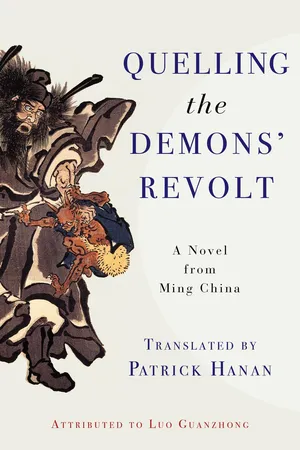
In this Ming-era novel, historical narrative, raucous humor, and the supernatural are interwoven to tell the tale of an unsuccessful attempt to overthrow the Song dynasty. A poor young girl meets an old woman who gives her a magic book that allows her to create rice and money. Her father, terrified that his daughter's demonic nature might be discovered, marries her off. Forced to flee, she and others with supernatural abilities find themselves in the midst of a grotesque version of a historical uprising, in which facts are intermingled with slapstick humor and wild fictions.
Attributed to the writer Luo Guanzhong, Quelling the Demons' Revolt is centered on the events of the rebellion led by Wang Ze in 1047–48. But it is a distorted, humorous version, in which Wang Ze's lieutenants show up as a comical peddler and a mysterious Daoist priest and a celebrated warrior appears despite having died many years earlier. Rather than fantastic adventures and supernatural marvels, the author points to human vanities and fixations as well as social injustice, warning of the vulnerability of any pursuit of order in a world plagued by demonic forces as well as mundane corruption. Although the story takes place long before the era in which it was written, ultimately Quelling the Demons' Revolt is the story of the Ming dynasty in Song masquerade, presciently warning of the dynasty's downfall. The novel is divided into chapters, but in many ways it is an arrangement of self-contained stories that draw on vernacular storytelling. This translation offers English-speaking readers a spirited example of social critique combined with caustic humor from the era of Luo Guanzhong.
- English
- ePUB (mobile friendly)
- Available on iOS & Android
eBook - ePub
About this book
Information
Subtopic
Chinese HistoryIndex
LiteratureQUELLING THE DEMONS’ REVOLT
1
MASTER HU ACCEPTS A PLEDGE AND OBTAINS A FAIRY’S PORTRAIT;
MISTRESS ZHANG BURNS A PICTURE AND BEARS A DAUGHTER.
POEM:
If the ruler’s up early, his court is, too—
In the hour before dawn they convene;
But for many of the capital’s richest men
The morning star is a sight unseen.
Let us tell how in the time of Emperor Renzong of the great Song dynasty, the Eastern Capital, the city of Bianzhou in Kaifeng prefecture, glowed like a brilliant tapestry. Thirty-six imperial highways did it boast, as well as twenty-eight city gates, thirty-six lanes of brothels, and seventy-two music halls, and any idle space in the city was given over to flower gardens or football fields. Let us put aside the powerful officials in the capital and speak instead of the many merchants of varying degrees of wealth. There was Master Wang of the dye works, Master Li the pearl merchant, Master Zhang the merchant adventurer, Master Jiao of the colored silks—the list goes on and on. Among them was one man so rich that “his stack of money rose higher than the stars, and his rice was so abundant that it rotted in his granaries.” He had three pawnshops in front of his house, the one on the left taking in silks and satins; the one on the right gold, silver, pearls, and kingfisher feathers; and the one in the center musical instruments, calligraphy, paintings, and antiques. Each pawnshop was staffed by a manager and three assistants. This merchant was named Hu Hao, style Dahong, and he had a wife, Mistress Zhang, but no children. “Of eyes he had a pair, but of children not a one.”
One day he and his wife were taking their ease in their hall when a sudden thought occurred to him and he began to weep. Noticing his tears, his wife rose to her feet. “Master,” she said, “you have all that you need in life—you lack for nothing—and you enjoy many luxuries as well. You may not compare with the richest in the land, but you’re far better off than the poorest. Why are you so upset?”
“This has nothing to do with either necessities or luxuries. I do own some property, it’s true, but we have no children. When the time comes, who can we depend on to see to our last rites? That’s what makes me sad.”
“But we’re not old, and who’s to say we can’t still have a baby? Perhaps we’re destined to have one later in life. I’ve heard that in the Precious Amulet Temple the Veritable Helpful and Saintly Master of the Polestar is wonderfully effective.1 Why don’t we choose an auspicious day to go over there, burn some paper money, and pray for a child? Even if it’s a girl, we’ll at least have someone to tend our graves.” She gave orders to the maidservants: “Set out the wine. The master and I are going to cheer ourselves up.” They drank several cups together before clearing away the wine things and going to bed.
An auspicious date came along several days later. Master Hu told a servant to buy some incense and paper money and arrange for a sedan chair. Then, with their servants in attendance, he and his wife set off for the temple, where they alighted and walked inside. In the main hall they burned incense and then, needless to say, did the same in the other halls and porticoes. At the Zhenwu Hall,2 Master Hu prayed most devoutly, giving the date of his birth and praying to the god for a child to continue the family line. He bowed down “like a tower toppling, a pillar falling,” clicking his teeth3 as he kowtowed. His wife bowed too, bobbing up and downlike a supplicant holding a candle in a candlestick. They prayed and burned paper money again before departing for home, which is where we shall leave them.
For about a year after that, on the first and fifteenth of every month, they returned to the temple to burn incense and pray for a son. One day in the fifth month, when the weather was turning hot, the door curtain in the central pawnshop rose and in walked a Daoist priest. How was he dressed?
He wore an iron-frame Daoist cap of fishtail shape
And a black-bordered, fiery red gown;
In his left hand he held a bramble basket,
In his right a turtle-shell fan;
Puttees he wore around his legs
And hempen shoes with grommets.
Now, a Daoist immortal has four remarkable qualities:
He travels like the wind;
He stands still as a pine;
He lies bent like a bow;
His voice sounds like a bell.
Raising the door curtain, the priest entered the pawnshop. He glanced at one of the assistants, who noticed his venerable appearance and quickly rose and welcomed him in, then bowed and sat down with him and ordered tea. When they had drunk it, he said, “Well, sir, and what instructions do you have for us?”
“This is the pawnshop that deals in musical instruments, calligraphy, and paintings, is it not?”
“Yes, sir, that’s correct.”
“In that case I have a small painting that I’d like to pawn. I’ll come back later to redeem it.”
“Kindly show it to me, sir, so that I can estimate its value.” The assistant assumed that the priest would have a servant with him to carry the painting, but the man reached into his basket and brought out a painting that was less than a foot wide and handed it to him. The assistant took it and said nothing, but he wondered to himself, could this priest be making fun of me? At most this painting can’t be worth very much. But of course the assistant had to take the picture pole and hang the painting up, only to find that it was less than five feet long. He looked at it close-up, and he looked at it from a distance; it was a painting of a beautiful woman, but although well executed, it was too small to be of much value.
The assistant turned back to face the priest. “And how much money did you hope to raise on it, sir?”
“It’s no ordinary work, you know. I’d want fifty taels for it.”
“But sir! I’m afraid we can’t give you that much. A small painting like this is worth only from thirty to fifty strings of cash. How could we give you fifty taels?”
The priest kept insisting, however, and the assistant continued to refuse. In the midst of the argument, footsteps sounded outside the door, the curtain rose, and the master came in from his private quarters. “Have you burned the noon incense today?” he asked the assistant.
“Yes, sir, I have.”
The priest looked at the master and said, “Master, I bow my head in greeting.”
“Please take a seat, sir, and have some tea,” said the master, returning the greeting. He assumed that the priest had come to solicit alms.
“The reverend gentleman has a small painting that he would like to pawn for fifty taels,” explained the assistant. “I couldn’t see my way to accepting it, but he keeps on insisting.”
The master took a look at it. “It’s a good painting, my dear sir, but it’s not worth very much. How can we offer you fifty taels on it?”
“But Master! You don’t know everything about this picture. It may be small, but it has a certain marvelous quality.”
“And what might that be?”
“This is hardly the place to talk. Let’s go somewhere else, and I’ll explain to you.”
The master took the priest by the hand and led him into the study, where they were alone. “Well, and what is this marvelous quality it possesses?”
“Don’t let anyone see you as you do this, but in the dead of night take that painting and hang it up in some very private place. Burn some fine incense, light two candles, cough once, knock three times on the table, and then in a reverent tone of voice invite the divine maiden to step forth from the picture and take tea with you. There’ll be a sudden gust of wind, and she’ll step down.”
If that’s the case, this must be a divine painting, thought Master Hu. As he left the study with the priest, he told the assistant, “Give the reverend gentleman the full amount that he asked for.”
“Then don’t blame me if he never comes back to redeem it!” said the assistant.
“That’s not your concern. Just enter it in the account book.” He invited the priest to tea, at the same time slipping the painting into his sleeve. He then took his guest into his private quarters and, after a vegetarian meal, saw him out to the shop again. The assistant paid him the fifty taels, and the priest took his leave.
The master could hardly wait until evening. He told a servant to sweep out the study and set up a censer, candlesticks, a teapoy, a kettle of water, and the like. When evening arrived at last, he had dinner with his wife, and then came up with a plausible excuse. “You go off to bed now, my dear,” he said. “I have some accounts I need to check. I’ll be along in a little while, once I’m done.” Then, before he knew it, the drums sounded from the watchtowers and the bells from the temples, and quickly it grew dark.
Over the ten parts of the earth there falls a sudden pitch-black pall;
In the nine margins of the sky stars move amid the clouds;
From all eight directions merchants head for inns to lay down their loads;
The seven stars of the Dipper appear above and beside Heaven’s Gate;4
In the green5 willows’ shade small boats tie up on weed-covered shores;
By the five planets’ light animals are driven into their pens;
In all four quarters brightness illumines the world for a hundred miles;
The three marketplaces6 fill with cool night air;
Two by two husbands and wives retire to their chambers;
And one circle of vivid whiteness shines all over the land.
Master Hu walked to the study, pushed open the door, which was fitted with a window, and went in, telling the servants to wait outside. Then, turning around, he shut the door and lit the lamp. The kettle on the wall stove was boiling vigorously. He lit a stick of incense and the two candles, then used the picture pole to hang the painting on the wall. It was indeed of an enchanting beauty, one so realistic that she looked as if she could be plucked right out of that painting. The master gave a cough and knocked three times on the table. A slight gust of wind sprang up. What was it like, that wind?
It could push the courtyard plants together—
Or part the duckweed in the river;
Kindhearted when it moves the curtains,
Heartless when it extinguishes the candle.
From the temples it brings forth a peal of bells;
From the towers it sends out a roll of drums.
All you hear is its roar among the trees,
For it shows no trace of visible form.7
Once the wind had passed by, the beauty in the picture, in plain sight, jumped down onto the table and from there onto the floor. She stood five feet three inches tall and was as pretty as a flower, with pure-white skin and jet-black hair....
Table of contents
- Cover
- Series Statement
- Title Page
- Copyright
- Contents
- Introduction
- Quelling the Demons’ Revolt
- Notes
- Series List
Trusted by 375,005 students
Access to over 1.5 million titles for a fair monthly price.
Study more efficiently using our study tools.
Frequently asked questions
Yes, you can cancel anytime from the Subscription tab in your account settings on the Perlego website. Your subscription will stay active until the end of your current billing period. Learn how to cancel your subscription
No, books cannot be downloaded as external files, such as PDFs, for use outside of Perlego. However, you can download books within the Perlego app for offline reading on mobile or tablet. Learn how to download books offline
Perlego offers two plans: Essential and Complete
- Essential is ideal for learners and professionals who enjoy exploring a wide range of subjects. Access the Essential Library with 800,000+ trusted titles and best-sellers across business, personal growth, and the humanities. Includes unlimited reading time and Standard Read Aloud voice.
- Complete: Perfect for advanced learners and researchers needing full, unrestricted access. Unlock 1.5M+ books across hundreds of subjects, including academic and specialized titles. The Complete Plan also includes advanced features like Premium Read Aloud and Research Assistant.
We are an online textbook subscription service, where you can get access to an entire online library for less than the price of a single book per month. With over 1.5 million books across 990+ topics, we’ve got you covered! Learn about our mission
Look out for the read-aloud symbol on your next book to see if you can listen to it. The read-aloud tool reads text aloud for you, highlighting the text as it is being read. You can pause it, speed it up and slow it down. Learn more about Read Aloud
Yes! You can use the Perlego app on both iOS and Android devices to read anytime, anywhere — even offline. Perfect for commutes or when you’re on the go.
Please note we cannot support devices running on iOS 13 and Android 7 or earlier. Learn more about using the app
Please note we cannot support devices running on iOS 13 and Android 7 or earlier. Learn more about using the app
Yes, you can access Quelling the Demons' Revolt by Guanzhong Luo, Patrick Hanan in PDF and/or ePUB format, as well as other popular books in Literature & Chinese History. We have over 1.5 million books available in our catalogue for you to explore.