The 1960s marked a transformation of human rights activism in the United States. At a time of increased concern for the rights of their fellow citizens—civil and political rights, as well as the social and economic rights that Great Society programs sought to secure—many Americans saw inconsistencies between domestic and foreign policy and advocated for a new approach. The activism that arose from the upheavals of the 1960s fundamentally altered U.S. foreign policy—yet previous accounts have often overlooked its crucial role.
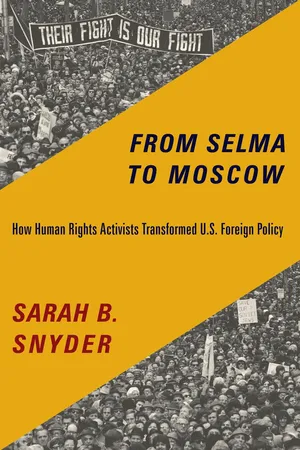
In From Selma to Moscow, Sarah B. Snyder traces the influence of human rights activists and advances a new interpretation of U.S. foreign policy in the "long 1960s." She shows how transnational connections and social movements spurred American activism that achieved legislation that curbed military and economic assistance to repressive governments, created institutions to monitor human rights around the world, and enshrined human rights in U.S. foreign policy making for years to come. Snyder analyzes how Americans responded to repression in the Soviet Union, racial discrimination in Southern Rhodesia, authoritarianism in South Korea, and coups in Greece and Chile. By highlighting the importance of nonstate and lower-level actors, Snyder shows how this activism established the networks and tactics critical to the institutionalization of human rights. A major work of international and transnational history, From Selma to Moscow reshapes our understanding of the role of human rights activism in transforming U.S. foreign policy in the 1960s and 1970s and highlights timely lessons for those seeking to promote a policy agenda resisted by the White House.
eBook - ePub
From Selma to Moscow
How Human Rights Activists Transformed U.S. Foreign Policy
- English
- ePUB (mobile friendly)
- Available on iOS & Android
eBook - ePub
About this book
Information
Subtopic
North American HistoryIndex
HistoryChapter One
HUMAN RIGHTS ACTIVISM DIRECTED ACROSS THE IRON CURTAIN
During the long 1960s Americans increasingly became aware of and responded to human rights violations overseas. Not surprisingly, the ideological, military, and economic Cold War with the Soviet Union heightened Americans’ focus on human rights abuses in that country. For many observers, the communist system inherently repressed a number of human rights, including the freedoms of religion, movement, and property ownership.1 Many so-called cold warriors believed that such repression needed to be highlighted for propaganda value with both domestic and international audiences.2 With the pursuit of détente, the focus on nuclear war lessened, and activists saw an opening to focus more U.S. attention on Soviet human rights violations. Détente, however, also made administrations less likely to press human rights concerns than might have been expected. The White House often felt that more could be gained in its relationship with the Soviet Union by overlooking human rights violations than by championing them, a dynamic that will reappear in later chapters. Such an approach was not uniformly supported in Congress or in nongovernmental circles, which led to ongoing negotiations about the proper place of human rights concerns in Soviet-American relations throughout this period. American activism was also shaped by shifting understandings of the stakes of the Cold War and by increasing questions about whether waging that battle should overwhelm all other foreign policy priorities. Despite uneven attention by successive administrations, the growing prominence of human rights issues helped to ensure their enduring salience in the years that followed.
HUMAN RIGHTS IN THE SOVIET UNION
In the Soviet Union in the 1960s the three greatest violations of human rights were those related to expression, due process, and movement. Soviet leader Nikita Khrushchev’s 1956 “secret speech” denouncing Joseph Stalin’s excesses offered an opening for some Soviet citizens to express their frustrations with the regime, which had not been permissible under Stalin. But the easing of repression in the wake of Stalin’s death extended only so far. It remained illegal to criticize the Soviet government, and those who did so could be charged with Article 70, which targeted speech or propaganda that defamed the Soviet state, or Article 190-1, which banned the circulation of materials that disparaged the state.3 These prohibitions were largely enforced with censorship and self-censorship. When they were violated, offenders faced harassment and arrest as well as the loss of their employment, apartment, or residence permit. For example, due to what was subsequently characterized as an “antiparty” speech, Soviet authorities deprived scientist Yuri Orlov of his job and exiled him to Armenia.4 Trials for political offenses in the Soviet Union were demonstrative rather than investigative, with the result and sentence determined either in advance or by the accused’s behavior in the courtroom. After conviction, Soviet political prisoners (of which there were thousands) suffered from a caloric intake set at barely subsistence level, beatings, solitary confinement, torture, the interception of packages, poor conditions in punishment cells, and forced commitment to mental institutions.5 Describing the internal policies of the Union of Soviet Socialist Republics (USSR), Soviet ambassador to the United States Anatoly Dobrynin later wrote, “Dissidents were considered enemies of the regime, and authors who published their works abroad were subjected to reprisals. Nonconformity was still frowned upon. In short, our dogmatic domestic ideology remained unchanged.”6 Most egregious of all, when faced with a government that offered no legal protections and inhibited all types of free expression, there was no escape; the right to emigrate was severely curtailed, often for spurious reasons.
The Soviets, like their Eastern European neighbors, largely declined to grant exit visas, because to do so would represent an admission that not all Soviet citizens were satisfied and that they preferred a life free from the communist system. Those denied the right to emigrate were known as refuseniks, and many would become leading activists against the government. Allowing freer emigration could produce ideological propaganda victories or, as in East Berlin before the construction of the Berlin Wall, a flood of refugees to the West that would threaten to destabilize the regime.7 In retrospect, however, the international consequences of Soviet policy were far more significant. As Dobrynin writes,
The prohibitive policy of the Soviet authorities over Jewish emigration resulted in growing friction with Israel and contributed to a vigorous anti-Soviet campaign in the United States.… Our biggest mistake was to stand on pride and not let as many Jews go as wanted to leave. It would have cost us little and gained us much. Instead, our leadership turned it into a test of wills that we eventually lost.8
In response, Soviet citizens protested for their human rights, often in small ways. In the words of activist Lyudmila Alexeyeva, “The human rights movement was born out of the experience of people who lived their lives under conditions of lawlessness, cruelty, and assault on the personality.”9 Expressions of dissent were generally individual initiatives during the late 1950s and early 1960s, focused on freedom of expression, the preservation of national culture, and fairness in the legal system.
In 1965 a network of human rights activists emerged publicly with a demonstration to commemorate the anniversary of the Universal Declaration of Human Rights. Approximately two hundred people assembled in Pushkin Square in December to press for fair trials for imprisoned writers; they focused particularly on Yuli Daniel and Andrei Siniavsky, who had been arrested for violating Article 70 when they published writings abroad that were critical of the Soviet state.10 The year 1965 also marked the first publication of the Chronicle of Current Events, the samizdat (self-published) compilation of human rights abuses.11 Those involved in the Pushkin Square demonstration periodically protested in following years, such as after the Warsaw Pact’s 1968 invasion of Czechoslovakia, an action that disillusioned many about the possibilities for progress and reform in the Soviet bloc.12
A smaller subset of Soviet activists focused on religious freedom and emigration to Israel. For many Soviet Jews, including prominent refusenik Anatoly Shcharansky, the 1967 Six-Day War in the Middle East awakened their Jewish identity, spurred greater participation in Jewish life, and fostered a desire to live in Israel.13 Yet the Soviet government refused nearly all applications for emigration. Because of demonstrations for exit visas, Soviet Jews faced police interruption of their holiday celebrations and internal exile. They also suffered discrimination in admission to higher education and in certain professions. More generally, they had little opportunity for a distinct cultural life, including the use of the Yiddish language or access to Jewish schools. Once officially classified as refuseniks, many lost their jobs and faced harassment for wishing to emigrate.14 The plight of Jewish refuseniks inspired considerable international sympathy, including growing American attention to Soviet Jewry in these years.
Beyond public protests, dissidents began to form organizations to advance their agendas. The two most important groups to develop during the 1960s and early 1970s were the Moscow Human Rights Committee (MHRC) and the Initiative Group for the Defense of Human Rights in the USSR.15 In describing the MHRC, U.S. representative to the UN Human Rights Commission Rita Hauser commented that such a group was “revolutionary for the Soviet Union, for non-governmental organizations are so rare as to be non-existent.”16 The Soviet government perceived such organizations as threatening and prevented them from operating freely. Members of the MHRC such as nuclear physicist Andrei Sakharov faced a prohibition against living in Moscow as well as the confiscation of written materials, the refusal of exit visas, and the interception of mail.17 In a notable act of protest, members of the Initiative Group for the Defense of Human Rights in the USSR signed a May 1969 letter that alleged human rights violations in the Soviet Union and addressed it to the UN, making the group the first Soviet NGO to send a letter to that organization.18 Later, in October 1973, several prominent Soviet dissidents, including Orlov, Valentin Turchin, and Sergei Kovalev, formed a national section of Amnesty International.19
Individual acts of protest also persisted. These often took the form of letters, but there were also efforts to escape. For example, after his return from Armenia, an increasingly activist Orlov drafted a September 1973 letter, “Thirteen Questions to Brezhnev,” and an appeal to mark Human Rights Day in December 1974.20 In one of the more extreme steps taken, a group of Soviet Jews plotted to hijack a plane as a means to escape. The KGB (the Soviet security agency) preemptively foiled the plan, and those behind the plot were sentenced to death. With the exception of the hijacking plot, many refuseniks were hesitant to dissent openly, as it could threaten their ultimate objective—an exit visa.
At times, activism produced positive results from the Soviet government, although on a relatively small scale. In late 1968 Soviet authorities broke their long-standing policy and allowed the emigration of a significant portion of Jewish activists, such that by January 1969, as observer Gal Beckerman writes, “almost the entire old guard” of Jews active in the Baltic republics had left.21 It seems likely that the Soviets were responding tactically to the growing Jewish emigration movement, hoping that allowing most of the leadership to leave would quell further agitation from the larger Jewish population. Instead, it inspired more Jews to apply for emigration.22
The audience for Soviet dissidence was not only internal. Over time, activists sought to reach the international community, particularly the UN, Western governments, and Western citizens, by utilizing the boomerang model described by political scientist Daniel Thomas—that is, through nongovernmental actors making appeals transnationally “in order to circumvent blocked domestic opportunities for protest.”23 In scholar Richard N. Dean’s view, Soviet dissidents were initially hesitant to seek support from the West, favoring quiet, private protests. When they shifted tactics, they relied heavily on Western journalists to cover press conferences, solicit interviews, and disseminate samizdat materials.24 A risky but effective way to publicize Soviet human rights abuses was through publication abroad, as Alexander Solzhenitsyn did with The Gulag Archipelago, which was released in translation in three volumes in the mid-1970s.25
By the 1970s many varied groups were reaching out to the We...
Table of contents
- Cover
- Title Page
- Copyright
- Dedication
- Contents
- Acknowledgments
- Introduction
- 1. Human Rights Activism Directed Across the Iron Curtain
- 2. A Double Standard Abroad and at Home? Rhodesia’s Unilateral Declaration of Independence
- 3. Causing Us “Real Trouble”: The 1967 Coup in Greece
- 4. Does the United States Stand for Something? Human Rights in South Korea
- 5. Translating Human Rights into the Language of Washington: American Activism in the Wake of the Coup in Chile
- 6. “A Call for U.S. Leadership”: Congressional Activism on Human Rights
- Conclusion
- Notes
- Bibliography
- Index
Trusted by 375,005 students
Access to over 1.5 million titles for a fair monthly price.
Study more efficiently using our study tools.
Frequently asked questions
Yes, you can cancel anytime from the Subscription tab in your account settings on the Perlego website. Your subscription will stay active until the end of your current billing period. Learn how to cancel your subscription
No, books cannot be downloaded as external files, such as PDFs, for use outside of Perlego. However, you can download books within the Perlego app for offline reading on mobile or tablet. Learn how to download books offline
Perlego offers two plans: Essential and Complete
- Essential is ideal for learners and professionals who enjoy exploring a wide range of subjects. Access the Essential Library with 800,000+ trusted titles and best-sellers across business, personal growth, and the humanities. Includes unlimited reading time and Standard Read Aloud voice.
- Complete: Perfect for advanced learners and researchers needing full, unrestricted access. Unlock 1.5M+ books across hundreds of subjects, including academic and specialized titles. The Complete Plan also includes advanced features like Premium Read Aloud and Research Assistant.
We are an online textbook subscription service, where you can get access to an entire online library for less than the price of a single book per month. With over 1.5 million books across 990+ topics, we’ve got you covered! Learn about our mission
Look out for the read-aloud symbol on your next book to see if you can listen to it. The read-aloud tool reads text aloud for you, highlighting the text as it is being read. You can pause it, speed it up and slow it down. Learn more about Read Aloud
Yes! You can use the Perlego app on both iOS and Android devices to read anytime, anywhere — even offline. Perfect for commutes or when you’re on the go.
Please note we cannot support devices running on iOS 13 and Android 7 or earlier. Learn more about using the app
Please note we cannot support devices running on iOS 13 and Android 7 or earlier. Learn more about using the app
Yes, you can access From Selma to Moscow by Sarah B. Snyder in PDF and/or ePUB format, as well as other popular books in History & North American History. We have over 1.5 million books available in our catalogue for you to explore.