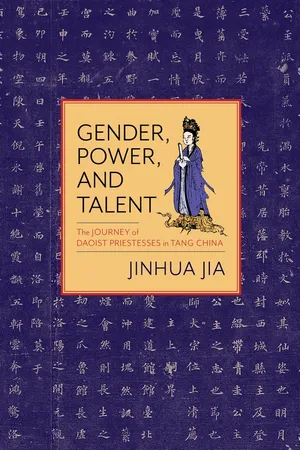
During the Tang dynasty (618–907), changes in political policies, the religious landscape, and gender relations opened the possibility for Daoist women to play an unprecedented role in religious and public life. Women, from imperial princesses to the daughters of commoner families, could be ordained as Daoist priestesses and become religious leaders, teachers, and practitioners in their own right. Some achieved remarkable accomplishments: one wrote and transmitted texts on meditation and inner cultivation; another, a physician, authored a treatise on therapeutic methods, medical theory, and longevity techniques. Priestess-poets composed major works, and talented priestess-artists produced stunning calligraphy.
In Gender, Power, and Talent, Jinhua Jia draws on a wealth of previously untapped sources to explain how Daoist priestesses distinguished themselves as a distinct gendered religious and social group. She describes the life journey of priestesses from palace women to abbesses and ordinary practitioners, touching on their varied reasons for entering the Daoist orders, the role of social and religious institutions, forms of spiritual experience, and the relationships between gendered identities and cultural representations. Jia takes the reader inside convents and cloisters, demonstrating how they functioned both as a female space for self-determination and as a public platform for both religious and social spheres. The first comprehensive study of the lives and roles of Daoist priestesses in Tang China, Gender, Power, and Talent restores women to the landscape of Chinese religion and literature and proposes new methodologies for the growing field of gender and religion.
- English
- ePUB (mobile friendly)
- Available on iOS & Android
eBook - ePub
About this book
Information
Topic
GeschichteSubtopic
Chinesische GeschichteNotes
Introduction
1. For a detailed discussion of the Tang ruling house’s promotion of Daoism, integration of the Daoist system, and establishment of Daoist monastic tradition, see chapter 2 of this book.
2. For a detailed discussion of the changes in gender relations, see chapter 2 of this book.
3. First applied in Stephen Wang’s master’s thesis and then adopted by his supervisor Edward H. Schafer (Schafer, The Vermilion Bird: T’ang Images of the South [Berkeley: University of California Press, 1967], 7), scholars of Daoism have commonly translated the term xian 仙 or xianren 仙人 as “transcendent” instead of “immortal.” Indeed, this translation is in accordance with the connotations of these terms in English. The term “transcendent” connotes both the religious sense of transcending the universe and material experience and the common sense of surpassing others of the same kind, whereas for most Westerners an “immortal” calls up obsolete ideas of godhood, like the immortal gods of Greek mythology; to speak of “immortals” places such beings outside this world, existing only in theory or imagination. On the other hand, there are also reasons for the translation of “immortal.” Since the Eastern Zhou and onward, the concept that human life can be prolonged (changsheng 長生) and humans can become immortal (chengxian 成仙) has been developed and has pervaded the Chinese cultural tradition, not just within the Daoist tradition, though Daoism, especially the tradition before the Song dynasty, focuses particularly on prolonging individual life and attaining immortality of both body and spirit; legends of common people becoming “immortals” have appeared throughout history. See Benjamin Penny, “Immortality and Transcendence,” in Daoism Handbook, ed. Livia Kohn (Leiden: Brill, 2004), 109–33. The term “immortal” makes smooth sense to the Chinese ear. Furthermore, the traditional Chinese worldview is basically “one world,” with heaven, earth, gods, humans, the myriad things, and even the Dao coexisting in one single universe; there is never a transcendental world beyond this universe, as in the Western tradition. See Roger T. Ames, Sun-tzu: The Art of Warfare (New York: Ballantine, 1993), 43–67; and Li Zehou 李澤厚, You wu dao li Shi li gui ren 由巫到禮釋禮歸仁 (Beijing: Sanlian shudian, 2015), 132–37, 170–90. Although the term “transcendent” is an etymologically correct translation of xian and retains the sense of a being who remains in our universe but on a higher level of existence, it does not foreground the idea of immortality. Here we encounter the common difficulty of finding an English term that covers completely the meaning inherent in a Chinese term: both “transcendent” and “immortal” present their advantages and disadvantages as a translation of xian. For the purpose of consistency, I use “immortal” and “immortality” throughout this book. I thank Paul W. Kroll for offering knowledgeable information for the preceding discussion.
4. For a detailed discussion of the formation of Daoist priestesses as a gendered group, see chapter 2 of this book.
5. Susan Calef, “Charting New Territory: Religion and ‘the Gender-Critical Turn,’ ” Journal of Religion & Society 5 (2009): 2. Of course, we should also keep in mind the dark side of religious traditions concerning women, as Calef also indicates.
6. See Michel Foucault, “An Aesthetics of Existence,” in Politics, Philosophy, Culture: Interviews and Other Writings, 1977–1984, ed. Lawrence D. Kritzman (New York: Routledge, 1988), 50; and Judith Butler, Excitable Speech: A Politics of the Performative (New York: Routledge, 1997), 16.
7. See Joan W. Scott, “Gender: A Useful Category of Historical Analysis,” American Historical Review 91, no. 5 (December 1986): 1053–75, esp. 1068.
8. Ursula King, “General Introduction: Gender-Critical Turns in the Study of Religion,” Gender, Religion and Diversity: Cross-Cultural Perspectives, ed. Ursula King and Tina Beattie (London: Continuum, 2005), 1–12.
9. See, for example, Catherine Despeux, Immortelles de la Chine ancienne: Taoïsme et alchimie feminine (Paris: Pardés, 1990); Patricia B. Ebrey, The Inner Quarters: Marriage and the Lives of Chinese Women in the Sung Period (Berkeley: University of California Press, 1993); Dorothy Ko, Teachers of the Inner Chambers: Women and Culture in Seventeenth-Century China (Stanford, CA: Stanford University Press, 1994); Susan Mann, Precious Records: Women ...
Table of contents
- Cover
- Title Page
- Copyright
- Dedication
- Contents
- List of Figures and Tables
- Acknowledgments
- List of Abbreviations
- Introduction
- I. The Rise of Daoist Priestesses as a Gendered Religio-Social Group
- II. Destiny and Power of the Ordained Royal Women
- III. Religious Leadership, Practice, and Ritual Function
- IV. Liu Moran and the Daoist Theory of Inner Cultivation
- V. Longevity Techniques and Medical Theory: The Legacy of Hu Yin
- VI. The Yaochi ji and Three Daoist Priestess-Poets
- VII. Unsold Peony: The Life and Poetry of the Priestess-Poet Yu Xuanji
- Conclusion
- Appendix: Du Guangting and the Hagiographies of Tang Daoist Women
- Notes
- Bibliography
- Index
Trusted by 375,005 students
Access to over 1.5 million titles for a fair monthly price.
Study more efficiently using our study tools.
Frequently asked questions
Yes, you can cancel anytime from the Subscription tab in your account settings on the Perlego website. Your subscription will stay active until the end of your current billing period. Learn how to cancel your subscription
No, books cannot be downloaded as external files, such as PDFs, for use outside of Perlego. However, you can download books within the Perlego app for offline reading on mobile or tablet. Learn how to download books offline
Perlego offers two plans: Essential and Complete
- Essential is ideal for learners and professionals who enjoy exploring a wide range of subjects. Access the Essential Library with 800,000+ trusted titles and best-sellers across business, personal growth, and the humanities. Includes unlimited reading time and Standard Read Aloud voice.
- Complete: Perfect for advanced learners and researchers needing full, unrestricted access. Unlock 1.5M+ books across hundreds of subjects, including academic and specialized titles. The Complete Plan also includes advanced features like Premium Read Aloud and Research Assistant.
We are an online textbook subscription service, where you can get access to an entire online library for less than the price of a single book per month. With over 1.5 million books across 990+ topics, we’ve got you covered! Learn about our mission
Look out for the read-aloud symbol on your next book to see if you can listen to it. The read-aloud tool reads text aloud for you, highlighting the text as it is being read. You can pause it, speed it up and slow it down. Learn more about Read Aloud
Yes! You can use the Perlego app on both iOS and Android devices to read anytime, anywhere — even offline. Perfect for commutes or when you’re on the go.
Please note we cannot support devices running on iOS 13 and Android 7 or earlier. Learn more about using the app
Please note we cannot support devices running on iOS 13 and Android 7 or earlier. Learn more about using the app
Yes, you can access Gender, Power, and Talent by Jinhua Jia in PDF and/or ePUB format, as well as other popular books in Geschichte & Chinesische Geschichte. We have over 1.5 million books available in our catalogue for you to explore.