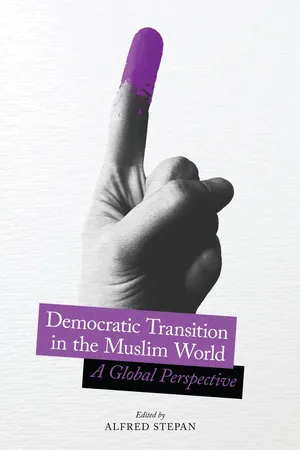
In early 2011, widespread protests ousted dictatorial regimes in both Tunisia and Egypt. Within a few years, Tunisia successfully held parliamentary and presidential elections and witnessed a peaceful transition of power, while the Egyptian military went on to seize power and institute authoritarian control. What explains the success and failure of transitions to democracy in these two countries, and how might they speak to democratic transition attempts in other Muslim-majority countries?
Democratic Transition in the Muslim World convenes leading scholars to consider the implications of democratic success in Tunisia and failure in Egypt in comparative perspective. Alongside case studies of Indonesia, Senegal, and India, contributors analyze similarities and differences among democratizing countries with large Muslim populations, considering universal challenges as well as each nation's particular obstacles. A central theme is the need to understand the conditions under which it becomes possible to craft pro-democratic coalitions among secularists and Islamists. Essays discuss the dynamics of secularist fears of Islamist electoral success, the role of secular constituencies in authoritarian regimes' resilience, and the prospects for moderation among both secularist and Islamist political actors. They delve into topics such as the role of the army and foreign military aid, Middle Eastern constitutions, and the role of the Muslim Brotherhood. The book also includes an essay by the founder and president of Tunisia's Ennadha Party, Rachid Ghannouchi, who discusses the political strategies his party chose to pursue.
- English
- ePUB (mobile friendly)
- Available on iOS & Android
eBook - ePub
About this book
Information
PART I
WHY DIFFERENT DEMOCRATIZATION OUTCOMES IN TUNISIA AND EGYPT?
Cross-Ideological Accommodations, Constitutions, Militaries, and the Content of International Assistance
1
ENNAHDA’S DEMOCRATIC COMMITMENTS AND CAPABILITIES
Major Evolutionary Moments and Choices
RACHED GHANNOUCHI
The story of Tunisia remained largely untold until seven years ago. In December 2010, after decades of stifling repression and authoritarian rule, the country arose to ignite the flame of the Arab Awakening. Since then, Tunisia has witnessed three democratic and fair elections, a consensual transition, and the adoption of a democratic and progressive constitution that enjoys broad support. The path to becoming a democratic and fair society is yet to be completed, but it has been preserved by painstaking efforts to build political consensus and foster an inclusive system based on coexistence. It is in this sense that Tunisia can be hailed as a model for the Arab region.
This democratic transition is unprecedented for our country and indeed the region. Tunisia’s transition from a repressive dictatorship to a newborn democracy brought about an evolution—and in some areas a revolution—on the political scene and in society as a whole. This chapter charts an overview of the evolution of the Ennahda (Renaissance) Party over the transitional period, from an opposition party persecuted and refused legal recognition to being the leading party in Tunisia’s first democratically elected government. It seeks to delineate the principles guiding the Ennahda Party’s approach to Tunisia’s delicate transition and to, in particular, the elaboration of its historic constitution, the cornerstone of the new democratic republic.
GUIDING PRINCIPLES OF DEMOCRATIC TRANSITION
FIRST PRINCIPLE: CROSS-PARTY PARTNERSHIPS AND COALITION BUILDING
The extraordinary transitional phase presented an immense challenge to Tunisia as a whole and in particular to the political parties that had the delicate task of managing the difficult journey from dictatorship to a democratic state. The transitional phase has provided an opportunity to build on existing partnerships and to form new ones, to implement previously learned lessons and to learn new ones.
The first principle that has guided the Ennahda Party’s approach is the willingness to form cross-party partnerships. The principle of pluralism is one that the party adopted at its inception. As early as 1981, when the party was founded, it explicitly recognized the right of any party, regardless of its ideological background, to govern if supported by the popular will. This was ahead of both Islamic and secular parties in Tunisia, who hesitated for a long time—some up to this moment—in recognizing genuine pluralism.
The Ennahda Party’s understanding of pluralism goes beyond merely the idea of coexistence; it embraces partnership with parties of different intellectual and political backgrounds. This was demonstrated in the October 18 Committee of 2005, which brought together political activists, journalists, and human rights activists from various parties as well as independents. The initiative began as a joint hunger strike on the occasion of the UN-sponsored World Summit on the Information Society in Tunis in order to draw attention to the continuing deterioration of rights in Tunisia and to call for an end to human rights violations and the release of political prisoners.
The October 18 Committee developed into a forum to elaborate a shared vision for a post–Ben Ali democratic Tunisia. The committee produced joint papers on fundamental questions such as mechanisms for the peaceful alternation of power, equality between men and women, freedom of belief in a modern Muslim society, and the relationship between religion and the state in a future democratic system. Forging a partnership between secular and Islamist activists was intellectually and politically challenging because the Ben Ali regime fiercely opposed and actively sought to obstruct any such rapprochement. However, the committee was critical in laying the groundwork for future partnership by concretely elaborating the principles for building a pluralistic democracy and imagining a free democratic Tunisia beyond dictatorship.
The revolution opened up further spaces for cross-party cooperation. In the immediate aftermath of the revolution, the Ennahda Party joined the Higher Commission for the Achievement of the Goals of the Revolution and cooperated with all of the other parties in the commission. Even before the first post–Ben Ali elections, Ennahda openly declared its firm belief that whatever the result of the elections, Tunisia needed a coalition government built on broad representation and cooperation between parties.
We were convinced that building the foundations of a democratic Tunisia was an immense challenge that could only be achieved by preventing polarization and fostering cooperation between parties, in particular between the two principal intellectual trends in our society—moderate secularism and moderate Islamism. These two movements have always been the two wings of the national reform movement and are both critical to the democratic project.
After winning the free and fair elections for the National Constituent Assembly in October 2011, we reiterated our call for a national unity government. We could have formed a coalition based on ideological similarity, but we consciously sought to establish a new democratic tradition in Tunisia—that of cross-ideological cooperation and rejection of any monopolization of power by one party or trend. Two center-left secular parties responded to our call: the Ettakatol Party and the Congress for the Republic (CPR) Party—and we formed a coalition that proved to be a pioneering model of coexistence between secularists and Islamists, the two trends that had been in conflict in the region for the preceding half-century.
SECOND PRINCIPLE: CONSENSUS BUILDING
The coalition between Ennahda, Ettakatol, and CPR was the result of our conviction that Tunisia should be governed through consensus and that transitions cannot be managed by the logic of majority versus minority.
In fact, Tunisia’s political leaders have elaborated a new form of transitional democracy based on participation and consensus building rather than on majoritarian democracy. This principle is at the root of the Tunisian model. Our adoption of consensus as a principle and as a methodology for governing was based on a conviction that transitional phases must not be governed by a majority of 51 percent. Rather, a broad consensus must be forged between the broadest possible trends in society in order to establish stability and shared political traditions. A democratic transition is the moment in which new foundational rules are established and new political conventions forged. It is critical that it be structured in a way that enables and incentivizes all political actors to contribute and commit to these new rules. The consolidation of that commitment, when there is no going back to the old rules, is what marks the end of the transition and the beginning of a stable democratic system.
The practice of consensus is an extremely delicate art, a complex response to a complex reality. In the absence of an established political culture between political elites, simple majoritarian democracy cannot provide an adequate framework. Thus, the model of consensus building between political trends provided the most appropriate tool for constructing shared conventions and a common political framework within which political competition could take place, leading to the success of the democratic transition and preventing chaos and conflict. Consensus building succeeded in saving Tunisia and its revolution from the many major crises it faced.
THIRD PRINCIPLE: CRISIS MANAGEMENT THROUGH DIALOGUE AND COMPROMISE
Despite the best of intentions, the Tunisian transition brought no shortage of challenges and crises. The Ennahda Party’s approach was to deal with political crises using the logic of dialogue and compromise. Following the assassination of the martyr Chokri Belaid in February 2013, Ennahda accepted a proposal to hand key ministries to independent figures and technocrats. Following the assassination of the parliamentarian Mohamed Brahmi in July 2013, we took a similar approach. When a number of parliamentarians suspended their participation in constitutional debates in order to protest the assassination, Ennahda could have continued the debates and proceeded to the adoption of the constitution without their participation. However, we did not seek to rush through the adoption of the constitution nor impose a hurried transition. We understood that while finding a compromise might take time, it would be better than making the Tunisian constitution the constitution of a majority imposed on a minority.
Thus, following a national dialogue, we signed a road map according to which the Ennahda-led coalition government would resign and hand over power to an independent technocrat government, once agreement had been reached on a new prime minister, the adoption of the constitution, and the election of an election commission. The aim was not to remain in power but to ensure that the National Constituent Assembly, the supreme representative body, could complete its work of drafting a constitution to set the political foundations for a democratic Tunisia. This required broad agreement and a climate of national unity, not a logic of conflict and confrontation.
Ennahda’s departure from government was a sign of the success of the national dialogue in resolving conflict. Prime Minister Ali Laarayedh’s resignation was a rare example of peaceful transfer of power in our region and of Ennahda’s commitment to democratic governance. As the largest party in the country, we believed Ennahda was required to give the greatest concessions to protect the revolution and the democratic transition process. These sacrifices helped preserve the country’s unity and its democratic transition, crowned by the adoption of a new constitution by a striking 94 percent of the National Constituent Assembly and the holding of the country’s second free and fair elections.
FOURTH PRINCIPLE: INCLUSION
In light of the dangers of polarization and division, whose consequences can be seen in the countries in crisis around the region, Ennahda chose to adopt the inclusive approach of consensus by incorporating the old system into the new. We rejected all the roads leading to exclusion or division between Tunisians and chose not to adopt a law of political exclusion such as the one introduced in Iraq and Libya. Anyone who enters under the political roof of democracy, as set out in the new constitution, is a Tunisian with full rights and without any discrimination. If they are proven to have wronged or violate...
Table of contents
- Cover
- Series Statement
- Title Page
- Copyright
- Contents
- Foreword by Monica Marks
- Acknowledgments
- Introduction by Alfred Stepan
- Part I. Why Different Democratization Outcomes in Tunisia and Egypt?: Cross-Ideological Accommodations, Constitutions, Militaries, and the Content of International Assistance
- Part II. Rethinking Other Democracies with Large Muslim Populations: What Policies Helped in Indonesia and India?
- Selected Bibliography
- Contributors
- Index
- Series List
Trusted by 375,005 students
Access to over 1.5 million titles for a fair monthly price.
Study more efficiently using our study tools.
Frequently asked questions
Yes, you can cancel anytime from the Subscription tab in your account settings on the Perlego website. Your subscription will stay active until the end of your current billing period. Learn how to cancel your subscription
No, books cannot be downloaded as external files, such as PDFs, for use outside of Perlego. However, you can download books within the Perlego app for offline reading on mobile or tablet. Learn how to download books offline
Perlego offers two plans: Essential and Complete
- Essential is ideal for learners and professionals who enjoy exploring a wide range of subjects. Access the Essential Library with 800,000+ trusted titles and best-sellers across business, personal growth, and the humanities. Includes unlimited reading time and Standard Read Aloud voice.
- Complete: Perfect for advanced learners and researchers needing full, unrestricted access. Unlock 1.5M+ books across hundreds of subjects, including academic and specialized titles. The Complete Plan also includes advanced features like Premium Read Aloud and Research Assistant.
We are an online textbook subscription service, where you can get access to an entire online library for less than the price of a single book per month. With over 1.5 million books across 990+ topics, we’ve got you covered! Learn about our mission
Look out for the read-aloud symbol on your next book to see if you can listen to it. The read-aloud tool reads text aloud for you, highlighting the text as it is being read. You can pause it, speed it up and slow it down. Learn more about Read Aloud
Yes! You can use the Perlego app on both iOS and Android devices to read anytime, anywhere — even offline. Perfect for commutes or when you’re on the go.
Please note we cannot support devices running on iOS 13 and Android 7 or earlier. Learn more about using the app
Please note we cannot support devices running on iOS 13 and Android 7 or earlier. Learn more about using the app
Yes, you can access Democratic Transition in the Muslim World by Alfred Stepan in PDF and/or ePUB format, as well as other popular books in Politik & Internationale Beziehungen & Vergleichende Politikwissenschaften. We have over 1.5 million books available in our catalogue for you to explore.