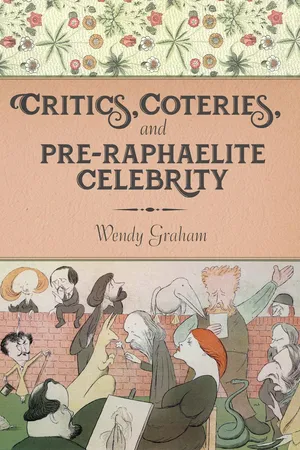
Founded by a band of young iconoclasts, the Pre-Raphaelite Brotherhood stunned Victorian England with its revaluation of culture and lifestyle. With Pre-Raphaelitism ascendant in the 1850s and canonical by the 1880s, the movement's refractory reception history is an object lesson in how avant-gardes burst upon the scene, dispense with their antagonistic posture, and become a mainstay of tradition. Wendy Graham traces the critical discourses that greeted the Pre-Raphaelites' debut, shaped their contemporary reception, and continued to inform responses to them well after their heyday. She explains the mechanics of fame and the politics of scandal contributing to the rise of aestheticism, providing a new interpretation of the place of aesthetic counterculture in Victorian England.
Critics, Coteries, and Pre-Raphaelite Celebrity sheds new light on Victorian discourses on sexuality and masculinity through a thick description of literary bravado, the emotions of male bonding within cliques, and homoerotic frissons among the creators and reviewers of Pre-Raphaelitism. Graham threads together the qualities that made William Holman Hunt, John Everett Millais, and Gabriel Rossetti exemplary figures of aesthetic celebrity in the 1850s; Algernon Swinburne and Simeon Solomon in the 1860s; and Edward Burne-Jones and Walter Pater in the 1870s. The book documents the symbiotic relationship between periodical writers and the artists and poets they helped make famous, demonstrating that the origin myth of Bohemian artistic transcendence was connected with the rise of a professional class of journalists. Graham shows that the Pre-Raphaelites innovated many of the phenomena now associated with Oscar Wilde, arguing that they were foundational for him in forging an artistic and personal identity with a full-blown publicity apparatus. Wilde had models. This book is about them.
- English
- ePUB (mobile friendly)
- Available on iOS & Android
eBook - ePub
Critics, Coteries, and Pre-Raphaelite Celebrity
About this book
Information
Topic
LiteraturaSubtopic
Historia del arteONE
The Pre-Raphaelite Vanguard
In the Royal Academy the works of the so-called Praeraphaelites, Millais and Hunt, are cynosures which now attract and absorb the attention of admiring multitudes. Amidst the sneers of stolid criticism, these two men have inaugurated a new era in art; and now it happens, in the fifth year of their epiphany, that many who came to laugh remain to worship.
—“Art and Artists”
Pre-Raphaelitism was a catalyst and mirror of human society in a period roiled by change. Pre-Raphaelite provocations against conventional art, literature, and lifestyle challenged the conceptual frameworks that governed Victorian society. Nothing less than revolutionary, Pre-Raphaelite strategies of visual, verbal, temporal, and thematic defamiliarization make a compelling case for the movement’s avant-garde disposition. Pre-Raphaelitism variously embraced or contradicted Victorian notions of “traditionalism,” “antiquarianism,” “medievalism,” and “classicism,” terms entering English usage or becoming commonplace in the mid-nineteenth century.1 Probing new concepts and altered meanings of older words, such as “sincerity,” the Pre-Raphaelites participated in cultural transformation as well as aesthetic experimentation. They belonged to Hobsbawm’s “age of revolution” (1789–1848) in a double sense.2 As a passel of “youthful revolutionaries,”3 they embodied the values of the French Revolution: liberté, egalité, fraternité. Pre-Raphaelitism emerged at the height of the Industrial Revolution, by which time the bourgeoisie had established a fluid societal order based on economic class and social mobility as opposed to the precapitalist hierarchy of rank still in force among the landed aristocracy and gentry. The increasing rationalization of economic life under capitalism led to a paradigm shift in the epistemic order, which now adhered to the law of “development-in-time.”4 In History of Bourgeois Perception, Donald Lowe argues that the field of human perception is delimited by epistemic suppositions, which order the content of perceptions; the media of communication, which frame and facilitate perception; and the hierarchy of senses, which determines the subject’s embodied perception (1). Lowe’s phenomenological approach to the consciousness of historical subjects is germane to Pre-Raphaelite endeavor in the age of progress (evolution), print media (typographic culture), and the artists’ assault on visual and temporal conventions in the machine age.
Connecting the complex reception history of Pre-Raphaelitism with the Victorian social discourse on class, work, and intimacy is the task of this chapter. Period informants, patrons, and the Pre-Raphaelites themselves displayed a diverse rather than homogeneous, and evolving rather than static, bourgeois consciousness. Providing a fixed set of contexts and personnel (local character) and historic span (1848–1882), Pre-Raphaelite narratives and artifacts are the type of “very densely textured facts” that can be used to link symbolic action to social structure.5 Painting and collecting (writing and publishing) involved discrete socioeconomic interactions among bourgeois factions. Rising to a position of wealth and complacency that brooked no admission of social inferiority, the British bourgeoisie helped to popularize a narrative art that mirrored its diurnal concerns, such as Frith’s zeitgeist paintings. Another subset of this class fascinated itself with the images produced by the members of the counterculture. Whether viewed as fetish objects, status symbols, or portals to a spiritual realm far removed from the marketplace, Pre-Raphaelite art sanctified the cultural authority of the capitalist class. Industrialists and businessmen favored contemporary British artists over the old masters, partly to avoid being rooked. According to the Pre-Raphaelite critic F. G. Stephens, “The so-called middle-class of England has been that which has done the most for English art. While its social superiors ‘praised’ Pietro Perugino, neglected Turner, let Wilson starve,” Stephens averred, “the merchant princes bought of Turner, William Hunt, Holman Hunt, and Rossetti.”6 The act of collecting became a gesture of self-assertion for a bourgeoisie anxious to demonstrate its taste, patriotism, and economic clout over and against the traditional elites. Merchants and industrialists challenged the aristocracy’s dominance in the cultural sphere, paradoxically relying on antibourgeois art to appear unapologetically bourgeois.
In Art and the Victorian Middle Class, Dianne Sachko Macleod explains the unlikely attraction of middle-class businessmen of a sober and pious bent to Pre-Raphaelite art. Describing the Mancunian preference for modern art reflecting the values of work, progress, aesthetic invention, and success, Macleod confirms the ambivalence of clients toward the term “Pre-Raphaelite,” with its antiquated associations. She cites Holman Hunt’s recollections of his conversation with the textile manufacturer Thomas Fairbairn: “Let me advise you, when talking to Manchester people about the works of your school, not to use that term; they are disposed to admire individual examples, but the term has to them become one of such confirmed ridicule that they cannot accept it calmly!”7 Discussing the nouveau riche tendency to favor objects that suggested “costliness,” Francis Klingender explains the appeal of minutely detailed replicas of even commonplace objects, for the reproduction of these things entailed hours of labor.8 In Hunt’s The Awakening Conscience (1853), the wood grain of the freshly polished piano, the Turkey carpet, and the eyelet lace suggest a tension between modern industrial commodities and the skilled, labor-intensive work of oil painting by hand.
Apart from its rightly appreciated workmanship, The Awakening Conscience instantiates the bourgeois patron’s failure to fully appreciate the artist’s aims and originality. Fairbairn instructed Hunt to soften the pained expression of the fallen woman, whose recovered sense of decency supplied the central motive for the picture. As Carol Christ claims, the PRB self-consciously relied on grotesque expression to evoke intense states of feeling (inciting charges of morbidity) in defiance of exhausted conventional symbolism.9 While the fallen woman was a staple of Victorian genre painting, Hunt’s meticulous revaluation of familiar domestic objects to convey foreboding was wholly original. Converted into symbols of shame and imminent ruin, domestic articles took on the function and emotional resonance of religious iconography (such as the picture above the mantelpiece of The Woman Taken in Adultery).10 As Ruskin pointed out in a letter to The Times, “The very hem of the poor girl’s dress, at which the painter has labored so closely, thread by thread, has story in it, if we think how soon its pure whiteness may be soiled with dust and rain, her outcast feet failing in the street.”11
Pre-Raphaelitism was a middle-class art (made for and by members of the bourgeoisie), but it was nothing like the Victorian kitsch manufactured by the yard. Members of the PRB hailed from the British middle classes but selectively incorporated middle-class ideals. Morse Peckham’s Victorian Revolutionaries: Speculations on Some Heroes of the Culture Crisis, a study of alienation and cultural transcendence, places the PRB and the poet Swinburne at the forefront of disaffected intellectuals.12 Counterintuitively, the qualities of self-assertion and self-sufficiency that fueled the rise of the industrial class also energized the bohemian rebellion against propriety and cultural institutions. Raymond Williams explains that the initial bourgeois rebellion against aristocratic privilege on the grounds of self-possessive individualism inevitably fomented internal dissent within the ranks. Focusing on the modernists’ hostility to domesticity, monogamy, and childcare as a check on personal freedom and mobile desire, Williams retroactively confirms the Pre-Raphaelites’ adherence to the ideology of the sovereign individual and vanguard rejection of the bourgeois family and the mores supporting it.13
For the Victorian capitalist class, success entailed professional, social, and domestic responsibility, inculcated by the Protestant work ethic and evangelical disdain for pleasure seeking, twin tenets that impinged on personal freedom. May-December second marriages were prevalent among the moneyed merchant class, but the bohemians routinely committed adultery, fornicated, and married “beneath them.” Gabriel Rossetti flouted the rules of bourgeois propriety in his courtship, marriage, and two-timing of Elizabeth Siddall, his fiancée for nine years. A significant number of middle-class artists, among them Holman Hunt, Rossetti, Ford Madox Brown, Whistler, and William Morris, married or cohabited with working-class women. Hunt’s The Awakening Conscience, Rossetti’s Found (1855), and Brown’s Take Your Son, Sir! (begun in 1851) depict the social chaos caused by love affairs between gentlemen and women of the lower classes. Merchants purchased these canvases as investments, decorations, and pictorial sermons, while the bohemians challenged class hierarchies through the representation of alternative lifestyles. As benefactor and friend of the bohemian artist, the captain of industry allied himself with creative genius but not necessarily with the outlier lifestyles and ribald collegiality of the PRB frolicking in bachelor digs. Writing to Brown on the eve of Walter Deverell’s bid to join the PRB, John Tupper appended a postscript to his letter suggestive of juvenile ebullience and unfeigned interest, evidently common among the brethren, in a friend’s sexual hygiene: “Happy New Year to you! And P.R.B. to Deverell, I suppose tonight, eh? You may interpret P.R.B. ‘Penis rather better’—which to him is important.”14 A reputation for sexual adventurism, which later fostered the ill fame of Wilde, lent a kind of glamour as well as notoriety to his predecessors.
The PRB challenged class and institutional hierarchies as an “Aristocracy of Talent.”15 They also afforded wealthy businessmen the opportunity to patronize aspiring men not unlike themselves. The revolutionary statements and bohemian gestures of PRB figureheads appealed to a select bourgeois clientele oppressed by ennui and dismayed by the creeping materialism of the period. Inspired by Carlyle and Ruskin’s sermonizing, the PRB addressed society’s yearning for art to take over hieratic functions in an era of scientific rationalism and religious controversy. The Pre-Raphaelites produced secular devotional art and, in Rossetti’s case, replaced organized religion with a religion of beauty.16 In both cases, the PRB’s indifference to fame and money and their faith in the social mission of art were essential values. Anticipating the emotional needs of their first constituency, the PRB advocated a return to a mode of life where literature and art served devotional and humanistic ends rather than commercial goals. This was an important message in 1848. In the year of the PRB’s founding, revolutionary activity across Europe calcified class antagonism between former allies in the struggle against monarchical privilege: the industrial bourgeoisie and the proletariat. Describing the supersession of the feudal aristocracy, Marx noted that aristocratic ideals (such as chivalry, fealty, honor) benefited a sliver of the community whereas bourgeois ideology proclaimed liberty and equality for all.17 At the onset of the French Revolution, the populace embraced the new ideology of personal freedom as a universal right; its appeal was widespread and enduring. The men who patronized the PRB made their fortunes exploiting the system of wage labor for their own benefit. By purchasing PRB canvases depicting scenes of rural life, biblical and literary anecdotes, and even images of poverty and prostitution, patrons practiced vicarious liberalism. Of course, this faith in a shared humanism was based on a series of misconceptions about Pre-Raphaelitism’s religious orientation, class outlook, and respect for patrons.
The Pre-Raphaelites’ claim to their “avant-garde position,” that of mortifying the Royal Academy in matters of style and the bourgeoisie in matters of morality, was tenable during Rossetti’s lifetime.18 They forced Victorians to confront the incongruities in the national narrative between the feudal past and industrial present; among Protestantism, Anglicanism, and Tractarianism; between Tory and Whig politics; between traditional and avant-garde art; and between domesticity and sexual freedom. The PRB and its affiliates were forerunners of later cultural conflicts connected with the avant-garde movements that eschewed the marketplace for art and literature. As a self-named and purposeful collective, they anticipated the formation of the historical avant-garde in the very terms laid out by Williams in “The Politics of the Avant-Garde.” Between 1848 and 1853, the PRB rejected the traditional apparatuses of cultural legitimation. They banded together to protect their innovative aesthetic practices from institutional and market interference. They developed their own techniques, tools, and facilities for production (from grinding pigments to hand-blocking wallpaper). Above all, they exploited the literary character of the public sphere to attack their enemies in the cultural establishment and promote their work: “Thus the defense of a particular kind of art bec...
Table of contents
- Cover
- Series Statement
- Title Page
- Copyright
- Contents
- List of Illustrations
- Acknowledgments
- Introduction
- 1. The Pre-Raphaelite Vanguard
- 2. Puff, Slash, Burn: Literary Celebrity
- 3. Fortune’s Weal
- 4. Dante Gabriel Rossetti: Aesthetic Celebrity
- 5. Anonymous Journalism: The Fleshly School Controversy
- 6. Henry James and British Aestheticism
- Afterword
- Notes
- Works Cited
- Index
- Series List
- Color Plates
Trusted by 375,005 students
Access to over 1.5 million titles for a fair monthly price.
Study more efficiently using our study tools.
Frequently asked questions
Yes, you can cancel anytime from the Subscription tab in your account settings on the Perlego website. Your subscription will stay active until the end of your current billing period. Learn how to cancel your subscription
No, books cannot be downloaded as external files, such as PDFs, for use outside of Perlego. However, you can download books within the Perlego app for offline reading on mobile or tablet. Learn how to download books offline
Perlego offers two plans: Essential and Complete
- Essential is ideal for learners and professionals who enjoy exploring a wide range of subjects. Access the Essential Library with 800,000+ trusted titles and best-sellers across business, personal growth, and the humanities. Includes unlimited reading time and Standard Read Aloud voice.
- Complete: Perfect for advanced learners and researchers needing full, unrestricted access. Unlock 1.5M+ books across hundreds of subjects, including academic and specialized titles. The Complete Plan also includes advanced features like Premium Read Aloud and Research Assistant.
We are an online textbook subscription service, where you can get access to an entire online library for less than the price of a single book per month. With over 1.5 million books across 990+ topics, we’ve got you covered! Learn about our mission
Look out for the read-aloud symbol on your next book to see if you can listen to it. The read-aloud tool reads text aloud for you, highlighting the text as it is being read. You can pause it, speed it up and slow it down. Learn more about Read Aloud
Yes! You can use the Perlego app on both iOS and Android devices to read anytime, anywhere — even offline. Perfect for commutes or when you’re on the go.
Please note we cannot support devices running on iOS 13 and Android 7 or earlier. Learn more about using the app
Please note we cannot support devices running on iOS 13 and Android 7 or earlier. Learn more about using the app
Yes, you can access Critics, Coteries, and Pre-Raphaelite Celebrity by Wendy Graham in PDF and/or ePUB format, as well as other popular books in Literatura & Historia del arte. We have over 1.5 million books available in our catalogue for you to explore.