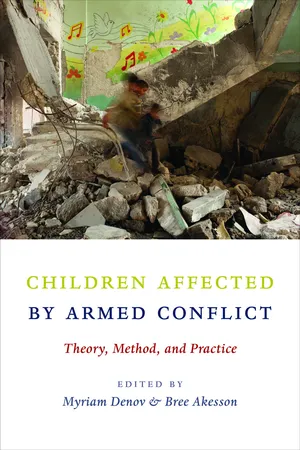
Societal turbulence, state collapse, religious and ethnic conflict, poverty, hunger, and social exclusion all underlie children's involvement in armed conflict. Drawing from empirical studies in eleven conflict-ridden countries, including Pakistan, Sri Lanka, Thailand, Colombia, Uganda, Palestine, Somalia, Liberia, Sierra Leone, Sudan, and South Sudan, Children Affected by Armed Conflict crosses cultures and contexts to capture a range of perspectives on the realities of armed conflict and its aftermath for children.
Children Affected by Armed Conflict upends traditional views by emphasizing the experience of girls as well as boys, the unique social and contextual backgrounds of war-affected children, and the resilience and agency such children often display. Including children who are victims of, participants in, and witnesses to armed conflict in their analyses, the contributors to this volume highlight innovative methodologies that directly involve war-affected children in the research process. This validates the perspectives of children and ensures more effective outcomes in postwar reintegration and recovery. Deficits-based models do not account for the realities many war-affected children face. The alternative approaches presented in this edited collection—which acknowledge the realities of both trauma and resilience—aim to generate more effective policies and intervention strategies in the face of a growing global public health crisis.
eBook - ePub
Children Affected by Armed Conflict
Theory, Method, and Practice
- English
- ePUB (mobile friendly)
- Available on iOS & Android
eBook - ePub
Children Affected by Armed Conflict
Theory, Method, and Practice
About this book
Information
Subtopic
Social WorkIndex
Social SciencesPART ONE
UNDERSTANDING THE REALITIES OF CHILDREN IN ARMED CONFLICT
Theoretical and Conceptual Considerations
This first section of the book aims both to capture the multifaceted realities of children affected by armed conflict and contribute to conceptual and theoretical considerations. The chapters in this section critically interrogate the concepts of resilience, social exclusion, connectedness and belonging, agency, and social construction and their implications for war-affected children in Burma, Colombia, Pakistan and Sri Lanka.
In chapter 1, “ ‘Raising the Dead’ and Cultivating Resilience: Postcolonial Theory and Children’s Narratives from Swat, Pakistan,” Lubna Chaudhry explores the realities of children’s experiences by reflecting on their constructions of trauma, violence, and resilience in the context of the armed conflict in Swat Valley, Pakistan. In her analysis, Chaudhry engages with postcolonial theories of trauma and mourning to argue that children are social actors whose narratives of trauma—by their very articulation—become assertions of agency and even manifestations of resilience. These narratives demonstrate how children negotiate the violence around them, as well as the ways in which gender, class, ethnicity, and geographical positioning influence individual and collective identities.
In chapter 2, “Young Children’s Experiences of Connectedness and Belonging in Postconflict Sri Lanka: A Socioecological Approach,” Nanditha Hettitantri and Fay Hadley consider young children’s experiences of connectedness to their social ecology in a postconflict Sri Lankan village. Through an analysis of the accounts of two young children, Hettitantri and Hadley demonstrate the ways in which these children experience connectedness to their social ecology and develop a sense of personal and community belonging. These factors, the authors argue, contribute to young children’s resilience in a post-conflict setting and hence should be further developed and supported through service provision. Hettitantri and Hadley illustrate that listening to the voices of very young children (3- and 4-year-old children) can be fruitful in understanding their lives and that agency does not discriminate according to age.
In chapter 3, “Contending with Violence and Discrimination: Using a Social Exclusion Lens to Understand the Realities of Burmese Muslim Refugee Children in Thailand,” Mollie Pepper explores the experiences of marginalization and social exclusion among Burmese Muslim children living in refugee camps in Thailand. Challenging the notion that refugee camps are inherently spaces of safety, this chapter demonstrates the ways in which children are deeply affected by discrimination and violence within refugee camps, showing that, in fact, refugee camps can be sites of social exclusion. At the same time, children’s limited access to resources and services within these sites shapes their unique coping mechanisms and may foster survival strategies for themselves and their families. Pepper ultimately highlights how children navigate multiple vulnerabilities and work to actively mitigate them.
In chapter 4, “A Social Constructionist Approach to Understanding the Experiences of Girls Affected by Armed Conflict in Colombia,” Maria Camila Ospina-Alvarado, Sara Victoria Alvarado, Jaime Alberto Carmona, and Hector Fabio Ospina present an alternative approach to child development that does not view children affected by armed conflict as mere victims. Drawing on a social constructionist approach and relying on the narratives of Colombian girls affected by armed conflict, the study proposes a shift from deficit-based and individualized views of children to perspectives that are collective in approach and that emphasize the role of boys and girls and their socializing agents in peace building, democracy, and reconciliation.
Chapter 5 addresses the realities of former girl soldiers in postwar northern Uganda. In “Armed with Resilience: Tapping into the Experiences and Survival Skills of Formerly Abducted Girl Child Soldiers in Northern Uganda,” Jessica Lenz argues that reintegration programs tend to ignore the resilient qualities that children gain from their experiences in armed groups and instead draw on approaches that assume that children are traumatized victims. Lenz demonstrates that, even though they experienced brutality and violence, the girls within the Lord’s Resistance Army (LRA) nonetheless gained multiple skills, including nursing, teaching, cartography, and team-building and negotiating skills. Lenz argues that current reintegration programs may weaken a girl’s resilience by (1) failing to build on her existing strengths; (2) explicitly or implicitly encouraging her to conform to generalized programs, rather than recognizing her unique potential; (3) encouraging her to forget the past; and (4) promoting traditional gender roles. By challenging existing models of reintegration, Lenz suggests the need not only to broaden theoretical understandings of girls as resilient but also to challenge assumptions surrounding the experiences of girls formerly associated with armed groups.
The theories and concepts that are drawn on in these chapters offer explanatory frameworks and ways of seeing that can help us make sense of the complexity of children’s lives, behavior, and experiences. Moreover, these theories and concepts can act like a blueprint to guide practice, providing a relatively clear direction and structure for practice, intervention, and action. Although theories and concepts are based on particular worldviews and assumptions, the changing nature of knowledge development requires that they change as new information influences the way we understand things or disproves ideas altogether. The chapters in this section offer theoretical and conceptual explanations that should be seen as fluid, changing, and shifting as new knowledge emerges.
1
“RAISING THE DEAD” AND CULTIVATING RESILIENCE
Postcolonial Theory and Children’s Narratives from Swat, Pakistan
Lubna N. Chaudhry
For decades most academic literature on war-affected children was motivated by a biomedical paradigm (Boyden & de Berry, 2004b); it generally cast children as one-dimensional victims. More recently there have been moves to embrace the psychosocial aspects of children’s lives and experiences in conflict situations (e.g., Boyden & de Berry, 2004a; Lloyd & Penn, 2010; Shakya, 2011; Williams & Drury, 2011). This burgeoning body of research, while still concerned with children’s trauma, underscores the importance of also looking at their resilience—on how children cope in situations of chronic and acute violence—and of putting children’s voices at the center of analysis. This focus on resilience and children’s own representations of their experiences facilitates an understanding of their creative responses to violence (Nordstrom, 1997) and helps locate sites of strategic interventions to augment their mental and social resources in conflict situations by building on existing strengths and spaces (Williams & Drury, 2011).
The objective of this chapter is to explore children’s constructions of trauma, violence, and resilience in the context of the beautiful Swat Valley in Pakistan, where three entities—the Pakistani Taliban, civilians supporting or resisting the Taliban, and the Pakistani military—were involved in armed conflict. Memories of the past and commentaries of the present are interwoven in narratives collected from 30 children aged 10–15 (half of them girls), just as personal experiences remain imbricated with collective identities in these accounts. Written in the vein of the new sociology of childhood (see, for example, Christensen & Prout, 2005), this chapter posits Swati children as social actors and reflexive subjects, as human beings who actively negotiate the words and spaces around them to make meaning and take action.
From 2006 onward, the lives of these children have unfolded in a complex sociopolitical scenario in which violence, both direct and physical (e.g., brutality against people and the destruction of property by the Taliban and Pakistani military) and indirect and structural (e.g., the sanctions against “Western” education by the Taliban and the inability of the state to effectively facilitate the evacuation of families before the invasion in 2009), contributed to the intense suffering of Swati communities.1 Children’s accounts at times blur the distinction between conflict-generated violence and everyday “peace-time crimes” (Scheper-Hughes & Bourgois, 2004, p. 19)—forms of violence, mostly structural, generated by oppressive social hierarchies that pre-date the conflict with the Taliban. These forms of violence persist into the so-called postconflict phase, with the addition of new forms related to the militarization of the region. State-sanctioned discourses center on celebrating the victory of the Pakistani military, which restored Swat to its tranquil mountain resort status (Khattak, 2014). However, children’s narratives undercut both descriptions of the idyllic pre-Taliban society and a triumphalist telling of the encounter with the Taliban. The articulation of trauma itself becomes an assertion of agency, ostensibly even a manifestation of resilience, as children insist on speaking their truths.
Although socioecological approaches to children in war-torn societies that emphasize the need to examine experiences within families, schools, and communities (see, for example, Akesson & Denov, chapter 6; Boothby, Strang, & Wessells, 2006) do inform my analysis, the use of postcolonial theories of trauma and mourning adds another layer to my reading/listening of children’s narratives. The Swati children I interviewed clearly positioned themselves as historical and political subjects. A postcolonial lens allows for an examination of how larger sociohistorical forces affected the everyday realities of the research participants.
Postcoloniality often does not represent a condition of celebration; around the world, including in Pakistan, nation-building or national security enterprises continue to be characterized by the state’s violence against its own citizens (Chaudhry, 2014). Postcolonial scholars (for example, Durrant, 2004; Holland, 2000) write of how memories of past violence project into the future, making the experiences of the present plight indistinguishable from historical trauma. This body of literature points to the nonlinear, recursive, and incomplete nature of grief, of the “ceaseless labor of remembrance” that “allows one to live in memory of both the dead and all those whose living human presence continues to be disavowed by the present world order” (Durrant, 2004, p. 1). From such a perspective, interviews became spaces to “raise the dead,” to permit the children “to speak about the unspoken”—that which has “slipped between the cracks of language” (Holland, 2000, pp. 3–5). “Raising the dead becomes a figurative enterprise, as well as an intellectual and therefore concrete endeavor. The task [is] … not only uncovering silences but transforming inarticulate places into conversational territories” (Holland, 2000, pp. 2–3).
In this chapter, I am especially concerned with the diversity of children’s experiences and perspectives. Gender is a salient category of differentiation and works with other axes of difference, such as ethnicity, socioeconomic status, and geographical location in Swat, to constrain and enable children’s agency in circumstances marked by extreme violence (see James, 2009, for my conception of agency). Children’s agency, or its lack thereof, becomes an indicator of resilience (Williams & Drury, 2011). This chapter addresses children’s capacity to negotiate the multiple forms of violence impinging on their lives and they ways in which they choose to respond, even if those choices are not always comprehensible to those who do not participate in their life-worlds.
Agency, as Lange and Mierendorff (2009) point out, can be reproductive or resistant, with the latter form having the potential to transform the generational order. In the case of Swati children, agency could also take both forms: Reproducing the generational order as envisaged by one set of adults might be regarded as resistant agency by another set. In addition, resistant agency can be enacted in relation to systems, such as the state apparatus. Integrating a postcolonial orientation into a socioecological framework makes it possible to note this form of agency. From such a perspective, the expression of resilience takes place along a continuum, with survival representing one pole and resistant agency the other one.
The next section provides a brief history of the Swat conflict. It is followed by a description of the research methodology and a discussion of the findings. The concluding section pulls together the different strands of analysis shared in the chapter and presents implications for policy and further research.
CONTEXT
The Swat Valley, located in northwestern Pakistan, is part of the “tribal belt” governed by the province, Khyber Pakhtunkhwa,...
Table of contents
- Cover
- Title Page
- Copyright
- Epigraph
- Contents
- Acknowledgments
- Introduction: Approaches to Studying Children Affected by Armed Conflict: Reflections on Theory, Method, and Practice
- Part I: Understanding the Realities of Children in Armed Conflict: Theoretical and Conceptual Considerations
- Part II: Methodological Approaches to Understanding the Realities of Children Affected by Armed Conflict
- Part III: Practice and Service Delivery: Professional Applications to Address the Realities of Children Affected by Armed Conflict
- Conclusion: Putting the Pieces Together: Future Directions in Research with Children Affected by Armed Conflict
- List of Contributors
- Index
Trusted by 375,005 students
Access to over 1.5 million titles for a fair monthly price.
Study more efficiently using our study tools.
Frequently asked questions
Yes, you can cancel anytime from the Subscription tab in your account settings on the Perlego website. Your subscription will stay active until the end of your current billing period. Learn how to cancel your subscription
No, books cannot be downloaded as external files, such as PDFs, for use outside of Perlego. However, you can download books within the Perlego app for offline reading on mobile or tablet. Learn how to download books offline
Perlego offers two plans: Essential and Complete
- Essential is ideal for learners and professionals who enjoy exploring a wide range of subjects. Access the Essential Library with 800,000+ trusted titles and best-sellers across business, personal growth, and the humanities. Includes unlimited reading time and Standard Read Aloud voice.
- Complete: Perfect for advanced learners and researchers needing full, unrestricted access. Unlock 1.5M+ books across hundreds of subjects, including academic and specialized titles. The Complete Plan also includes advanced features like Premium Read Aloud and Research Assistant.
We are an online textbook subscription service, where you can get access to an entire online library for less than the price of a single book per month. With over 1.5 million books across 990+ topics, we’ve got you covered! Learn about our mission
Look out for the read-aloud symbol on your next book to see if you can listen to it. The read-aloud tool reads text aloud for you, highlighting the text as it is being read. You can pause it, speed it up and slow it down. Learn more about Read Aloud
Yes! You can use the Perlego app on both iOS and Android devices to read anytime, anywhere — even offline. Perfect for commutes or when you’re on the go.
Please note we cannot support devices running on iOS 13 and Android 7 or earlier. Learn more about using the app
Please note we cannot support devices running on iOS 13 and Android 7 or earlier. Learn more about using the app
Yes, you can access Children Affected by Armed Conflict by Myriam Denov,Bree Akesson, Myriam Denov, Bree Akesson in PDF and/or ePUB format, as well as other popular books in Social Sciences & Social Work. We have over 1.5 million books available in our catalogue for you to explore.