Narrative in Social Work Practice features first-person accounts by social workers who have successfully integrated narrative theory and approaches into their practice. Contributors describe innovative and effective interventions with a wide range of individuals, families, and groups facing a variety of life challenges. One author describes a family in crisis when a promising teenage girl suddenly takes to her bed for several years; another brings narrative practice to a Bronx trauma center; and another finds that poetry writing can enrich the lives of people living with dementia. In some chapters, the authors turn narrative techniques inward and use them as vehicles of self-discovery. Settings range from hospitals and clinics to a graduate school and a case management agency. Throughout, Narrative in Social Work Practice showcases the flexibility and appeal of narrative methods and demonstrates how they can be empowering and fulfilling for clients and social workers alike.
The differential use of narrative techniques fulfills the mission and core competencies of the social work profession in creative and surprising ways. Stories of clients and workers are, indeed, powerful.
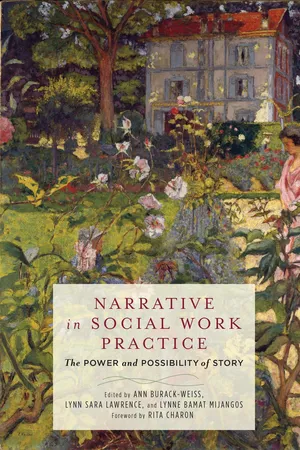
eBook - ePub
Narrative in Social Work Practice
The Power and Possibility of Story
- English
- ePUB (mobile friendly)
- Available on iOS & Android
eBook - ePub
Narrative in Social Work Practice
The Power and Possibility of Story
About this book
Information
PART | I
Writing as Discovery and Healing
The circuitous route to self-knowledge is well expressed by the novelist Eudora Welty in One Writer’s Beginnings (1983, 102): “It is our inward journey that leads us through time—forward or back, seldom in a straight line, most often spiraling. Each of us is moving, changing, with respect to others. As we discover, we remember; remembering, we discover.”
Narrative approaches are particularly suited to that “inward journey,” the slow unfolding of meaning over time, and the way that meaning enriches practice.
Lynne Mijangos has recurring dreams of a gnome, which finally yield up their meaning. In a narrative that weaves back and forth between a first-year field experience and adult understanding of a memory from childhood, she shows how the very act of writing one’s story changes it: as unformulated experience rises to the surface, new insights emerge.
Lynn Sara Lawrence is stopped in her tracks by a painting seen on a museum wall. The chapter braids the close read of the painting with increasing levels of self-reflection. Writing as discovery takes on new meaning as the past gives up its secrets in real time. What was hidden in the painting provides the key to what was hidden from her.
Kristen Slesar tells of her work with children who have been abused—work that she loves but that hurts her. She describes a time when she sustained personal and psychic injuries in the process of restraining a child from doing harm to herself. The transformative effect of writing of this experience in a narrative medicine workshop brings healing.
COUNCIL ON SOCIAL WORK EDUCATION SOCIAL WORK COMPETENCIES
1. Demonstrate Ethical and Professional Behavior
The professional self begins as a personal self. Mijangos, Lawrence, and Slesar are midcareer professionals whose chapters exemplify “continued professional development” and engagement in “career-long learning.” Their chapters illustrate the ways in which writing fosters understanding of how “personal experiences and affective reactions influence professional judgments and behavior.” Each author learns something. Whether the self-discovery occurs before, during, or after their encounters with clients is less important than the result: an enhanced ability to “use reflection and self-regulation to manage personal values and maintain professionalism in practice situations.”
1
Stuck
AN INTERSECTION OF STORIES
▶ LYNNE BAMAT MIJANGOS
When we cannot find a way of telling our story, our story tells us—we dream these stories, we develop symptoms, or we find ourselves acting in ways we don’t understand.
Stephen Grosz, The Examined Life
A mother hears the short, sharp sound of her own heels against the waxed linoleum floor of a hospital corridor as she makes her way to the isolation room where her five-year-old daughter has been a patient for the past eight days. No communicable disease or infection has been identified and, since entering the hospital for fever and dehydration, the girl has not vomited again. She is pale, but she is eating and her temperature is normal. The doctor wrote her discharge order this morning.
Here in the hospital corridor the mother passes a nurse’s aide, who comes out of the men’s ward pulling a stainless steel, squeaky-wheeled cart laden with breakfast trays. The smell of oatmeal and half-eaten eggs mingles with base notes of hospital antisepsis. These smells are more familiar than she would like, not only from visits this past week but also from eight days on the second-floor maternity ward six months earlier.
Full term, she had delivered a stillborn baby boy. The baby’s body was released for burial before she was discharged from the hospital. Only her husband stood with an undertaker in the March wind and pushed the metal marker, with the name John Robert and the year 1954, into snow-covered ground on the edge of the church cemetery.
Now, halfway down the hospital corridor, she hears, “Mommy, Mommy!”
Her daughter has memorized the sound of her footsteps this week as she approaches the isolation room during visiting hours. “Mommy, Mommy,” she calls again. “I have good news. I get to go home today!” The girl’s voice pulls her into the present. Daily her children’s voices pull her from muzzy, sad grey thoughts. She laughs and crosses the threshold to the five-year-old, who she calls her “easy child,” the girl who is easier to please and quicker to laugh than her four-year-old sister.
• • •
I was that “easy child,” who became an “assistant mother” (Deutsch 1945, 73) before I turned two. When I was sixteen months old—before I learned to talk—my sister Cathy was born and my mother’s father died suddenly of a heart attack. I learned to use good behavior, cheerfulness, and helpfulness to cushion adult “soft spots,” just as I would learn to protect newborn fontanels—the spot where temporal and parietal bones have not yet knit together and blood pulses just beneath the scalp.
From mother’s helper I grew to be teacher’s helper, and babysitter for a family with two girls who were born with spinal muscular atrophy, before I entered a hospital school of nursing. Hospitals were familiar places. Not only had I been hospitalized at five with fever of unknown origin but also I had shared a room with Cathy, several years later, when we had our tonsils removed. We waved to Mom in the window of her room on the maternity floor when two more siblings were born. We visited the children’s ward when our baby brother developed pneumonia and an allergic reaction to penicillin, read every Cherry Ames adventure, and became candy stripers before going off to nursing school.
I planned to be a pediatric nurse, but I quickly learned that hospitalized children want only their mothers. After graduation I donned my white cap with black velvet stripe and, armed with stethoscope, wristwatch, bandage scissors, and hypodermic needles, worked in an emergency department. It did not occur to me then that I was trying to turn my passive role as a patient into a nurse’s active role.
Three years later I left the hospital’s rotating shifts and physical demands to my husband, who was a surgical resident. I became a full-time mom until the youngest of our three children was in grade school. When I entertained thoughts of returning to work as a nurse, I remembered liking the pace and stimulation of work in urgent care but not liking the rapid turnover of patients. Their stories of illness or accident were only beginning to unfold when they were transferred, discharged, or died. Perhaps more importantly, I had been sensitized to loss. Since last working in the hospital, I had delivered a full-term, stillborn child. My mother had died of peritonitis five days after she was diagnosed with pancreatic cancer. The novel Ordinary People (Guest 1976) introduced me to the idea of working with people needing something other than medical or surgical intervention. My own grief work confirmed the usefulness of talk therapy. Tying tourniquets, dressing wounds, and giving tetanus shots was not the only way to help. Rather than read thermometers and sphygmomanometers, I would read theories of mind.
I entered a master’s program in social work with a concentration in families. The program requirement—that first-year students learn to provide concrete services and partner in community systems—sounded like what I had been doing as nurse, mother, and community volunteer for fifteen years. It seemed extraneous to my intended work as clinical social worker, talk therapist, and interpreter of dreams, but it was during my first field placement that I stumbled on the significance of a dream that began when I was five and still, occasionally, pestered me:
My mother and I are on our way to the corner grocery store.
A gnome, dressed in curly-toed shoes, striped stockings, and pointy cap, waits on the sidewalk. He tries to pinch me. My mother cannot see the gnome. I try to hide, wrapping myself in her skirt.
I wish readers could see the gnome, silent as the G in his name, but it is as difficult now as it was when I was five to relate dream-sensation. “The inner eye of the dreamer … catches more than the tongue can tell” (Kahn 1975, in Sanville 1991, 186).
• • •
“Bethany” had been treated in a local emergency room after her mother, “Vivien,” struck her with the cord of an electric iron, after hearing that her fifteen-year-old daughter was pregnant. A report was filed with Child Protective Services. The caseworker who followed up found mother and daughter sorry, scared, and in need of services. She referred them to the agency where I was a student making home visits and learning to “start where the client is.”
Vivien opened the door of a one-bedroom apartment on the fifteenth floor of a housing project. Autumn light cut through the barely cleaved, claret-colored drapes and sliced across wall-to-wall shag carpeting strewn with 78 rpm records. The black shellac platters with purple labels brought to mind music coaxed by a gem-tipped needle from grooved disks spinning in the record cabinet, which I remembered from childhood. “White Christmas” and “I’ll Be Seeing You” were songs my parents knew from World War II. Vivien’s collection transported me to the past.
On my way up in the elevator, I had tried to imagine what it might feel like to be “mandated clients,” held hostage by questions and assessments of a blue-sweatered stranger studying to be a do-gooder. Social workers know our reputation in housing projects often precedes us: sensibly dressed, scrubbed-faced workers who take away people’s children. No matter how many goods and services we help access—milk and cheese, medical care, and emotional support—we can be as feared as the women who are said to cover their hair with kerchiefs, wear gold-hoop earrings, and steal sleeping children.
So there I was on a Thursday afternoon, in the living room of people I had never met, trying my student best to “assess needs” and “facilitate connections” as Bethany and Vivien made room for a baby in their family. The pregnant teenager had not yet started to show. She seemed to float in and out of the room, appearing and disappearing. Her mother sat on a flocked velvet couch and invited me to sit across from her in a matching chair. They offered soft drinks and cookies.
Vivien seemed eager to talk. She had not left the housing project for more than ten years. I listened as she told of being a singer who had worn sequined gowns and feather boas while entertaining audiences in a big city. She had “entertained temptations,” too. “But then,” she said, “I found God, and a little girl who needed me.” Pointing to baby pictures on the wall, she described the neighborhood where Bethany was born and the crime that flourished there.
“I stole her from my brother and his wife,” Vivien said.
“Stole her?” I asked.
Vivien gave a quick summary of her actions eleven years earlier, when, prompted by a desire to protect her niece, she went to court and legally adopted Bethany. “I wanted her to have a cultured life and a college education,” she said. “That’s why I lost my temper when she got in a family way.”
Listening to stories of herself as a baby and hearing of hopes harbored on her behalf, Bethany closely studied Vivien, whose eyes grew bright with tears she refused to let fall.
My role, in the agency’s broadly stated goal of family preservation, was to facilitate transitions into new phases of their life together. I visited weekly after Bethany got home from school. Her due date was in May, near the end of her sophomore year.
In November, Vivien gladly signed an application to a school that provided daycare for students who wanted high school diplomas and also wanted to be with their babies during free periods. Mother and daughter started to sit near each other on the sofa, to smile, and to anticipate their new roles as grandmother and mother.
By January, they began to consider names—strong names, sweet names—names for girls and names for boys. Bethany shopped for blankets, booties, and bibs. Vivien borrowed a crib from a neighbor down the hall.
In February, during winter break, I invited the two of them to have lunch at a neighborhood diner. Bethany showed interest. Vivien quickly agreed that her daughter could go with me, but she herself could not be coaxed to come with us. One of my goals—to have Vivien venture out of doors—had never been hers. When she first said that she had not left the apartment in ten years, I offered a referral for individual counseling. She refused, saying, “No, I talked to someone once, back when my nerves were botherin...
Table of contents
- Cover
- Title Page
- Copyright
- Contents
- Foreword
- Preface: A Carnival of Possibilities
- Acknowledgments
- Introduction: Many Ways of Knowing
- Part I: Writing as Discovery and Healing
- Part II: Narrative Social Work with Individuals and Families
- Part III: Narrative Social Work with Groups
- Part IV: Narrative Social Work in Education, Supervision, and Research
- Conclusion: On Narrative Competence and Narrative Humility
- List of Contributors
- Index
Trusted by 375,005 students
Access to over 1.5 million titles for a fair monthly price.
Study more efficiently using our study tools.
Frequently asked questions
Yes, you can cancel anytime from the Subscription tab in your account settings on the Perlego website. Your subscription will stay active until the end of your current billing period. Learn how to cancel your subscription
No, books cannot be downloaded as external files, such as PDFs, for use outside of Perlego. However, you can download books within the Perlego app for offline reading on mobile or tablet. Learn how to download books offline
Perlego offers two plans: Essential and Complete
- Essential is ideal for learners and professionals who enjoy exploring a wide range of subjects. Access the Essential Library with 800,000+ trusted titles and best-sellers across business, personal growth, and the humanities. Includes unlimited reading time and Standard Read Aloud voice.
- Complete: Perfect for advanced learners and researchers needing full, unrestricted access. Unlock 1.5M+ books across hundreds of subjects, including academic and specialized titles. The Complete Plan also includes advanced features like Premium Read Aloud and Research Assistant.
We are an online textbook subscription service, where you can get access to an entire online library for less than the price of a single book per month. With over 1.5 million books across 990+ topics, we’ve got you covered! Learn about our mission
Look out for the read-aloud symbol on your next book to see if you can listen to it. The read-aloud tool reads text aloud for you, highlighting the text as it is being read. You can pause it, speed it up and slow it down. Learn more about Read Aloud
Yes! You can use the Perlego app on both iOS and Android devices to read anytime, anywhere — even offline. Perfect for commutes or when you’re on the go.
Please note we cannot support devices running on iOS 13 and Android 7 or earlier. Learn more about using the app
Please note we cannot support devices running on iOS 13 and Android 7 or earlier. Learn more about using the app
Yes, you can access Narrative in Social Work Practice by Ann Burack-Weiss,Lynn Sara Lawrence,Lynne Bamat Mijangos, Ann Burack-Weiss, Lynn Sara Lawrence, Lynne Bamat Mijangos in PDF and/or ePUB format, as well as other popular books in Sozialwissenschaften & Wissenschaftliche Forschung & Methodik. We have over 1.5 million books available in our catalogue for you to explore.