
Great leaders aspire to manage "by design"—with a sense of purpose and foresight. But too few leaders incorporate the proven practices and principles of the design disciplines. Lessons learned from the world of design, when applied to management, can turn leaders into collaborative, creative, deliberate, and accountable visionaries. Design thinking loosens the mind and activates innovation. It creates the conditions for employees to thrive and for all kinds of businesses to succeed.
In Designed Leadership, the strategic-design scholar and urban-systems designer Moura Quayle shares her plan for integrating design and leadership, translating processes, principles, and practices from years of experience into tools of change for professional leaders. Quayle describes the key concepts of designed leadership, such as "make values explicit" and "learn from natural systems," showing how strategic design can spur individual creativity and harness collective energy. For managers at any level, Designed Leadership uses original visuals and field-tested examples to teach the kind of thinking, theorizing, and practicing that result in long-lasting high performance in the workplace and beyond.
eBook - ePub
Designed Leadership
About this book
Information
Topic
CommerceSubtopic
Stratégie commerciale
PART I
Principles and Methods
IN THIS SECTION I lay the foundation for understanding the principles and methods of designed leadership.
In chapter 1, I write about the importance of core, process, and foundation values. I then outline ten principles of designed leadership that are based on the strategic design method—a collaborative, visual, disciplined thinking method for tackling complex problems (small and large) and systemic challenges.
These ten principles ideally illuminate how a designer mindset applies to leadership and can be useful to employ in life and work.
1. Make Values Explicit
2. Know Place and Experience
3. Value Diversity
4. Emphasize Edges and Boundaries
5. Bridge Gaps and Make Connections
6. Evaluate for Fit, Scale, and Context
7. Learn from Natural Systems
8. Apply the Jane Jacobs Test
9. Attend to Patterns
10. Never Finished but Always Complete
In chapter 2 I dive into the strategic design method, explaining ASK, TRY, DO, and giving a simple “design an adventure weekend” example of how to use the method. I provide a reference list of techniques for each of the ASK, TRY, and DO processes that I use in the example.

1
Ten Principles for Designed Leadership
“Management is doing things right; leadership is doing the right things.”
—PETER F. DRUCKER, ESSENTIAL DRUCKER: MANAGEMENT, THE INDIVIDUAL AND SOCIETY, 2001
“The man who grasps principles can successfully select his own methods. The man who tries methods, ignoring principles, is sure to have trouble.”
—HARRINGTON EMERSON, THE TWELVE PRINCIPLES OF EFFICIENCY, 1912
A Matter of Principle
PRINCIPLE IS JUST a word adrift. In one system, principles bridge values and practices—a principle is a statement to clarify a value in application.1 By that definition, principles are not instinctive but learned. For most people, however, there is less thought and more passion behind their unspoken principles. Design is a principled decision-making process; designed leadership is a principled learning process.
A Question of Value
“Designed” is a value. Intentional. Disciplined. Fun. Everyone has values, yet few people use normative identifiers to describe their thinking or conduct. A colleague, for example, starts by assuming that people are selfish, arrogant, argumentative, ungrateful, fickle, pretenders and dissemblers, evaders of danger, and eager for gain; he is inspired by how we learn to be respectful, cooperative, collaborative, and effective.2 Values are tough to articulate, and even more difficult to pay attention to when we should.
“Design” itself is a protean word that can be a noun, an adjective, or a verb. As a noun, it too is a value—really, a meta-value that needs to be couched by qualifiers like “good,” or “effective,” or “modern,” that clarify intended qualities. As an adjective or verb, design can either modify a “process” or be a process itself.
Using Values Intentionally
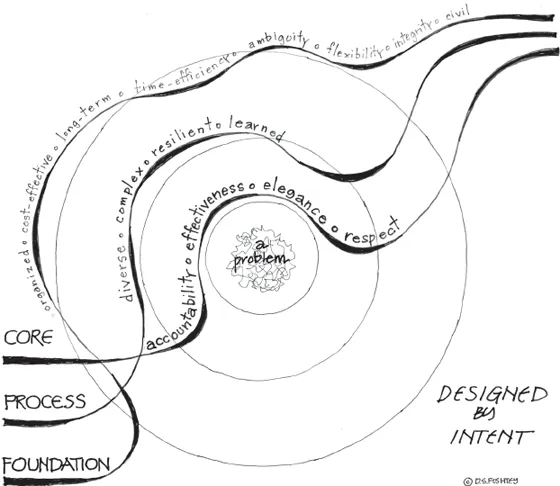
In designed leadership, values are strategic markers to orient principles and provide touchstones for assessments of incremental or final performance. This accountability (also a value) is fundamental to the effectiveness of designed leadership—it’s the value-add of the design process generally. Together with David Fushtey, governance lawyer, I have sketched a diagram called “Designed by Intent,” indicating core values, process values, and foundation values that all interact with one another and demand reconciliation.3 We like the idea of intention, knowing that design is driven to move well beyond talking toward concrete action.
Core Values
Core values are those values (such as accountability, effectiveness, elegance, and respect) that are defined only as a means to aggregate other components or meta-values.
Accountability. In many of the governance structures I have inherited, there have been accountability gaps. Even for the deeply ethical, accountability can be a tricky concept. In many countries, the word is associated only with financial or numeric accounting. However, we cannot assume that we all understand this word the same way. Thanks to my own professional practice, I have come to a clear definition.4 Despite the criticality of accountability in relationships and leadership positions, there exists a clarity gap around my responsibilities and my accountability.
Effectiveness. It is hard to imagine an organization that doesn’t value and reward effectiveness. The problem, again, is in understanding what effectiveness means to the engineer, the politician, the academic, the financier, the native citizen, and the global citizen. Accountability is oversight and assessment by outside parties. Effectiveness, to me, is the assessment of internal values. Effectiveness ranges from relationships to communication to process understanding to getting the job done.
Elegance. Elegant solutions are different for different people, but the value and principles should be the same. The mathematician, the computer programmer, the haute couture designer, and the diplomat all respect that an elegant outcome is one that takes complex inputs and makes the solution look easy. Solutions to difficult-to-define, not-one-right-answer problems5 can be deliciously elegant, achieved through hard work and intention. In good design, elegance is enduring. Elegant solutions look simple, succinct, even understated.
Respect. Of all the values, respect is core, process, and foundation all rolled together for designed leadership. It is essential, aspirational, and learned. Only with respect can you successfully navigate hundreds of belief systems, thousands of languages, and billions of experiences. Now, more than ever, people have to feel respected before they can be comfortable with change, and these days change is constant. Again, strategic design demands that we ask questions, and one of the best ways to show respect is to listen—carefully and actively, with full attention. When things have gone off track during a change process, I’ve generally recognized that it was because I had not listened carefully or communicated consistently. The most resistant person or response will provide an insight that is useful and can move an idea ahead. Respect is why it is important to plan for deliberative processes—for effective, elegant, and accountable outcomes.
Process Values
Complexity, resilience, diversity, erudition—these values bring another perspective to intentional design. Process values help direct us and provide guidance through any thinking and problem-solving methodology.
Complexity. Complicated problems can usually be unpacked and systematically solved—they are not easy to solve, but it is doable. Complex problems, on the other hand, can stymie us. They are difficult to define, grapple with, and resolve. If we try to oversimplify, we get into trouble. The strategic design method is intended to be useful for both the complicated and the complex.
Resilience. A good process needs to be nimble and tough. It can’t get bogged down in detail or stuck in a...
Table of contents
- Cover
- Title Page
- Copyright
- Contents
- Acknowledgments
- Introduction
- Part I: Principles and Methods
- Part II: Learning and Practice
- Appendix: The Evolution of Strategic Design in Business Thinking
- Notes
- Works Cited
- Index
Trusted by 375,005 students
Access to over 1.5 million titles for a fair monthly price.
Study more efficiently using our study tools.
Frequently asked questions
Yes, you can cancel anytime from the Subscription tab in your account settings on the Perlego website. Your subscription will stay active until the end of your current billing period. Learn how to cancel your subscription
No, books cannot be downloaded as external files, such as PDFs, for use outside of Perlego. However, you can download books within the Perlego app for offline reading on mobile or tablet. Learn how to download books offline
Perlego offers two plans: Essential and Complete
- Essential is ideal for learners and professionals who enjoy exploring a wide range of subjects. Access the Essential Library with 800,000+ trusted titles and best-sellers across business, personal growth, and the humanities. Includes unlimited reading time and Standard Read Aloud voice.
- Complete: Perfect for advanced learners and researchers needing full, unrestricted access. Unlock 1.5M+ books across hundreds of subjects, including academic and specialized titles. The Complete Plan also includes advanced features like Premium Read Aloud and Research Assistant.
We are an online textbook subscription service, where you can get access to an entire online library for less than the price of a single book per month. With over 1.5 million books across 990+ topics, we’ve got you covered! Learn about our mission
Look out for the read-aloud symbol on your next book to see if you can listen to it. The read-aloud tool reads text aloud for you, highlighting the text as it is being read. You can pause it, speed it up and slow it down. Learn more about Read Aloud
Yes! You can use the Perlego app on both iOS and Android devices to read anytime, anywhere — even offline. Perfect for commutes or when you’re on the go.
Please note we cannot support devices running on iOS 13 and Android 7 or earlier. Learn more about using the app
Please note we cannot support devices running on iOS 13 and Android 7 or earlier. Learn more about using the app
Yes, you can access Designed Leadership by Moura Quayle in PDF and/or ePUB format, as well as other popular books in Commerce & Stratégie commerciale. We have over 1.5 million books available in our catalogue for you to explore.