- English
- ePUB (mobile friendly)
- Available on iOS & Android
eBook - ePub
About this book
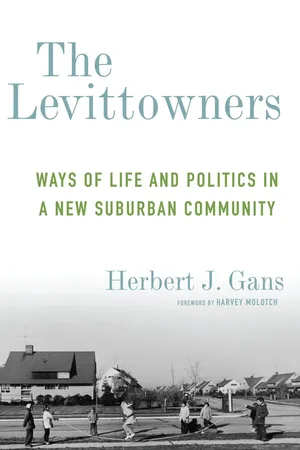
In 1955, Levitt and Sons purchased most of Willingboro Township, New Jersey and built 11,000 homes. This, their third Levittown, became the site of one of urban sociology's most famous community studies, Herbert J. Gans's The Levittowners. The product of two years of living in Levittown, the work chronicles the invention of a new community and its major institutions, the beginnings of social and political life, and the former city residents' adaptation to suburban living. Gans uses his research to reject the charge that suburbs are sterile and pathological. First published in 1967, The Levittowners is a classic of participant-observer ethnography that also paints a sensitive portrait of working-class and lower-middle-class life in America. This new edition features a foreword by Harvey Molotch that reflects on Gans's challenges to conventional wisdom.
Information
Subtopic
North American HistoryIndex
Social SciencesPart 1 ▪ THE ORIGIN OF A COMMUNITY
Chapter One
THE PLANNERS OF LEVITTOWN
IN ORDER TO DESCRIBE LEVITTOWN’S ORIGIN, ONE MUST BEGIN WITH its planners: who made the critical decisions for the conception of the community, with what goals in mind, and for what kinds of residents and aspirations? The most important role was, of course, played by the builder, Levitt and Sons. The firm was founded during the Depression by the late Abraham Levitt, a “self-made” son of Russian-Jewish immigrants who had practiced real estate law for a quarter of a century before going into the building business, and by his two sons, William and the late Alfred. Until the beginning of World War II, the firm built a number of small suburban subdivisions on Long Island, priced to appeal to the upper middle class then streaming to the Island. After World War II, as a result of experience gained in building Navy housing, the Levitts developed a mass production scheme that allowed them to build inexpensive housing for the postwar flood of veterans and their families.1
Most of the concepts that went into planning Levittown, New Jersey, were evolved in the two earlier Levittowns, in New York and Pennsylvania. Levittown, Long Island, begun in 1947, was built in traditional subdivision style, with the builder buying a piece of land—much larger than most others, to be sure—and then acquiring further acreage as sales continued to go well. The houses in Levittown were smaller versions of the expensive suburban ones the Levitt firm had built previously, but included an array of home appliances and were located around Village Greens that consisted of neighborhood shops, a playground, and a swimming pool.2 Perhaps these additional items were provided because of the builder’s uncertainty that the house alone was salable. Levittown was, after all, an experiment, begun when the housing industry as a whole had known only lack of demand and when fears of a postwar depression were still prevalent. But the firm also had an additional goal: to create a community. This emerged more clearly when Alfred Levitt, who was trained in architecture, proposed his scheme for Landia, a 675-acre community elsewhere on Long Island.3 It was planned to provide separate residential neighborhoods without through streets, a town center, and a complete set of community facilities, including parks.
Landia was never built, partly because of the moratorium on housing at the start of the Korean War, but some of its ideas were incorporated in the building of the second Levittown, in Bucks County, Pennsylvania, in 1951. Although the Levitt firm was secure enough by this time to buy a much larger amount of land at the start, the community was still not totally planned in advance, the individual neighborhoods being laid out just before their construction. The plan for this second Levittown called for about 17,000 homes, and neighborhoods free from through traffic, with elementary schools, playgrounds, and pools at their center. The local shopping centers were almost entirely eliminated after the firm learned to its dismay that a large shopping center in the Long Island Levittown—not built by the firm—was drawing most of the sales away from shops on the Village Greens. Instead, the Levitts built a huge “regional” shopping center on the edge of their new Levittown, hoping to attract not only their house buyers but people from other communities as well. The firm also gave land to a number of churches, institutionalizing a practice that had begun on an ad hoc basis in the initial Levittown when a church came to the builder with a request for free land.
But Levittown, Pennsylvania, like Levittown, Long Island, had one major drawback. Because of the way land had been purchased, the final community was spread out over four townships and many other governmental units, and in developing the land the builder had to negotiate separately with each unit. This not only took considerable time and energy, but required changes in the initial plan, particularly in the design of neighborhoods and location of schools, and also forced the firm to administer recreation areas so as to limit their use to purchasers of Levitt houses. As a result, the firm’s executives were frequently diverted from the business of building and even became embroiled in community conflicts.
Not long after the Bucks County development had gotten off to a successful start, the firm began to consider yet a third Levittown, and this time it sought to eliminate the difficulties it had encountered previously by purchasing land within a single township. Ultimately, the choice fell on Willingboro township in New Jersey. Willingboro township was an area of small farms, producing peaches, plums, and tomatoes on the region’s sandy soil. Just outside the ring of postwar surburbs that had sprung up around Philadelphia, and only about ten miles from Levittown, Pennsylvania, it was eminently “ripe” for residential development. It was particularly suitable for Levitt and Sons because it was inhabited only by individual farmers, a few owners of what had once been a summer home colony, and the village of Rancocas, a nineteenth century Quaker settlement of less than 500 people. Soon after the firm bought the land, it had the township boundaries changed so that Rancocas was incorporated into the neighboring township of Westampton. Thus it had obtained a large acreage, located entirely within one township and occupying most of it. Once Rancocas had been moved out, only about 600 people were left in the township, and they, the builder felt, could be persuaded to give him a free hand to build as he wished. Willingboro would provide a virtual tabula rasa for realizing William Levitt’s goals and plans.
THE PLANNING PROCESS
By the time the planning for Levittown, New Jersey, began, control of the firm was entirely in the hands of William Levitt. Abraham Levitt had retired because of increasing age, and Alfred Levitt had left the firm, selling his share of the stock to his brother, reputedly because they could not develop a method for making decisions jointly. Working with William Levitt were half a dozen executives, many of whom had been with the firm since the late 1940s, but the final decisions were his.4 Like his brother, he was open to advice, but he was known as a man who rarely changed his mind once he had made it up.5 William Levitt’s goals were to build another profitable development and a better community, more comprehensively planned in advance and more completely stocked with public facilities. He also sought to end the attacks by planners, architects, and social critics against the firm and the past Levittowns. Known for his low opinion of the city planning profession, however, and lacking Alfred’s interest in its concepts and schemes, he had no intention of building the community to please the planners. Nor was he especially concerned about how to satisfy the buyers and meet their aspirations. As the most successful home builder in the East, with a decade’s reputation for providing “the best house for the money,” he felt he knew what they wanted. Unlike his father, he had no desire to involve the firm in the life of the community or to uplift the cultural level and civic performance of the residents. He wanted only to build what he deemed to be a better Levittown, what he often called a “showplace.”
Because of the success of the Bucks County community, Levitt felt secure enough to buy 80 per cent of the land he would need for the entire community, with options on the remaining portion. A fairly complete plan of the eventual community was developed, including an overall road system, a community-wide sewage and water supply system to be built before the community was occupied, and a generalized scheme for shopping, including both a regional retail center and a series of local ones, and for locating schools and churches. The plan was generalized in that preliminary locations for these facilities were included in the site maps with which the firm worked, but final locations and facility designs were not made until just before actual construction. No longer needing to accommodate his ideas to several township boundaries, the builder could plan the community as a set of residential “parks,” with school, playground, and pool located at the center in true neighborhood planning tradition.
There were other innovations in the plan for the third Levittown. The elementary schools would be provided by the firm and their cost incorporated into the house price. They could be “donated” to the community, thus keeping taxes down, and would be open when people moved in. The previous pattern of neighborhoods with only one house type was dropped. From now on, the three types of houses were to be mixed on each street: a four-bedroom “Cape Cod” initially selling for $11,500; a three-bedroom, one-story “Rancher” for $13,000; and a two-story “Colonial,” one with three, another with four bedrooms and costing $14,000 and $14,500 respectively. Each house type was built in two elevations, but with the same floor plan, and was varied in external color to effect yet more visual heterogeneity. Whereas the houses in Levittown, Pennsylvania, were of a fairly severe modern style, those in New Jersey would be in the pseudo-Colonial style popular all over the Eastern seaboard. The shopping center, again located at the edge of the community, was designed by a nationally known architect who had built a prize-winning center in the Middle West, providing a considerably more attractive shopping area than in the Pennsylvania Levittown.
During the initial planning phase, Levitt employed an engineer with city planning experience to develop the overall plan, and also brought in a number of nationally known consultants to design detailed plans for educational and recreational facilities; but no city planners were included among the consultants. Subsequently, he did work with the planner hired by Willingboro township, and in 1964, when the firm was building developments of varying size in a number of locations all over the world, it finally hired a city planner to help select sites and make preliminary master plans.
The executives themselves were divided into two relatively stable factions, the self-styled “idealists” who wanted to build what they considered the best possible community, and the “realists,” concentrated mainly in the comptroller’s office, who were concerned with economy and sometimes questioned innovations that might increase costs or affect sales. Levitt himself seems to have mediated between the two groups. In the initial phases of planning he sided with the idealists, but later, when plans were about to be implemented, he became more conscious of cost and market considerations and often supported the realists. Generally speaking, the plans put forth by the idealists and their consultants were accepted when they contributed to the development of the best community at the lowest cost, and rejected when they were too expensive or added “frills” that would not help sales. Although Levitt had been traditionally hostile to outsiders, he accepted many of the consultants’ proposals—often because they agreed with his own ideas. The consultants had been chosen initially because of their national reputations, and the agreement between them and Levitt was often fortuitous. For example, the concept of the school at the center of the neighborhood, originally brought into the firm by Alfred Levitt, was also part of traditional planning ideology and was favored by the school consultants as well. Similarly, because the firm wanted to divest itself of control of the recreation facilities and believed that the school and playground would be used by the same people and should therefore be administered jointly, it proposed a combined school-playground-pool area. When the firm asked the National Recreation Association for technical help, it did not know that that organization had advocated such a combination for almost forty years.
But some plans were rejected. One Levitt official wanted a new and comprehensively planned educational system to be designed under the aegis of the Ford Foundation, but when Foundation funds for this scheme were not available, a more conventional school system, more akin to existing county and township values and practices, was developed instead. The ambitious recreation plan of another firm member, providing for a large park and playground system around the school and more than one swimming pool for each neighborhood, was similarly cut down to make more land available for houses. As the time for building drew closer, both of these officials who stood for a maximum investment in community facilities could not agree with the emphasis on housing, and eventually they were fired, although not for this reason alone.
Perhaps the principal innovation in the new Levittown was the mixing of house types. This idea, originally suggested by Mrs. Levitt, debated within the firm for several months, and finally carried out by Levitt over the strong objections of all his executives, stemmed indirectly from the criticisms of the city planners, particularly Lewis Mumford. During the 1950s, when attacks on the physical and demographic homogeneity of the postwar suburban subdivisions began, Levittown was frequently mentioned as the prototype. At first, the firm shrugged off this criticism. As it continued to mount, however, and spread into the mass media, Levitt became concerned that Levittown’s image would be impaired and even that sales might be affected, particularly when, later in the decade, the sellers’ market was starting to become a buyers’ market. By the time he was ready to start the third Levittown, Levitt also wanted a reputation for building the best possible communities.
In addition, the firm was beginning to upgrade the image of the purchaser it was seeking. In Long Island it had built for veterans and had attracted predominantly lower middle class buyers. In Pennsylvania, however, Levittown also drew a number of blue collar workers and what Levitt officials worriedly called “marginal” buyers, people who could not really afford the house-but were able to take it because no down payment had been required under Veterans Administration mortgage insurance regulations. The firm did not want marginal buyers in the new Levittown, and, in fact, hoped to build somewhat more expensive houses which would increase its profit margin. If it was to do so, and bring in middle and upper middle class home buyers, Levitt wanted to prove incorrect the critical magazine articles on suburbia read by this population. When the idea of mixed house types was approved, one of the Levitt executives pointed out, “Now Lewis Mumford can’t criticize us any more”; later, the firm promoted the innovation as a sales device. In the press release announcing the opening of the new Levittown, Levitt said, “We are ending once and for all the old bugaboo of uniformity…. In the new Levittown, we build all the different houses…right next to each other within the same section.”
The struggle against criticism affected other features of the plan. Although the Levitts personally identified so much with their developments as to give them the family name, William Levitt was quite aware that some people considered “Levittown” a symbol of the worst in suburban development, even if others saw it as a brand name for good and inexpensive houses.6 Several executives urged strongly that the name be dropped, but Levitt rejected the idea. As a compromise, the merchandising was to stress the individual parks into which people would buy. A Levitt official pointed out, “One of the major reasons for the neighborhood plan was to answer the critics of Levittown who say that it is one huge mass of homogeneous mass-produced housing, all preplanned to standardization and mass production.”
Shortly before Levittown, New Jersey, opened for occupancy, an article by William Levitt entitled “What! Live in a Levittown?” appeared in Good Housekeeping.7 In it, the builder argued—and quite rightly so—that mass-produced housing did not lead to conformity or homogeneity among the population. After Levittown opened, many tongue-in-cheek advertisements appeared in the Philadelphia papers which sought to give the impression that Levittowners were diverse, respectably middle class, but not overly sophisticated. One ad, headed “Wanted: Zoologist for a Neighbor,” indicated that all occupations were represented in Levittown but listed mostly professional ones. Another, entitled “Hi and Middle Fi,” suggested that the Levitt house could be rigged up for hi-fi enthusiasts, but poked fun at such sophisticated taste and concluded, “You’ll find all kinds of music lovers in Levittown, but we...
Table of contents
- Cover
- Legacy Editions
- Title Page
- Copyright
- Contents
- List of Tables
- Foreword
- Preface to the Morningside Edition
- Preface
- Acknowledgments
- Introduction The Setting, Theory, and Method of the Study
- Part 1: The Origin of a Community
- Part 2: The Quality of Suburban Life
- Part 3: The Democracy of Politics
- Appendix: The Methods of the Study
- References
- Index
Trusted by 375,005 students
Access to over 1.5 million titles for a fair monthly price.
Study more efficiently using our study tools.
Frequently asked questions
Yes, you can cancel anytime from the Subscription tab in your account settings on the Perlego website. Your subscription will stay active until the end of your current billing period. Learn how to cancel your subscription
No, books cannot be downloaded as external files, such as PDFs, for use outside of Perlego. However, you can download books within the Perlego app for offline reading on mobile or tablet. Learn how to download books offline
Perlego offers two plans: Essential and Complete
- Essential is ideal for learners and professionals who enjoy exploring a wide range of subjects. Access the Essential Library with 800,000+ trusted titles and best-sellers across business, personal growth, and the humanities. Includes unlimited reading time and Standard Read Aloud voice.
- Complete: Perfect for advanced learners and researchers needing full, unrestricted access. Unlock 1.5M+ books across hundreds of subjects, including academic and specialized titles. The Complete Plan also includes advanced features like Premium Read Aloud and Research Assistant.
We are an online textbook subscription service, where you can get access to an entire online library for less than the price of a single book per month. With over 1.5 million books across 990+ topics, we’ve got you covered! Learn about our mission
Look out for the read-aloud symbol on your next book to see if you can listen to it. The read-aloud tool reads text aloud for you, highlighting the text as it is being read. You can pause it, speed it up and slow it down. Learn more about Read Aloud
Yes! You can use the Perlego app on both iOS and Android devices to read anytime, anywhere — even offline. Perfect for commutes or when you’re on the go.
Please note we cannot support devices running on iOS 13 and Android 7 or earlier. Learn more about using the app
Please note we cannot support devices running on iOS 13 and Android 7 or earlier. Learn more about using the app
Yes, you can access The Levittowners by Herbert J. Gans in PDF and/or ePUB format, as well as other popular books in Social Sciences & North American History. We have over 1.5 million books available in our catalogue for you to explore.