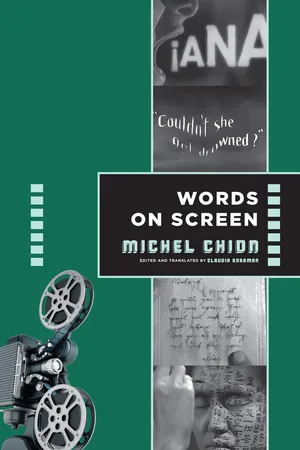
Michel Chion is well known in contemporary film studies for his innovative investigations into aspects of cinema that scholars have traditionally overlooked. Following his work on sound in film in Audio-Vision and Film, a Sound Art, Words on Screen is Chion's survey of everything the seventh art gives us to read on screen. He analyzes titles, credits, and intertitles, but also less obvious forms of writing that appear on screen, from the tear-stained letter in a character's hand to reversed writing seen in mirrors. Through this examination, Chion delves into the multitude of roles that words on screen play: how they can generate narrative, be torn up or consumed but still remain in the viewer's consciousness, take on symbolic dimensions, and bear every possible relation to cinematic space.
With his characteristic originality, Chion performs a poetic inventory of the possibilities of written text in the film image. Taking examples from hundreds of films spanning years and genres, from the silents to the present, he probes the ways that words on screen are used and their implications for film analysis and theory. In the process, he opens up and unearths the specific poetry of visual text in film. Exhaustively researched and illustrated with hundreds of examples, Words on Screen is a stunning demonstration of a creative scholar's ability to achieve a radically new understanding of cinema.
- English
- ePUB (mobile friendly)
- Available on iOS & Android
eBook - ePub
Words on Screen
About this book
Information
1
The Name on Screen
Place Names
The Place Name and Photography
I urge you, dear reader, not to be alarmed by all the lists and categories in this chapter and the two that follow. I am hoping you will take a bit of the same journey that I did in my process of discovery. First, this means avoiding auteurist preconceptions of my subject.1 Second, I hope you will try, as I have, not to set out with a priori arguments. This book was not conceived to prove a thesis but rather aims to formulate an inventory of a field as a basis for further study.
It seems to me that names—of places and of people—are a good way to begin, for is this not the way we ourselves begin as human beings?
The universe of printed place names does not belong to the realm inhabited by children. Place names are signs that have been posted over their heads and are not part of reality for them, and only with great difficulty could they constitute a coherent universe with the world (1).
Such a separation of the name from the place does not occur in literature. If you write in a novel, “Anna Karenina went to the Moscow train station and took the train for Saint Petersburg,” the name of the place and its reality are one and the same thing. But this is not how a child sees things. The cinema resembles reality as a child experiences it, for it piggybacks (without confusing them) the world of words on the world of things.
In so doing, it cannot long maintain the illusion offered by maps. On maps, names are often as big as countries and bigger than cities. They are united with the shape of the country or the lake. In other words the names on maps are part of the same man-made graphic world, since a map is a symbolic representation.
Geography derives from the Greek geo, earth, and graphein, to write. For centuries geographic maps inscribed names onto the earth, the rivers, the mountains, and the oceans. People knew that it was humans (or some god) who had bestowed these names and that they were not physically written in the sand or on the waters. Travelers could see this with their own eyes when they climbed mountains and flew over the earth in balloons, dirigibles, and airplanes over time. But the advent of a mechanical system, photographic reproduction (first aerial photography, then satellite photography), made real the divorce of the world of names from the world of places. Ever since the first satellite launched into space in 1957, we have also seen the reality of an Earth from which names have been erased, as it were.
A photographic image of the world is what geography calls a mute map. If the name of a city is added to a photograph, we are aware that the map remains mute, because it’s not a drawing but an objective image created by a mechanical eye.
The cinema can choose to deny this.
At the beginning of To Have and Have Not (Howard Hawks, 1944) we see what looks like a close-up on a globe, where the name of the Caribbean Sea is printed. A slight dolly-in toward the island of Martinique (also labeled) is accompanied by a title superimposed on the map: “Martinique, in the / summer of 1940, shortly / after the fall of France.” The camera continues its “zoom” closer to Martinique; the title text disappears. The “zoom” ends with what looks like an aerial photo view of a city. Over this aerial view, superimposed in capital letters, is the name Fort de France. All in one shot with apparent camera movement, the map, place names, and photography are seamlessly tied together.
This presentation, by simulating a continuity between map and photography, mimics the transmutation of the name into reality, a genesis via the word that every film recounts (if only in the sense that films begin with projected names that dissolve into places).
At the beginning of Agora (Alejandro Amenábar, 2009), whose story opens in the year 391, the director, conveying a universalism that’s comforting in this moment of the twenty-first century, audaciously shows a “mute globe” seemingly photographed from heaven, then segues to a scene of teaching in the famed ancient library of Alexandria. The shot of the world viewed from space reappears later: it turns out that the heroine, Hypatia (a real historical character), employs scientific method and reason in the attempt to understand whether Earth moves. This is quite an original approach, since historical films normally stress that names and borders in those ancient times were not the same, and they make much use of diegetic and nondiegetic maps (2).
So photography has made writing—particularly names—something that no longer incorporates itself into the world. To do so, it erases the mythic names (unlike certain current practices, such as rebaptizing Earth as Gaia), and fiction films call mainly on photography (as distinct from digital effects or animation). It is photography of places that has made us aware that the universe of words and the universe of things and places are no longer the same.
My idea is that the fiction film tells us this story, too: not only what happens to characters but also the changes in our relation to the world and in the relation between the world and words.
City Names
The 1920s and 1930s witnessed the publication of great unanimist novels that take place in big cities:2 Dublin in James Joyce’s Ulysses (1914–21), Alfred Döblin’s Berlin Alexanderplatz (1929), John Dos Passos’s Manhattan Transfer (1928), London in Virginia Woolf’s Mrs. Dalloway (1928). In cinema this impulse led to numerous city-film documentaries, such as Walter Ruttmann’s Berlin, Symphony of a Great City (1927) and Dziga Vertov’s Man with a Movie Camera (shot in Kiev, Moscow, and Odessa to represent one communist metropolis). We should also mention several silent films that take place in cities not identified by name or even country. The cities of F. W. Murnau’s The Last Laugh (Der letzte Mann, 1924) and Sunrise (1927) and also the city of Chaplin’s City Lights (1931) were constructed in studios and conceived as impossible to situate in a precise country (though in Chaplin’s film street signs in English discreetly appear). Even street and hotel signage avoided identifying one language over another. In The Street (Karl Grune, 1923) the names on signs are replaced by pictograms. But these films depicted cities constructed in the studio, not real cities whose name had to be erased.
The coming of sound seems to have made it more difficult to create nameless cities, obviously owing to the presence of a specific language on the soundtrack. However, further on I will mention several universalist films that are not necessarily perceived as such (precisely because of language).
The place name in sound film is often replaced by an image that symbolizes the city: Big Ben for London, the Christ-the-Redeemer statue with outstretched arms atop the mountain of Rio, the Brandenburg Gate for Berlin. One variant is a monument seen from a window; Hollywood’s most famous one is the Capitol in Washington, DC, seen in countless movies. One elegant solution is adopted in North by Northwest (Alfred Hitchcock, 1959), where the Capitol is reflected in the shiny metal plaque outside CIA national headquarters. With the image cast onto the printed surface, the two seem to belong to the same world (3).
A modern form of this contextualization: the digitally rendered bird’s-eye image of our Earth seen from space, ending with a tracking shot onto the roof of a building (the opening of Burn After Reading (Joel and Ethan Coen, 2008). But of course it’s a parody and negation of the establishing shot, and the negation of human history, since seen from space, Earth cannot tell the stories of people, great men, arts, and civilization.
Place and Time
In a good number of films of the 1960s, when a city’s name overlays the image, it is paired with an indication of time.
The opening shot of Psycho (Alfred Hitchcock, 1960) pans across a large impersonal American city, and words appear: “Phoenix, Arizona.” The name Phoenix arrives from the left, Arizona slides in from the right, and they join together in the middle. The rightward pan over the city continues and another indication appears, “Friday, December the eleventh.” Same thing. And finally, when the shot continues by zooming in toward the window, we see “two forty-three p.m.”
Hitchcock insisted on explaining this printed text to Truffaut, since he did not often use the device. “In the opening of Psycho, I wanted to say that we were in Phoenix, and we even spelled out the day and the time, but I only did that to lead up to a very important fact: that it was two-forty-three in the afternoon and this is the only time the poor girl has to go to bed with her lover. It suggests that she’s spent her whole lunch hour with him.”3
The director justifies this maniacal precision of the date and time but not the naming of the city. Of course, identifying Phoenix satisfies moviegoers who enjoy coded messages, for the phoenix is the bird that rises from its own ashes and the theme of resurrection and birds is important in the film. But it also satisfies another need: the time notation would seem incomplete if it weren’t paired with a place notation, whatever it might be. The when is important to us only linked with the where, as with birth certificates and identity cards: born on X day in X place.
A City Name to Pronounce
The simplest way to identify a city is to have the name in the title of the movie: San Francisco, Algiers, Philadelphia, Manhattan, Munich, The Shanghai Gesture, and countless others. Sometimes the city’s name has nothing to do with the actual story setting, as in Welles’s Lady from Shanghai or Chaplin’s Countess from Hong Kong. Let us briefly examine two of these, Casablanca and Dogville.
For Casablanca we should start by naming the French film that was one of its sources, Pépé le Moko (Julien Duvivier, 1937). This exotic movie was an international success, and it inspired a number of remakes, imitations, and parodies (including one by the Italian comedian Totò). Pépé is a French gangster played by Jean Gabin, who hides in the old part of Algiers to escape the police. This district’s name is repeated like a refrain, “the Casbah,” which is a word meaning “fortress” in Arabic and actually applies to sections of a good number of North African cities.
After the opening credits the film begins with a map of Algiers and the Casbah on a wall in police headquarters as voices of police detectives offscreen discuss the elusive Pépé. A bit later, a dissolve from the map to a general photographic view of the Casbah briefly superimposes the two. Again, the world of the map and ...
Table of contents
- Cover
- Series Page
- Title Page
- Copyright
- Contents
- List of Illustrations
- Preface
- Introduction
- Part I: An Infinite Inventory
- Part II: Writing, Reading
- Part III: Writing in Film Space
- Glossary
- Notes
- Bibliography
- Index
- Series List
- Illustrations
Trusted by 375,005 students
Access to over 1.5 million titles for a fair monthly price.
Study more efficiently using our study tools.
Frequently asked questions
Yes, you can cancel anytime from the Subscription tab in your account settings on the Perlego website. Your subscription will stay active until the end of your current billing period. Learn how to cancel your subscription
No, books cannot be downloaded as external files, such as PDFs, for use outside of Perlego. However, you can download books within the Perlego app for offline reading on mobile or tablet. Learn how to download books offline
Perlego offers two plans: Essential and Complete
- Essential is ideal for learners and professionals who enjoy exploring a wide range of subjects. Access the Essential Library with 800,000+ trusted titles and best-sellers across business, personal growth, and the humanities. Includes unlimited reading time and Standard Read Aloud voice.
- Complete: Perfect for advanced learners and researchers needing full, unrestricted access. Unlock 1.5M+ books across hundreds of subjects, including academic and specialized titles. The Complete Plan also includes advanced features like Premium Read Aloud and Research Assistant.
We are an online textbook subscription service, where you can get access to an entire online library for less than the price of a single book per month. With over 1.5 million books across 990+ topics, we’ve got you covered! Learn about our mission
Look out for the read-aloud symbol on your next book to see if you can listen to it. The read-aloud tool reads text aloud for you, highlighting the text as it is being read. You can pause it, speed it up and slow it down. Learn more about Read Aloud
Yes! You can use the Perlego app on both iOS and Android devices to read anytime, anywhere — even offline. Perfect for commutes or when you’re on the go.
Please note we cannot support devices running on iOS 13 and Android 7 or earlier. Learn more about using the app
Please note we cannot support devices running on iOS 13 and Android 7 or earlier. Learn more about using the app
Yes, you can access Words on Screen by Michel Chion, Claudia Gorbman in PDF and/or ePUB format, as well as other popular books in Medios de comunicación y artes escénicas & Dirección y producción cinematográfica. We have over 1.5 million books available in our catalogue for you to explore.