eBook - ePub
I-Docs
The Evolving Practices of Interactive Documentary
- English
- ePUB (mobile friendly)
- Available on iOS & Android
eBook - ePub
I-Docs
The Evolving Practices of Interactive Documentary
About this book
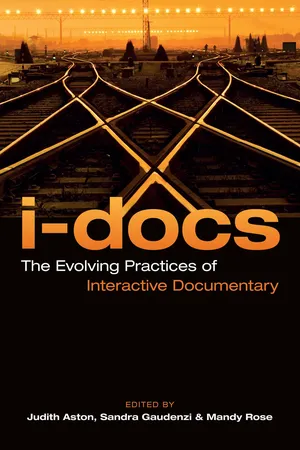
The history of documentary has been one of adaptation and change, as docu-mentarists have harnessed the affordances of emerging technology. In the last decade interactive documentaries (i-docs) have become established as a new field of practice within non-fiction storytelling. Their various incarnations are now a focus at leading film festivals (IDFA DocLab, Tribeca Storyscapes, Sheffield DocFest), major international awards have been won, and they are increasingly the subject of academic study. This anthology looks at the creative practices, purposes and ethics that lie behind these emergent forms. Expert contributions, case studies and interviews with major figures in the field address the production processes that lie behind interactive documentary, as well as the political, cultural and geographic contexts in which they are emerging and the media ecology that supports them. Taking a broad view of interactive documentary as any work which engages with 'the real' by employing digital interactive technology, this volume addresses a range of platforms and environments, from web-docs and virtual reality to mobile media and live performance. It thus explores the challenges that face interactive documentary practitioners and scholars, and proposes new ways of producing and engaging with interactive factual content.
Information
Subtopic
Film & Video1 CO-CREATION
PREFACE
Digital media and networked connectivity have the potential to reconfigure the relationship between media producer, subject and audience at the heart of documentary, bringing them into a dialogic relationship and into play with interactive systems. In this section we take ‘co-creation’ as a broad term for the collaborations that emerge within that space. The contributions are interested in the production processes that allow co-creation – in engagement strategies and design approaches. They are also concerned with the contribution of users, and with the ethics, social meaning and values that arise within co-creative encounters. They address co-creation between media makers and documentary subjects, with academic researchers and communities, and through algorithms (having been programmed by humans) and online users.
Kate Nash explores two projects to consider how interactive media develops documentary’s citizenship role. She examines evidence of user engagement with Fort McMoney (Dufresne 2013) and Hollow (McMillion Sheldon 2013) and makes a case that the civic value of these projects is linked to their capacity to bridge between private and public media.
Anandana Kapur offers a case study of her own work-in-progress – a cross-class collaboration between domestic workers and their employers in Delhi. She describes the process through which she is harnessing everyday technology – the mobile phone – to surface hidden dimensions of female life, agency and friendship in India’s ‘rape capital’.
In an extensive interview, the award-winning interactive documentary maker Kat Cizek discusses what it means for her practice to make work ‘with partners instead of just about them’. From her first experiments in interactive as National Film Board of Canada filmmaker-in-residence to the final piece within the Highrise project ‘The Universe Within’ (2015), she shows how a collaborative ethos has shaped her work.
Mandy Rose explores co-creation as a strategy for activism. Through a consideration of Question Bridge: Black Males (Johnson et al 2012) and The Quipu Project (Court et al 2015), she considers interactive documentary as a platform for convening dialogue between documentary subjects and audiences, and suggests how forms of shared editorial control can enable media making for change.
Christopher Allen turns the reader’s attention towards the practice of exhibition. His case study of the Living Los Sures (Allen et al 2014) project explores the multiple collaborations and encounters involved in this multi-year process through which a ‘hipster’ Brooklyn micro-cinema and a local community re-examine a lost 1980s documentary classic and the meaning of neighbourhood.
Craig Hight draws on Software Studies to highlight the ubiquitous but generally overlooked collaboration between machine and user on which interactivity depends. Considering the interfaces and affordance of two interactive documentary platforms – Klynt and Korsakow – his chapter makes an urgent case for the opening up of discussions around agency and ethics within these encounters.
I-DOCS AND THE DOCUMENTARY TRADITION
EXPLORING QUESTIONS OF CITIZENSHIP
Documentary media’s relationship to the social world is distinctive. This is particularly the case in relation to questions of citizenship, with documentary long claiming a particular, albeit historically variable, role in its mediation. Central to the civic role of documentary is the claim that documentary serves as a source of public knowledge that serves to inform political participation. While i-docs are formally and technically distinct from linear documentary media, there is some evidence for continuity at the level of their social functions, with citizenship a continuing touchstone for documentary practice. I-docs frequently aspire to expand documentary’s political role, particularly by providing new ways of engaging with social issues and opportunities for forms of self-representation. In these aspirations is a continuation of documentary’s political ambition, but also a response, shaped by the cultures and possibilities of digital media, to the contemporary challenges of representing and attempting to impact on the real. Documentary’s social functions, its connection to social participation and citizenship, journalistic investigation and the exploration of alternative perspectives (Corner 2002), inform the use of digital technologies just as these technologies, their representational possibilities and cultures, are shaping the political uses of documentary.
This chapter engages with ways in which i-docs connect to citizenship. In particular, it considers how we might capture i-docs’ multiple modes of address and forms of participation and their implications for public engagement. Focusing on two examples, Fort McMoney (Dufresne 2013) and Hollow (McMillion Sheldon 2013), I consider both what documentary makers seek to achieve civically and politically and what we know about how audiences have responded to these projects. While these two projects cannot be considered representative of the many ways in which i-docs intersect with politics, they highlight different ways of thinking about citizenship and interactive documentary and reveal some of the implications of i-docs for current debates in digital media citizenship. The analysis presented here suggests that i-docs’ particular significance may lie in their potential to foster connections between the private realm of media engagement and of public participation.
I-DOCS AND DIGITAL MEDIA CITIZENSHIP
Citizenship has been a central, if variable, concept in documentary history and scholarship. It is invoked in John Grierson’s vision of documentary as a promotional vehicle in the service of government (Aitkin 2013: 131), television documentary’s informational and watchdog role (Corner 1996, Ellis 2000: 44–7), and independent documentary’s ability to ‘give voice’ to alternative perspectives (Chanan 2007). Across this difference there has been a central focus on the ability of documentary – as with other factual ‘mass’ media – to enhance (or not) ‘public knowledge’ (Corner 1998), providing citizens with the informational resources required for informed decision-making. This focus on the informational role of documentary has, in recent years, included recognition of the significance of emotion, entertainment and culture for citizenship (Hartley 2012, Smaill 2010). However, because documentary scholarship has predominantly assumed film and television as media platforms, it has also assumed that audience engagement with documentary is necessarily separate from political action. This is captured in Jane Gaines’ question about the connection between political film and action: ‘What is it that moves viewers to want to act…to do something instead of nothing in relation to the political situation represented on screen?’ (1999: 89). Whatever the ‘something’ is that moves audiences, any action they take happens after their engagement with documentary. The role of documentary is essentially one of providing information of different kinds that might motivate political action.
In the case of i-docs, this question is potentially altered, as audiences are not only positioned as interpreters of political representations – although this is part of the experience of engaging with i-docs that can be too easily overlooked; they are also invited (at times perhaps compelled) to act in politically significant ways. Of course these actions vary considerably in their significance for the individual and for society, connecting in different ways to formal and informal political spaces. Nevertheless, what they point to is the potential expansion of documentary’s civic role beyond the provision of ‘public knowledge’ as a preparation for political participation. There is a need to rethink the relationship between documentary and society, considering the connections between representation and dialogue, participation and co-creation (to highlight some of the relevant practices).
Audience practices and their political implications have been the focus of much recent i-doc scholarship. In exploring documentary through ideas of ‘open space’, Helen de Michiel and Patricia Zimmermann, for example, argue that interactive documentary is less about ‘changing lives or establishing deductive rhetorical arguments’ but more about ‘opening up complex dialogues that reject binaries through polyphonies and which creates mosaics of multiple lenses on issues’ (2013: 356). Similarly, Dale Hudson and Zimmermann (2015) draw attention to the ways in which interaction, participation and relationships can be structured around social issues. Jon Dovey and Mandy Rose highlight documentary’s participatory heritage while suggesting that digital platforms reinvigorate co-creative documentary authorship, understood as storytelling shaped not by a singular voice (be that an individual author or a specific collective) but emerging ‘within a network of relationships’ (2013: 371).
These ways of thinking about the politics of interactive documentary draw strongly on the ideal of polyvocality and the theoretical framework of the public sphere as a normative model for mediated citizenship. Drawing on the work of Jürgen Habermas, the public sphere has been influential as a way of thinking about the democratic role of the media, highlighting its significance as a source of information but also as a platform for the exchange of ideas and the formation of collective public opinion. While film and television documentary was most significant in terms of its provision of information (Chanan 2000), i-docs are potentially also platforms for action, and it is their ability to link documentary representation and forms of participation in the public sphere that has been a key focus of scholarly attention. However, the political potential of digital media is both claimed and contested. In order to understand how i-docs might link documentary representation to forms of politically significant action there is need to critically explore the ways in which participation is fostered and different voices positioned or potentially silenced within specific projects.
In relation to participatory i-docs, Mandy Rose (2014) has argued that their significance lies in their ability to address gaps in participation by creating interactive architectures and discursive structures that support different voices to speak with authority and purpose. She draws attention to the potential for participatory projects to eschew overall synthesis allowing for the creation of issue frames grounded in recognition of different perspectives. While there has been a tendency to see i-doc participation as something quite distinct from documentary’s traditional representative function, Rose draws attention to the importance of documentary discourse as framing the offer of participation. While she focuses particularly on the potential for documentary discourse to promote polyvocality, this need not exhaust the relationship between discourse and participation. This is something that will be taken up further in the analysis below.
Rose also points to a broader range of questions, asking whether there are differences in the extent to which audiences feel informed and confident to participate. In doing so, she connects analysis of i-doc participation in the public sphere to a critical question in digital media research: ‘What does it take for people to participate in public?’ (Livingstone 2005: 29). This is an important question for any critical engagement with i-doc participation in that it moves from a consideration of what is technically possible for people to do with an i-doc to analysis of the ways in which these technical possibilities intersect with documentary discourse and individual subjectivities.
Peter Dahlgren’s civic cultures framework (2009: 104–5) seeks to provide a way of examining the political potential of digital media that acknowledges the complex relationships between technology, communication and subjectivity. He identifies six interdependent dimensions of the socio-cultural world, including those facilitated by the media, that he argues that are important for public sphere participation. Citizens need: information and increasingly strategies for acquiring knowledge; democratic values such as tolerance, equality, responsibility and respect, among others, which underpin participation; a degree of trust in each other in order to engage in democratic exchange; communicative spaces in which to encounter others; practices, which may vary but whose significance lies in helping them to acquire the skills and competencies required to engage democratically; and finally, they need identity in order to see themselves as members of a democratic collective (2009: 108–22).
Central to Dahlgren’s analysis is a recognition of the value of the private sphere for political action (2009: 74). While the public sphere is where mediation and political action intersect, participation in this political sphere depends on identities, skills and relationships that are formed in the private realm. The media can play a role at this level that has the potential to support participation in the public sphere. To ask, as Rose does, about when people might feel confident to participate in the public sphere through i-docs is to consider the relationship between civic cultures, documentary discourse and the private and public spaces that i-docs create. Looking at i-docs from this perspective highlights the potential for an expansion of documentary’s civic role, beyond the provision of information i-docs may offer spaces in which collective identities, civic values and communicative skills can be developed. Dahlgren notes, however, that the move from the private spaces of media engagement to participation in the public sphere is always possible but not always realised. It is a move that, he argues, depends on the emergence of a collective orientation and commitment to action. In the following analysis, I consider how i-docs might contribute to the formation of civic cultures. At the same time, I look for evidence that they work to connect private engagement to public participation and the realm of formal politics.
FORT McMONEY: FROM CIVIC CULTURES TO PUBLIC SPHERE?
‘The Fort McMoney experience will be a kind of web-era platform for direct democracy. The winner, if there is one, will be the battle of ideas.’
David Dufresne (2013)
The docume...
Table of contents
- Cover
- Series Page
- Title Page
- Dedication
- Copyright
- Contents
- Acknowledgments
- Notes on Contributors
- Foreword
- Introduction
- 1. Co-Creation
- 2. Methods
- 3. Horizons
- Index
Trusted by 375,005 students
Access to over 1.5 million titles for a fair monthly price.
Study more efficiently using our study tools.
Frequently asked questions
Yes, you can cancel anytime from the Subscription tab in your account settings on the Perlego website. Your subscription will stay active until the end of your current billing period. Learn how to cancel your subscription
No, books cannot be downloaded as external files, such as PDFs, for use outside of Perlego. However, you can download books within the Perlego app for offline reading on mobile or tablet. Learn how to download books offline
Perlego offers two plans: Essential and Complete
- Essential is ideal for learners and professionals who enjoy exploring a wide range of subjects. Access the Essential Library with 800,000+ trusted titles and best-sellers across business, personal growth, and the humanities. Includes unlimited reading time and Standard Read Aloud voice.
- Complete: Perfect for advanced learners and researchers needing full, unrestricted access. Unlock 1.5M+ books across hundreds of subjects, including academic and specialized titles. The Complete Plan also includes advanced features like Premium Read Aloud and Research Assistant.
We are an online textbook subscription service, where you can get access to an entire online library for less than the price of a single book per month. With over 1.5 million books across 990+ topics, we’ve got you covered! Learn about our mission
Look out for the read-aloud symbol on your next book to see if you can listen to it. The read-aloud tool reads text aloud for you, highlighting the text as it is being read. You can pause it, speed it up and slow it down. Learn more about Read Aloud
Yes! You can use the Perlego app on both iOS and Android devices to read anytime, anywhere — even offline. Perfect for commutes or when you’re on the go.
Please note we cannot support devices running on iOS 13 and Android 7 or earlier. Learn more about using the app
Please note we cannot support devices running on iOS 13 and Android 7 or earlier. Learn more about using the app
Yes, you can access I-Docs by Judith Aston,Sandra Gaudenzi,Mandy Rose, Judith Aston, Sandra Gaudenzi, Mandy Rose in PDF and/or ePUB format, as well as other popular books in Medien & darstellende Kunst & Film & Video. We have over 1.5 million books available in our catalogue for you to explore.