Aisin Gioro Xianyu (1907–1948) was the fourteenth daughter of a Manchu prince and a legendary figure in China's bloody struggle with Japan. After the fall of the Manchu dynasty in 1912, Xianyu's father gave his daughter to a Japanese friend who was sympathetic to his efforts to reclaim power. This man raised Xianyu, now known as Kawashima Yoshiko, to restore the Manchus to their former glory. Her fearsome dedication to this cause ultimately got her killed.
Yoshiko had a fiery personality and loved the limelight. She shocked Japanese society by dressing in men's clothes and rose to prominence as Commander Jin, touted in Japan's media as a new Joan of Arc. Boasting a short, handsome haircut and a genuine military uniform, Commander Jin was credited with many daring exploits, among them riding horseback as leader of her own army during the Japanese occupation of China.
While trying to promote the Manchus, Yoshiko supported the puppet Manchu state established by the Japanese in 1932—one reason she was executed for treason after Japan's 1945 defeat. The truth of Yoshiko's life is still a source of contention between China and Japan: some believe she was exploited by powerful men, others claim she relished her role as political provocateur. China holds her responsible for unspeakable crimes, while Japan has forgiven her transgressions. This biography presents the richest and most accurate portrait to date of the controversial princess spy, recognizing her truly novel role in conflicts that transformed East Asia.
eBook - ePub
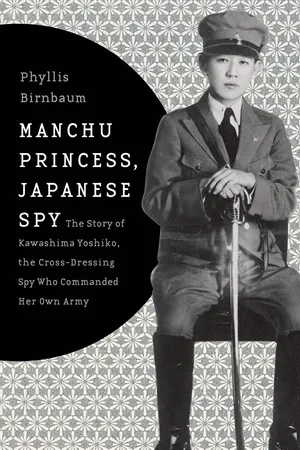
Manchu Princess, Japanese Spy
The Story of Kawashima Yoshiko, the Cross-Dressing Spy Who Commanded Her Own Army
- English
- ePUB (mobile friendly)
- Available on iOS & Android
eBook - ePub
Manchu Princess, Japanese Spy
The Story of Kawashima Yoshiko, the Cross-Dressing Spy Who Commanded Her Own Army
About this book
Information
Subtopic
Social Science BiographiesIndex
History1
BORN TO CHAOS
I don’t want to die with humans. But I’ll be happy if I die with monkeys. Monkeys are honest. Dogs too.
—KAWASHIMA YOSHIKO
On a March morning in 1948, the prisoner emerged just as the sun was coming up. She had expressed a wish to die quietly, without the fanfare that had often accompanied her every move. She had also wanted to wear a white Japanese robe for her last moments, but this request was denied. “On March 25, I will be executed,” she had written to her adoptive father. “Please tell young people to never stop praying for China’s future.” As she was brought out to the Beijing prison yard, the prison official announced the charges against her and confirmed her identity. She died, kneeling, a bullet to the back of her head. Later on, the official reported that she had not flinched in the slightest.
In rambling letters she had written from prison, she took pride in her tranquil state of mind. She had not weakened under the pressures of the trial, nor did she fear the outcome. “They’ll probably execute me. The court ruling says that I am a big spy, that I tried to use the Japanese to bring the Qing dynasty back to power. They say I sold China to the enemy. They’ll execute me since this is what they have in their heads. I feel like thanking them—was I really such an important person? Excuse me—I ask them—please show me some proof. That’s when the monkey show really gets going.”
In these letters, she went out of her way to praise her adoptive father, who had formed her ideas. She believed that she had honored his teachings by dedicating her life to her people, as he had urged. She had ridden her horse to Rehe, commanding troops against those who stood in her way. Wounded in battle, she had looked ahead to the benefits a victory would bring—a return of her clan to power and an end to chaos for all Chinese. She told her father not worry about her, for she had lived as she wished and credited him with giving her courage. “I am truly calm and clear in my mind, as befits your daughter. I am proud of myself.” If not for his instruction, she would have had nothing, not the glory, not the toil for her people. And without that, what worth did life possess? “For me,” she wrote in her warrior style, “there’s not much difference between being exonerated or executed.”
One shot to the head at close range ended her life that morning in 1948 and the exploits that had earned her international celebrity. A gruesome photo showed her dead, body laid out for public view, face covered with blood. It was the last of a woman who had been, for some, a traitor, and for others, a liberator—or for others still, a lonely and unstable figure, perhaps mad.
But was it the end? Almost as soon as the photo of her corpse was presented to the public, the questions began. Had she really died that morning in the courtyard of Beijing’s Number 1 Prison? Only two Western journalists had been allowed to witness the execution, and they were outsiders who could not be trusted to verify the facts. A reporter from the Associated Press wrote about seeing the fabled woman fall before his own eyes, but skeptics wondered whether he could identify her correctly. The Chinese reporters, expecting to be present at the great event, had been barred from the prison that morning. Denied entry to the execution, they raised a ruckus. If government officials had nothing to hide, why weren’t Chinese journalists allowed to identify the deceased? When a family member sought to put an end to the controversy by asserting that the hands of the corpse in the photograph were unmistakably Yoshiko’s, few took notice. Nothing was distinct in the photograph, so how could anyone profess to identify the hands?
The questions never found satisfactory answers, and the rumors gained new, persuasive details as the years passed. Why, money could purchase anything in China, and her family was rich and well connected. They could have easily bribed an official to fake an execution. Later on, a woman came forward to claim that it was not the famed spy who had died that morning but her own poor, ailing sister. The woman’s family had been promised a lot of money if the sister died in the prisoner’s place. While some of the money had been paid beforehand, the woman complained that her family never received the rest.
And so the gossip spread. In a country as vast as China, even someone well-known as—depending on whose side you’re on—the “Mata Hari of the East” or “Joan of Arc of the Manchus” could have set up a secret life in a remote region. She was spotted whipping up mischief in Mongolia and then Korea. Just recently, Chinese researchers came forward to insist that until 1978 she had lived on in Changchun, in China’s Northeast, where she had many connections. According to these reports, she had become more interested in Buddhism as she had aged, often visiting a nearby temple. In her youth, she had been known for her tomboyish ways, and some Changchun residents swore that they had definitely seen her not so long ago climbing trees in the neighborhood.
*
No matter when or where she died, this woman, who went by various names, shows no sign of disappearing from history anytime soon. While the details of her life are often disputed, few doubt that a more serene start might have produced a more serene end. But quiet was not to be her lot as she faced dynastic upheavals and alleged sexual abuse. Born in China and raised in Japan, she finished belonging to neither place.
As Aisin Gioro Xianyu, she started out in Beijing as the fourteenth daughter of a Manchu prince, whose legacy included unfulfilled dreams of a coup d’état and thirty-eight children. After the Manchu Qing dynasty fell in 1912, the prince plotted to bring about its return to power. His supply of children abundant, he thought nothing of giving Xianyu to a Japanese friend who promoted his political causes.
As Kawashima Yoshiko, she settled down into a life in Japan, where she startled the neighbors by riding horseback, as befit a Manchu princess, to her country school. She also soaked up her adoptive father’s beliefs about how she must devote herself to bringing the Manchus back to their former glory. This goal, impelling her to storm off to battle, suited her hot, erratic temperament.
As Commander Jin, she built a reputation as a spy who liked to dress as a man and became the heroine of a best-selling novel. With her short, handsome haircut and military uniforms, she was credited with unconfirmed exploits, among them riding horseback again, this time as leader of her own army. Renown intoxicated her, and she branched out into other areas where her qualifications were just as dubious. She recorded what she declared were genuine Mongolian folk songs, but she made up the lyrics and themes herself.
If her ideas were sometimes sublime, her colleagues were not. While trying to promote the Manchus, she got involved in promoting the puppet Manchu state the Japanese had set up in Manchuria. That’s one of the reasons why Yoshiko was tried for treason in China after the Japanese were defeated. By then, her myth had captured the imagination of the public worldwide. Either she had lost her teeth and her man’s wardrobe by 1948, when Chiang Kai-shek had her executed at dawn. Or, she did not really die that day but in the nick of time was swept off to a waiting plane, to begin a new life in places unknown.
*
No matter that her death remains a question to this day, the celebrity spy still has a way of turning up time and again. For a government seeking to whip up its citizens’ patriotic fervor, recounting her past deeds can stir the crowds. It is a tricky business, however, for her aims were contradictory, and so she can be held up as an example by both sides. To the Chinese, she continues to offer a case of all-purpose evil as a Chinese traitor who caused damage that can never be forgotten. They blame her for starting a war in Shanghai and for otherwise assisting the Japanese occupation; they do not fail to bring up her childhood rape and later unquenchable sexual thirst. While there is substance to some of these charges, her Chinese accusers go too far when they blame her for masterminding the bombing of a certain warlord’s train as it passed under a bridge in Shenyang. In fact, she had no expertise in explosives and was far more qualified for her role as a dance hall girl in Shanghai. It is impossible that the young woman who won a first prize for her waltz carried out that spectacular assassination.
For Japanese, the story takes on another look entirely. In Japan, as Kawashima Yoshiko, she is accepted as almost one of their own since she spent much of her youth in the country. Therefore, in Japan they take a more wistful view of Yoshiko’s escapades. They emphasize her psychological problems, and once they start along this line—childhood woes, abandonment, solitude—there is much to consider. The Japanese tend to forgive her wartime activities and have no interest in the assassination plot. For the Japanese, Yoshiko has been wronged over and over, by her birth father, her adoptive father, the entire Japanese military establishment, other males who took advantage of her beauty and her daring. Finally, she was wronged by carelessness: there are claims she would not have faced execution if a certain form had been filled in when she was a young girl. By the time anyone got around to worrying about this form, she was on trial for her life. “Poor Yoshiko,” her niece lamented upon learning of her death. “That one piece of paper would have saved her.”
This Chinese-Japanese spy has also been taken up by the moviemakers, most notably Bernardo Bertolucci in his 1987 film The Last Emperor. She makes her first appearance in the film at the Tianjin residence of Puyi, the exiled “Last Emperor” who was her distant relative. Dashing in men’s clothes, she arrives in a pilot’s leathers, and more dashingly, she identifies herself as “Eastern Jewel,” another of her names. Eastern Jewel quickly establishes her contempt for convention when she dismisses the institution of marriage and becomes the empress’s opium supplier.
“Oh, I know everything,” she tells the empress. “I know Chiang Kai-shek has false teeth. I know his nickname, ‘Cash My Check.’ I’m a spy and I don’t care who knows it.”
When Emperor Puyi strides into the room, Eastern Jewel welcomes him with an enthusiastic, uncousinly embrace. Since Puyi’s consort has just left him, Eastern Jewel volunteers to serve as substitute. Puyi, however, declares that she’s not his type.
Unfazed, Eastern Jewel moves on to political intrigue.
*
As Bertolucci’s film and other, more reliable sources make plain, Yoshiko’s fame was tangled up in the Japanese occupation of China, which started in Manchuria in 1931 and went on until the Japanese defeat in 1945. During those years, Yoshiko moved between China and Japan with ease, undaunted by the differences in language and customs of her two home countries. She also did not seem to fear the peril of her unusual circumstances, and this insouciance in the face of danger proved either her immense courage or her utter misunderstanding of current events.
To justify their aggressions, the Japanese claimed that they were liberating China from imperialist Western powers. Britain and France, among others, had foisted degrading treaties upon China and “carved up the Chinese melon” by taking control of swaths of land. In the course of their “liberation” of China, the Japanese proved themselves more bloodthirsty imperialists than the Westerners, all the while spouting slogans about the all-Asian heaven they were creating. Ruthless in their usurpation of Chinese territory, they eventually advanced from Manchuria down along much of China’s east coast.
A princess of Manchuria with strong Japanese influences, Yoshiko thrived and fell on that turmoil. As China and Japan continue to argue about the terrible events of those years, she has taken her place in the never-ending debate. Was she just a gullible victim in the butchery going on around her? Could she have avoided being drawn into the “paradise” the Japanese claimed to be creating in China? Once drawn into that “paradise,” did she bear any responsibility for that regime’s cruelty?
Yoshiko’s supporters now say that she was just a lonely woman, discarded by her birth father and looking for affection. Others, less sympathetic, point out that not every lonesome woman rides off on horseback to assist foreign invaders or does undercover work for the occupiers of her native land.
2
LITTLE SISTER
A picturesque film-drama figure, half tomboy, half heroine, flits through the Japanese press these days with the nickname “the Manchukuo Joan of Arc.” Yoshiko Kawashima is her name, and there are about her many strange circumstances that make her appealing to a nation which takes deep pride in the army and its exploits.
Yoshiko has been a spy for the Japanese, has been photographed riding with the Manchukuo troops to war and has been featured in newspaper stories and in a novel. When she visited Tokyo recently, a waitress at a café asked her whether she was a boy or girl. “I am half boy and half girl,” she is reported to have replied. Soon afterward she broadcast an address in which she said she was now a man, and as a man she proceeded to advise Japanese women against bobbed hair and foreign dress.
Yoshiko Kawashima is Manchu by birth. Her father (according to the versions of her history which find currency in Japan) was a Manchu prince. … After the revolution her father fled from Tientsin to Port Arthur, aided by a Japanese ronin or freelance, who had been mixing in China’s troubled politics.
—NEW YORK TIMES, SEPTEMBER 17, 1933
Although at her trial Yoshiko claimed to be younger than commonly believed and may not have died when the Chinese government said she did, it is absolutely certain that she has not made any public pronouncements since her execution date. Until recently, the closest anyone could get to seeing Yoshiko was her sister Jin Moyu, who, in fact, provided a good place to start. Born in 1918, Jin was the youngest of their father, Prince Su’s, thirty-eight children from five mothers. Waspish always, Jin had her own view of the family, easily mixing fashion commentary with pointed remarks about her siblings. Over her long life—she died in 2014—she learned that certain personal characteristics could be life threatening. In particular, outspokenness mixed with a noble class background in China could guarantee at the very least a prison stay and at the worst, execution at dawn.
Both Yoshiko and Jin Moyu were daughters of Prince Su’s fourth consort, and, like many in the family, both lived for long periods in China and Japan. This ensured the divided loyalties that brought disaster to both of them. Yoshiko was (supposedly) shot in 1948, while Jin spent fifteen years imprisoned in China, accused of being an enemy of the Chinese Revolution because of her infamous older sister and her own Japanese associations. Philosophical in her old age about what she had endured, Jin never forgot her complicated history.
“I’m Chinese,” she wrote in her autobiography I Was Born a Qing Princess, “but I’ve been Japanized in my approach to things and my way of thinking. … I never studied anything about Communism or Socialism. I am totally apolitical. … I have never spent even one day in Chinese schools. From primary school to college, I went to Japanese schools. All my friends are Japanese.” Although Jin was persecuted in China because of her ties ...
Table of contents
- Cover
- Title Page
- Series Page
- Dedication
- Contents
- Main Characters
- Chronology
- A Note on the Text
- 1. Born to Chaos
- 2. Little Sister
- 3. Royalty in Exile
- 4. Continental Adventurer
- 5. A New Life in Japan
- 6. Manchu Prince, Japanese Wife
- 7. School Days
- 8. The Beauty in Men’s Clothing
- 9. Extreme Measures
- 10. Repercussions
- 11. On Her Own
- 12. Poisonous Devil’s Brew
- 13. Advance Into Manchuria
- 14. An Emperor in Flux
- 15. The Reluctant Empress
- 16. Powerful Connections
- 17. Woman of Influence
- 18. A Growing Awareness
- 19. Commander Jin
- 20. Starting Over in Manchukuo
- 21. In the Bright Light
- 22. Wild Child
- 23. A Daughter Looks Back
- 24. China Nights
- 25. Emergency Help
- 26. An Old Love
- 27. Adrift in Fukuoka
- 28. Hopeful to the End
- 29. Narrow Escapes
- 30. Postwar Justice
- 31. Go with a Smile
- Notes
- Acknowledgments
- Index
- Copyright
Trusted by 375,005 students
Access to over 1.5 million titles for a fair monthly price.
Study more efficiently using our study tools.
Frequently asked questions
Yes, you can cancel anytime from the Subscription tab in your account settings on the Perlego website. Your subscription will stay active until the end of your current billing period. Learn how to cancel your subscription
No, books cannot be downloaded as external files, such as PDFs, for use outside of Perlego. However, you can download books within the Perlego app for offline reading on mobile or tablet. Learn how to download books offline
Perlego offers two plans: Essential and Complete
- Essential is ideal for learners and professionals who enjoy exploring a wide range of subjects. Access the Essential Library with 800,000+ trusted titles and best-sellers across business, personal growth, and the humanities. Includes unlimited reading time and Standard Read Aloud voice.
- Complete: Perfect for advanced learners and researchers needing full, unrestricted access. Unlock 1.5M+ books across hundreds of subjects, including academic and specialized titles. The Complete Plan also includes advanced features like Premium Read Aloud and Research Assistant.
We are an online textbook subscription service, where you can get access to an entire online library for less than the price of a single book per month. With over 1.5 million books across 990+ topics, we’ve got you covered! Learn about our mission
Look out for the read-aloud symbol on your next book to see if you can listen to it. The read-aloud tool reads text aloud for you, highlighting the text as it is being read. You can pause it, speed it up and slow it down. Learn more about Read Aloud
Yes! You can use the Perlego app on both iOS and Android devices to read anytime, anywhere — even offline. Perfect for commutes or when you’re on the go.
Please note we cannot support devices running on iOS 13 and Android 7 or earlier. Learn more about using the app
Please note we cannot support devices running on iOS 13 and Android 7 or earlier. Learn more about using the app
Yes, you can access Manchu Princess, Japanese Spy by Phyllis Birnbaum in PDF and/or ePUB format, as well as other popular books in History & Social Science Biographies. We have over 1.5 million books available in our catalogue for you to explore.