- English
- ePUB (mobile friendly)
- Available on iOS & Android
eBook - ePub
About this book
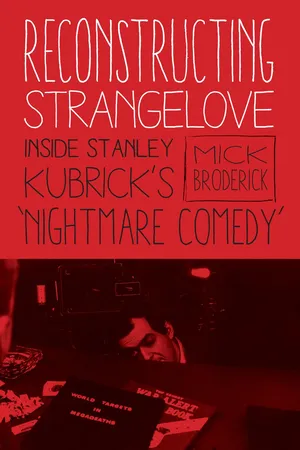
During his career Stanley Kubrick became renowned for undertaking lengthy and exhaustive research prior to the production of all his films. In the lead-up to what would eventually become Dr. Strangelove (1964), Kubrick read voraciously and amassed a substantial library of works on the nuclear age. With rare access to unpublished materials, this volume assesses Dr. Strangelove's narrative accuracy, consulting recently declassified Cold War nuclear-policy documents alongside interviews with Kubrick's collaborators. It focuses on the myths surrounding the film, such as the origins and transformation of the "straight" script versions into what Kubrick termed a "nightmare comedy." It assesses Kubrick's account of collaborating with the writers Peter George and Terry Southern against their individual remembrances and material archives. Peter Sellers's improvisations are compared to written scripts and daily continuity reports, showcasing the actor's brilliant talent and variations.
Information
Subtopic
Film & VideoCHAPTER ONE
The Road to Strangelove: From Red Alert to The Delicate Balance of Terror and Beyond
The development of what ultimately became the Dr. Strangelove script was a lengthy and convoluted process. It was by far the most complex writing assignment that Kubrick had undertaken up to that point, including the massive re-writing of Nabokov’s overlong screenplay with James B. Harris and the unplaced efforts under Harris-Kubrick Pictures.1 Due to the fluid working arrangements and the competing, often parallel project development, the complete chronology and quantified outputs during this period are difficult to establish definitively. Kubrick’s papers and production files (mostly donated to the University of the Arts London Archives and Special Collections Centre) do allow for a substantial reconstruction of these events, aided by the materials kept by David George and the few surviving Strangelove items held by Nile Southern (and the literary deposit at the New York Public Library).
The Stanley Kubrick Archive holds copious undated notes, script fragments, rewrites, miscellaneous drafts and multiple notecards, many in the director’s distinctive handwriting, some with annotations by George, and many typed, that are difficult to date accurately despite attempts at cross-referencing. Conflicting lists of possible actors are detailed, often without assigned roles. Characters’ names change inexplicably and some are shunted about across script drafts, while others return to their original designation or with slight modification. Hence, some of what follows in this chapter is speculative, a best guess at a calendar of events in the development process. As this book endeavours to demonstrate, Kubrick’s overall working methods were expanded, refined and consolidated during Dr. Strangelove. His deliberate embrace of improvisation and opportunity during rehearsal enabled creative contributions from cast and crew to improve the script and narrative perspective (see chapters two and five). Chief amongst these developments was Kubrick’s construction of the film while editing – a process where entire sequences were pragmatically jettisoned if they did not match the tone of the film or were otherwise considered superfluous.
As noted in the Introduction, Kubrick had been concerned by the potential (mis)use of nuclear weapons for years. His musing on the thermonuclear dilemma became an infectious one. He ploughed through Herman Kahn’s On Thermonuclear War (1960) and passed it onto Harris, who became ‘involved in the same concerns’. The producer recalls it was
pretty sophisticated in terms of how it explained everything. Stanley had already read the thing several times and was an expert on it as he always becomes on any new subject that takes his fancy.2
From October 1961 to January 1963, Kubrick continued to develop and revise a range of nuclear scenarios, initially working with producer-partner Harris, then Red Alert author Peter George, and lastly with Terry Southern. Within the first three months a serious nuclear thriller had emerged based on George’s novel. Harris-Kubrick Pictures secured a production deal with Seven Arts. However, Kubrick soon changed his mind. He trusted his instinct not to abandon nagging reservations that compelled him to see the inherent, comic absurdity of the nuclear era. After announcing the change towards ‘nightmare comedy’ to George and Harris, Seven Arts promptly rescinded the deal. Kubrick regrouped and worked on satirical script treatments with George, while still retaining the ‘serious’ version as a working option. A fortuitous meeting with Terry Southern, who had come to interview Kubrick about Lolita for Esquire magazine, led to a later invitation by the director to engage Southern for approximately eight weeks in late 1962 in order to sharpen the dialogue and bring hipster Southern’s unique talent for the absurd and grotesque into play.
As outlined in the Introduction, although the director had been concerned with the perils of the nuclear age since the early 1950s, and had contemplated migrating to Australia for a number of years, it wasn’t until after he had completed his post-production and distribution commitments on Lolita that he seriously turned his mind to the subject. When Stanley cast Christiane in Paths of Glory in 1957 she already had a young daughter (Katharina, born in 1953) from her marriage to German actor Werner Bruhns. Christiane had spent a good deal of time as an actor and performer in Berlin and knew the city well. In 1961 when the second Berlin crisis emerged (following the Allied air-lift in 1948) it seemed as though a conflict might erupt between NATO, East Germany and the Soviets, and possibly escalate to all-out thermonuclear war. The year before, tensions between Khrushchev and Eisenhower had peaked over the shooting down of a U-2 spy plane overflying Russia. An irate Soviet Premier cancelled his offer to Eisenhower to visit Moscow to discuss disarmament and publicly paraded captured American pilot, Francis Gary Powers, in a subsequent ‘show trial’.3 Berlin remained a geopolitical irritant and unresolved matter for Soviets as East German citizens increasingly sought refuge in the West, rejecting the communist system.
With a new President in the White House, Khrushchev met Kennedy in Vienna in June 1961 but the leaders’ meeting began frostily and quickly deteriorated towards impasse. The next day Khrushchev demanded that JFK solve the ‘Berlin problem’ by year’s end. Kennedy responded, ‘It’s going to be a cold winter’.4 Khrushchev had previously issued an ultimatum to Eisenhower in 1958 and secretly decided in July 1961 to close the East German boarder in order to prevent the large flow of communist refugees entering the West. On 13 August, East German border guards began restricting such movements, a mass transit that had risen to over a thousand per day.5
Within 24 hours construction began on concrete walls at key Berlin check-points. East German soldiers were ordered to shoot anyone who attempted to defect. That same day, after meeting with staff at the Australian embassy in London, Kubrick sent a letter of thanks for the working lunch to discuss his possible residency options.6 A week later amid increasing tensions in Berlin, Kubrick wrote to his attorney, Louis Blau, advising him that he was planning to return to New York the next month, noting that he was ‘trying to come up with a worthwhile project to do’.7
The idea of becoming a southern hemisphere nuclear refugee was likely taking hold. On 24 August the Kennedy administration issued a ‘solemn warning’ at ‘aggressive’ Soviet moves to prevent Allied access to West Berlin. By the end of August the Soviet Union suddenly abandoned its self-imposed nuclear test moratorium by detonating a nuclear weapon. They continued to explode on average at least one atomic or thermonuclear device every day throughout September and October. The Soviets also withdrew from tripartite (US/UK/USSR) talks aimed at establishing a limited test ban treaty. Troubled by international financial affairs, on 5 September Kubrick wrote to his to legal advisors with concerns that an associate might empty one of his bank accounts and travel to ‘a non-extradition treaty country and live out the rest of their lives in wealth and safety from the H-bomb’.8 The correspondence suggests that Kubrick’s strongly held nuclear concerns were becoming manifest in the filmmaker’s day-to-day business.
Throughout early October Kubrick continued to liaise with Australian authorities about his proposed visit. He wrote to Australia House in London to obtain tourist visas for himself and his family ‘for the dual purpose of having a vacation and scouting locations in Australia for a film project which I am considering’.9 The London office of the Bank of New South Wales advised him that he would face no penalty if ‘remitting capital funds from Australia should you decide not to stay there on a permanent basis’. The bank also provided him with two letters of introduction to be used in Australia. Due to meet Embassy officials for an interview on 4 October, Kubrick raised the question about how he might prove that his permanent place of abode was outside Australia since he didn’t ‘own a home in America’.10
The following day Kubrick visited Alastair Buchan at the Institute for Strategic Studies in London. Although Buchan was dismissive of Kubrick’s ambitious idea to make a film on the possibilities of nuclear war and the procedures that the US had in place to prevent unauthorised attack, Buchan gave Kubrick a copy of Red Alert.11 Already immersed in the scholarship of the nuclear age, and having read Kahn’s On Thermonuclear War, Peter George’s novel hit a nerve. From there things moved quickly. Harris and Kubrick spent the next few weeks working on ideas for adapting the novel into a film; their working title was Edge of Doom.12 In a letter dated 25 October 1961, headed ‘Intended Screen Play Revisions for the Novel “Red Alert”’, Harris and Kubrick outlined the broadest possible scope for the proposed movie.13 The document was later sent to American authors Eugene Burdick and Harvey Wheeler, while politely declining their offer of rights to the early, pre-publication draft of their forthcoming novel Fail-Safe (see chapter three).14
Throughout October Kubrick continued to liaise with various Australian authorities regarding his ‘idea of taking up permanent residence’, seeking tax advice on precedents by visiting American actors whose previous tax exemptions were being challenged in the Australian High Court. A Sydney-based tax consultant advised Kubrick that, while any future ruling would not adversely affect him personally, ‘the tax position of actors and actresses who might join your project may well turn on’ the court’s decision.15 It is impossible to tell from the remaining correspondence what that project was. It may well have been the nuclear narrative he felt so impelled to produce. Having filmed in the USA on both the east and west coasts, in Germany, Spain and the UK, the prospect of relocating to film in Australia was far from fanciful. Stanley Kramer had recently spent the summer of 1959 filming the post-nuclear drama On the Beach on location in Melbourne with Gregory Peck, Ava...
Table of contents
- Cover
- Dedication
- Title Page
- Copyright
- Contents
- Acknowledgements
- Dr. Strangelove Timeline
- Glossary
- Introduction: Stanley Kubrick’s Atomic Antecedents
- 1. The Road to Strangelove: From Red Alert to The Delicate Balance of Terror and Beyond
- 2. Doctors Strangelove – A Character Evolution
- 3. ‘Gentlemen, you can’t fight in here…’: Brinksmanship Amongst the Authors and Producers of Dr. Strangelove and Fail-Safe
- 4. Authentically Strange: Presidential Predelegation, Fail-safes and Doomsday Machines
- 5. Reconstructing Strangelove: Outtakes from the Cutting Room Floor
- Conclusion: Sons of Strangelove
- Bibliography
- Production Credits
- Index
Trusted by 375,005 students
Access to over 1.5 million titles for a fair monthly price.
Study more efficiently using our study tools.
Frequently asked questions
Yes, you can cancel anytime from the Subscription tab in your account settings on the Perlego website. Your subscription will stay active until the end of your current billing period. Learn how to cancel your subscription
No, books cannot be downloaded as external files, such as PDFs, for use outside of Perlego. However, you can download books within the Perlego app for offline reading on mobile or tablet. Learn how to download books offline
Perlego offers two plans: Essential and Complete
- Essential is ideal for learners and professionals who enjoy exploring a wide range of subjects. Access the Essential Library with 800,000+ trusted titles and best-sellers across business, personal growth, and the humanities. Includes unlimited reading time and Standard Read Aloud voice.
- Complete: Perfect for advanced learners and researchers needing full, unrestricted access. Unlock 1.5M+ books across hundreds of subjects, including academic and specialized titles. The Complete Plan also includes advanced features like Premium Read Aloud and Research Assistant.
We are an online textbook subscription service, where you can get access to an entire online library for less than the price of a single book per month. With over 1.5 million books across 990+ topics, we’ve got you covered! Learn about our mission
Look out for the read-aloud symbol on your next book to see if you can listen to it. The read-aloud tool reads text aloud for you, highlighting the text as it is being read. You can pause it, speed it up and slow it down. Learn more about Read Aloud
Yes! You can use the Perlego app on both iOS and Android devices to read anytime, anywhere — even offline. Perfect for commutes or when you’re on the go.
Please note we cannot support devices running on iOS 13 and Android 7 or earlier. Learn more about using the app
Please note we cannot support devices running on iOS 13 and Android 7 or earlier. Learn more about using the app
Yes, you can access Reconstructing Strangelove by Mick Broderick in PDF and/or ePUB format, as well as other popular books in Media & Performing Arts & Film & Video. We have over 1.5 million books available in our catalogue for you to explore.