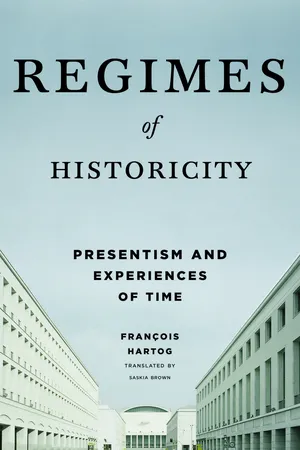
François Hartog explores crucial moments of change in society's "regimes of historicity," or its ways of relating to the past, present, and future. Inspired by Hannah Arendt, Reinhart Koselleck, and Paul Ricoeur, Hartog analyzes a broad range of texts, positioning The Odyssey as a work on the threshold of historical consciousness and contrasting it with an investigation of the anthropologist Marshall Sahlins's concept of "heroic history." He tracks changing perspectives on time in Chateaubriand's Historical Essay and Travels in America and sets them alongside other writings from the French Revolution. He revisits the insights of the French Annales School and situates Pierre Nora's Realms of Memory within a history of heritage and today's presentism, from which he addresses Jonas's notion of our responsibility for the future.
Our presentist present is by no means uniform or clear-cut, and it is experienced very differently depending on the position we occupy in society. We are caught up in global movement and accelerated flows, or else condemned to the life of casual workers, living from hand to mouth in a stagnant present, with no recognized past, and no real future either (since the temporality of plans and projects is inaccessible). The present is therefore experienced as emancipation or enclosure, and the perspective of the future is no longer reassuring, since it is perceived not as a promise, but as a threat. Hartog's resonant readings show us how the motor of history(-writing) has stalled and help us understand the contradictory qualities of our contemporary presentist relation to time.
- English
- ePUB (mobile friendly)
- Available on iOS & Android
eBook - ePub
About this book
Information
Subtopic
Historical Theory & CriticismIndex
HistoryORDERS
of
TIME 1
1
MAKING HISTORY
SAHLINS’S ISLANDS
IN A LECTURE SIGNIFICANTLY ENTITLED “OTHER TIMES, Other Customs: The Anthropology of History,” Marshall Sahlins evoked Jean-Paul Sartre’s question of whether we are yet able “to constitute a structural, historical anthropology.” Sahlins’s response was unequivocal: “Yes, I have tried to suggest here, le jour est arrivé” (in French in Sahlins). In other words, the day had dawned when one could “explode the concept of history through the anthropological experience of culture.”1 Taking my cue from this, I will start with this anthropological experience of culture, guided by Sahlins, whose lecture sought to bring that “day” into being, or at least see it break, with all the promises it held. What interests me here is the anticipated or desired explosion of the concept of history, and with it the assertion that “the heretofore obscure histories of remote islands deserve a place alongside the self-contemplation of the European past.”2 And not only as parallel histories, but as a contribution from the margins to our thinking about history and historical time.
That was in 1982, which was—already—another time, if not other customs. What were the issues back then? Sahlins had developed his historical anthropology on the basis of the ethnographic, historical, and archival work he had carried out on the distant islands of the Pacific Ocean. Over the years, his fieldwork and tireless archival research had made these islands into something to be reckoned with in any work on anthropology and history, and particularly on forms of history. Hawaii was particularly important for him, and especially the emblematic figure of Captain Cook (whose twofold apotheosis Sahlins describes).3 Time and again, in article after article—and supplement after supplement—this Sherlock Holmes of the South Pacific called his historian and anthropologist colleagues to account,4 with a Supplement to the Voyage of Cook and even eventually a Supplement to Claude Lévi-Strauss’s The Savage Mind,5 whose thought had initially so inspired him. Sahlins’s body of work marked the beginning of another time, which sought to consecrate at long last the marriage of structural method and history through a structuralism informed by language pragmatics. The first imperative was to undo the plethora of false binary oppositions structuralism had spawned, and particularly the opposition of history and structure, for which Sahlins proposed the alternative of “structure of the conjuncture.”6
What were the influences on Sahlins? In 1960 Lévi-Strauss had made a distinction between “cold” and “hot” societies. It met with immediate success, but was also the object of fierce debate and to this day is poorly understood.7 “Cold” societies border on “the zero [of] historical temperature” and seem to be predominantly concerned with “preserving their existence.” “Hot” societies, on the other hand, exist at a higher temperature or, more precisely, experience internal differences in temperature within the system, from which they “extract change and energy.” They “interiorize history, as it were, and turn it into the motive power of their development.”8 Such are, preeminently, European societies. Lévi-Strauss’s metaphors are clearly drawn from the model of the steam or internal combustion engine, even though, as we have seen, he attributed the first period of “warming up” to the Neolithic revolution, of which the Industrial Revolution was but a distant copy.
Importantly, when Lévi-Strauss returned to this distinction some twenty years later, he stressed that it should be taken for what it was, namely, a model. His aim in presenting two states which, like the state of nature in Rousseau “do not exist, have never existed, and will never exist,” and yet which must be “[understood] correctly,” was above all “heuristic.” “All societies,” he went on,
are equally historical, but some of them admit it openly whereas others resist the idea and prefer to ignore it. So if we can legitimately place societies on an ideal scale not according to their degree of historicity, which is the same for all, but according to the way they experience it, it is important to identify and analyze the borderline cases: under what conditions and in what forms does a community’s way of thinking and the individuals who constitute it open up to the idea of history? When and how do they come to view it as a tool by means of which they can act on the present and transform it, rather than as a disorder and a threat?9
In Lévi-Strauss’s terms, one could say that all societies have the same degree of historicity, but that “the subjective image they have of themselves” and “the way they experience it” vary. Their awareness of history and the uses they put it to are not the same. That is, societies differ in their modes of historical consciousness, and their ways of living, thinking, and exploiting it, in other words, in the ways they articulate past, present, and future. It is their regimes of historicity, therefore, which differ.
Later still, in 1998, Lévi-Strauss again felt obliged to clarify his position, which was still being misunderstood. He again stressed the point that at issue were only a society’s “subjective” attitudes toward history, which is why “if it is not our history, we fail to perceive them.” He then made a new point, which reflected the decade of the 1990s: “I have been wondering, as this century draws to a close, whether there are not perceptible signs that our own societies are cooling down.” He went on to explain:
Our societies, which are the perpetrators or victims of such ghastly tragedies, which are frightened by the consequences of demographic expansion, of wars and other scourges, have rediscovered an attachment to heritage and the importance of roots…, which is their way of living the illusion, as it is for other countries which feel under threat, that they can—symbolically only, of course—move against the course of history and suspend time.10
For Lévi-Strauss, “cooling down” was thus another name for the crisis of the future.
Yet Lévi-Strauss had not always approached history through this kind of subjective comparison of historicities. In his original article on ethnology and history, published in 1949, his argument had taken a different turn, and centered on each discipline’s relation to the object. The two disciplines differed, in his view, not in the nature of their object, aim, or method, but solely in the perspective adopted, since “history organizes its data in relation to conscious expressions of social life, while anthropology proceeds by examining its unconscious foundations.”11 Historicity, or rather its different modes, was not Lévi-Strauss’s main concern at this point.
In 1952, however, when commissioned by UNESCO to write Race and History, he could no longer ignore the issue, but he chose a different focus.12 As we saw in the prior chapter, in order to establish the idea of the diversity of cultures, he introduced the notions of “stationary” and “cumulative” history, while immediately adding that the processes of accumulation were neither continuous nor the privilege of a single civilization, and that the difference between “stationary” and “cumulative” history was a function of the observer’s viewpoint, such that phenomena that seemed to the observer to be developing in the same direction as his or her civilization tended to be regarded as “cumulative,” whereas those which lay outside the civilization’s frame of reference, as “stationary.” If we reckon with the “ethnocentric point of view which we always adopt in assessing the value of a different culture,” then historicity, “or, to use a more accurate term, [a culture’s] eventfulness, thus depends not on its intrinsic qualities but on our situation with regard to it and on the number and variety of our interests involved.”13 Or, in another wording, “the contrast between progressive and stagnant cultures would thus appear to result, in the first place, from a difference of focus.”14
This conclusion prompted Lévi-Strauss to call for a general theory of relativity that could embrace both the physical and the social sciences. Race and History was a wide-ranging meditation on the diversity of cultures, published at a time when a global civilization was appearing for the first time. He stressed the “fact” of diversity, but the analysis of different cultures’ forms or regimes of historicity evidently lay beyond the book’s scope. Nevertheless, he gestured toward these ideas through ill-fitting notions such as “eventfulness,” which is dependent upon a culture’s “intrinsic qualities.” With hindsight, we can interpret this slightly hesitant or clumsy vocabulary as the sign of a difficulty in defining what was being referred to. But no precise terms seemed available, and historians certainly had nothing better to offer. With Race and History, Lévi-Strauss had established a framework or, better, opened up an approach based on the idea of relativity.15 It was, after all, the era of decolonization.
In the very same year, 1952, and likewise exploring the notion of historicity, Claude Lefort’s somewhat overlooked article “Société ‘sans histoire’ et historicité” (“Societies ‘without history’ and historicity”) also broke new ground. It went back to Hegel’s great divide between societies with and without history, and tried to move beyond it by placing the question of historicity squarely in the center.16 “What is proper to historical societies,” Lefort maintained, “is that they contain the principle of the event within themselves and have the capacity to convert it into the dimension of an experience, such that it may figure as an element in an on-going debate.”17 When Lefort referred to an “event,” he clearly had in mind an event like the French Revolution, whereas Lévi-Strauss in his speculations on the emergence of “hot” societies was thinking, rather, of the Neolithic revolution. The time—and temperature!—scales were clearly not the same. For Lefort, “historical” societies were based on the “principle of the event,” whereas the principle of “primitive” societies had yet to be defined. Far from separating the two or treating them as opposites, Lefort wanted to make them comparable, precisely by “distinguishing two modes of historicity.” His introduction of the notions of “principle” (the principle of the event) and of “modes of historicity” provided a way out of the vagueness of the historical categories used hitherto, and enabled the question of forms of historicity to be addressed more subtly.
Lefort’s question was thus: “How does primitive society close off its own future, how does it develop without being aware that it is changing and, as it were, establish itself in view of its own replication?” In short, what is its historical principle, “what genre of historicity” does it have, “by which we mean the general relation which people entertain with the past and the future”?18 This was a definition of historicity we could already work with, except for the omission of any explicit consideration of the present. Although Lefort was well-read in anthropology, he wrote as a philosopher, mindful of preserving differences without reducing them to a lack that would reactivate the old Hegelian divide between societies with and without history. Exploring this “genre of historicity” further, through fieldwork, lay beyond Lefort’s scope.
This is where Marshall Sahlins came in. Although with Sahlins the key issue—the type of historicity—remained unchanged, the terms used to address it were no longer the same. Structuralism had left its mark, first on anthropology, and then on the study of history.19 It was something one supported, opposed, or wanted to improve. The whole field of the humanities and social sciences was bristling with binary oppositions, not least myth and history, which would be the object of fierce debate, along with event and structure. The terms of the discussion were to change yet again, with the various moves out of structuralism. But let us simply explore for the moment the context of Sahlins’s work, its methods, and its concerns.
The Heroic Regime
Sahlins starts by transporting his reader to Fiji. Through a series of micro-analyses he depicts how the history, or rather mode of historical consciousness, of these islands is experienced, constructed, and narrated. In a short introduction, he reminds the reader that Western history itself has a history and that its modern forms, concerned with quantifiable data, cycles, and structures, are inseparable from the forms of our modernity. But this word of caution, which seems so very obvious to us today, is immediately overlaid or relativized by another one, to the effect that a history in which numerical importance and the idea of collective values counted emerged long before the market economy and modern democracies. For with the rise of the Greek city-state (for which Sahlins refers to Jean-Pierre Vernant’s Origins of Greek Thought20), a new history had gained currency in which the agora replaced the royal palace and the majority principle won out over the appropriation of power by a single person. In other words, in ancient Greece, a new mode of historical existence had arisen, as well as a new historical consciousness (which would soon lead to this history being written down, becoming what the Western tradition would thereafter precisely call “History”).21
Sahlins’s double detour, however schematic or approximate it may appear, had the propaedeutic virtue of injecting a dose of relativism into Western observers, prompting them from the outset to question their own traditions: “Other times, other customs,” to be sure, but also other histories. However, these histories were not like the islands on ...
Table of contents
- Cover
- Series Page
- Title Page
- Copyright
- Dedication
- Contents
- Presentism: Stopgap or New State?
- Introduction: Orders of Time and Regimes of Historicity
- Orders of Time 1
- Orders of Time 2
- Our Doubly Indebted Present: The Reign of Presentism
- Notes
- Index
- Series List
Trusted by 375,005 students
Access to over 1.5 million titles for a fair monthly price.
Study more efficiently using our study tools.
Frequently asked questions
Yes, you can cancel anytime from the Subscription tab in your account settings on the Perlego website. Your subscription will stay active until the end of your current billing period. Learn how to cancel your subscription
No, books cannot be downloaded as external files, such as PDFs, for use outside of Perlego. However, you can download books within the Perlego app for offline reading on mobile or tablet. Learn how to download books offline
Perlego offers two plans: Essential and Complete
- Essential is ideal for learners and professionals who enjoy exploring a wide range of subjects. Access the Essential Library with 800,000+ trusted titles and best-sellers across business, personal growth, and the humanities. Includes unlimited reading time and Standard Read Aloud voice.
- Complete: Perfect for advanced learners and researchers needing full, unrestricted access. Unlock 1.5M+ books across hundreds of subjects, including academic and specialized titles. The Complete Plan also includes advanced features like Premium Read Aloud and Research Assistant.
We are an online textbook subscription service, where you can get access to an entire online library for less than the price of a single book per month. With over 1.5 million books across 990+ topics, we’ve got you covered! Learn about our mission
Look out for the read-aloud symbol on your next book to see if you can listen to it. The read-aloud tool reads text aloud for you, highlighting the text as it is being read. You can pause it, speed it up and slow it down. Learn more about Read Aloud
Yes! You can use the Perlego app on both iOS and Android devices to read anytime, anywhere — even offline. Perfect for commutes or when you’re on the go.
Please note we cannot support devices running on iOS 13 and Android 7 or earlier. Learn more about using the app
Please note we cannot support devices running on iOS 13 and Android 7 or earlier. Learn more about using the app
Yes, you can access Regimes of Historicity by François Hartog, Saskia Brown in PDF and/or ePUB format, as well as other popular books in History & Historical Theory & Criticism. We have over 1.5 million books available in our catalogue for you to explore.