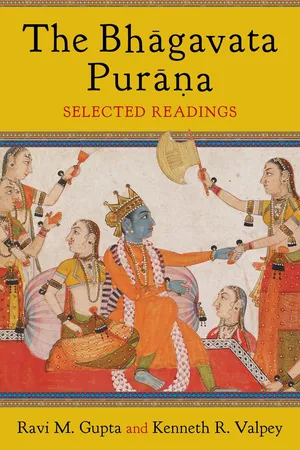
Formalized by the tenth century, the expansive Bhagavata Purana resists easy categorization. While the narrative holds together as a coherent literary work, its language and expression compete with the best of Sanskrit poetry. The text's theological message focuses on devotion to Krishna or Vishnu, and its philosophical outlook is grounded in the classical traditions of Vedanta and Samkhya. No other Purana has inspired so much commentary, imitation, and derivation. The work has grown in vibrancy through centuries of performance, interpretation, worship, and debate and has guided the actions and meditations of elite intellectuals and everyday worshippers alike.
This annotated translation and detailed analysis shows how one text can have such enduring appeal. Key selections from the Bhagavata Purana are faithfully translated, while all remaining sections of the Purana are concisely summarized, providing the reader with a continuous and comprehensive narrative. Detailed endnotes explain unfamiliar concepts and several essays elucidate the rich philosophical and religious debates found in the Sanskrit commentaries. Together with the multidisciplinary readings contained in the companion volume The Bhagavata Purana: Sacred Text and Living Tradition (Columbia, 2013), this book makes a central Hindu masterpiece more accessible to English-speaking audiences and more meaningful to scholars of Hindu literature, philosophy, and religion.
- English
- ePUB (mobile friendly)
- Available on iOS & Android
eBook - ePub
About this book
Information
Topic
Theology & ReligionSubtopic
Indian & South Asian HistoryNOTES
INTRODUCTION
1. Here we employ “the Rāmāyaṇa” in a generic sense to refer to the many vernacular versions and adaptations as well as film and television renditions. The Bhāgavata Purāṇa includes its own highly abridged rendition of the Rāmāyaṇa (in Book Nine), explicitly referring to other Rāmāyaṇa versions as being commonly known, justifying a very brief summary within the Bhāgavata.
2. Readers unfamiliar with classical Indian literature may find the profusion of strange names found in the Bhāgavata to be rather daunting. We encourage patience while grappling with these names; gradually some familiarity with at least the more important names will develop, and this knowledge can be useful in relating to other classical (and some later) Indian texts.
3. Bhagavān means, literally, “possessor of fortune,” from which is derived the sense of “possessor of plenitude,” sometimes referring, in the Bhāgavata Purāṇa, to any superhuman being but mainly to the supreme divinity, identified as Krishna or one of his many forms. Unlike other texts, such as the Viṣṇu Purāṇa, which identifies Krishna as a form or “expansion” of Vishnu, the Bhāgavata (specifically in 1.3.28) identifies Krishna as the origin of Vishnu, Nārāyaṇa, and all the avatāras.
4. Rasa means, literally, “taste,” “juice,” or “that which is aesthetically relished” or “aesthetic mood” and is a term of great significance for the Bhāgavata’s later commentarial tradition and for followers of the various sectarian devotional traditions that regard it as canonical. See Gupta and Valpey (2013), especially chapter 7, for further explanation.
5. See Jarow (2003), chapters 2 and 3, for further discussion on the Bhāgavata as an antidote to the sense of loss and absence, particularly the absence of Krishna.
6. While it is reasonable to assume that the Bhāgavata Purāṇa was compiled with a specific community of listeners or readers in mind, the identity of such a community is a matter of conjecture. See Colas (2003, 230–34), for a discussion of epigraphic evidential traces of a Bhāgavata cult.
7. Purāṇic tradition (alluded to in 12.7.10) makes a distinction between greater and lesser Purāṇas, the latter said to include five topics and the former, ten. The Bhāgavata Purāṇa names its ten topics at 2.10.1. Lists of the main Purāṇas usually include eighteen, some of which are named after avatāras such as Varāha, Kūrma, Matsya, and Vāmana.
8. Allusions to maṇḍala formations in the Bhāgavata are evident particularly in sacrificial rites (in which the fire rituals would be performed within a ritually demarcated symmetrical space that may include a circular boundary or fire pit) and in references to assemblies of persons (typically sages) surrounding a single leader sage or divinity. On the macrocosmic level, Book Five, chapter 16, describes the universe as being in the form of a maṇḍala.
9. To quote Noel Sheth (1984, 108), “When we turn to the Bhāgavata Purāṇa, we find that it is literally saturated with devotion; every page drips with the juice (rasa) of devotion. In its variety, elaborateness and intensity, it leaves the Harivaṁśa and the Viṣṇu Purāṇa far behind.”
10. According to Soifer (1991, 98), the Viṣṇu Purāṇa also makes Prahlāda the central character of the story and argues for the supremacy of bhakti, and yet the Viṣṇu Purāṇa’s understanding of bhakti differs markedly from the Bhāgavata’s. The former sees bhakti as transcending and thus trivializing the world of dharma, whereas the Bhāgavata attempts to synthesize the two realms by demonstrating bhakti’s ability to encompass the world, fulfill dharma, and yet move beyond it.
11. The Sanskrit term dharma carries a wide range of meanings, some of which will be encountered occasionally in this book. Rooted in the notion of “sustaining” or “upholding,” in the present context it refers to the faithful observance of one’s duties as circumscribed by one’s social position.
12. Hospital (1995, 30); see his essay for elaboration on the Bhāgavata’s presentation of līlā in relation to earlier texts.
13. The different types of bhakti practice are further discussed in Sheth (1984, 108–43).
14. Ashutosh Sarma Biswas has exhaustively documented the Bhāgavata’s use of Vedic grammar and archaic words in his Bhāgavata Purāṇa: A Linguistic Study (1968). Biswas organizes his work as a verse-by-verse commentary on the Bhāgavata, pointing out unexpected grammatical forms, meanings, and etymologies as they occur.
15. Take, for example, the word, apīcya, which is used thrice in the Bhāgavata, always in the sense of “beautiful” or “charming.” Biswas (1968) points out that apīcya is a Vedic word, virtually unknown in classical Sanskrit, and is never used to mean “beautiful” except in the Bhāgavata. (See Biswas’s comments on 1.19.28 and 3.28.17.) Another example can be found at 3.15.22, where the word uccheṣitam occurs. Biswas writes that this is an “unusual obscure word used in the sense of ‘kissed’, for which no other parallel instance is available.”
BOOK ONE
1. 1.1 Invocation. “Oṁ! Obeisance…Bhagavān!” translates oṁ namo bhagavate vāsudevāya—a line that appears in modern editions of the Bhāgavata here and again at the beginning of Book Two. (It is also found at 4.8.54, where Nārada instructs Dhruva). In present-day Bhāgavata recitation events this mantra is typically recited as an initial invocation.
2. 1.1 This initial verse of the Bhāgavata Purāṇa consists of a series of dense, metrically arranged sūtras (aphorisms) that echo the famous opening lines of the Brahmasūtra. The reader is encouraged to consult this volume’s concluding chapter, “Commentarial Excursions,” where we provide a more detailed explanation of the first verse, drawing from the Sanskrit commentary of Śrīdhara Svāmī. The first verse speaks of the supreme truth by freely mixing both masculine and neuter pronouns (yaḥ, yat, “who,” “which,” and asya, “his” or “its”) and introducing other ambiguities. For example, the phrase trisargomṛṣā can be read as “the threefold creation…is not false” or “the threefold creation is false.” The parenthetical phrase (upon him it rests, and in him it dissolves) is supplied in place of the word ādi, “etc.” Nearly all commentators explain ādi as shorthand for “rest” and “dissolution,” which—along with “birth”—constitute the three cyclical phases of this world. The first seer is identified by Śrīdhara as Brahmā, the four-faced demiurge who is born from Vishnu. According to Jīva Gosvāmī, positive and negative reasoning refers to anvaya-vyatireka, a method of defining the Supreme by compiling scriptural statements about what he is and what he is not. For a fuller discussion of this verse, see Gupta (2007, 105–12).
3. 1.2 In the present context, dharma can be understood as “expressions of righteous disposition and behavior.” The three miseries are those caused by other beings, by oneself, and by natural occurrences. These constitute a standard Purāṇic typology of human misery.
4. 1.3 The Bhāgavata Purāṇa here promotes itself not only as a philosophical text (stated in the previous verses) but also as a work of poetry. This verse contains an extended metaphor: as the fruit of the Veda tree, the Bhāgavata Purāṇa is both a direct product of and also very different from the Vedic corpus of texts. Fruits are said to become sweeter when they are tasted first by a parrot, and here the first speaker of the Bhagavata is the sage Śuka, whose name means, literally, “parrot.” The Bhāgavata fruit is bursting with rasa (literally, “juice” or “sap”)—an exceptionally difficult word to translate in its fullness. In Indian aesthetics, the word usually denoted the intensified emotion born of human (or divine) relationships. For a brief history of rasa and a discussion of its use in the Bhāgavata Purāṇa, see Haberman (1994). For a discussion of Śuka’s identity as sage-parrot, see Doniger (1993).
5. 2.2 Śrīdhara explains the compound sarvabhūtahṛdayam as “he who has entered the hearts of all beings by the powe...
Table of contents
- Cover
- Title Page
- Copyright
- Dedication
- Epigraph
- Contents
- Foreword
- Preface
- Introduction
- Book One
- Book Two
- Book Three
- Book Four
- Book Five
- Book Six
- Book Seven
- Book Eight
- Book Nine
- Book Ten
- Book Eleven
- Book Twelve
- Commentarial Excursions
- Notes
- Glossary
- References
- Index
Trusted by 375,005 students
Access to over 1.5 million titles for a fair monthly price.
Study more efficiently using our study tools.
Frequently asked questions
Yes, you can cancel anytime from the Subscription tab in your account settings on the Perlego website. Your subscription will stay active until the end of your current billing period. Learn how to cancel your subscription
No, books cannot be downloaded as external files, such as PDFs, for use outside of Perlego. However, you can download books within the Perlego app for offline reading on mobile or tablet. Learn how to download books offline
We are an online textbook subscription service, where you can get access to an entire online library for less than the price of a single book per month. With over 1.5 million books across 990+ topics, we’ve got you covered! Learn about our mission
Look out for the read-aloud symbol on your next book to see if you can listen to it. The read-aloud tool reads text aloud for you, highlighting the text as it is being read. You can pause it, speed it up and slow it down. Learn more about Read Aloud
Yes! You can use the Perlego app on both iOS and Android devices to read anytime, anywhere — even offline. Perfect for commutes or when you’re on the go.
Please note we cannot support devices running on iOS 13 and Android 7 or earlier. Learn more about using the app
Please note we cannot support devices running on iOS 13 and Android 7 or earlier. Learn more about using the app
Yes, you can access The Bhāgavata Purāna by Ravi M. Gupta,Kenneth R. Valpey in PDF and/or ePUB format, as well as other popular books in Theology & Religion & Indian & South Asian History. We have over 1.5 million books available in our catalogue for you to explore.