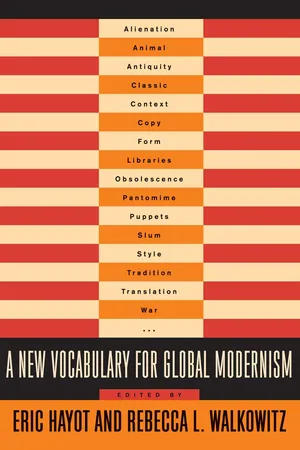
Bringing together leading critics and literary scholars, A New Vocabulary for Global Modernism argues for new ways of understanding the nature and development of twentieth-century literature and culture. Scholars have largely understood modernism as an American and European phenomenon. Those parameters have expanded in recent decades, but the incorporation of multiple origins and influences has often been tied to older conceptual frameworks that make it difficult to think of modernism globally. Providing alternative approaches, A New Vocabulary for Global Modernism introduces pathways through global archives and new frameworks that offer a richer, more representative set of concepts for the analysis of literary and cultural works.
In separate essays each inspired by a critical term, this collection explores what happens to the foundational concepts of modernism and the methods we bring to modernist studies when we approach the field as a global phenomenon. Their work transforms the intellectual paradigms we have long associated with modernism, such as tradition, antiquity, style, and translation. New paradigms, such as context, slum, copy, pantomime, and puppets emerge as the archive extends beyond its European center. In bringing together and reexamining the familiar as well as the emergent, the contributors to this volume offer an invaluable and original approach to studying the intersection of world literature and modernist studies.
eBook - ePub
A New Vocabulary for Global Modernism
- English
- ePUB (mobile friendly)
- Available on iOS & Android
eBook - ePub
A New Vocabulary for Global Modernism
About this book
Information
Topic
Letteratura1. Introduction
Eric Hayot and Rebecca L. Walkowitz
Why This Book Now?
A New Vocabulary for Global Modernism could not have been written ten years ago. It operates in the wake of the field’s unprecedented expansion. Once focused exclusively on artworks produced in Europe and the United States, modernist studies now engages with aesthetic objects and expressive culture produced in spaces throughout the world. Hefty anthologies such as The Oxford Handbook of Global Modernisms and The Oxford Handbook of Modernisms, published in 2012 and 2010, respectively, introduce readers to the creativity of artists and intellectuals in Havana, Hanoi, and Helsinki as well as in London, Paris, and New York. A New Vocabulary for Global Modernism begins from the premise, established by these substantial reference works and by a series of ground-clearing essays that preceded them, that modernism was a world phenomenon.1 Instead of describing more modernism, therefore, this collection shifts its attention to what we take to be a second but crucial labor. Our contributors ask what happens to the foundational concepts of modernism and to the methods we bring to modernist studies when we approach the field globally. A New Vocabulary brings together some of the most prominent critics thinking and writing at the intersection of world literature and modernist studies. Their essays open up the study of global modernism in two ways. The first way involves showing how the intellectual paradigms we’ve long associated with modernism—such as tradition, antiquity, style, classic, and translation—are transformed and how new paradigms—such as context, puppets, slum, copy, and pantomime—emerge when the archive extends beyond the European center. The second way explores how our methodologies change when we approach modernism comparatively and when we draw out modernism’s own engagement with ideas of the world. This book thus adds to the archive of modernist works but also to the archive of works that imagine other worlds and other versions of the world.
A New Vocabulary is therefore not a reference but a user’s manual. It is a set of instructions for entering into modernism from a global perspective and for entering into a global perspective from modernism. This difference, between sampling modernism and revising the organizing principles of modernism, has shaped the form of the object you have before you. Readers will notice, first of all, that the essays are organized by words rather than by geographies. A New Vocabulary does not accumulate distinctive national or regional traditions. It is not organized as a list or an atlas of located modernisms—modernism in Norway, modernism in India, modernism in Peru, and so on. Instead, each essay draws out connections across several geographies, often following an idea as it travels among various readers and writers and visual artists. So, for example, Judith Brown traces style as it moves from being an Orientalist term in European art criticism to a term deployed by “the Orient” itself and, thus, considers how Indian artists overtook and reshaped a concept that had implicitly excluded them. Martin Puchner lights on puppets to show that childhood, folklore, and cults—phenomena usually excluded from modernism—were at the heart of modernism’s engagement with exoticism and images of the nonhuman. Puchner demonstrates that the European fascination with Asian puppetry was animated in part by a desire to diminish rather than extend human agency. Refining the usual claim that European artists used non-European devices to heighten their own sense of individualism while negating the individualism of others, Puchner argues that theater makers in the West turned to the East to imitate its models of antihumanism and that non-Western theater makers have used intercultural puppetry to generate novel forms of estrangement.
As these two essays intimate, the volume draws on the aesthetic practices of several continents, numerous languages, and many cultures. Readers will find discussions of novels, poetry, drama, performance, music, architecture, photography, film, and sculpture created throughout the world, including artworks that got their start in Argentina, Brazil, China, Egypt, France, Germany, India, Ireland, Japan, Kenya, Mexico, Russia, Senegal, South Africa, Turkey, the United Kingdom, and the United States. They will find analysis of materials produced originally in Arabic, Aramaic, Bengali, Chinese, English, Egyptian, French, German, Gikuyu, Greek, Hindi, Italian, Latin, Portuguese, Russian, Spanish, and Turkish. Yet, for all this diversity, the volume does not approach the global as a single or inert container. The essays describe the many different itineraries and rationales that have helped generate and distribute modernism. We’ve approached our project from the bottom up: If you want to theorize modernism globally, you have to theorize modernism’s ideas of the global. The “global” is never some fixed center around which other ideas revolve (even when it is conceived that way); it is instead a shifting concept of fixity and centrality, a set of claims made about the world (another concept) and how it works, whose force depends in every case on the situation and context of its elaboration. Understanding the “global” in/and/of modernism thus means discovering the language of the global as it operates, sometimes only locally and sometimes variously in many locales, throughout well-known as well as newly visible modernist works. Readers may also notice that the language of the global goes well beyond English. Many of our contributors approach global modernism from the perspective of artworks that have operated, at least in part, in relatively local languages. Narrating modernism’s global actors, origins, energies, and critical frameworks, these essays invite us to imagine new literary histories. A New Vocabulary is thus a companion to an emergent field. Contributors offer self-consciously revisionist interpretations that provide readers with an alternative way of thinking about what modernism was and is.
In addition to the absence of spatial markers, readers may notice among our collection of words the absence of contemporary critical markers such as race, class, gender, empire, sexuality, and disability. These frameworks, which have been crucial to the intellectual work of the past several decades and to the scholarship that helped make Europe one space among many, are certainly present in this book.2 In particular, A New Vocabulary is indebted to the postcolonial critique of Eurocentrism (Europe as the self-generating origin of aesthetic innovation), diffusion (the idea that modernism began in the West and then moved to Rest), and parity (the world modeled as an abstract distribution of equivalent nations). The concepts gathered in this volume are made possible by that critique. However, our essays route their global approaches through the language of modernist practices, institutions, and aesthetic categories. Instead of thinking about the global through paradigms that have operated at the same worldly scale, the essays in this volume recalibrate older and flatter paradigms (those that have appeared to be universal to modernism) and fashion new paradigms from materials that have seemed unworldly because too small or too abstract or, indeed, too local. Highlighting formal or aesthetic properties, contributors are engaged in a process of defamiliarization: showing how concepts that seem generic to (all) modernism have global origins or implications and developing fresh concepts drawn from modernism’s expanded archive.
Readers interested in contemporary frameworks can nevertheless use the volume to consider how global modernism alters or refines those terms. Monica Miller’s treatment of pantomime, for example, shows how contemporary African and African American visual artists reflect on the geopolitical and aesthetic history of race by engaging with the modernist figure of the black-and-white harlequin/mime. Miller uses the global phenomenon of the pantomime—not only its ubiquity but also its divergent uses—to rethink the more typically regional history of masks and mimicry within U.S. literary and visual culture. Christopher Reed’s essay on alienation approaches race and imperialism from the perspective of Japanism (the vogue for Japanese art and culture within Europe and the United States). Reed shows how alienation allowed artists marginalized by their sexuality to make new versions of home by cultivating the foreignness they imagined elsewhere. Reed’s essay takes up what appears to be a structural or formal principle of modernism and shows how it was used to project and imagine specific ways of being in the world. In a similar way, Tsitsi Jaji argues that intellectuals of African heritage, such as the British–Sierra Leonean composer Samuel Coleridge-Taylor and the Batswana–South African linguist and writer Solomon Tshekisho Plaatje, made the concept of the classic into a “curatorial procedure.” She shows how these artists standardized the vernacular and vernacularized the standard, putting virtuosity in service to black transnationalism. What we notice in each of these cases is the testing and refining of modernism’s foundational concepts against new examples and archives and, at the same time, an effort to make those concepts newly useful for global approaches to the field. Earlier versions of concepts continue to function, but they no longer exhaust all possible meanings and uses: pantomime, alienation, and classic, to follow just the examples we have introduced thus far, operate in alternative ways once we look beyond the dominant spaces, languages, and actors in which we have known them. This is why modernism changes when we shiftits geographic and linguistic ambit: because the concepts mean something new, because we need new concepts.
How to Use This Book
Why a vocabulary? We considered alternatives. One was “keywords,” a term made famous by Raymond Williams, whose analysis of the language of everyday life via terms like “culture,” “society,” and “class” revealed the vast icebergs of ideology that sustain ordinary discourse. But “keywords” are (to be a bit obvious about things) already “key,” steeped in advance in the stuff of culture and so in need of unpacking and illumination. Many of the words in this new vocabulary are not so crucial or so established. They have never grounded a universal theory of the modernist, and we do not intend them to do so here. Instead, these words cut diagonally across the ways we have thought modernism until now, slicing the centers and the margins into new configurations.
We considered calling the book a “dictionary” of global modernism instead. But a dictionary is a report on language as it’s used, a codification of existing practices. In the long run a dictionary functions, too, as a guide to future use. A dictionary aims for a completeness; it elaborates the whole of a language, performs a total circuit of a conceptual field (The Dictionary of Obscure Sorrows, for example). Neither of those goals—the codification of existing practice or the encirclement of an established whole—was the right one for this book.
A vocabulary, then. These words are new, emergent, unestablished, or old, odd, out of fashion. They ostentatiously do not belong to the general list of terms that govern the study of modernism today. Some of the terms are practically preconceptual. Words like slum, puppets, animal, or obsolescence have never had any currency in modernist scholarship: too small, too located in a specific set of examples, they seem unable to generate a theoretical approach to the field as a whole. Other words had currency once and lost it: classic, tradition, and antiquity, for instance, have conceptual inheritances decades or even centuries old. Having fallen out of common use, they indicate in contemporary use a mode of thought—“what is tradition?” “how can we know whether something is a classic?”—that functions mainly as the object of critical thinking and never as a ground. To reverse that polarity, to think of something like antiquity as a concept that modernism thinks not just about but through, is one of the tasks of this book.
Still other words here—war, library, alienation, form—have developed some contemporary critical value in the context of an earlier modernist studies. They feel somehow prior to, or made obsolete by, the recent shifttoward the global, which renders them too narrow, too European, too enraptured by the aesthetic. Yet if we begin again from them, abandoning the sense that we already know what something like “form” means in the modernist context, we find, as Jahan Ramazani does here, that new meanings emerge. Passing through the diffusionist model of literary production emblematized by Franco Moretti’s phrase “foreign form, local content,” Ramazani finds in form not only a new (and more global) modernism but also a new (and less provincial) theory of literature’s transnational production.
In this way, Ramazani’s essay defamiliarizes the common use of form within modernist studies and defamiliarizes modernist studies in turn, thereby modeling the more general practice of the book. This shiftfrom the word to the field, the former allowing for a new perspective on the latter, is what generates the newness of the vocabulary here, whether the words in question begin as “new” to us or not. In being used these ways the words reveal a new version of what we thought we knew all along, in a world in which what we “know” includes, always in advance, that we’re using the right vocabulary for the job. These essays aim to destabilize that knowledge.
This explains, we think, some of the flatness or literalness of the choices our authors have made. Take war or alienation. “Everyone” knows that the old European modernism had something to do with both. But of course that knowledge is only partial because behind the usual use of a word like “war” (in relation to modernism) it will turn out that we have tended to mean mainly one war, the Great War—because we “knew” that modernism began in Europe—and not any of the other wars going on at roughly the same time, elsewhere in the world, which generated their own local responses. Or, for that matter, we might consider the responses in those other places to Europe’s Great War, which was, as Mariano Siskind shows us, a “world” war before it was called a “world” war (two useful comparatives here include the Sino-Japanese War of 1894–1895 and the Russo-Japanese War a decade later). Likewise, alienation, as Christopher Reed demonstrates, goes quickly from being a matter of aesthetic concern to being fully imbricated with the geographic as soon as one is willing to take seriously the erotics of travel or the forms of mutual pleasure and affiliation that bind the “appropriating” culture to what it “appropriates” (the term, Reed shows, is too simply used). In neither case is it a question of showing how a “nonglobal” term becomes global in the right hands but rather of showing that if one simply begins from a fairly simpleminded reading of a word, in which “war” is not code for one particular war and “alienation” is not code for only one limited kind of alienation, one finds that the global was there (in modernism, everywhere) all along. This, too, is one of the larger arguments of the book: that the global in modernism is not something that one has to be smarter or cleverer than anyone else to seek out and identify, something that requires special tools or a kind of extra effort on top of the effort that “nonglobal” modernism demands. Rather, it is enough simply to relax one’s focus for a moment, to be slightly less clever than we have been so far, in order to see that there is no “modernism” without the global in it and that a literal reading of many of modernism’s major concepts (including, say, “style” or “form”) will get you to a modernism about which one does not have to ask, anymore, whether it is global or not since the two concepts are so clearly intertwined from their mutually constitutive beginnings.
Why, then, do we need the phrase “global modernism” at all? If the global is there from the beginning—if it appears in the active practice of modernism as it translates, travels, and otherwise generates itself from the interaction between the local and the regional, the local and the foreign, the local and the global, or if, more theoretically, we think of modernism as a particular kind of response to a modernity defined as a novel experience of the globe as such—then why not just use the term “modernism,” allow the global to be understood as always already present there, and be done with it? Actually, that’s one of the endpoints of the project of this book, a project that we and our contributors have been engaged in together in a variety of ways for the last two decades. But we are not there yet. We’re getting there, but we’re not there yet. Hence, while we wait, but only for now, we will speak of global modernism to indicate that the force of the adjective is still needed as a contrast for some other more local or “normal” modernism imagined to be not so, or not at all, global. But for us the question is already decided. We are not asking, was modernism global? It was and is, in theory and in practice. The concepts that point us to this globalism are not, then, just spatial or linguistic terms like “planet” or “world” or even (to pick a term from this volume) “translation.” Global concepts are also “copy” or “antiquity” or “puppets.” It is not therefore simply a question of saying modernism happened all over the world. It...
Table of contents
- Cover
- Series Page
- Title Page
- Copyright
- Contents
- Acknowledgments
- 1. Introduction
- 2. Alienation
- 3. Animal
- 4. Antiquity
- 5. Classic
- 6. Context
- 7. Copy
- 8. Form
- 9. Libraries
- 10. Obsolescence
- 11. Pantomime
- 12. Puppets
- 13. Slum
- 14. Style
- 15. Tradition
- 16. Translation
- 17. War
- Appendix: More Vocabulary
- Contributors
- Index
Trusted by 375,005 students
Access to over 1.5 million titles for a fair monthly price.
Study more efficiently using our study tools.
Frequently asked questions
Yes, you can cancel anytime from the Subscription tab in your account settings on the Perlego website. Your subscription will stay active until the end of your current billing period. Learn how to cancel your subscription
No, books cannot be downloaded as external files, such as PDFs, for use outside of Perlego. However, you can download books within the Perlego app for offline reading on mobile or tablet. Learn how to download books offline
Perlego offers two plans: Essential and Complete
- Essential is ideal for learners and professionals who enjoy exploring a wide range of subjects. Access the Essential Library with 800,000+ trusted titles and best-sellers across business, personal growth, and the humanities. Includes unlimited reading time and Standard Read Aloud voice.
- Complete: Perfect for advanced learners and researchers needing full, unrestricted access. Unlock 1.5M+ books across hundreds of subjects, including academic and specialized titles. The Complete Plan also includes advanced features like Premium Read Aloud and Research Assistant.
We are an online textbook subscription service, where you can get access to an entire online library for less than the price of a single book per month. With over 1.5 million books across 990+ topics, we’ve got you covered! Learn about our mission
Look out for the read-aloud symbol on your next book to see if you can listen to it. The read-aloud tool reads text aloud for you, highlighting the text as it is being read. You can pause it, speed it up and slow it down. Learn more about Read Aloud
Yes! You can use the Perlego app on both iOS and Android devices to read anytime, anywhere — even offline. Perfect for commutes or when you’re on the go.
Please note we cannot support devices running on iOS 13 and Android 7 or earlier. Learn more about using the app
Please note we cannot support devices running on iOS 13 and Android 7 or earlier. Learn more about using the app
Yes, you can access A New Vocabulary for Global Modernism by Eric Hayot,Rebecca L. Walkowitz, Eric Hayot, Rebecca Walkowitz in PDF and/or ePUB format, as well as other popular books in Letteratura & Storia e teoria della critica letteraria. We have over 1.5 million books available in our catalogue for you to explore.