This anthology explores the dynamics of shared religious sites in Turkey, the Balkans, Palestine/Israel, Cyprus, and Algeria, indicating where local and national stakeholders maneuver between competition and cooperation, coexistence and conflict. Contributors probe the notion of coexistence and the logic that underlies centuries of "sharing," exploring when and why sharing gets interrupted—or not—by conflict, and the policy consequences.
These essays map the choreographies of shared sacred spaces within the framework of state-society relations, juxtaposing a site's political and religious features and exploring whether sharing or contestation is primarily religious or politically motivated. Although religion and politics are intertwined phenomena, the contributors to this volume understand the category of "religion" and the "political" as devices meant to distinguish between the theological and confessional aspects of religion and the political goals of groups. Their comparative approach better represents the transition in some cases of sites into places of hatred and violence, while in other instances they remain noncontroversial. The essays clearly delineate the religious and political factors that contribute to the context and causality of conflict at these sites and draw on history and anthropology to shed light on the often rapid switch from relative tolerance to distress to peace and calm.
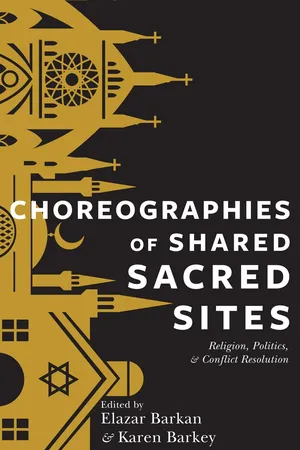
eBook - ePub
Choreographies of Shared Sacred Sites
Religion, Politics, and Conflict Resolution
- English
- ePUB (mobile friendly)
- Available on iOS & Android
eBook - ePub
Choreographies of Shared Sacred Sites
Religion, Politics, and Conflict Resolution
About this book
Information
1
RELIGIOUS PLURALISM, SHARED SACRED SITES, AND THE OTTOMAN EMPIRE
PERHAPS ONE OF the most salient problems shared by our contemporary world and the field of social science relates to ethnic and religious conflict and coexistence. The question of what makes certain societies relatively tolerant of ethnic and religious diversity while others appear prone to conflict, violence, and even genocide remains unanswered. Many scholars want to understand how people of different religious and ethnic backgrounds manage to live together, cooperating across social boundaries, but also sometimes engage in life-threatening conflict. In this book, the sharing of sacred space—which has occurred freely in many mixed societies—is taken to reside at the heart of understanding both peaceful coexistence and violence.
Shared sacred sites are holy for multiple religious groups (groups that may also be ethnically or nationally distinct) and serve not only as places where persons are brought together to variously respect the site but also as sites where they are forced by their coexistence to mediate and negotiate their otherness. These sites are often “indices of the quality of interreligious relations” in larger national contexts.1
Possessing tremendous religious, ethnic, and linguistic diversity, the Ottoman Empire gave rise to many forms of coexistence (peaceful or otherwise) that offer us a genuine laboratory of research possibilities that have yet to be exhausted. There is ample proof that the Ottoman case is still relevant to discussions of diversity and that the millet organization of religious communities is understood as a relatively successful historical example of ruling diversity.2 While there is apparent agreement that the millet system of organizing diverse communities under a common religious umbrella and incorporating them into the state through their own religious hierarchy worked relatively well, such an institutional focus faces the danger of oversimplifying the day-to-day complexity of interreligious relations.3 For this reason, we need to look beyond the millet system and self-consciously rethink diversity as a dynamic and capacious concept. Diversity flags difference, indicating boundaries and relations within sites as varied as markets, religious institutions, and political, legal, and administrative organizations, among others. There are so many locations and institutions where difference was negotiated and managed in the Ottoman Empire that a true study of its diversity would be deservedly path breaking.
It is by now an accepted fact that the first three hundred years of the empire were tolerant of diversity. Toleration in the Ottoman Empire was an organizational by-product of state society relations in which both the state and religious community leaders were interested in intercommunal peace and order and in the maintenance of boundaries within a flexible system of negotiation. Islam provided an initial cultural blueprint for how to rule non-Muslim “peoples of the Book”—that is, Christians and Jews—in a Muslim polity: the empire would offer protection in return for the subordination and special taxation of its religious minorities. The Ottomans adapted and adjusted Islamic teachings to address the needs of the state. Examples of conflict and persecution can nonetheless be found at the local level: both individual and communal cases of local violence occurred and are inscribed in the archives. Yet these were not allowed to spiral out of control, and state officials acted quickly to punish culprits and establish local peace. As both state and social actors benefited from accommodation and coexistence, toleration became the norm. Political leaders, scholars, and public intellectuals of the time wrote about Ottoman diversity and its positive characteristics.4 Local pashas sometimes declared their own small-scale edicts of toleration, interfering in Christian confessional struggles.5 As they watched the religious divisions caused by the Reformation and religious wars, the Ottomans were eager to exhibit their state policies of accommodation, especially at the borders with Europe. Most sensitive to these confessional struggles were the local high-ranking officials who were wary of these religious tensions spilling over into the Ottoman lands they governed.
While this form of toleration provided a general and pragmatic understanding of diversity, the proof of a wide-ranging construction of mutual coexistence and forbearance can be found at many sites and sets of relations. Groups related to each other in their everyday activities, frequently engaging with one another on economic, social, and cultural levels. When they encountered disagreement, they had multiple legal forums to resolve their issues. They also interacted with one another in religious contexts, navigating issues that pertained to cohabitation in mixed neighborhoods, such as the intrusion of religious symbols and sounds upon the other, participation in each other’s ceremonies, and cohabiting spaces of worship.
One approach to uncovering the workings of diversity is through the history of the numerous shared sacred sites that existed in the vast dominions of the Ottoman Empire. These sites were sacred places—churches, shrines, and mausoleums—shared by more than one religious and ethnic group. Looking at the manner in which shared sacred sites became places of coexistence, conflict, and cooperation is one way to evaluate the quality of interreligious relations in the empire. Given that many of these sites remain shared in the post-Ottoman world raises the significance of this phenomenon as well. These spaces of sharing have survived numerous religious and ethnic wars, several nationalizing regimes, and efforts aimed at creating a forced homogeneity, which only reinforces the fact that coexistence and toleration are possible in the longue durée and that the forbearance necessary for coexistence between groups can pass down through generations, even though conflict might temporarily and abruptly interrupt peace.
This chapter explores toleration and coexistence by proceeding in three interrelated sections: First, I rethink the conceptual language of coexistence, toleration, and violence in order to apply them to the long history of Ottoman pluralism, where toleration set the stage for centuries of coexistence in various religious, legal, and social contexts. Second, I explore key debates on the sharing of sacred sites and discuss how we can bring some of the analytic dimensions used in the toleration discussions to bear on sacred sites. I argue that to understand the manner in which sacred sites were shared in the Ottoman Empire, we need to focus on state policies, boundary relations across groups, and the construction of identities. Doing so will enable us to develop a methodology for historical ethnography, which will in turn allow us to understand the manner in which relations across boundaries change over time as well as how they manifest themselves in the practical negotiations of the day to day. Third, I analyze the historical circumstances that provided the context for the sharing of sacred spaces in the Ottoman Empire.
This chapter then demonstrates that during the reign of the Seljuk and Ottoman empires the larger context of toleration and accommodation to diversity, especially of Christians across the frontiers, promoted the sharing of sacred sites between Muslims and Christians. While churches and monasteries were often converted to Islamic buildings, mixed worship became the rule in many places as openness to the other was encouraged by state authorities. I also show that Ottomans made a concerted effort to build institutions that were inclusive of the diversity of the empire, often positioning their foundations within reach of Christians and Jews. I also raise several issues not fully resolved and require further research and analysis.
DEFINING COEXISTENCE, TOLERATION, AND VIOLENCE
Debates around toleration and coexistence have broad significance, especially as the former is often contested and the latter takes various and contradictory forms. These remain relevant concepts to the study of shared sacred sites since sharing occurs under an umbrella of coexistence, whether tolerant or violent. Generally, we speak of coexistence when two or more groups live together while respecting differences and working out conflicts in a nonviolent fashion. We categorize a situation as tolerant when variance between groups is marked, but the majority decides they will live together even if their differences are irreconcilable. Toleration comes from the Latin word “tolerare,” which means to endure. In this sense, scholars have understood toleration “to signify no more than forbearance and the permission given by the adherents of a dominant religion for other religions to exist, even though the latter are looked upon with disapproval as inferior, mistaken, or harmful.”6 Toleration, then, usually refers to the actions of public authorities, whereas the term “tolerance” refers to the understanding and consideration that local populations may develop toward each other. Toleration represents that state policies aim at ensuring coexistence and that different groups can earn their livelihood and live in peace together. Tolerance represents the more organic, social, and civic notions of living together among people who recognize differences in their everyday lives. These two do not always coincide. One can be present without the other. Historians and political philosophers have primarily carried out historical and analytic work on toleration within the geographical confines of Western Europe. More recently, toleration has been explored in various geographical contexts, and the analytic boundaries of its study have stretched to the social sciences more generally. In this chapter I do not intend to review the field, although I will highlight those studies that have provided useful concepts and mechanisms for understanding coexistence.
There was a time when historical studies of toleration in Western Europe were written to stress more long-term trends of persecution and violence. Particularly in the classic work of Robert Moore, The Formation of a Persecuting Society, there is a tendency to see connected histories of intolerance, with every episode of violence becoming more important and widespread.7 This reminds us of many conflicts where it is said that ancient hatreds and long-term historical animosities endure, flaring up from time to time and causing the collapse of multicommunal societies.8 Here the assumption is that hatred and violence are deep-rooted between groups and will erupt into violent action at every possible juncture. There is also the assumption that difference is marked by inflexible and fixed markers with conflict across boundaries dependent on these essentialist notions of identity. As we will see, this view is similarly embedded in parts of recent anthropology scholarship.
These rigid assumptions might mostly be a part of the past. In his work on the Reformation in Europe, historian Bob Scribner argues that “there were moments or circumstances in which intensified persecution could be mobilised for various reasons, yet it was not possible for this to be continuous over time or across an entire society.”9 He adds that “persecution which is both extensive and intensive is socially dysfunctional in the long or even medium term, and persecution may be more a matter of short term political conjunctures or expedients.”10 In Communities of Violence, David Nirenberg reconsiders the function of violence. Rather than just viewing violence as part of an explanation of a “persecutory longue durée,” he emphasizes its role in the immediate setting, its multiple meanings, and the various tasks it performs in regulating community relations.11 His intervention makes violence part of relations on the ground while also making it visible within a contained time and space. Violence and persecution are conceptualized as episodes within the broad temporality of coexistence. This makes sense theoretically if we take a Simmelian view of conflict, understanding it as an integral component of sociability; conflict then is essential and omnipresent but also serves a positive function in social relations.12
Recently historians of Western European religious coexistence have produced studies where the complicated, contingent, and often historically unique configuration of toleration and persecution is clearly demonstrated.13 These scholars show that there were multiple ways in which coexistence and conflict could become complementary in the unfolding of the Western European history as rulers, subjects, and members of different communities found ways of organizing social relations.14 They stress the role of both public authorities (usually the state) and boundaries aries between groups in their work. By analyzing different modes of coexistence across confessional boundaries, Keith Luria demonstrates the dramatic ways in which French Catholics and Huguenots began peacefull...
Table of contents
- Cover
- Series Page
- Title Page
- Copyright
- Contents
- Introduction
- 1. Religious Pluralism, Shared Sacred Sites, and the Ottoman Empire
- Comparisons: Cyprus/Bosnia/Anatolia/Algiers
- Palestine/Israel
- Museums
- Bibliography
- Contributors
- Index
Trusted by 375,005 students
Access to over 1.5 million titles for a fair monthly price.
Study more efficiently using our study tools.
Frequently asked questions
Yes, you can cancel anytime from the Subscription tab in your account settings on the Perlego website. Your subscription will stay active until the end of your current billing period. Learn how to cancel your subscription
No, books cannot be downloaded as external files, such as PDFs, for use outside of Perlego. However, you can download books within the Perlego app for offline reading on mobile or tablet. Learn how to download books offline
Perlego offers two plans: Essential and Complete
- Essential is ideal for learners and professionals who enjoy exploring a wide range of subjects. Access the Essential Library with 800,000+ trusted titles and best-sellers across business, personal growth, and the humanities. Includes unlimited reading time and Standard Read Aloud voice.
- Complete: Perfect for advanced learners and researchers needing full, unrestricted access. Unlock 1.5M+ books across hundreds of subjects, including academic and specialized titles. The Complete Plan also includes advanced features like Premium Read Aloud and Research Assistant.
We are an online textbook subscription service, where you can get access to an entire online library for less than the price of a single book per month. With over 1.5 million books across 990+ topics, we’ve got you covered! Learn about our mission
Look out for the read-aloud symbol on your next book to see if you can listen to it. The read-aloud tool reads text aloud for you, highlighting the text as it is being read. You can pause it, speed it up and slow it down. Learn more about Read Aloud
Yes! You can use the Perlego app on both iOS and Android devices to read anytime, anywhere — even offline. Perfect for commutes or when you’re on the go.
Please note we cannot support devices running on iOS 13 and Android 7 or earlier. Learn more about using the app
Please note we cannot support devices running on iOS 13 and Android 7 or earlier. Learn more about using the app
Yes, you can access Choreographies of Shared Sacred Sites by Elazar Barkan,Karen Barkey, Elazar Barkan, Karen Barkey in PDF and/or ePUB format, as well as other popular books in Politics & International Relations & Middle Eastern History. We have over 1.5 million books available in our catalogue for you to explore.