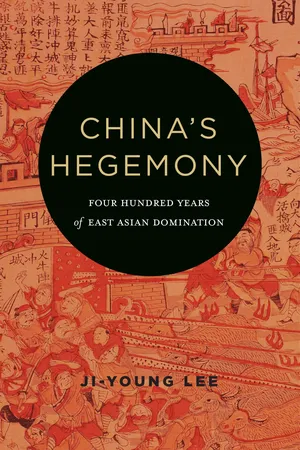
Many have viewed the tribute system as China's tool for projecting its power and influence in East Asia, treating other actors as passive recipients of Chinese domination. China's Hegemony sheds new light on this system and shows that the international order of Asia's past was not as Sinocentric as conventional wisdom suggests. Instead, throughout the early modern period, Chinese hegemony was accepted, defied, and challenged by its East Asian neighbors at different times, depending on these leaders' strategies for legitimacy among their populations. This book demonstrates that Chinese hegemony and hierarchy were not just an outcome of China's military power or Confucian culture but were constructed while interacting with other, less powerful actors' domestic political needs, especially in conjunction with internal power struggles.
Focusing on China-Korea-Japan dynamics of East Asian international politics during the Ming and High Qing periods, Ji-Young Lee draws on extensive research of East Asian language sources, including records written by Chinese and Korean tributary envoys. She offers fascinating and rich details of war and peace in Asian international relations, addressing questions such as: why Japan invaded Korea and fought a major war against the Sino-Korean coalition in the late sixteenth century; why Korea attempted to strike at the Ming empire militarily in the late fourteenth century; and how Japan created a miniature tributary order posing as the center of Asia in lieu of the Qing empire in the seventeenth century. By exploring these questions, Lee's in-depth study speaks directly to general international relations literature and concludes that hegemony in Asia was a domestic, as well as an international phenomenon with profound implications for the contemporary era.
- English
- ePUB (mobile friendly)
- Available on iOS & Android
eBook - ePub
About this book
Information
Subtopic
Storia cinese1
UNDERSTANDING THE TRIBUTE SYSTEM
What exactly is a “tribute system”? How is the tribute system related to the concept of hegemony in Asian international relations (IR)? Although many scholars believe that the tribute system is the key to understanding the early modern East Asian international order, few have attempted to elucidate empirically just how the tribute system is linked to Chinese hegemony. To understand the varying degrees of receptivity to Chinese hegemony, we must first investigate the specific rules of the game and what compliance looked like in early modern East Asia.
This chapter begins by providing a review of the tribute system and pointing out the literature’s general neglect of the role played by less powerful East Asian states in the tribute system. I then present a practice-oriented approach to the tribute system, thus shedding light on the social aspects of the tribute system. In so doing, I draw on the writings of Chinese and Korean tributary envoys. It is through such richly descriptive empirical details that we can grasp the nature of hierarchical relations between China and its neighboring states and understand the social context of actors’ compliance. The chapter concludes by addressing some questions of research design and the selection of case studies presented in this book.
EXPLAINING THE TRIBUTE SYSTEM
The introduction discussed the emerging theoretical debate between liberal-constructivists and realists regarding the tribute system. Beyond the field of IR, how have historians explained the notion of the tribute system? Curiously, perhaps with the notable exception of John King Fairbank’s “Chinese world order,”1 little work has directly focused on the tribute system. However, this is not to say that scholars have ignored the concept. Across the subfields of history, economic sociology, and political science, there are roughly six different, but not mutually exclusive, “lenses” through which they interpret what the tribute system was and how it worked: (1) the Fairbankian model of Sinocentric hierarchy, (2) the New Qing perspective, (3) the transnational economic history school, (4) China’s borderlands studies perspective, (5) the investiture model, and (6) the tianxia system.
The first half of this chapter surveys the literature associated with these six lenses in an effort to answer three questions: First, what is the tribute system? Second, how is it linked to the notion of the international order? Third, why did actors comply (or refuse to comply) with the tribute system in early modern Asia? Although most scholars offer only partial answers to these questions, they have created useful building blocks to use to consider the workings of the tribute system for this study. Across these lenses, such concepts and words as “tribute,” “investiture,” “the ideology of civilized versus barbarian distinction,” and the “ji mi (loose rein) policy” emerge as key components of the tribute system. Overall, scholarship has shifted toward problematizing a monolithic, static view of the tribute system, acknowledging that its workings varied across time and space. Despite an increasing awareness about Sinocentrism in the study of the tribute system, however, there is still a tendency to interpret the tribute system as China’s strategy and/or a projection of its power or culture, relying heavily on Chinese sources.
The Fairbankian Model Versus the New Qing Perspective
The term tribute system is a Western invention. There was no Chinese word for what scholars consider the tribute system today, nor did East Asian contemporaries recognize it as a distinct institution or a “system.”2 The concept was developed in the postwar United States by historian John King Fairbank to refer to “a set of ideas and practices developed and perpetuated by the rulers of China over many centuries.”3 To Fairbank, the international order was an extension of the Confucian hierarchic and nonegalitarian social order of China; the more the culture-based theory of Chinese superiority was accepted by actors in the periphery, the more likely they were to participate in the tribute system.4 His culture-based graded hierarchy model categorizes China’s neighbors into three zones based on the extent to which they accepted Chinese Confucian culture as well as their geographic proximity to China. Fairbank singled out Korea, Vietnam, Japan, and Ryukyu as having resided in the Chinese cultural area, an area influenced by the civilization of ancient China. These societies formed the Sinic zone, followed by the Inner Asian zone and the Outer zone (the latter eventually comprising Japan, other states in Southeast and South Asia, and Europe).
In the Fairbankian model, it is noteworthy that Japan was categorized as part of the Sinic zone and was eventually moved to the Outer zone, whereas Korea remained part of the Sinic zone during the Qing period. According to this model, because the Chinese world order was “sustained by a heavy stress on ideological orthodoxy,”5 hierarchy was a function of education and indoctrination in the Confucian classics. But it is therefore a puzzle that Japan’s active indoctrination in the Confucian classics during the Tokugawa period coincided with its refusal to accept hierarchical relations with China during the Qing period.6 Fairbank’s theory of hierarchy cannot explain these contrasting trajectories between Korea and Japan, because it rests on a dualism between culturalist and materialist views of the tribute system. He argues that, for China, the biggest incentive behind the tribute system was the symbolic prestige value of tribute, which enabled China to avoid “the dangers inherent in foreign relations on terms of equality.”7 For China’s neighboring states, compliance with the system was motivated by trade opportunities with China. Therefore, the compliance of China’s neighbors depended on a rationalist logic of the pursuit of wealth and technology, although variations in hierarchy rested on culture.
The New Qing history challenges Fairbank’s culture-based hierarchy model by criticizing several assumptions that underlie his Sinocentric interpretation of the tribute system.8 Rather than denying the existence of the tribute system itself,9 the New Qing’s critiques focus on two main planks. First, no one “real Chinese” culture and identity was associated with imperial China. The New Qing history questions the Fairbankian model’s validity by asking, who was China? To put it another way, the term China as a country cannot be tied to a single Chinese Confucian culture or identity.10 Second and relatedly, the notion of a monolithic tribute system cannot adequately explain the historically contingent nature of social interactions associated with the tribute practices across time and space. According to Pamela Kyle Crossley and other New Qing historians, the ways in which the rulers of the Qing empire constructed political authority were remarkably different from how the rulers of the previous Ming empire constructed authority. The Qing emperors presented themselves not just as the traditional Chinese Confucian persona of authority as “Son of Heaven,” as Fairbank posited. Rather, in order to raise their legitimacy and authority in the eyes of different ethnicities and cultures within the empire, they posed also as a Cakravartin (“wheel-turning king”) to the Buddhist Tibetans and as a Khan to the nomadic Mongols.11 In other words, the rulers of the Qing empire strategically assumed multiple identities and employed different symbols of power in different societies in order to facilitate domination of those societies.
As noted by New Qing historians and other critics, Fairbank’s tribute system model has limitations because of its simplistic, one-sided Chinese perspective on international relations. Although I acknowledge its weaknesses, I argue that it is a mistake to dismiss Fairbank’s insights completely. For example, the New Qing historiography is more applicable to the Inner Asian dynamic. The Qing empire continued more or less similar tribute practices toward its East Asian neighbors as the Ming. In East Asia, the Confucian worldview of placing China at the center, as embedded and repeated through tribute practices, was a powerful mechanism of coercion as well as one of consent. This is not because the Confucian culture led its neighbors to behave deferentially to Chinese authority, as Fairbank, Kang, and some advocates of Asia’s “long peace” thesis seem to suggest, but because Confucian culture was part of a taken-for-granted practice in the social dynamics of China’s neighboring states themselves, perpetuated because of their own domestic political conditions. In order to explain variations with regard to participation in the tribute system, I modify Fairbank’s model by highlighting the need to filter its emphasis on culture by considering domestic politics while incorporating insights by New Qing historians regarding actors’ use of culture and identity for strategic purposes.
The Borderlands Studies Lens
In Chinese historical scholarship, the area of research called “borderlands (bianjiang) studies”12 is relevant to the concept of the tribute system, because it speaks to the long-running question of the “place of culturally or racially non-Han peoples in Chinese history.”13 From this body of research, one can interpret the tribute system as an outgrowth of a method by which ancient China, the center, managed its relations with the peoples at the borderlands, the non-Han groups. For the purpose of this book, this lens does not provide a direct explanation for China’s relations with East Asian neighboring states outside its empire, but it does explain the Chinese side approach to the tribute system. Of particular importance is imperial China’s employment of loose rein policies, literally meaning “bridle and halter (checking by pulling and pushing),”14 which explains at least in part why Chinese hegemony did not rest on physical domination over other neighboring states. At the same time, when China felt threatened, as in the late Ming period, its opportunistic behavior and strategic thinking were often associated with the yi yi fa yi (以夷制夷, the use of barbarians to fight other barbarians), requesting its tributaries to fight against its own enemies.15
This perspective focuses on the relations between the center and borderlands within the current boundaries of today’s People’s Republic of China rather than on East Asia per se. According to Ma Dazheng and Liu Ti, the term bianjiang (邊疆, borderlands) as a political concept has historically referred to regions located outside the direct control and governance of the political center. From a strategic point of view, the borderlands represent the front line of the Chinese state in terms of its defense and security.16 In English, bianjiang can be translated both as “border” and as “frontier,” which respectively refer to “a zone in which two or more states meet—and where a distinct society emerges” and “a zone without clear boundaries, where cultures meet, overlap, and compete.”17
In ancient China, the traditional ideology of the “civilized versus barbarian distinction” (華夷) framed the debate on whether the “civilized” (the center) should try to govern the “barbarians”—a debate that was in effect an early form of today’s borderlands studies.18 Ma and Liu explain that the “barbarian versus civilization” distinction was determined culturally rather than ethnically, and that the goal of making the distinction was to protect “the Chinese cultural tradition symbolizing the civilization.”19
More specifically, there are three kinds of strategic thinking in ancient China’s approach toward the borderlands. The first is to prevent the “civilized center” from becoming “barbarian.” The second is to transform “barbarian” peoples into culturally “civilized” peopl...
Table of contents
- Cover
- Title Page
- Copyright
- Dedication
- Contents
- Acknowledgments
- Introduction
- 1. Understanding the Tribute System
- 2. Chinese Hegemonic Authority: A Domestic Politics Explanation
- 3. The Making of Ming Hegemony
- 4. The Imjin War (1592–1598)
- 5. The Making of Qing Hegemony
- Conclusion
- Notes
- Bibliography
- Index
Trusted by 375,005 students
Access to over 1.5 million titles for a fair monthly price.
Study more efficiently using our study tools.
Frequently asked questions
Yes, you can cancel anytime from the Subscription tab in your account settings on the Perlego website. Your subscription will stay active until the end of your current billing period. Learn how to cancel your subscription
No, books cannot be downloaded as external files, such as PDFs, for use outside of Perlego. However, you can download books within the Perlego app for offline reading on mobile or tablet. Learn how to download books offline
Perlego offers two plans: Essential and Complete
- Essential is ideal for learners and professionals who enjoy exploring a wide range of subjects. Access the Essential Library with 800,000+ trusted titles and best-sellers across business, personal growth, and the humanities. Includes unlimited reading time and Standard Read Aloud voice.
- Complete: Perfect for advanced learners and researchers needing full, unrestricted access. Unlock 1.5M+ books across hundreds of subjects, including academic and specialized titles. The Complete Plan also includes advanced features like Premium Read Aloud and Research Assistant.
We are an online textbook subscription service, where you can get access to an entire online library for less than the price of a single book per month. With over 1.5 million books across 990+ topics, we’ve got you covered! Learn about our mission
Look out for the read-aloud symbol on your next book to see if you can listen to it. The read-aloud tool reads text aloud for you, highlighting the text as it is being read. You can pause it, speed it up and slow it down. Learn more about Read Aloud
Yes! You can use the Perlego app on both iOS and Android devices to read anytime, anywhere — even offline. Perfect for commutes or when you’re on the go.
Please note we cannot support devices running on iOS 13 and Android 7 or earlier. Learn more about using the app
Please note we cannot support devices running on iOS 13 and Android 7 or earlier. Learn more about using the app
Yes, you can access China's Hegemony by Ji-young Lee in PDF and/or ePUB format, as well as other popular books in Politica e relazioni internazionali & Storia cinese. We have over 1.5 million books available in our catalogue for you to explore.