A history that extends from the 1750s to the present, In Pursuit of Privilege recounts upper-class New Yorkers' struggle to create a distinct world guarded against outsiders, even as economic growth and democratic opportunity enabled aspirants to gain entrance. Despite their efforts, New York City's upper class has been drawn into the larger story of the city both through class conflict and through their role in building New York's cultural and economic foundations.
In Pursuit of Privilege describes the famous and infamous characters and events at the center of this extraordinary history, from the elite families and wealthy tycoons of the eighteenth and nineteenth centuries to the Wall Street executives of today. From the start, upper-class New Yorkers have been open and aggressive in their behavior, keen on attaining prestige, power, and wealth. Clifton Hood sharpens this characterization by merging a history of the New York economy in the eighteenth century with the story of Wall Street's emergence as an international financial center in the late nineteenth and early twentieth centuries, as well as the dominance of New York's financial and service sectors in the 1980s. Bringing together several decades of upheaval and change, he shows that New York's upper class did not rise exclusively from the Gilded Age but rather from a relentless pursuit of privilege, affecting not just the urban elite but the city's entire cultural, economic, and political fabric.
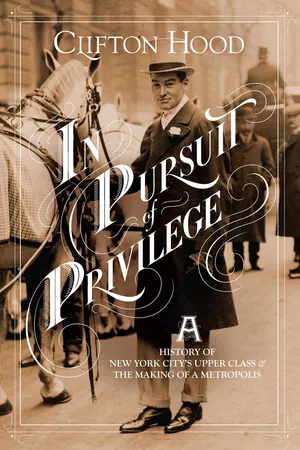
eBook - ePub
In Pursuit of Privilege
A History of New York City's Upper Class and the Making of a Metropolis
- English
- ePUB (mobile friendly)
- Available on iOS & Android
eBook - ePub
In Pursuit of Privilege
A History of New York City's Upper Class and the Making of a Metropolis
About this book
Information
Topic
HistoriaSubtopic
Historia del siglo XIX

“THE BEST MART ON THE CONTINENT”
The 1750s and 1760s
AN APPRAISAL OF NEW YORK CITY IN 1753
In 1753 William Livingston wrote a pamphlet entitled A Brief Consideration of New York that proclaimed the superiority of his native province and its major city over other colonies. The scion of one of the richest families in British North America, he grew up on Livingston Manor, a landed estate that occupied more than 150,000 acres near Albany. He moved to New York City after college and began writing pamphlets that earned him a reputation for trenchant social criticism. In A Brief Consideration, Livingston surveyed conditions in the colony with an eye to persuading its leaders to improve its prospects for social progress.1
Livingston attributed much of the economic success of the province to the mild climate and fertile soils of the Hudson Valley and Long Island that constituted “the inexhaustible Source of a profuse Abundance” of wheat, vegetables, and cattle.2 Yet he maintained that trade, not agriculture, had made New York City “the best Mart on the Continent” and would eventually allow it to overtake Boston and Philadelphia to become the principal colonial seaport.
New York’s promise, he believed, lay in its waterborne transportation. While the agricultural hinterlands of Boston and Philadelphia, situated in the interior and largely inaccessible by river, had necessitated that roads be built at great expense to take crops to market, New York farmers could traverse the Hudson River or Long Island Sound, an easier and cheaper means of transportation that gave them a competitive advantage.3
He also praised the superiority of New York harbor. Manhattan’s landings were only sixteen or eighteen miles from the Atlantic Ocean, at the end of a broad and deep channel that protected shipping from stormy seas and was unobstructed by shallows or rocks. A royal official later called the harbor “a kind of Amphitheatre” that was “constantly Covered with Boats Sloops & every kind of Shipping passing & repassing through it & across it in all directions [which] seems alive with bustle & business.”4 Livingston exulted that the main anchorage of the city, off lower Manhattan in the East River, “is good, free from Bars, and not incommoded by Rocks, the Water of an equal and convenient Depth.”5 By contrast, the port of Philadelphia was located one hundred miles up a winding river on which vessels frequently ran aground, while Boston harbor was strewn with rocky islands that imperiled shipping.
Although Livingston proclaimed that New York would eventually outstrip its colonial rivals, even he had to acknowledge that it was a small and unimpressive city. He admitted that its economy and population were smaller than Philadelphia’s and its upper class poorer and less elegant than Boston’s. He tried to claim that its compact size enhanced its prospects for trade by saving labor and money in the loading and unloading of ships, but that argument seemed weak and defensive.6
As with many other descriptions of New York City that were made in the eighteenth and early nineteenth centuries when it was still a small place that did not yet signify in national or international affairs, Livingston’s A Brief Consideration has sometimes been interpreted as foretelling metropolitan greatness. But that is a naïve and anachronistic reading that overlooks his true objective in writing this pamphlet.7 His aim was not colossal growth—for that would have seemed unthinkable to residents of eighteenth-century New York—but rather the quality of leadership.
Operating in the Whig tradition of condemning luxury and frivolity as the root of moral corruption, Livingston had been conditioned to think that virtue was a prerequisite for modernization. And since he also believed that a society could achieve civic virtue only through the actions of enlightened leaders who manifested wisdom and reason, Livingston addressed his pamphlet to the colony’s foremost merchants, lawyers, and planters, the brightest lights of a provincial upper class that was notorious for its political fragmentation and disputatiousness. Afraid that elites would let their selfish desire for wealth and leisure divert them from their civic responsibility, Livingston implored these men to join together to implement development projects that would stimulate the economy, such as the construction of a new market house, better drainage of the wharves, and the founding of an ironworks.
Livingston was less a prophet than a critic and a booster: he emphasized New York’s promise because he feared it would continue to lag behind Philadelphia and Boston unless elites recognized its potential and acted on behalf of the general welfare, and he contended that growth would benefit all political factions and economic interests because he believed that its leadership must promote a common good separate from the struggle of private interests. His claim that New York was “the best Mart on the Continent,” then, was sheer embroidery.
Ironically, however, Livingston’s prediction that New York would realize its potential started to come true much faster than he could have anticipated. This chapter concentrates on the 1750s and early 1760s when New York City first began to gain international significance during the Seven Years’ War. As the nucleus of British military operations in North America, the city served as the principal command and control center, troop quarters, supply depot, and naval base in the Western Hemisphere. As a communications hub, it was the chief source of North American war news published in the British press.
Until then, New York—much like Philadelphia and Boston—had been a minor seaport and provincial capital within an Atlantic economy of empires and trading. In terms of the size of their populations and the structure of their economies, the three northern seaports were not markedly dissimilar. Their main difference was cultural rather than economic. While New York had been founded as a trading post, the Massachusetts and Pennsylvania cities had been created as religious and political utopias, and the sense of religious mission remained paramount and modulated the pursuit of wealth there well into the eighteenth century. New Yorkers did not exhibit a similar aversion to moneymaking. To the contrary, the centrality of moneymaking in New York had been reinforced and legitimated by a series of events and accidents in the seventeenth and eighteenth centuries, including its role in the Seven Years’ War itself. The New York City of the 1750s was not the New York City of today, but the cultural values that would eventually facilitate its rise as the dominant metropolis in North America were already apparent by the mid-eighteenth century.
In a colonial seaport whose lifeblood was commerce, merchants were the people who made the principal economic decisions and accordingly are the center of analysis here. From around 1700, a few wealthy merchants—known as “great merchants”—existed alongside the lesser merchants, with the bigger players garnering handsome returns through their control of transatlantic imports and their retailing of textiles and other wares. A consumer revolution in the middle of the eighteenth century further expanded the volume of the city’s commerce, enabling the great merchants to accumulate even bigger fortunes that supplied a material basis for a luxurious way of life.8
New York’s merchants did not yet constitute a distinct social group. Rather, merchants conceived of themselves and were seen by others as being part of a larger provincial upper class that also incorporated royal officials, planters, doctors, lawyers, and other professionals. This upper class had taken shape between the 1680s and the 1720s, driven by the expansion of the transatlantic trade. It was characterized by its relative openness and its preoccupation with individual economic advancement. Compared to the stuffy and backward-looking elites found elsewhere in the colonies, the New York upper class was relatively dynamic, adaptable, and aggressive. However, the standing of merchants within this New York upper class was compromised by the code of gentility and by the place of royal officials atop the status hierarchy. The incompatibility of gentility with overly aggressive moneymaking and the privileged status of royal administrators relegated merchants to a secondary position in that upper class.
In the end, what did not change in the 1750s and 1760s proved more important than what did change. Despite New York’s newfound centrality in the British Empire, the Seven Years’ War represents a false dawn in the history of the city. The war did not expand New York’s economy or its population, alter the social composition or the status hierarchy of the upper class, or stimulate new ways of acting and thinking on the part of its merchants. Those transformations would begin later, during the nation-building efforts of the 1780s and 1790s, and would accelerate with the economic growth of the nineteenth century.
ON THE EDGE OF THE ATLANTIC WORLD
The primacy of empire and market in mid-eighteenth-century New York was reflected in the urban landscape. Its largest structure was Fort George, which stood on a small rise at the southwestern tip of Manhattan to protect against sea attack. Inside the fort’s walls were the governor’s palace, which was the largest residential building in the city, and a barracks. The next largest government building was the City Hall on Wall Street, the meeting place of the provincial council, assembly, and general courts. The structure associated most closely with commerce was the Merchants’ Exchange, on Broad Street, where traders came to buy and sell goods and share news.9
When William Livingston published his pamphlet in 1753, New York possessed a flourishing commercial economy whose major imports were linen, silk, and manufactured goods from Great Britain; sugar, molasses, and rum from the West Indies; and wine from Madeira. Traders also hawked newly arrived enslaved Africans at the foot of Wall Street.10 While Charleston, South Carolina, and Savannah, Georgia, exported staple crops such as indigo and rice, for which great demand existed in Europe, New York paid for its imports by conducting a general trade, primarily in agricultural goods and natural resources. Grains were its leading export, but the city shipped a remarkable number of materials overseas, as Governor George Clinton detailed in a 1749 report to officials in London:
And the Outward [trade] is to London and its Outposts, the latter more seldom, Naval Stores, Copper ore, Furs, and other the enumerated Species…To Ireland Flax Seed, Rum, Sugar, being Prise effects, and Staves. To Sev’l Parts in Europe, Grain, Hides, Deer & Elk Skins, Ox Horns, Sarsaperila, Indico, Logwood, Cocoa Nutts &c. And [the re-export of] Foreign Produce & Lumber, Moreover Argent Vivum, Coffee, Anato, Elephant’s Teeth, Beeswax, Leather, Sarsafrax, Casia-fistula, Wines, and Other Goods as Prise Effects hitherto brought [into British territory from foreign nations] and in the Vice-Admiralty Courts here and elsewhere adjudicated upon proper certifying. To Madeira & the Azores, Grain and other Provisions, Bee Wax, and Staves. To English Districts North and South of this Continent & West Indies, Provisions, Chocolate, Lumber[,] European and India Goods with those Enumerated in the Plantation Acts, and [the re-export of] such other Imported here for conveyance home regularly[.] To neutral [Caribbean] Ports such as Coracoa, Souronhaim, & Saint Thomas; Provisions, Lumber, Horses, sheep & other live Stock with their Provender.11
Clinton revealed that New Yorkers also carried on a large coastal trade with other British colonies in fish, sealskins, whale products, turpentine, hops, cider, bricks, iron, and furniture. Many of the exports on Clinton’s inventory—notably sarsaparilla, indigo, cocoa, chocolate, coffee, and wine—had not originated in the city’s hinterland but rather had been produced elsewhere and become part of its vigorous re-export trade. The elephants’ teeth probably entered the continent through Rhode Island, the colony with the largest slave trade at the time.
Clinton’s report showed that the cargo that passed through New York harbor was extraordinarily varied and had multiple points of origin and destination around the Atlantic basin.12 In recent decades historians have utilized the idea of an “Atlantic world” to comprehend the linkages that began to connect geographical areas in Europe, Africa, and the Americas in the premodern era and that tightened during the seventeenth and eighteenth centuries. Scholars generally agree that by 1700 a coherent economy dominated by Europeans and their American colonists had evolved in the Atlantic basin that was organized around production complexes, state-building institutions, commercial practices, and transportation and communication facilities. While it had become more integrated and cohesive over time, this Atlantic world was fluid, decentralized, variegated, and conflict-ridden, and it put a premium on access to trading networks and capital and on entrepreneurial judgment, risk taking, and flexibility. Merchants helped pull this Atlantic world together.13
The transatlantic, international perspective shows us that the important relationships that New York City had with distant locales largely determined the scale and structure of its economy, the composition of its population, and the sources of the wealth of its upper class. Much like Philadelphia, Boston, and Charleston, New York sat on the rim of the Atlantic world, a bustling seaport that was the entrepôt for New York, Connecticut, and East Jersey.
Reliable population data did not become available until the first federal decennial census was taken in 1790, and the exact sizes of American cities and towns cannot be determined for earlier periods. Probably the best estimate is that New York City had 11,000 inhabitants in 1743, fewer than either Boston (already beginning to stagnate, but still the biggest colonial town, with 16,380 residents) or Philadelphia (the second largest, with 13,000).14 Except for Boston, American cities grew rapidly in the eighteenth century. By the 1760s Philadelphia had become the largest city in the colonies, New York occupied second place, and Boston languished in third. Even then the three ports remained roughly the same size: in 1760 Philadelphia had an estimated population of 23,750; New York, 18,000; and Boston, 15,630.15
The three seaports were regional centers whose economic hinterlands did not overlap appreciably or envelop the entire Eastern Seaboard. Instead, each supplied goods and services (agricultural marketplaces, public administration, and information) for its own hinterland. The economic functions of the three cities corresponded closely enough for them to have similar occupational structures. According to Gary Na...
Table of contents
- Cover
- Title Page
- Copyright
- Dedication
- Contents
- Introduction: The Upper Class Is a Foreign Country
- 1. “The Best Mart on the Continent”: The 1750s and 1760s
- 2. Uncertain Adjustments: The 1780s and 1790s
- 3. Wealth: The 1820s and Beyond
- 4. All for the Union: The 1860s
- 5. A Dynamic Businessman’s Aristocracy: The 1890s
- 6. The Ways of Millionaireville: The 1890s
- 7. Making Spaces of Their Own: The 1940s
- 8. The Antielitist Elite: The 1970s and Beyond
- Conclusion: The Limits of Antielitism
- Acknowledgments
- Abbreviations for Selected Manuscript Sources
- Notes
- Index
Trusted by 375,005 students
Access to over 1.5 million titles for a fair monthly price.
Study more efficiently using our study tools.
Frequently asked questions
Yes, you can cancel anytime from the Subscription tab in your account settings on the Perlego website. Your subscription will stay active until the end of your current billing period. Learn how to cancel your subscription
No, books cannot be downloaded as external files, such as PDFs, for use outside of Perlego. However, you can download books within the Perlego app for offline reading on mobile or tablet. Learn how to download books offline
Perlego offers two plans: Essential and Complete
- Essential is ideal for learners and professionals who enjoy exploring a wide range of subjects. Access the Essential Library with 800,000+ trusted titles and best-sellers across business, personal growth, and the humanities. Includes unlimited reading time and Standard Read Aloud voice.
- Complete: Perfect for advanced learners and researchers needing full, unrestricted access. Unlock 1.5M+ books across hundreds of subjects, including academic and specialized titles. The Complete Plan also includes advanced features like Premium Read Aloud and Research Assistant.
We are an online textbook subscription service, where you can get access to an entire online library for less than the price of a single book per month. With over 1.5 million books across 990+ topics, we’ve got you covered! Learn about our mission
Look out for the read-aloud symbol on your next book to see if you can listen to it. The read-aloud tool reads text aloud for you, highlighting the text as it is being read. You can pause it, speed it up and slow it down. Learn more about Read Aloud
Yes! You can use the Perlego app on both iOS and Android devices to read anytime, anywhere — even offline. Perfect for commutes or when you’re on the go.
Please note we cannot support devices running on iOS 13 and Android 7 or earlier. Learn more about using the app
Please note we cannot support devices running on iOS 13 and Android 7 or earlier. Learn more about using the app
Yes, you can access In Pursuit of Privilege by Clifton Hood in PDF and/or ePUB format, as well as other popular books in Historia & Historia del siglo XIX. We have over 1.5 million books available in our catalogue for you to explore.