- English
- ePUB (mobile friendly)
- Available on iOS & Android
eBook - ePub
About this book
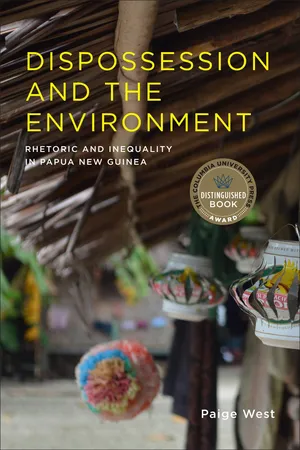
When journalists, developers, surf tourists, and conservation NGOs cast Papua New Guineans as living in a prior nature and prior culture, they devalue their knowledge and practice, facilitating their dispossession. Paige West's searing study reveals how a range of actors produce and reinforce inequalities in today's globalized world. She shows how racist rhetorics of representation underlie all uneven patterns of development and seeks a more robust understanding of the ideological work that capital requires for constant regeneration.
Information
Subtopic
EcologyIndex
Social Sciences1 “Such a Site for Play, This Edge”
Tourism and Modernist Fantasy
At three a.m. on December 21, 2007, I found myself standing in a freezing shower at the Nusa Island Retreat in New Ireland, Papua New Guinea, fully clothed, holding the head of a teenaged Australian surfer as he vomited on my bare feet.1 He was inconsolable and very intoxicated. He, along with his father, his father’s “mates,” and their sons had been drinking for the entire day. A friend of mine who works at the Nusa Island Retreat tasked me with looking after the young man. As a woman, I was thought to be able to provide a calming, somewhat motherly, influence. In fact, my presence, as an anthropologist who works in Papua New Guinea, incited him to say, between gasps for air and the expelling of copious amounts of vomit, “It’s just so, you know, man, so real. It’s so real here…. I mean they are just so, like, they just live…. It’s just, like, a man and his hut and the sea and the waves like forever…. I’m never going back home.”
The young man had accompanied eight other men on a surf holiday to Papua New Guinea. They were all Australians, from Brisbane or other smaller Gold Coast towns, and they were all accomplished surfers. While on Nusa Island, they surfed, drank astounding quantities of South Pacific Lager and Bundaberg Rum, fished, ate, and then surfed and drank more. And they enjoyed every second of it. Earlier in the day, prior to my unexpected shower, I had spent several hours with the young man, whom I will call Brendan, poring over Surfing, Surfer, Surfer’s Journal, and Carve, four of the top-selling international surf-related magazines, talking about Papua New Guinea, anthropology, and his future. Brendan, his father, and their friends exemplify the people who come to Papua New Guinea as surf tourists. They are male, they have visited multiple surf-tourism destinations, they are from Australia, they are between the ages of twenty and sixty, they are voracious consumers of surf-related media, and they all identify themselves as “surfers.”
At four p.m. on June 18, 2013, I was sitting on a curb in the downtown area of Kavieng, sharing a South Pacific Lager (white can) with a longtime friend of mine who is from Mussau Island. I had met him the first time I visited New Ireland, in 2005. At the time he was the star bartender at a local resort. By 2013, he was without a home of his own (although he will always be welcome in his natal village), divorced and denied access to his two young children by their mother’s mother’s brothers, jobless, and recently released from the provincial hospital. When I asked him what he was going to do for work, he said, “I’d like to go back to bartending. It was such good money. But they won’t hire me back. I don’t know what I’m going to do, but I’ve been thinking about opening my own bar. But I can’t get a bank loan, and I can’t get in touch with any of my mates in Australia for help.”
When I first met this young man, whom I will call Thomas, he lived in the staff housing complex of the resort, worked six nights a week at the bar, and swam or kayaked around the island every morning. We became friendly during these early morning outings, as I am a swimmer also, and even after I established a base elsewhere in the province, we stayed in touch, and I spent time with him whenever I was in Kavieng. Thomas is a person who exemplifies the men from Papua New Guinea who work in the nation’s surf tourism industry. He is between twenty and thirty years old, comes from one of the islands in New Ireland, is well educated, is a great surfer, and sees his labor in the industry as a starting point for a life in business.
In 2009 an Australian surfer who was a repeat customer at the resort where he worked invited Thomas to accompany him to Australia. Thomas was enticed by the idea of exciting travel to exotic places. He was also lured by the promise of a job that would pay what he termed “expatriate-level wages.” He quit his job and went to the Gold Coast where he went to parties and bars and spent his days surfing and meeting his friend’s mates. From what Thomas says, everyone he met thought it was amazing to meet a man from Papua New Guinea who was an excellent surfer with perfect English-language skills, lovely manners, and a serious desire to work and make money. He told me stories of how Australian surfers repeatedly asked him about cannibalism, “the island lifestyle,” and “undiscovered waves” and how they all seemed disappointed in him because of his answers. Sadly, there were no jobs offered. Thomas’s Australian friend quickly grew tired of his presence once “the novelty wore off” (Thomas’s words, not mine). He found himself without work (indeed, Papua New Guineans are not entitled to obtain work permits in Australia, and he would have been deported if he had tried to work illegally), without a place to stay (his mate’s girlfriend got tired of him living with them), and without the money to return home. Thomas finally got home, almost a year later, but he had no job and few appealing prospects for the future.
In what follows, I examine the relationship between the production and circulation of mediated images of Papua New Guinea, the production of ideas about nature and culture (place and people in Papua New Guinea), and processes of self-fashioning by people who visit Papua New Guinea as these processes are enacted with regard to surf-related tourism. The surf tourism industry in Papua New Guinea depends on, and then reproduces, fantasies about the relation between primitive and civilized peoples, places, and times, projecting this fantasy through notions of “discovery” and “frontiers.” Such fantasies are a form of dispossession that ultimately result in material dispossession and the creation of or enhancement of inequality. These fantasies then drive the production of place and space in Papua New Guinea and set the conditions of possibility for what tourists actually experience when they are in the country. Subsequently, the tourists reproduce these fantasy formations in their own self-fashioning, replicating the narrative forms that scholars have seen in primitivist travel writing for hundreds of years. With this, surfing as sport-tourism becomes another avenue for the reproduction of modernist forms and ideas about Western selves and “others.”
This chapter draws on ethnographic fieldwork and participant observation in New Ireland Province, Papua New Guinea, survey data collected from 239 surf-tourists who have visited Papua New Guinea, e-mail interviews with 45 surf-tourists who have visited Papua New Guinea, and textual analysis of surf-related magazines. The focus here is on fantasy and tourism lives of men because the vast majority of surfers who come to Papua New Guinea are male. Women surf tourists tend not to visit Papua New Guinea. Of the 239 people surveyed, eight were women. Of the forty-five surf-tourists interviewed by e-mail, five were women. During my ethnographic fieldwork in New Ireland only nine surfers I encountered were women.2

FIGURE 1.1 New Ireland Province. Photograph courtesy of J. C. Salyer.
Surf Tourism in Papua New Guinea
The traditional stories of coastal peoples in Papua New Guinea, like most places in the Pacific, include tales of riding waves in canoes, on housing timbers, and on other flat bits of wood. There was not, however, the kind of stand-up surfing most people practice today until the 1960s and 1970s, when Australians working for the colonial government brought manufactured surfboards with them to what is now Papua New Guinea, which was then an Australian colony. In the early 1980s, both expatriates and Australian-educated nationals began surfing in earnest the breaks near Port Moresby, Vanimo, and Kavieng. By the late 1980s, these surfers had established the Surfing Association of Papua New Guinea (SAPNG), a national body to regulate the industry and develop strategies for how surfing might contribute to the Papua New Guinea economy, and the Vanimo Surf Club, modeled on Australian surf clubs and meant to promote the sport in and around Vanimo. After its legal incorporation under Section 7 of the Associations Incorporations Act in December 1996, the SAPNG sponsored national surfers in the South Pacific Games and the Oceania Indigenous Surfing Competition.
Because of the growing interest in Papua New Guinea as a surf-tourism destination (2005 saw 1,200 people come to the country specifically to surf), in April 2006 the SAPNG presented the Pacific Enterprise Development Facility of the International Finance Corporation with a proposal for the development of a formal, national “surf management plan.” In both Vanimo and Kavieng, the local surf clubs had already established local “management plans.” The plans do three things. First, they limit the number of surfers permitted in the water at any one time. Second, they charge a levy or tax on each surfer for each day surfed and distribute this money back to the communities who hold the area surf breaks in traditional marine tenure. Third, they provide a small income for the local surf clubs that is intended to help them grow and promote the development of local surfers.
The SAPNG has ten goals, and the development of these “management plans” is meant to help them meet several of them (Abel and O’Brien 2015). According to one SAPNG board member, the plans are meant to “promote sustainable development of the industry and make sure that locals get some benefit from it” (SAPNG n.d.; see also O’Brien and Ponting 2013). Additionally, although stated outside of the official SAPNG rhetoric, the plans are meant to, according to one of the plan’s architects, “make sure we don’t become another Indo, with overcrowded breaks and too many international operators taking advantage.” This is the first and only functioning management plan for surfing in the world (Abel and O’Brien 2015).
Prior to the adoption of the surf management plan, between 1987 and 2003, Papua New Guinea, as a surf tourism destination, was profiled in the following print magazines: Pacific Longboarder, Surfing Life (three times), Surfers’ Trip (three times), Niugini Blue (three times), Paradise Magazine (six times), Surf Trip, Surf Europe, Blue Edge Magazine, Island Business, Surf 1, and Sports Scope. Since 2004 it has been profiled in Surfing Magazine, Gold Coast Surf, Surfing Life, Surfer Magazine, the Surfers’ Journal, Surf Magazine, Island Business, Tracks (“the Surfers’ Bible”), and Surfline’s Water. Additionally, since 1980, it has been covered in 73 newspaper stories (including in all the major Australian and New Zealand newspapers). The vast majority of these magazines mention the surf management plan. They also cast Papua New Guinea as exotic, unknown, undiscovered, secret, primitive, wild, lost, and beautiful, and the men who surf there as intrepid explorers, echoing Regis Tove Stella’s excavation of the terms used during the colonial period in Papua New Guinea (Stella 2007).
The Ocean as Modernist Fantasy and Circulated Medium
The sea has long been a medium over which people travel physically and a medium through which they travel aesthetically, with literature, poetry, and art. The sea inspires, expands, and reflects certain fantasies and fears. In the past century or so the sea has metamorphosed from a world of the deep, dark unknown to a world of science, technology, and recreation (Ford and Brown 2006; Helmreich 2007). Its shores have been violently transformed from the home-places of indigenous peoples, to colonial and postcolonial ports, to working-class slums, to opulent sites for the conspicuous display of wealth. (For details of this process across the Pacific, see Finney 1996; Baugh 1990; Wills 2007; Douglas 1998; J. Kelly 1992; and, especially, Sahlins 1989.) For many people, the sea has gone from “something to be inhabited” to “something to be contemplated as an expensive backdrop” (Taussig 2000:258). Its inhabitants, the creatures who find their home-places in it, have been transformed from fantastic, unknown monsters into commodities. Today, sea creatures galvanize harrowing direct action in environmental campaigns and are used to depict the impending planetary doom that is global climate change.
Although most people use objects and products that come to them across oceans on a daily basis, they rarely think about the sea as a medium for movement. The ships that deliver toothbrushes, dental floss, glass cups, and coffee, and the people that work to make those objects or move goods from production to distribution sites, fail to cross people’s minds as they brush their teeth, rinse their mouths out and then ruin the whole process with a second cup of coffee (West 2012). Euro-Americans are more likely today to experience the sea as recreation and restoration than they are as networks across which commodities move around the planet. In addition to the things of daily life that circulate over the ocean, the sea also serves as a medium for the movement of people. In the Pacific, especially, this has been the case for a very long time.3 Today, there is less ship travel than in the past, but the sea lures many of the millions of tourists who travel from the global North to the global South each year. The World Tourism Organization estimates that there were 935 million international arrivals at tourism destinations in 2010 (UNWTO 2011).
Surf tourism is one of the most robust sectors of the tourism industry (Warshaw 2004). It is also an economic lynchpin for the global surf industry (Kampion 2003). The industry, which caters to 10 million surfers globally, is a multibillion-dollar business that includes the production of material commodities, like surfboards and clothing; the distribution of those commodities, through retail sales; and the organization of professional sporting events and contests, like the Rip Curl Pro, the Roxy Pro, and the Quicksilver Pro (see Buckley 2003:407 and Reed 1999). It also features multiple forms of tourism, including high-end resort-tourism and eco-tourist ventures. All tourism depends on mediated images to drive consumer desire (Urry 2002; see also Croy et al. 2009; Foale and Macintyre 2005; and Kahn 2011). The surf tourism industry depends on internal, industry-generated and -owned media (surf magazines, “documentaries,” and websites), as well as externally produced media, like surfing movies (Bettie 2001; Buckley 2003; Henderson 1999; Ormond 2005; Ponting 2009; Rutsky 1999). The media associated with surfing produces images of kinds of people and types of places. The people are, overwhelmingly, white male surfers cast as brave and intrepid explorers who are carefree, alternative minded, and nonconformist. The places typically are exotic, uninhabited (or lightly inhabited), undiscovered (or recently discovered) sites with perfect waves, delicious food, a chance of danger or intrigue, beautiful bikini-clad women, and uncrowded breaks.
Surfing magazines have always been the major form of media though which images circulate to and from surfers.4 These magazines range from general-interest publications, like Surfer, to special-interest ones, like Pacific Longboarder, and they are circulated through subscriptions and through distribution at newsagents and surf shops (Buckley 2006:453; see also Ponting 2009). All surfing magazines have information on contests and on the celebrity surfers who participate in these events, advertisements for all manner of surf-related items—everything from surfboards to clothing, wetsuits, tours, and stories about surfing localities and destinations. They are heavily illustrated with photographs taken by professional surf photographers (Buckley 2006:453). These magazines are directly connected to the tourism industry, both in terms of the vertical integration of various surf-related companies that own magazines, resorts, and tour companies, and in that these magazines drive touristic desires.
Tourism, Image, Media, and Space
Tourism takes standard forms that rely, in part, on mediated images.5 Contemporary scholars of tourism and media often use John Urry’s notion of the “hermeneutic circle” of tourism to analyze the relationship between images, forms, and actions (Urry 2002; see Canton and Santos 2008g and Jenkins 2003). For Urry, tourism is a social form that is based on the visual consumption and reproduction of images (Urry 2002:135). Images circulate, they are imbued with certain meanings, and then these meanings are shared through further circulation (Urry 2002; see also Hall 1997). These images then drive touristic desires and practices. In his analysis of images and surf tourism, Jess Ponting argues, drawing on Urry, that images are transmitted to tourists through surf-related media, that these images inspire travel, that the tourists work to find “the icons of symbolic elements seen in the projected images” and record them themselves, and that finally, the tourists then display their own images in ways that work to inspire others to travel (Ponting 2009:176; see also Preston-Whyte 2002:313). Ponting calls the surf images “nirvanic” and shows, with ethnographic material from the Mentawai Islands of Indonesia, that mediated images of perfect waves, uncrowded conditions, soft adventure, and exotic, tropical environments drive surf tourism there. Tourism operators know exactly what images they need to produce, on the ground, to enhance the tourism experiences of their guests. They are conscious of the media images and work diligently to make sure that the surfers’ experiences mirror the ideals of the media-induced fantasy (Ponting 2009:178–182).
These touristic images are tied to older images of people and places, or the environment and society. Miriam Kahn examines the ways that colonial and postcolonial images of nature and culture have worked to produce space and place in the Pacific Islands in general and in Tahiti specifically (Kahn 2011). Tahiti is not just imagined as exotic and tropical, as much of the Pacific is; it is the site of origin for the exotic and the tropical, for European ideas about utopian worlds populated by noble savages living in harmony with nature, and for the dusky maidens that have fueled the sexualized fantasies of Europeans since the 1700s (Kahn 2011:32–60). Kahn shows that for the contemporary tourists who visit because of these fantasies, only certain kinds of activities and images are allowed into their already existing fantasy formations of space, place, nature, and culture. They literally do not see places, peoples, and events that sit outside of the fantasy. This is, in part, because of the ways that tourism operators structure experience and, in part, because of tourists’ limited field of vision. To this analysis of image and tourism Kahn adds an analysis of the worlds of Tahitians and how they experience and produce space, place, nature, and culture. She shows, very clearly, that tourists and Tahitians live in “parallel, but disconnected, worlds” (Kahn 2011:15). Additionally, Kahn highlights the material manifestations of image and fantasy with a sophisticated analysis of the production of space in Tahiti. It is not simply that fantasy endures or that images motivate travel. Rather, fantasy and image, when intertwined with economic and political power, help to bring spaces and places into being (Kahn 2011:97).
Touristic fantasy and image as they relate to space are intertwined with modernist ideas about temporality. David Lipset and Rupert Stasch have both used Mikhail Bakhtin’s notion of the chronotope to examine spatiotemporal understandings and representations of peoples living in New Guinea.6 Bakhtin argued that a chronotope is “the intrinsic connectedness of temporal and spatial relationships that are artistically expressed in literature” (Bakhtin 1981:84). Writers create worlds that reflect the spatiotemporal reality of their own worlds, or at least of how they experience their worlds. In his analysis of the circulation of the figure of the primitive in print media, Stasch uses the chronotope to describe three different scales of spatiotemporal understanding that are displayed in travel writing (Stasch 2011). The first scale is the “narrated chronotope,” or the narrated sequence of the writer’s interactions with seemingly primitive peoples; the second is the “chronotope of textual performance,” or the set of material, ideological, and linguistic relations bet...
Table of contents
- Cover
- Series Page
- Title Page
- Copyright
- Dedication
- Contents
- Acknowledgments
- Map of the Early Colonial Boundaries of New Guinea
- Introduction
- 1. “Such a Site for Play, This Edge”: Tourism and Modernist Fantasy
- 2. “We Are Here to Build Your Capacity”: Development as a Vehicle for Accumulation and Dispossession
- 3. Discovering the Already Known: Tree Kangaroos, Explorer Imaginings, and Indigenous Articulations
- 4. Indigenous Theories of Accumulation, Dispossession, Possession, and Sovereignty
- Afterword: Birdsongs—In Memory of Neil Smith (1954–2012)
- Notes
- Bibliography
- Index
Trusted by 375,005 students
Access to over 1.5 million titles for a fair monthly price.
Study more efficiently using our study tools.
Frequently asked questions
Yes, you can cancel anytime from the Subscription tab in your account settings on the Perlego website. Your subscription will stay active until the end of your current billing period. Learn how to cancel your subscription
No, books cannot be downloaded as external files, such as PDFs, for use outside of Perlego. However, you can download books within the Perlego app for offline reading on mobile or tablet. Learn how to download books offline
We are an online textbook subscription service, where you can get access to an entire online library for less than the price of a single book per month. With over 1.5 million books across 990+ topics, we’ve got you covered! Learn about our mission
Look out for the read-aloud symbol on your next book to see if you can listen to it. The read-aloud tool reads text aloud for you, highlighting the text as it is being read. You can pause it, speed it up and slow it down. Learn more about Read Aloud
Yes! You can use the Perlego app on both iOS and Android devices to read anytime, anywhere — even offline. Perfect for commutes or when you’re on the go.
Please note we cannot support devices running on iOS 13 and Android 7 or earlier. Learn more about using the app
Please note we cannot support devices running on iOS 13 and Android 7 or earlier. Learn more about using the app
Yes, you can access Dispossession and the Environment by Paige West in PDF and/or ePUB format, as well as other popular books in Social Sciences & Ecology. We have over 1.5 million books available in our catalogue for you to explore.