The recipient of the Kluge Prize for lifetime achievement in the humanities and the Tang Prize for "revolutionary research" in Sinology, Ying-shih Yü is a premier scholar of Chinese studies. Chinese History and Culture volumes 1 and 2 bring his extraordinary oeuvre to English-speaking readers. Spanning two thousand years of social, intellectual, and political change, the essays in these volumes investigate two central questions through all aspects of Chinese life: what core values sustained this ancient civilization through centuries of upheaval, and in what ways did these values survive in modern times?
From Yü Ying-shih's perspective, the Dao, or the Way, constitutes the inner core of Chinese civilization. His work explores the unique dynamics between Chinese intellectuals' discourse on the Dao, or moral principles for a symbolized ideal world order, and their criticism of contemporary reality throughout Chinese history. Volume 1 of Chinese History and Culture explores how the Dao was reformulated, expanded, defended, and preserved by Chinese intellectuals up to the seventeenth century, guiding them through history's darkest turns. Essays incorporate the evolving conception of the soul and the afterlife in pre- and post-Buddhist China, the significance of eating practices and social etiquette, the move toward greater individualism, the rise of the Neo-Daoist movement, the spread of Confucian ethics, and the growth of merchant culture and capitalism. A true panorama of Chinese culture's continuities and transition, Yü Ying-shih's two-volume Chinese History and Culture gives readers of all backgrounds a unique education in the meaning of Chinese civilization.
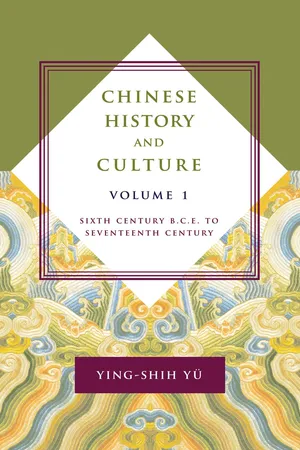
eBook - ePub
Chinese History and Culture
Sixth Century B.C.E. to Seventeenth Century, Volume 1
- English
- ePUB (mobile friendly)
- Available on iOS & Android
eBook - ePub
Chinese History and Culture
Sixth Century B.C.E. to Seventeenth Century, Volume 1
About this book
Trusted by 375,005 students
Access to over 1.5 million titles for a fair monthly price.
Study more efficiently using our study tools.
Information
Subtopic
Chinese HistoryIndex
History1. Between the Heavenly and the Human
The idea of the “unity of Heaven and man” (tian ren heyi 天人合一) has been generally regarded as a feature uniquely characteristic of Chinese religious and philosophical imagination. The tian-ren polarity as a category of thinking was already essential to Chinese philosophical analysis in classical antiquity. Thus, in the Zhuangzi, the question of where the fine line is to be drawn between “the heavenly” and “the human” is often asked. Zhuangzi’s emphasis on the notion of tian was later sharply criticized by Xunzi (ca. 312–230 B.C.E.) as being blinded by the heavenly and insensitive to the human. For his own part, however, Xunzi also insisted that true knowledge of the world must begin with a clear recognition of the distinction between the two realms.
By the second century B.C.E. at the latest, the tian-ren category had been firmly established as a basic way of thinking due, in no small measure, to the pervasive influence of the yin-yang 陰陽 cosmology in general and Dong Zhongshu (ca. 179–ca. 104 B.C.E.) in particular. Throughout the Han dynasty (206 B.C.E.–220 C.E.), belief in the mutual interaction between the Way of Heaven (tiandao 天道) and human affairs in both elite and popular cultures was nearly universal. It was in such a climate of opinion that Sima Qian (145–90? B.C.E.), the Grand Historian of China, devoted his entire life to the writing of his monumental Shiji 史記 (Records of the Grand Historian), which was intended, in his own words, “to examine all that concerns Heaven and man.” Thus, he set an example for historians of later centuries to follow. It is by no means a mere coincidence that Liu Zhiji 劉知幾 (661–721), the great Tang official historiographer, was praised by his contemporaries as a man “whose learning joined together the realms of Heaven and man.” In the eighteenth century, Zhang Xuecheng 章學誠 (1738–1801), arguably the most philosophically minded of all historians in the Chinese tradition, also took great pride in the purpose he set for his work, which was “to show the interrelatedness of the heavenly to the human, thereby throwing light on the Great Way.” In both cases, the allusion to Sima Qian 司馬遷 is unmistakable.
The tian-ren polarity also figured prominently in both Wei-Jin Neo-Daoism and Song-Ming Neo-Confucianism. He Yan 何晏 (?–249) and Wang Bi 王弼 (226–249) enjoyed each other’s company because they could always discuss “matters concerning the interrelationships between Heaven and man” with perfect understanding. Needless to say, complex metaphysical issues arising from the basic distinction between the “Heavenly principle” (tianli 天理) and “human desires” (renyu 人欲) constituted the very core of Neo-Confucian discourse. The story is too familiar to require further elaboration here.
The notion of “unity of Heaven and man” proved to be so surprisingly resilient that it continues to haunt the Chinese mind in the twentieth century. During the early 1940s, Chin Yueh-lin (Jin Yuelin 金岳霖, 1895–1984), a leading Chinese metaphysician thoroughly trained in Western philosophy, and Fung Yu-lan (Feng Youlan 馮友蘭) made a concerted philosophical effort to develop the idea of tian ren heyi each in his own way, with the explicit purpose of exploring the possibility of its relevance to the modern world. In a comparativist context, Chin singled out tian ren heyi as the “most distinguishing characteristic” of Chinese philosophy. Fully aware of the comprehensiveness and complexity of the thesis, he nevertheless tended to interpret it in terms of the “unity of nature and man” and contrasted it to the dominant Western idea of “conquest of nature.”1 On the other hand, Fung applied this thesis to what he called “the transcendent sphere of living,” the highest ideal in his philosophy of life. In his own words, “the highest achievement of the man living in this sphere is the identification of himself with the universe, and in this identification, he also transcends the intellect.”2
Since the early 1990s, a great controversy has flared up in the Chinese intellectual world around the notion of tian ren heyi. In this ongoing debate, many questions have been raised regarding the exact meanings of this classic thesis. Some are continuous with Chin’s interpretation but focus more sharply on the dilemma of how to achieve oneness with nature and simultaneously accommodate science and technology in Chinese culture. Others echo Fung’s metaphysical, ethical, or religious concerns but go beyond him by drawing modern, and even postmodern, implications from this thesis for Chinese spirituality. The details of this current debate need not concern us here. I mention it only to show that tian ren heyi is by no means a fossilized idea of merely historical interest. Instead, it remains a central component of the Chinese frame of mind to this very day. Indeed, it may hold the key to one of the doors leading to the World of Chinese spirituality.
As a historian, however, I do not feel at ease with pure speculation. In what follows, I propose first to offer an account of the genesis and development of this idea and then to endeavor to explain how it eventually evolved into one of the defining features of Chinese mentality. My approach is essentially historical.
To begin with, let me introduce the ancient myth of the “Separation of Heaven and Earth” (Jue di tian tong 絕地天通). Briefly, the myth runs as follows: In high antiquity, humans and deities did not intermingle. Humans, for their part, held the gods in reverence and kept themselves in their assigned places in the cosmic order. On the other hand, deities also descended among them from time to time through the intermediaries of shamans (wu 巫). As a consequence, the spheres of the divine and the profane were kept distinct. The deities sent down blessings on the people and accepted from them their offerings. There were no natural calamities. Then came the age of decay, in which humans and deities became intermingled, with each household indiscriminately performing for itself the religious observances that had hitherto been conducted by the shamans. As a result, the people lost their reverence for the deities, the gods violated the rules of the human world, and calamities arose. It was at this point that the sage-ruler Zhuanxu 顓頊 (traditionally dated to the twenty-fifth century B.C.E.) intervened, presumably with the approval of the God-on-High (Shang Di 上帝); he rearranged the cosmic order by cutting the communication between Heaven and Earth.3
This myth is very rich with meanings and can be interpreted in a variety of ways. In the present context, I wish to make only a simple historical observation: it may have served as a justification for the fact that in ancient China, only the universal king had direct access to Heaven. According to tradition, under the Three Dynasties of Xia 夏, Shang 商, and Zhou 周, making sacrificial offerings to Heaven was a prerogative exclusively reserved for the king. The local feudal lords were entitled to communicate with the earthly deities through sacrificial rites within their domains but not with the celestial ones. In other words, the “unity between the Heavenly and the human” was strictly confined to the Son of Heaven, who, as one modern interpretation suggests, was also the head shaman.
Here, however, a difficulty inevitably arises: the idea of the “unity between the heavenly and the human” mentioned in the beginning of this chapter is built on an assumption diametrically opposed to the myth of the “Separation of Heaven and Earth”; it presupposes that every individual person on earth is, in principle, able to communicate with Heaven. Admittedly, the exact meanings of the concept “Heaven” are quite different in these two theses. Nevertheless, structurally speaking, the two must be viewed as each other’s negation. The very notion that everyone can communicate with Heaven without the assistance even of a shaman clearly implies that access to Heaven is no longer a royal monopoly. Since, as we shall see, the beginning of an individualistic version of tian ren heyi can be traced to no earlier than the sixth century B.C.E., we may assume that it was developed, at least partly, as a conscious response to the ancient myth of “separation” that had dominated the Chinese mind for many centuries. It is to this important development of Chinese spirituality that I must now turn.
The author of the last chapter of the Zhuangzi—perhaps a latter-day follower of the Master—describes with a profound sense of sadness the “breakup” of the primeval oneness of Dao 道. He linked this “breakup” to the rise of the “Hundred Schools” of philosophy in China. Each of the schools, he said, comprehended but a singular aspect of the original whole. It is like the case of the ear, eye, nose, and mouth, each having a particular sense, without being able to function interchangeably. As a result, the purity of Heaven and Earth and the wholeness of Dao have been forever lost.4 In this earliest account of the first philosophical movement in Chinese classical antiquity, our writer historicizes an original allegory suggested by Zhuangzi 莊子 himself. It runs as follows:
The God of the South Sea was called Shu 儵 [Swift], the God of the North Sea was called Hu 忽 [Sudden], and the God of the central region was called Hundun 渾沌 [Chaos]. Shu and Hu from time to time came together for a meeting in the territory of Hundun, and Hundun treated them very generously. Shu and Hu discussed how they could repay his kindness. “All men,” they said, “have seven openings so they can see, hear, eat, and breathe. But Hundun alone doesn’t have any. Let’s try boring him some.”
Every day they bored another hole, and on the seventh day Hundun died. (97)
I am quite convinced that the latter-day follower’s historical account is a truthful reading of the Master’s original allegory. The analogy of sensory apertures in both cases makes it clear that Zhuangzi’s Chaos (Hundun) is the symbol of the primordial wholeness of Dao. In making use of this famous allegory about the death of Chaos, Zhuangzi must have had in mind what historians today see as a “swift” (Shu) and “sudden” (Hu) beginning of spiritual enlightenment in ancient China. Laozi 老子, Confucius, and Mo Di (or Mozi) 墨翟—to mention only three of the greatest names in the history of Chinese philosophy—all appeared in the sixth and fifth centuries B.C.E.
Now the question is, how are we to understand this sudden spiritual enlightenment and relate it to the distinction between the heavenly and the human? In this connection, I would like to begin by placing the question in a comparative perspective, because China was not the only civilization in the ancient world that experienced this enlightenment. It took place in other civilizations as well. Some four decades ago, Karl Jaspers called our attention to the most fascinating fact that in the first millennium B.C.E., which he called the Axial Period, a spiritual “breakthrough” occurred in several high cultures, including China, India, Persia, Israel, and Greece. It took the form of either philosophical reasoning or postmythical religious imagination, or a mixed type of moral-philosophic-religious consciousness, as in the case of China. Apparently, the breakthroughs in the Axial Period all took place independently of one another and no mutual influences can be established. The most we can say about them is probably that when civilizations or cultures developed to a certain stage, they would undergo a common experience of spiritual awakening of some kind. Jaspers further suggested that the ultimate importance of this Axial breakthrough lies in the fact that it tended to exert a defining and formative influence on the character of the civilizations involved.5 In the past decades, much has been discussed about Jaspers’s concept of “breakthrough,” and there is a general consensus that the great transformation of the Chinese mind in the time of Confucius can be more sensibly understood as one of the major breakthroughs during the Axial Period. It is therefore all the more remarkable that Zhuangzi and h...
Table of contents
- Cover
- Title Page
- Copyright
- Dedication
- Contents
- Author’s Preface
- Editorial Note
- List of Abbreviations
- Chronology of Dynasties
- 1. Between the Heavenly and the Human
- 2. Life and Immortality in the Mind of Han China
- 3. “O Soul, Come Back!”: A Study in the Changing Conceptions of the Soul and Afterlife in Pre-Buddhist China
- 4. New Evidence on the Early Chinese Conception of Afterlife
- 5. Food in Chinese Culture: The Han Period (206 B.C.E.–220 C.E.)
- 6. The Seating Order at the Hong Men Banquet
- 7. Individualism and the Neo-Daoist Movement in Wei-Jin China
- 8. Intellectual Breakthroughs in the Tang-Song Transition
- 9. Morality and Knowledge in Zhu Xi’s Philosophical System
- 10. Confucian Ethics and Capitalism
- 11. Business Culture and Chinese Traditions: Toward a Study of the Evolution of Merchant Culture in Chinese History
- 12. Reorientation of Confucian Social Thought in the Age of Wang Yangming
- 13. The Intellectual World of Jiao Hong Revisited
- 14. Toward an Interpretation of the Intellectual Transition in Seventeenth-Century China
- Acknowledgments
- Appendix: Address of Professor Ying-shih Yü on the Occasion of Receiving the John W. Kluge Prize at the Library of Congress and Acceptance Speech on the Occasion of Receiving the Tang Prize for Sinology
- Index
Frequently asked questions
Yes, you can cancel anytime from the Subscription tab in your account settings on the Perlego website. Your subscription will stay active until the end of your current billing period. Learn how to cancel your subscription
No, books cannot be downloaded as external files, such as PDFs, for use outside of Perlego. However, you can download books within the Perlego app for offline reading on mobile or tablet. Learn how to download books offline
Perlego offers two plans: Essential and Complete
- Essential is ideal for learners and professionals who enjoy exploring a wide range of subjects. Access the Essential Library with 800,000+ trusted titles and best-sellers across business, personal growth, and the humanities. Includes unlimited reading time and Standard Read Aloud voice.
- Complete: Perfect for advanced learners and researchers needing full, unrestricted access. Unlock 1.5M+ books across hundreds of subjects, including academic and specialized titles. The Complete Plan also includes advanced features like Premium Read Aloud and Research Assistant.
We are an online textbook subscription service, where you can get access to an entire online library for less than the price of a single book per month. With over 1.5 million books across 990+ topics, we’ve got you covered! Learn about our mission
Look out for the read-aloud symbol on your next book to see if you can listen to it. The read-aloud tool reads text aloud for you, highlighting the text as it is being read. You can pause it, speed it up and slow it down. Learn more about Read Aloud
Yes! You can use the Perlego app on both iOS and Android devices to read anytime, anywhere — even offline. Perfect for commutes or when you’re on the go.
Please note we cannot support devices running on iOS 13 and Android 7 or earlier. Learn more about using the app
Please note we cannot support devices running on iOS 13 and Android 7 or earlier. Learn more about using the app
Yes, you can access Chinese History and Culture by Ying-shih Yü, Josephine Chiu-Duke,Michael Duke,Michael S. Duke in PDF and/or ePUB format, as well as other popular books in History & Chinese History. We have over 1.5 million books available in our catalogue for you to explore.