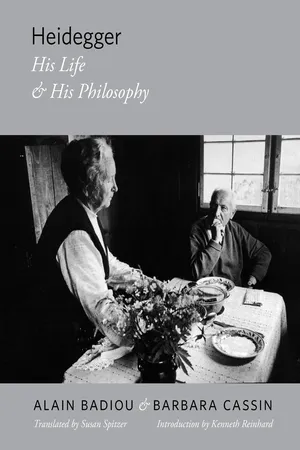
Martin Heidegger was an ordinary Nazi and a loyal member of the provincial petty bourgeoisie. He was also a seminal thinker of the Continental tradition and one of the twentieth century's most important philosophers. How are we to make sense of this dual life? Should we factor Heidegger's domestic and political associations into our understanding of his thought, or should we treat his intellectual work independently of his abhorrent politics? How does any thinker reconcile the mundane with the ideal or the pursuit of philosophical inquiry with the demands of civic engagement?
In Heidegger, Alain Badiou and Barbara Cassin immerse themselves in the philosopher's correspondence with his wife Elfride to answer these questions as they relate to Heidegger and all thinkers vulnerable to the politics of their times. They focus on Heidegger's tormented relationship with his wife, with Hannah Arendt, and with numerous other women, bringing an unusual level of intimacy to his personal and intellectual worlds.
- English
- ePUB (mobile friendly)
- Available on iOS & Android
eBook - ePub
About this book
Information
Topic
FilosofíaSubtopic
Biografías filosóficas1. The Heidegger “Affair”
Heidegger, especially in France, is the subject, or the stakes, of an ongoing debate. Its focus is clearly the presumable relationship between the philosophical works that made the name Heidegger a major reference point for the whole of twentieth-century thought and the ideological and institutional commitments that, at least in the early 1930s, or even until the end of World War II, coupled that name with National Socialist politics and/or the Nazi state, even though the philosopher never had the courage to explain himself, whatever his private conviction may have been, in the years that followed.
This debate would have remained at a basic level, as was long the case, if it had simply established that a philosopher, however great she or he may be, can be utterly wrong in areas whose reality we know full well cannot be reduced to the philosopher’s conception of it. It is not hard to come up with a sort of blooper collection of falsifiable convictions and questionable positions in the history of philosophy. When we recall what was said about women by Rousseau, Kant, or Comte; about Africans by Hegel and so many others; about the Germans by Leibniz or Fichte; about solid-state physics by Descartes or Malebranche; about slaves by Aristotle; about epic or lyric poetry by Plato; or about sexuality by Schopenhauer or Aquinas, we can no longer ask any philosopher to have a respectable position on every single subject. This just means that philosophy is a distinctive kind of activity whose unavoidable relationship with a sort of encyclopedic desire also happens to be the privileged site of errancy.
The debate might also have remained bounded, in a way, by metapolitical considerations, at the heart of which is the uneasy relationship between political action and the philosophical category of truth, or the Absolute. Constructing its concept of truth as antithetical to opinions, philosophy, in its main current, does not readily accept that politics seeks to operate with the total freedom of those opinions and thus purports to evade the authority of the True, hence the authority of philosophy. This leads to the well-known comment Hannah Arendt made in 1969, at the very same time as she publicly expressed her extreme admiration for Heidegger: “Theoretically, the tendency to the tyrannical can be detected in almost all great thinkers […].”1 This comment lumps Heidegger and Plato together, which is by no means a mere condemnation, even in Hannah Arendt’s eyes: “When they got involved in human affairs, both Plato and Heidegger resorted to tyrants and führers,” she further wrote, quite rightly condemning that course of action as “disgraceful” but seeing in it, by the same token, the confirmation-by-negation of the fact that Heidegger was indeed part of the chain of “great thinkers.” These great thinkers, Hannah Arendt essentially says—with the exception of the skeptics and Kant, that cleverly disguised skeptic—would be better off refraining from any involvement “in human affairs,” where it is not absolute truth that prevails but opinion, related as always to the diverse nature of being-together. In any case, it is not his withdrawal into thought and the major body of work that resulted from it, his “contemplative life,” of which Heidegger can be found guilty, but only of the fact that he felt he had to cloak in opaque phraseology, in which he compromised some of his concepts, his circumstantial fascination with action and power, when the occasion for that involvement was clearly criminal.
LOCAL DISAGREEMENT 1
• Barbara Cassin questions whether “circumstantial” shouldn’t be replaced by “essential” here, given that no “great thinker” is willing to forgo the absurd phrase “political philosophy.” A distinction needs to be made between the idea that “great thinkers don’t have respectable positions on every single subject, which is only to be expected” and another idea, undoubtedly Hannah Arendt’s, which could be expressed as “no great thinker can be politically respectable,” precisely because the categories of “the contemplative life” are radically inadequate when it comes to political action. The exception for her would be Aristotle at least as much as Kant. But does that exception prove the rule? Or does it prove that there are great thinkers who are also great political thinkers because they possess judgment and taste? The division here is the same as that established by Aristotle in Thales’ case: he was sophos but not phronimos, wise and sage but not prudent, when he cornered the market on olive presses and instituted the first monopoly capitalism. Except that the fortune Thales then made only took on meaning in response to the laughter of the Thracian servant girl who made fun of the philosopher when he fell into a well as he was observing the stars to predict the weather. Thales wanted to prove to her (it was an epideixis, a performance, as much as a demonstration) that meteorology, a part of sophia, can enable you to make a bundle, provided you want to, something that the prudent, and thus truly wise, philosopher couldn’t care less about. For both Arendt and Aristotle, any man worthy of the name must be phronimos. And when the thinker gets involved in human affairs, his sophia, as such and alone, lacks prudence and practical wisdom.
• Alain Badiou agrees with Barbara Cassin that the phrase political philosophy is absurd, but for opposite reasons. Politics, provided it’s not reducible to the mere management of affairs, is a truth procedure in its own right, concerning the capacities for collective and organized action and, as such, has no need for philosophy (any more than nuclear physics, for example, or lyrical abstraction, or pre-Islamic love poetry do). The relationship between philosophy and politics in no way entails a “political philosophy” but rather a transformation—subject to the (always problematic and in any case rare) existence of political sequences—of certain philosophical concepts, in particular those associated with the relationship between “truth” and “multiplicity,” in the mediation of the existence of a collective Subject. And this has nothing whatsoever to do with “judgment” or “taste,” any more than it does, incidentally, in politics properly speaking, which involves protocols of decision and organization in which the leading role is played not by the spectator, of course, but by the militant. The fact that when philosophers “get involved in human affairs,” as Hannah Arendt puts it, they are just like everyone else, is self-evident. Do we require a philosopher who speaks about poetry to be a good poet or even to be a first-rate mathematician if she or he speaks about mathematics? Heidegger’s properly political commitment, if measured against his philosophy, was therefore “circumstantial.” For Hannah Arendt herself, we should note, this type of commitment is fundamentally different from the “withdrawal” in which philosophical concepts are reflected upon. As regards Heidegger, moreover, the components of his basic philosophy existed long before his Nazi political activism and therefore could not derive in any “essential” way from it. The way in which Kant and Aristotle deal with politics is much closer, unfortunately for them, to a “political philosophy”: pragmatic, expedient, indeed irrelevant, and helplessly reduced to mere “judgment” because it is focused on the narcissistic idea that “what’s good is the middle class,” a class that never has any autonomous political capacity. Utterly different from this is the (quite simply) philosophical vision governing the retroactive relationship with politics, of Plato, who is only concerned with perfecting his concept of the Idea; or of Hegel, seeking a dialectic of totality; or of Heidegger, who philosophically reconstructs History, including the history of political sequences, as the historiality of Being.2
• Barbara Cassin adamantly refuses to absolve Heidegger of his Nazism by way of a potentially ambiguous Arendtian kind of leniency, on account of philosophy understood as being inherently irrelevant to politics. But that philosophy should in one way or another constitute itself as the metalanguage of the political, that ontology (Being, Truth), like ethics (the Good), for that matter, should purport to define politics, in short, that politics should have to be considered from the perspective of truth—this is what seems dangerous to her, as it did to Arendt, dangerous, from Plato to Heidegger and Badiou. That is why Alain Badiou is clearly right to stress that, in the generic case of Heidegger, the derivation cannot start from the political and that it was there before any Nazism: Heidegger holds (and this applies to himself mutatis mutandis) that it is only because the Greeks were an essentially apolitical people, that is, a people linked to Being, that they ultimately could and had to found the polis. Yet, for one thing, that’s wrong—Homer, tragedy, sophism, and even the Aristotelian definition of man as an animal endowed with logos, each in its own way proves as much. And, for another, it’s dangerous, and Barbara Cassin has no desire to believe that “where danger is, grows the saving power also.”3 This is why she maintains that, in her eyes, the problem isn’t the militant but the militant philosopher.
In France in particular, the controversy surrounding Heidegger couldn’t be contained within the kind of reasonable confines that this type of debate, which is ultimately regulated by an assumed distinction between philosophy and politics, involves. We can’t go into all the reasons here for this (as usual dubious) “French exception.” One thing, however, is very clear: the whole of French philosophical production between the 1930s and the 1970s, which it would not be an exaggeration to say was world renowned and at times dominant, had a fundamental, even if critical, relationship with Heidegger’s project. Suffice it to mention, to confine ourselves to those who are no longer alive, Sartre, Merleau-Ponty, Lautman, Derrida, Foucault, Lacan, and Lacoue-Labarthe (with Deleuze being the exception, something that actually provides food for thought) to understand what this means. To attack Heidegger with the utmost ferocity was also, and even above all, to settle scores with that glorious period of philosophy, a time when there was a strong relationship between intellectual work and revolutionary politics in all its forms. There was a petty, vindictive aspect, combined, as is often the case, with a reactionary impulse, to the delight that some critics took in ferreting out the thinker’s worst faults. The fact remains that, here in France, it was the extreme positions of the debate that gradually crystallized into the only relevant ones. On one side were the thinker’s devotees, who categorically denied that anything in his life any more than in his philosophy was in any way connected with Nazism. On the other side were those who held that Heidegger was a thoroughgoing ideologue of Nazism or even the overt and covert inspirer of its worst aspects. In their opinion, as a result, he is completely discredited as a philosopher and should be removed from the academic curriculum in every democratic country. To make clear what was involved, let us just mention the diehard defense counsel François Fédier and the ruthless prosecutor Emmanuel Faye.4
Once can note here the traditional point in common, which the laws of the dialectic always require us to discern between two extreme positions, namely, the characterization of the object of the controversy as indivisible. For one group of people, it is necessarily in his totality that the thinker dominated his century, and he therefore cannot have been involved in either the abjection or the crimes of his times. For the other group, it is also in his totality that the Nazi thoroughly destroyed his claim to philosophy. Doesn’t Emmanuel Faye think that Heidegger’s project can be defined as “the introduction of Nazism into philosophy?” That’s a bit like defining Plato as the introduction into philosophy of a Sicilian type of fascism—which, by the way, is pretty much Karl Popper’s position.
LOCAL DISAGREEMENT 2
• Barbara Cassin then raises the question: Sicilian fascism or the philosopher-king? Nazism or the history of the meaning of being (hence Gelassenheit, the pervasive serenity of the existential shepherd, and Selbstbehauptung, the self-assertion of the German university). Which is Arendt’s real accusation? We shouldn’t end up in the position of the valet de chambre.5 The truth of the matter is that we should consider each philosopher or thinker as uniquely fractal. But if we subsume him or her under the One, then he or she should be regarded in terms of his o...
Table of contents
- Cover
- Title Page
- Series Page
- Copyright
- Contents
- Introduction
- 1. The Heidegger “Affair”
- 2. About the Uses of the Word Jew
- 3. About Nazism
- 4. Planetary Prose in the German Provinces
- 5. Heidegger’s Women
- 6. Maneuvering and Career
- 7. Couples from France and Germany
- 8. Linguistic Transfiguration
- Notes
- Bibliography
- Index
- Series List
Trusted by 375,005 students
Access to over 1.5 million titles for a fair monthly price.
Study more efficiently using our study tools.
Frequently asked questions
Yes, you can cancel anytime from the Subscription tab in your account settings on the Perlego website. Your subscription will stay active until the end of your current billing period. Learn how to cancel your subscription
No, books cannot be downloaded as external files, such as PDFs, for use outside of Perlego. However, you can download books within the Perlego app for offline reading on mobile or tablet. Learn how to download books offline
Perlego offers two plans: Essential and Complete
- Essential is ideal for learners and professionals who enjoy exploring a wide range of subjects. Access the Essential Library with 800,000+ trusted titles and best-sellers across business, personal growth, and the humanities. Includes unlimited reading time and Standard Read Aloud voice.
- Complete: Perfect for advanced learners and researchers needing full, unrestricted access. Unlock 1.5M+ books across hundreds of subjects, including academic and specialized titles. The Complete Plan also includes advanced features like Premium Read Aloud and Research Assistant.
We are an online textbook subscription service, where you can get access to an entire online library for less than the price of a single book per month. With over 1.5 million books across 990+ topics, we’ve got you covered! Learn about our mission
Look out for the read-aloud symbol on your next book to see if you can listen to it. The read-aloud tool reads text aloud for you, highlighting the text as it is being read. You can pause it, speed it up and slow it down. Learn more about Read Aloud
Yes! You can use the Perlego app on both iOS and Android devices to read anytime, anywhere — even offline. Perfect for commutes or when you’re on the go.
Please note we cannot support devices running on iOS 13 and Android 7 or earlier. Learn more about using the app
Please note we cannot support devices running on iOS 13 and Android 7 or earlier. Learn more about using the app
Yes, you can access Heidegger by Alain Badiou,Barbara Cassin, Susan Spitzer in PDF and/or ePUB format, as well as other popular books in Filosofía & Biografías filosóficas. We have over 1.5 million books available in our catalogue for you to explore.