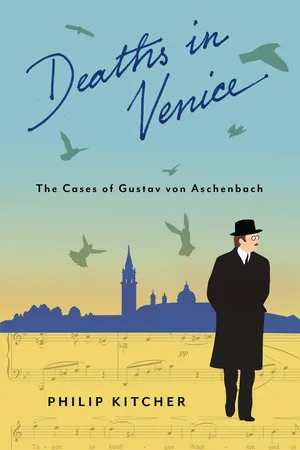
Published in 1913, Thomas Mann's Death in Venice is one of the most widely read novellas in any language. In the 1970s, Benjamin Britten adapted it into an opera, and Luchino Visconti turned it into a successful film. Reading these works from a philosophical perspective, Philip Kitcher connects the predicament of the novella's central character to Western thought's most compelling questions.
In Mann's story, the author Gustav von Aschenbach becomes captivated by an adolescent boy, first seen on the lido in Venice, the eventual site of Aschenbach's own death. Mann works through central concerns about how to live, explored with equal intensity by his German predecessors, Schopenhauer and Nietzsche. Kitcher considers how Mann's, Britten's, and Visconti's treatments illuminate the tension between social and ethical values and an artist's sensitivity to beauty. Each work asks whether a life devoted to self-sacrifice in the pursuit of lasting achievements can be sustained and whether the breakdown of discipline undercuts its worth. Haunted by the prospect of his death, Aschenbach also helps us reflect on whether it is possible to achieve anything in full awareness of our finitude and in knowing our successes are always incomplete.
- English
- ePUB (mobile friendly)
- Available on iOS & Android
eBook - ePub
About this book
Information
Topic
PhilosophieSubtopic
Critique littéraire européenneTable of contents
- Cover
- Series Page
- Title Page
- Copyright
- Dedication
- Contents
- List of Illustrations
- Preface
- List of Abbreviations
- A Note on Translations
- 1. Discipline
- 2. Beauty
- 3. Shadows
- Notes
- Index
Trusted by 375,005 students
Access to over 1.5 million titles for a fair monthly price.
Study more efficiently using our study tools.
Frequently asked questions
Yes, you can cancel anytime from the Subscription tab in your account settings on the Perlego website. Your subscription will stay active until the end of your current billing period. Learn how to cancel your subscription
No, books cannot be downloaded as external files, such as PDFs, for use outside of Perlego. However, you can download books within the Perlego app for offline reading on mobile or tablet. Learn how to download books offline
Perlego offers two plans: Essential and Complete
- Essential is ideal for learners and professionals who enjoy exploring a wide range of subjects. Access the Essential Library with 800,000+ trusted titles and best-sellers across business, personal growth, and the humanities. Includes unlimited reading time and Standard Read Aloud voice.
- Complete: Perfect for advanced learners and researchers needing full, unrestricted access. Unlock 1.5M+ books across hundreds of subjects, including academic and specialized titles. The Complete Plan also includes advanced features like Premium Read Aloud and Research Assistant.
We are an online textbook subscription service, where you can get access to an entire online library for less than the price of a single book per month. With over 1.5 million books across 990+ topics, we’ve got you covered! Learn about our mission
Look out for the read-aloud symbol on your next book to see if you can listen to it. The read-aloud tool reads text aloud for you, highlighting the text as it is being read. You can pause it, speed it up and slow it down. Learn more about Read Aloud
Yes! You can use the Perlego app on both iOS and Android devices to read anytime, anywhere — even offline. Perfect for commutes or when you’re on the go.
Please note we cannot support devices running on iOS 13 and Android 7 or earlier. Learn more about using the app
Please note we cannot support devices running on iOS 13 and Android 7 or earlier. Learn more about using the app
Yes, you can access Deaths in Venice by Philip Kitcher in PDF and/or ePUB format, as well as other popular books in Philosophie & Critique littéraire européenne. We have over 1.5 million books available in our catalogue for you to explore.