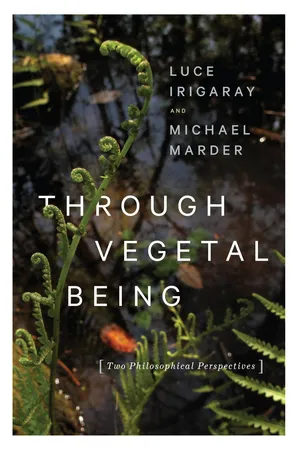
Blossoming from a correspondence between Luce Irigaray and Michael Marder, Through Vegetal Being is an intense personal, philosophical, and political meditation on the significance of the vegetal for our lives, our ways of thinking, and our relations with human and nonhuman beings. The vegetal world has the potential to rescue our planet and our species and offers us a way to abandon past metaphysics without falling into nihilism. Luce Irigaray has argued in her philosophical work that living and coexisting are deficient unless we recognize sexuate difference as a crucial dimension of our existence. Michael Marder believes the same is true for vegetal difference.
Irigaray and Marder consider how plants contribute to human development by sustaining our breathing, nourishing our senses, and keeping our bodies and minds alive. They note the importance of returning to ancient Greek tradition and engaging with Eastern teachings to revive a culture closer to nature. As a result, we can reestablish roots when we are displaced and recover the vital energy we need to improve our sensibility and relation to others. This generative discussion points toward a more universal way of becoming human that is embedded in the vegetal world.
- English
- ePUB (mobile friendly)
- Available on iOS & Android
eBook - ePub
About this book
Information
Topic
PhilosophieSubtopic
Literarische BriefeINDEX
Page numbers refer to the print edition but are hyperlinked to the appropriate location in the e-book.
Absolute, 17, 19, 39, 42, 61, 67, 84, 94, 120, 148, 170
Accomplishment, 35, 54, 80, 83, 88, 95, 115, 145, 187, 197–98
Aeschylus, 37, 104n3
Agni 30, 32
Ailanthus, 149
Alienation, 23, 130
Allergy, 129–31, 133–34
Alteration, 143–45
Alternation, 142–45
Alterity, 101. See also Other, the
Anaximenes, 137
Antigone (Sophocles), x, 16–20, 25, 33, 65, 67, 74, 126–27
Appearance, 24, 28, 30, 32, 39, 47, 74, 91–92, 101, 124, 142, 167, 169–71, 179; co-, 169, 171–72; coming-to-, 167–69, 172; non-, 168
Appropriation, 3, 23, 35, 45–46, 50, 53, 61–62, 80, 83, 88–89, 124–27, 132, 134, 169, 179, 188–89, 200, 204–5, 210
Arendt, Hannah, 169–70, 198
Aristotle, 33, 38, 75–76, 125, 136–38, 153, 162, 167, 175, 184–87, 204–5, 207–8
Art, 4, 43, 125, 159, 162, 187; of living, 195, 197, 205
Articulation, 75, 93, 192–94, 205; dis-, 182, 193
Atmosphere, 22, 27–28, 36, 43, 50, 117, 126, 130, 132–33, 136, 140, 199
Attention, 17, 29, 47, 60, 86, 132, 155–60, 182; continuous, 158; convoked...
Table of contents
- Cover
- Series Page
- Title Page
- Copyright
- Contents
- Preface
- Luce Irigaray
- Michael Marder
- Index
Trusted by 375,005 students
Access to over 1.5 million titles for a fair monthly price.
Study more efficiently using our study tools.
Frequently asked questions
Yes, you can cancel anytime from the Subscription tab in your account settings on the Perlego website. Your subscription will stay active until the end of your current billing period. Learn how to cancel your subscription
No, books cannot be downloaded as external files, such as PDFs, for use outside of Perlego. However, you can download books within the Perlego app for offline reading on mobile or tablet. Learn how to download books offline
Perlego offers two plans: Essential and Complete
- Essential is ideal for learners and professionals who enjoy exploring a wide range of subjects. Access the Essential Library with 800,000+ trusted titles and best-sellers across business, personal growth, and the humanities. Includes unlimited reading time and Standard Read Aloud voice.
- Complete: Perfect for advanced learners and researchers needing full, unrestricted access. Unlock 1.5M+ books across hundreds of subjects, including academic and specialized titles. The Complete Plan also includes advanced features like Premium Read Aloud and Research Assistant.
We are an online textbook subscription service, where you can get access to an entire online library for less than the price of a single book per month. With over 1.5 million books across 990+ topics, we’ve got you covered! Learn about our mission
Look out for the read-aloud symbol on your next book to see if you can listen to it. The read-aloud tool reads text aloud for you, highlighting the text as it is being read. You can pause it, speed it up and slow it down. Learn more about Read Aloud
Yes! You can use the Perlego app on both iOS and Android devices to read anytime, anywhere — even offline. Perfect for commutes or when you’re on the go.
Please note we cannot support devices running on iOS 13 and Android 7 or earlier. Learn more about using the app
Please note we cannot support devices running on iOS 13 and Android 7 or earlier. Learn more about using the app
Yes, you can access Through Vegetal Being by Luce Irigaray,Michael Marder in PDF and/or ePUB format, as well as other popular books in Philosophie & Literarische Briefe. We have over 1.5 million books available in our catalogue for you to explore.