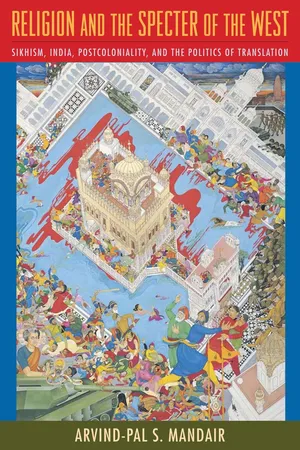
Arguing that intellectual movements, such as deconstruction, postsecular theory, and political theology, have different implications for cultures and societies that live with the debilitating effects of past imperialisms, Arvind Mandair unsettles the politics of knowledge construction in which the category of "religion" continues to be central. Through a case study of Sikhism, he launches an extended critique of religion as a cultural universal. At the same time, he presents a portrait of how certain aspects of Sikh tradition were reinvented as "religion" during the late nineteenth and early twentieth centuries.
India's imperial elite subtly recast Sikh tradition as a sui generis religion, which robbed its teachings of their political force. In turn, Sikhs began to define themselves as a "nation" and a "world religion" that was separate from, but parallel to, the rise of the Indian state and global Hinduism. Rather than investigate these processes in isolation from Europe, Mandair shifts the focus closer to the political history of ideas, thereby recovering part of Europe's repressed colonial memory.
Mandair rethinks the intersection of religion and the secular in discourses such as history of religions, postcolonial theory, and recent continental philosophy. Though seemingly unconnected, these discourses are shown to be linked to a philosophy of "generalized translation" that emerged as a key conceptual matrix in the colonial encounter between India and the West. In this riveting study, Mandair demonstrates how this philosophy of translation continues to influence the repetitions of religion and identity politics in the lives of South Asians, and the way the academy, state, and media have analyzed such phenomena.
eBook - ePub
Religion and the Specter of the West
Sikhism, India, Postcoloniality, and the Politics of Translation
- English
- ePUB (mobile friendly)
- Available on iOS & Android
eBook - ePub
Religion and the Specter of the West
Sikhism, India, Postcoloniality, and the Politics of Translation
About this book
Information
PART I
“Indian Religions” and Western Thought
1 Mono-theo-lingualism
Religion, Language, and Subjectivity in Colonial North India
The “Failure of Secular Creeds” in Politics and Theory
As late as the 1980s, a period that saw the end of the Cold War and the spread of free-market global capitalism, many political commentators continued to regard the phenomenon of religion as an anomaly in the hegemonic narrative of Western secularist modernity. Yet barely two decades later, faced with the global resurgence of religion, this uncontested self-identification of Western secularism with modernity and postmodernity was forced to see itself as suffering from a crisis, a rupture in its self-congratulatory narrative. A notable indicator of this change was provided by the special report and lead article on religion and public life that was run on November 3, 2007, by the respected journal of political economy The Economist. In his sobering reassessment of religion in public life, the author of the article argued that “in the twentieth century most Western politicians and intellectuals (and even some clerics) assumed that religion was becoming marginal to public life.”1 However, the alternative idea that “religion has re-emerged in public life is to some extent an illusion. It never really went away—certainly not to the extent that French politicians and American college professors imagined. Its new power is mostly the consequence of two changes. The first is the failure of secular creeds.”2 The second is that “religion has returned to the stage as a much more democratic, individualistic affair: a bottom-up marketing success, surprisingly in tune with globalization. Secularism was not as modern as many intellectuals imagined.”3
Although The Economist’s special report stopped well short of positing an alternative model to secularism, theorists of religion have argued that the rupture that manifests as the appearance of “public religions” in a previously secular world is one indication among others of a shift from a secular to a postsecular world.4 The term “postsecular,” as Hent de Vries reminds us, is not indicative of a change in historical periodization, nor of any sudden increase in religiosity of those who had held fast to the doctrine of secularism. Rather, “postsecular” is indicative of a change in the mindset of those who previously considered religion to be a primitive relic consigned to history rather than the present, or to the privacy of one’s home rather than to the public domain.5 This rupture, shift, or change in mindset consists in the acknowledgment by secularists and the secular state alike of the continuous presence or survival of religion and religious communities in a world that is becoming more and more disenchanted, more and more secular. Postsecularism is therefore a paradoxical but nevertheless global phenomenon in which religion lives on beyond its preestablished contexts, horizons, and concepts by taking refuge in virtual spaces created by new technologies.6
But one could go even further and suggest, as Scott Thomas does, that the term “postsecular” describes something like a loss of faith in the political myth of modernity.7 According to this political myth, the history of religious sectarianism in premodern Europe has taught us that when religion is politicized or deprivatized it inevitably causes war, intolerance, and perhaps even the collapse of social order; the liberal or secular state is therefore needed to save us from the violent consequences of religion. At the heart of this myth is a conceptualization of religion as the cause of violence. This manner of thinking about religion came into play after the Treaty of Westphalia in 1648 and the rise of Enlightenment reason. The very idea of a postsecularism is therefore inconceivable except as a crisis, an invasion of the secular from the outside. In recent years such invasions have been identified by a variety of markers, such as the “‘problem’ of Islam,” the Taliban, the veil or headscarf, the “Rushdie affair,” suicide bombing, and, of course, 9/11. Crisis, according to this manner of thinking, is the name given to the violence produced by the return of religion. Thomas argues that this understanding of religion was invented as part of the political mythology of liberalism and eventually emerged as a universal concept applicable to other cultures. Such a concept of religion has been used to legitimize a form of liberal politics that considers the mixing of politics and religion to be a recipe for violence and therefore dangerous to reason, freedom, and social order. The global resurgence of religion, however, has brought this concept of religion into crisis and challenges the idea that only secular reason can provide a neutral standpoint from which to interpret religion.8
Despite its seeming ubiquity, however, the phenomenon in question, which has variously been described as the “return of religion” or the “crisis of secularism,” displays revealing similarities and differences in the way it has been received within different geopolitical contexts. In the case of India, for example, the contemporary crisis of secularism can be traced both politically and theoretically. Politically, the crisis can be traced to two very different visions of the secular, advocated by Mohandas K. Gandhi and J. L. Nehru, the respective fathers of the Indian independence movement and the postindependence Indian nation. While Gandhi advocated a religion-inflected version of secularism based on the need for tolerance and pluralism as a means for promoting harmonious coexistence of different religions and ethnic communities in India, Nehru’s idea of secularism was based on a strictly rationalistic separation of religion and politics.9 Unlike Gandhi’s idea of secularism, which seemed to be more attuned to indigenous traditions, Nehruvian secularism derived its rationale from the British colonial machinery, which was in large part responsible for creating religious and caste identities as political categories. As Gyan Pandey has pointed out, the British identified “communalism” as an essential feature of Indian society, thereby implying a state of eternal and pervasive conflict between different religious communities: Hindu/Muslim, Śaiva/Vaiṣṇava, Sikh/Muslim, Hindu/Sikh, etc.10 These communal identities were fixed along lines of caste and religion via (i) census operations, and (ii) separate electorates. This process consolidated competing political identities, which in turn passed into the self-perception of Indians, but, more importantly, affected the policies of the Indian National Congress for almost five decades after independence. Nehru and his successors understood secularism as an instrument that could unify differences by dissolving particular identities under the figure of the Nation. According to Mukul Kesavan, this policy helped to “smelt a citizenry from the ore of a heterogenous population embedded in subjecthood.”11 While this policy clearly succeeded, it nevertheless had to rely on the “colonial predilection” for organizing politics by recourse to communal identities and therefore tapped into and manipulated the self-identification of Hindu and Muslim identities as these had evolved over the last one hundred years. Official (Nehruvian) secularism showed the two very different faces of modernity in postindependence India: modernity as purely secular (universal); versus modernity as religious and communitarian (particular), which in turn was comprised of majoritarian (Hindu) and minoritarian (Muslim, Sikh, Christian, etc.) factions.
In many ways the central problem with the Nehruvian model of secularism was the confident assumption, held by the majority of the Congress leadership, that national solidarity was inherently a quality of India’s (Hindu) cultural heritage.12 This assumption was made painfully evident to the world during the 1947 partition of India as Muslims and Hindus were polarized even further, each community seeing itself as the defender of its own cultural values and integrity. Unlike the Muslims, Sikh politicians cast their lot with Nehru’s Congress, which promised to establish a secular state that would defend minority rights. Yet within two decades of partition many Sikhs were regretting this decision as throughout the 1960s and 70s they became locked into one dispute after another with a secular state that was manipulated—invisibly, or so it seemed—by a majoritarian Hindu community.
The “Sikh problem,” as it was represented by influential sections of the Indian media and perceived by the Hindu majority, was about a troublesome minority whose secessionist demands challenged the stability and sovereignty of the Indian nation-state. From the Sikh standpoint, the problem was primarily about their need to secure rights as a vulnerable minority in India and about the rights of successively elected majority Sikh governments in Punjab to pursue their own governance free from interference by what was becoming an increasingly centralized government machinery, based in New Delhi. These disputes culminated in the Emergency of 1975 and by the 1980s had grown into a demand for regional autonomy of the Punjab province. It is now well established that Congress policies polarized the situation in Punjab by politically undermining the Akali Dal’s nonviolent agitation, thereby promoting the more militant and polarizing elements among the Sikhs.13 As events seemingly spiraled out of control in 1984, Prime Minister Indira Gandhi ordered the Indian army’s invasion of the Golden Temple complex in Amritsar—code name “Operation Blue Star”—to oust Sikh militants occupying the complex, which contained the premier seats of religious and political authority for Sikhs. Barely five months later, Indira Gandhi was assassinated by her Sikh bodyguards, followed almost immediately by several days of anti-Sikh pogroms throughout India but especially in the capital, New Delhi. As numerous human rights reports have made clear, these pogroms were orchestrated once again with the approval of high-level clearance in the ruling Congress party. Operation Blue Star unleashed a vicious cycle of insurgency that lasted until 1996 and was responsible for thousands of deaths, random disappearances, systematic torture, and human rights abuses against a civilian populace by the state police and army.14
Congress involvement in what Upendra Baxi has called “state-supported” violence was by no means limited to the “Sikh problem.” In retrospect it seems clear that Congress’s preoccupation with the Sikhs was to some extent an elaborate smokescreen for the much bigger challenge to Nehruvian secularism: the steady and inexorable rise of the Hindu right under the slogan of Hindutva (Hindu-ness). Led by the Bhartiya Janata Party (BJP) as the publicly elected face of Hindu nationalism, the Hindutva movement had by the late 1980s considerably eroded the Congress’s power base. Apart from the sectarian violence that accompanied the rise of the Hindu right, their arrival in 1994 as a democratically elected majority government led by the BJP signaled a watershed in Indian politics: the transformation of Indian democracy from the “pseudo-secularism” of Congress to a secularism defined by the majority Hindu community, effectively a Hindu secularism. So by 1994 India was already being defined by some as a Hindu democracy fueled by a religious nationalism.
When we look at the theoretical responses to the various crises of the Indian polity, it is hardly surprising to note how closely they have paralleled political events. Thus until the late 1980s the dominant left-liberal secularist position among Indian intellectuals—most of whom were either Nehruvians or Marxists—identified “religion,” “sectarianism,” “fundamentalism,” and “separatism” (euphemisms for Muslims in Kashmir and Sikhs in Punjab) as the threat to a fledgling Indian democracy. This perceived threat was usually instigated from outside the nation by a “foreign hand.” Interestingly, Hindu nationalism, though perceived as communalist, was rarely considered a threat to Indian democracy: the threat was always projected as non-Hindu. As the crisis of Indian secularism had set in by the early 1990s, other voices began to make themselves heard. Political psychologists such as Ashis Nandy and Sudhir Kakar and sociologists such as T. N. Madan began to formulate a “communitarian” critique of secularism that advocated decentralizing policies, based on their support for a pluralist democracy rooted in the recognition of the pivotal role of India’s religious communities in the makeup of Indian democracy.
For some years the debate between left-liberal secularists and communitarians defined the polarized state of Indian theoretical responses. It was not until the BJP began to redefine Indian democracy in terms of a Hindu secularism and began to influence the writing of Indian history and the entire educational and pedagogical infrastructure of India that a third position began to emerge. This alternative position was defined mainly by disaffected intellectuals of the Indian radical left, many of whom were historians or literary theorists influenced by French poststructuralism and especially by Edward Said’s postcolonial theory. Said’s critiques of Orientalism and nationalism in works such as Orientalism (1978) and Culture and Imperialism (1992) and his formulation of a “secular anti-imperialist critique” seems to be the moving influence behind these Indian postcolonial theorists. Central to Said’s rethinking of secularism as a safeguard against the injustices of democracy defined by a majoritarian community was the ideological proximity between religion and nationalism. Said’s opposition to nationalism is aligned with a notion of the secular as a domain “enunciated from minority positions.”15 When inflected into the scene of Indian polity, Said’s “secular anti-imperialist critique” provided a way to think about democracy without succumbing to the myth of national belonging, that is, from the standpoint of those most vulnerable to the vagaries of majoritarian rule. Indian intellectuals influenced by Said—including Ranajit Guha, Romila Thapar, G. C. Spivak, Dipesh Chakrabarty, Homi Bhabha, Partha Chatterjee, Gyan Pandey, and Gyan Prakash, among many others—have in a very real sense helped to establish India as the paradigmatic case of postcolonial theory.
But it is here that we come across an important and revealing difference between the theoretical responses to the crisis of secularism by Western (European-American) and by Indian academics. Much of the critique of secularism by Western academics has been performed mainly by those who are professedly religious, or by those who write from the perspective of the academic study of religion and therefore keep a minimal distance from religion. Nevertheless, Western academics generally share at least a minimal commitment to the idea that religion has been, for better or for worse, part and parcel of the cultural and philosophical frame of the history of the West. By contrast, critiques of secularism by Indian academics come mainly from a strictly historicist perspective and rarely from academics who either profess affiliation to a religion or are part of the scholarly study of religion. Even within critiques of secularism that have been written from a postcolonial/historicist perspective, the absence of discussion about “religion,” or any admission that “religion” is an intrinsic part of the Indian cultural frame, is startling.
This point is amply illustrated by Anuradha Dingwaney and Rajeshwari Sundar Rajan in their volume entitled The Crisis of Secularism in India. The editors offer the following explanation for the absence of discussion about religion in the discussions of secularism in their book:
Despite its crisis, secularism bears a normative status within and as constitutive of a modernity that remains the context from which we perform our critique. The critique of secularism is therefore obliged to be self-reflexive, an insider job by secularists themselves. In the contempo...
Table of contents
- Cover
- Half title
- Series Page
- Title
- Copyright
- Dedication
- Contents
- Preface
- Acknowledgments
- Introduction
- Part I. “Indian Religions” and Western Thought
- Part II. Theology as Cultural Translation
- Part III. Postcolonial Exits
- Epilogue
- Notes
- Glossary of Indic Terms
- Index
Trusted by 375,005 students
Access to over 1.5 million titles for a fair monthly price.
Study more efficiently using our study tools.
Frequently asked questions
Yes, you can cancel anytime from the Subscription tab in your account settings on the Perlego website. Your subscription will stay active until the end of your current billing period. Learn how to cancel your subscription
No, books cannot be downloaded as external files, such as PDFs, for use outside of Perlego. However, you can download books within the Perlego app for offline reading on mobile or tablet. Learn how to download books offline
Perlego offers two plans: Essential and Complete
- Essential is ideal for learners and professionals who enjoy exploring a wide range of subjects. Access the Essential Library with 800,000+ trusted titles and best-sellers across business, personal growth, and the humanities. Includes unlimited reading time and Standard Read Aloud voice.
- Complete: Perfect for advanced learners and researchers needing full, unrestricted access. Unlock 1.5M+ books across hundreds of subjects, including academic and specialized titles. The Complete Plan also includes advanced features like Premium Read Aloud and Research Assistant.
We are an online textbook subscription service, where you can get access to an entire online library for less than the price of a single book per month. With over 1.5 million books across 990+ topics, we’ve got you covered! Learn about our mission
Look out for the read-aloud symbol on your next book to see if you can listen to it. The read-aloud tool reads text aloud for you, highlighting the text as it is being read. You can pause it, speed it up and slow it down. Learn more about Read Aloud
Yes! You can use the Perlego app on both iOS and Android devices to read anytime, anywhere — even offline. Perfect for commutes or when you’re on the go.
Please note we cannot support devices running on iOS 13 and Android 7 or earlier. Learn more about using the app
Please note we cannot support devices running on iOS 13 and Android 7 or earlier. Learn more about using the app
Yes, you can access Religion and the Specter of the West by Arvind-Pal S. Mandair in PDF and/or ePUB format, as well as other popular books in Theologie & Religion & Indische & südasiatische Geschichte. We have over 1.5 million books available in our catalogue for you to explore.