What Is a People? seeks to reclaim "people" as an effective political concept by revisiting its uses and abuses over time. Alain Badiou surveys the idea of a people as a productive force of solidarity and emancipation and as a negative tool of categorization and suppression. Pierre Bourdieu follows with a sociolinguistic analysis of "popular" and its transformation of democracy, beliefs, songs, and even soups into phenomena with outsized importance. Judith Butler calls out those who use freedom of assembly to create an exclusionary "we," while Georges Didi-Huberman addresses the problem of summing up a people with totalizing narratives. Sadri Khiari applies an activist's perspective to the racial hierarchies inherent in ethnic and national categories, and Jacques Rancière comments on the futility of isolating theories of populism when, as these thinkers have shown, the idea of a "people" is too diffuse to support them. By engaging this topic linguistically, ethnically, culturally, and ontologically, the voices in this volume help separate "people" from its fraught associations to pursue more vital formulations.
Together with Democracy in What State?, in which Giorgio Agamben, Alain Badiou, Daniel Bensaid, Wendy Brown, Jean-Luc Nancy, Jacques Rancière, Kristin Ross, and Slavoj Žižek discuss the nature and purpose of democracy today, What Is a People? expands an essential exploration of political action and being in our time.
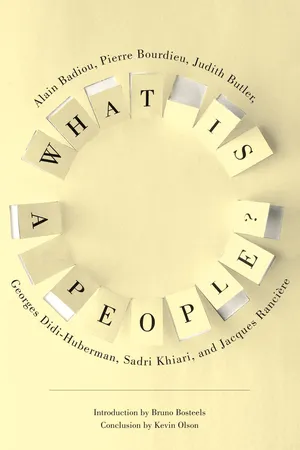
eBook - ePub
What Is a People?
- English
- ePUB (mobile friendly)
- Available on iOS & Android
eBook - ePub
About this book
Information
Topic
PhilosophieSubtopic
Théorie critique1
TWENTY-FOUR NOTES ON THE USES OF THE WORD “PEOPLE”
1
Even if we can only nod, time and again, to the “we are here by the will of the people” of the nascent French Revolution, we must acknowledge that “people,” by itself, is not in the least a progressive noun. When Mélanchon’s posters proclaim “a place for the people!” it is only unreadable rhetoric today. Likewise we must acknowledge that neither is “people” a fascist term, even if the Nazi uses of the word Volk seem inclined in that direction. When Marine Le Pen’s “populism” is denounced almost everywhere, this only adds to the confusion. The truth is that “people” is now a neutral term, like so many others in the political lexicon. Everything is a matter of context. Thus we will have to examine it a bit more closely.
2
The adjective “popular” is more connotative, more active. We have only to look at what was meant by expressions like “popular committee,” “popular movement,” “popular tribunal,” “popular front,” “popular power,” and, even on the state level, “popular democracy,” to say nothing of “popular liberation army,” to observe that the adjective aims at politicizing the noun, at conferring upon it an aura that combines the breaking off of oppression and the light of a new collective life. Of course if a singer or a politician is “popular,” it is only a statistical fact without real value. But not if a movement or an insurrection is so classified exactly like such episodes in areas of history where it was a question of emancipation.
3
On the other hand, we distrust the word “people” when it is accompanied by an adjective, especially an adjective of identity or nationality.
4
We know of course that there was nothing legitimate or politically positive about the “heroic war of liberation of the Vietnamese people.” It seems that “liberation” in the context of colonial oppression, indeed even in the context of an intolerable foreign invasion, confers upon “people”—accompanied by an adjective that characterizes said people—an undeniable liberating touch. And all the more so when the imperial colonial camp would prefer to speak of “tribes” or “ethnic groups,” if not “races” and “savages.” The word “people” was only suitable for the conquering powers, elated by the conquest itself: “the French people,” “the English people,” yes…. But the Algerian people, the Vietnamese people? No! And even today for the Israeli government, “the Palestinian people”? An even louder no. The period of the wars of national liberation sanctified “national adjective + people,” by establishing the right—often at the cost of armed struggle—to the word “people” for those to whom the colonizers refused its use, considering only themselves to be “true” peoples.
5
But beyond the violent process of liberation, beyond the movement to appropriate a forbidden word, of what value is “national adjective + people”? Not much, let’s admit it. And especially now. Because now is the time when the truth of one of Marx’s powerful maxims asserts itself, a sentence as forgotten as it is forceful, even though it was crucial in the eyes of its author: “The workers have no country.” This is even more true because although they have always been nomads—since they had to uproot themselves from the land and rural poverty to be enlisted into capitalism’s workshops—workers are more nomadic now than ever. No longer are they just moving from the country to the city but from Africa and Asia to Europe and America, even from Cameroon to Shanghai or from the Philippines to Brazil. Thus to what “national adjective + people” do they belong? Much more than when Marx, that great prophet of the future of the classes, was forming the First International, now is the time when the workers are the living body of internationalism, the only territory where something like a “proletariat” can exist, “proletariat” understood here as the subjectivized body of communism.
6
We must abandon to their reactionary fate expressions like “the French people” and other phrases in which “people” is saddled with an identity. Where “the French people” in reality means nothing more than “the inert mass of those upon whom the state has conferred the right to call themselves French.” We will accept this yoking only in cases where that identity is in reality a political process under way, as with “the Algerian people” during the French war in Algeria, or the “Chinese people” when the expression is pronounced from the communist base of Yan’an. And in these cases we should note that “adjective + people” derives its reality only in violent opposition to another “adjective + people,” the one with a colonial army breathing down its neck that claims to refuse insurgents any right to the word “people,” or the army of a reactionary state that desires the extermination of “anti-national” rebels.
7
Thus “adjective + people” is either an inert category of the state (like “French people” today from the mouths of politicians on both sides) or a category of wars and political processes associated with situations of so-called national liberation.
8
In parliamentary democracies in particular, the “people” has in fact become a category of the right of state. Through the political sham of the vote, the “people,” composed of a collection of human atoms, confers the fiction of legitimacy on the elected. This is the “sovereignty of the people,” or more exactly the sovereignty of the “French people.” If for Rousseau sovereignty still meant a live and effective popular assembly—let us recall that Rousseau considered English parliamentary government to be a sham—it is clear today that such sovereignty, with its multiplicity of inert and fragmented opinions, constitutes no true political subject. As legal referent for the representative process, the “people” means only that the state can and must persist in its being.
9
“What being?” we will ask. And so without going into detail here we will propose that our states do not in the least derive their reality from the vote but rather from an insurmountable allegiance to the necessities of capitalism and the antipopular measures (let us stress in passing the undoubtedly strained values that derive from the adjective “popular”) that those necessities constantly require. And this is happening more and more overtly, more and more shamelessly. And that is how our “democratic” governments make the people, whom they claim to represent, into a substance we may call capitalized. If you don’t believe it, if like Saint Thomas you believe only in what you can see, look at Hollande.
10
But can’t the “people” be a reality that underlies the progressive virtue of the adjective “popular”? Isn’t a “popular assembly” a kind of representation of the “people” in a different sense than the closed, state-controlled one masked by adjectives of nationality and the “democratic” legalization of sovereignty?
11
Let us return to the example of the wars of national liberation. In this context, “the Vietnamese people” means in effect the existence of a people just as it was refused status as referent for a nation, which can itself only exist on the global scene insofar as it is granted a state. Thus it is in the retrospective effect of the nonexistence of a state that the “people” can be part of the naming of a political process and thus become a political category. As soon as the state in question is formed, regulated, and enrolled in the “international community,” the people it claims as its authority ceases to be a political subject. It becomes a passive mass that the state configures, universally, no matter what the form of the state.
12
But within this passive mass, can’t “people” designate something singular? If we consider, for example, the great strikes in France during the Occupation in June 1936 or in May 1968, don’t we have to say that a people—a “working people”—emerged there as a kind of immanent exception to the constitutional inertia designated by the expression “the French people”? Yes, we can, we must say it. And as early as Spartacus and his rebellious companions, or Toussaint Louverture and his friends both black and white, we must say that in ancient Rome or on the colonial island of Haiti, they configured a true people.
13
Even the dangerous inertia of the word “people” modified by a national adjective can, despite the contradiction, be subverted by pressure from within this national and lawful “people.” What did those who occupied Tahrir Square in Egypt at the height of the “Arab Spring” mean when they asserted, “We are the Egyptian people”? That their movement, their own unity, their slogans configure an Egyptian people free from its established national inertia, an Egyptian people with the right to actively claim the national adjective, because the nation of which they speak is yet to come. Because it only exists in the dynamic form of a vast political movement. Because, in the face of that movement, the state that claims to represent Egypt is illegitimate and must disappear.
14
From which we see that “people” here takes on a meaning that implies the disappearance of the existing state. And, beyond that, the disappearance of state itself, from the moment that political decisions are in the hands of a new people assembled on a square, assembled right here. What is affirmed in vast popular movements is always the latent necessity of what Marx made the supreme objective of all revolutionary politics: the demise of the state.
15
Let us note that in all these cases, in the place of the electoral process’s majority representation, which shapes the state-controlled inertia of the people through the legal means of state legitimacy, and also in the place of submission, always half consensual and half forced, to a despotic authority, we have a minority detachment that activates the word “people” according to an unprecedented political orientation. The “people” can once again designate—in a context completely different from the one of struggles for national liberation—the subject of a political process. But it is always in the form of a minority that declares not that it represents the people but that it is the people as it destroys its own inertia and makes itself the body of the political precedent.
16
Let us note that this minority detachment can only enforce its declaration (“we are the people, the true people”) insofar as, beyond its own strength, beyond the small numbers that make it the body of the political precedent, it is constantly tied to a living popular mass by a thousand channels and actions. Speaking of that specific and specialized detachment that called itself “the Communist Party” in the last century, Mao Zedong indicated that his legitimacy was at every moment suspended from what he called the “mass liaison,” which was in his eyes the alpha and omega of the possible reality of a politics. Let us say that the immanent exception that is the people in the sense of an active detachment only supports its claim of being the provisional body of the true people in a lasting way by validating that claim at any moment within the wide masses, by deploying its activity in the direction of those whom the inert people, subject to its configuration by the state, keeps forever at a distance from their political capacity.
17
But isn’t there also the “people” in the sense that, even without ever activating an assembled detachment, is nevertheless not truly included in the contingent of “the sovereign people” as constituted by the state? We will answer “yes.” It makes sense to speak of “the people’s people” as they are what the official people, in the guise of the state, regards as nonexistent. Here we arrive at the margins of objectivity, the social, economic, and state margins. For centuries the “nonexistent” mass was the mass of poor peasants, and the existent society properly speaking, as deemed by the state, consisted of a mix of hereditary aristocracy and the nouveaux riches. Today in the societies that grant themselves the title of “advanced” societies or “democracies,” the central core of the nonexistent mass is composed of newly arrived workers (those called “immigrants”). Around them is a loose composite of provisional workers, the underemployed, displaced intellectuals, and the entirety of exiled, segregated youth on the peripheries of large cities. It is legitimate to speak of the “people” with regard to this ensemble, insofar as, in the eyes of the state, it has no right to the consideration the official people enjoys.
18
Let us remark that in our societies, the official people is given the very strange name of the “middle class.” As if what is “middle” could be admirable…. That is because the dominant ideology of our societies is Aristotelian. Counter to the obvious aristocratism of Plato, Aristotle established the excellence of what cleaves to the golden mean. That is the grounds for the creation of a significant middle class as the necessary medium for a democratic-style constitution. Today when the official propaganda newspapers (that is to say, nearly all the newspapers) rejoice over the growth of the Chinese middle class—they have counted, feverishly…—to five hundred million people, consumers of new products who want to be left in peace, they are the unknowing followers of Aristotle. Their conclusion is the same as his: in China, a democracy—the happy medium…—is in sight, for which the “people” is the satisfied ensemble of the middle class that constitutes the masses so that the power of the capitalist oligarchy can be considered democratically legitimate.
19
The middle class is the “people” of capitalist oligarchies.
20
From this perspective, the Malian, Chinese, Moroccan, Congolese, or Tamil who is refused legal status, to whom papers are denied, is the emblem of the people in that he is and can only be what is rescued of the word “people” from the false people composed of those who form a consensus around the oligarchy. Moreover, that is why the process of political organization around the issue of papers, and more generally around the issues related to the newest arrivals among workers, is central to all progressive politics today; it can configure the new people as it is constituted on the margins of the official people in order to rescue for it the word “people” as a political word.
21
Thus we have two negative senses of the word “people.” The first and most obvious is the one saddled with a closed—and always fictive—racial or national identity. The historical existence of this type of “people” requires the construction of a despotic state, which brings its founding fiction violently into existence. The second, more subtle one, though on a large scale even more harmful—because of its adaptability and the consensus that it fosters—is the one that subordinates the recognition of a “people” to a state that is assumed to be legitimate and beneficent by the sole fact that it organizes when possible the growth, and in any case the persistence, of a middle class, free to consume the empty products that capitalism force-feeds it and free as well to say what it wants, provided that this free speech has no effect whatsoever on the general mechanism.
22
And finally we have two positive senses of the word “people.” The first is the constitution of a people in pursuit of its historical existence, insofar as that aim is denied by colonial and imperial domination or by the domination of an invader. Thus the “people” exists according to the future perfect of a nonexistent state. The second is the existence of a people who declares itself as such, beginning from its central core, which is precisely what the official state excludes from its supposedly legitimate “people.” Such a people asserts its existence politically in the strategic aim of abolishing the existing state.
23
The “people” is therefore a political category, either leading up to the existence of a desired state denied existence by some power or in the aftermath of an established state of which a new people, both interior and exterior to the official people, requires its demise.
24
The word “people” has a positive sense only with regard to the possible nonexistence of the state. Either the forbidden state whose creation is desired. Or the official state whose disappearance is desired. The “people” is a word that takes all its value either, in transitory forms, from the wars of national liberation or, in definitive forms, from communist politics.
2
YOU SAID “POPULAR”?
POPULAR. Adj. (Populeir, XIIe; lat. popularis). 1: What belongs to the people, emanates from the people. Popular gover...
Table of contents
- Cover
- Series Page
- Title Page
- Copyright
- Contents
- Preface
- Introduction: This People Which Is Not One
- 1. Twenty-Four Notes on the Uses of the Word “People”
- 2. You Said “Popular”?
- 3. “We, the People”: Thoughts on Freedom of Assembly
- 4. To Render Sensible
- 5. The People and the Third People
- 6. The Populism That Is Not to Be Found
- Conclusion: Fragile Collectivities, Imagined Sovereignties
- Notes
- Index
- Series List
Trusted by 375,005 students
Access to over 1.5 million titles for a fair monthly price.
Study more efficiently using our study tools.
Frequently asked questions
Yes, you can cancel anytime from the Subscription tab in your account settings on the Perlego website. Your subscription will stay active until the end of your current billing period. Learn how to cancel your subscription
No, books cannot be downloaded as external files, such as PDFs, for use outside of Perlego. However, you can download books within the Perlego app for offline reading on mobile or tablet. Learn how to download books offline
Perlego offers two plans: Essential and Complete
- Essential is ideal for learners and professionals who enjoy exploring a wide range of subjects. Access the Essential Library with 800,000+ trusted titles and best-sellers across business, personal growth, and the humanities. Includes unlimited reading time and Standard Read Aloud voice.
- Complete: Perfect for advanced learners and researchers needing full, unrestricted access. Unlock 1.5M+ books across hundreds of subjects, including academic and specialized titles. The Complete Plan also includes advanced features like Premium Read Aloud and Research Assistant.
We are an online textbook subscription service, where you can get access to an entire online library for less than the price of a single book per month. With over 1.5 million books across 990+ topics, we’ve got you covered! Learn about our mission
Look out for the read-aloud symbol on your next book to see if you can listen to it. The read-aloud tool reads text aloud for you, highlighting the text as it is being read. You can pause it, speed it up and slow it down. Learn more about Read Aloud
Yes! You can use the Perlego app on both iOS and Android devices to read anytime, anywhere — even offline. Perfect for commutes or when you’re on the go.
Please note we cannot support devices running on iOS 13 and Android 7 or earlier. Learn more about using the app
Please note we cannot support devices running on iOS 13 and Android 7 or earlier. Learn more about using the app
Yes, you can access What Is a People? by Alain Badiou,Judith Butler,Georges Didi-Huberman,Sadri Khiari,Jacques Rancière,Pierre Bourdieu, Jody Gladding in PDF and/or ePUB format, as well as other popular books in Philosophie & Théorie critique. We have over 1.5 million books available in our catalogue for you to explore.