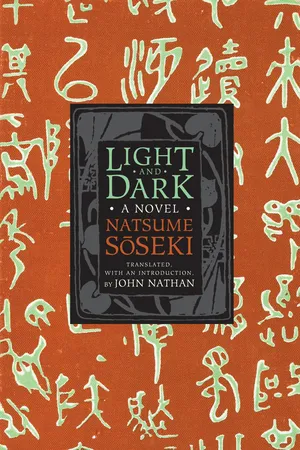
Light and Dark, Natsume Soseki's longest novel and masterpiece, although unfinished, is a minutely observed study of haute-bourgeois manners on the eve of World War I. It is also a psychological portrait of a new marriage that achieves a depth and exactitude of character revelation that had no precedent in Japan at the time of its publication and has not been equaled since. With Light and Dark, Soseki invented the modern Japanese novel.
Recovering in a clinic following surgery, thirty-year-old Tsuda Yoshio receives visits from a procession of intimates: his coquettish young wife, O-Nobu; his unsparing younger sister, O-Hide, who blames O-Nobu's extravagance for her brother's financial difficulties; his self-deprecating friend, Kobayashi, a ne'er-do-well and troublemaker who might have stepped from the pages of a Dostoevsky novel; and his employer's wife, Madam Yoshikawa, a conniving meddler with a connection to Tsuda that is unknown to the others. Divergent interests create friction among this closely interrelated cast of characters that explodes into scenes of jealousy, rancor, and recrimination that will astonish Western readers conditioned to expect Japanese reticence.
Released from the clinic, Tsuda leaves Tokyo to continue his convalescence at a hot-springs resort. For reasons of her own, Madam Yoshikawa informs him that a woman who inhabits his dreams, Kiyoko, is staying alone at the same inn, recovering from a miscarriage. Dissuading O-Nobu from accompanying him, Tsuda travels to the spa, a lengthy journey fraught with real and symbolic obstacles that feels like a passage from one world to another. He encounters Kiyoko, who attempts to avoid him, but finally manages a meeting alone with her in her room. Soseki's final scene is a sublime exercise in indirection that leaves Tsuda to "explain the meaning of her smile."
- English
- ePUB (mobile friendly)
- Available on iOS & Android
eBook - ePub
About this book
Information
Subtopic
ClassicsIndex
Literature
[ 1 ]
“It appears the lesion extends all the way to the intestine. Last time I felt the ridge of a scar and assumed it stopped there, but when I scraped away just now to help it drain, I see it’s deeper.”
“To the intestine?”
“Yes. What I thought was less than two centimeters appears to be more than three.”
A flush of disappointment rose faintly to Tsuda’s face beneath his strained smile. The doctor shook his head, his hands clasped in front of him against his baggy white smock. “It’s too bad but it’s the reality we have to face,” he might have been saying. “A doctor can’t compromise professional standards with a lie.”
Tsuda retied his obi in silence and turned again to face the doctor, lifting his hakama* from the back of a chair where he had dropped it.
“If it’s all the way to the intestine there’s no way it’ll heal?”
“There’s no reason to think that.”
The doctor’s denial was emphatic and unhesitating, as if to invalidate Tsuda’s mood at the same time.
“It does suggest we’ll have to do more than just clean the canal as we’ve been doing. Since that won’t get us any new tissue our only option is a more fundamental approach.”
“Meaning?”
“Surgery. We’ll resect a portion of the canal and connect it to the intestine. That will allow the resected ends to knit naturally and you’ll be, well, almost as good as new.”
Tsuda nodded without speaking. Next to where he stood, a microscope sat on a table that had been installed beneath a window facing south. Entering the examination room earlier, his curiosity had prompted him to ask the doctor, with whom he was on familiar terms, if he could have a look. What he had seen through the 850-power lens were grape-shaped bacteria as vividly colored as if they had been photographed.
Fastening his hakama, Tsuda reached for the leather wallet he had placed on the same table and abruptly recalled the bacteria. The association was a breath of uneasiness. Having inserted the wallet inside his kimono in preparation to leave, he was on his way out when he hesitated.
“If it’s tuberculosis, I suppose it wouldn’t heal even if you performed what you call fundamental surgery?”
“If it were tubercular, no. In that case it would burrow straight in toward the intestine so that just treating the opening would be ineffective.”
Tsuda winced involuntarily.
“But mine isn’t tubercular?”
“That’s right.”
Tsuda looked hard at the doctor for an instant, as if to determine the degree of truth in what he was saying. The doctor didn’t move.
“How do you know? You can tell from just an examination?”
“That’s right—from how it looks.”
Just then the nurse, standing at the entrance to the room, called the name of the next patient, who had been waiting for his turn and immediately appeared in the doorway. Tsuda was obliged to exit quickly.
“So when can I have this surgery?”
“Any time. Whenever it suits you.”
Promising to pick a date after thinking it over, Tsuda stepped outside.
[ 2 ]
He felt miserable. Shifting his focus abruptly, he cast an eye around him. The passengers near him were impassive, not even aware of his existence. He turned his thoughts back on himself.
Why did I have such an agonizing experience?
On his way home from viewing cherry blossoms at the Arakawa Wharf, the pain had struck with no warning, its cause a mystery to him. It wasn’t strange so much as terrifying. There’s no guarantee that a change won’t occur in this body of mine at any hour of any given day. For that matter, some sort of change could be taking place even now. And I myself have no idea. Terrifying!
Having proceeded this far, his mind was unable to stop. With the force of a powerful blow to the back it jolted him forward. Abruptly he called out silently inside himself:
It’s the same with the mind. Exactly the same. There’s no knowing when or how it will change. I’ve witnessed such a change with my own eyes.
Pursing his lips, he glanced around him with the eyes of a man whose self-esteem has been injured. But the other passengers were oblivious of what was happening inside him and paid no heed to the look in his eyes.
Like the streetcar he was riding, his mind merely moved forward on its own tracks. He recalled what his friend had told him a few days ago about Poincarré. Having explained “probability” for his benefit, his friend had turned to him and spoken as follows:
“So you see, what you commonly hear described as chance, an accident, a chance occurrence, is really just a case where the actual cause is too complex to grasp. For a Napoleon to be born, an extraordinary sperm must unite with an extraordinary egg; but when you start considering the circumstances that were required to create that necessary union it boggles the imagination.”
He was unable to dismiss his friend’s words as merely a fragment of new knowledge that had been imparted to him. Thinking about how closely they fit his own circumstances, he seemed to become aware of a dark, imponderable force pushing him left when he meant to go right or pulling him back when he meant to go forward. Until that moment, he would have felt certain that his actions had never been subject to restraint by others. He had been certain that he did whatever he did of his own accord, that everything he said he intended to say.
Why would she have married him? Because she chose to, no doubt. But she couldn’t possibly have wanted that. And what of me, why did I marry the woman who is my wife? No doubt our marriage happened because I chose to take her. But I have never once felt that I wanted her. Chance? Poincarré’s so-called zenith of complexity? I have no idea.
Alighting from the streetcar, he walked ruminatively home.
[ 3 ]
“What are you looking at?”
As if surprised by his voice, Tsuda’s wife quickly turned to face him.
“You startled me—welcome home.”
As she spoke, she turned her sparkling eyes on him and drenched him in their light. Then, bending forward slightly she dipped her head in a casual greeting. Tsuda halted where he stood, half responding to the coquette in her and half hesitating.
“What are you doing standing here?”
“I was waiting—for you to come home.”
“But you were staring at something.”
“A sparrow. You can see the sparrow nesting under the eaves across the street.”
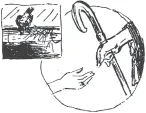
Tsuda glanced up at the roof of the house. But there was no visible sign of anything that appeared to be a sparrow. His wife abruptly extended her hand toward him.
“What?”
“Your stick.”
As if he had just noticed it, Tsuda handed the cane to his wife. Taking it, she slid open the lattice door at the entrance and moved aside for her husband to enter. Close behind him, she stepped up to the wooden floor from the concrete slab for shoes.
When she had helped him change out of his kimono, she brought from the kitchen a soap dish wrapped in a towel as he was sitting down in front of the charcoal brazier.
“Go and have a quick bath now. Once you get comfortable there you won’t feel like going out.”
Tsuda had no choice but to reach out and take the towel. But he didn’t stand right away.
“I might skip a bath today.”
“Why? You’ll feel refreshed. And dinner will be ready as soon as you get back.”
Tsuda stood up again as he was told. On his way out of the room he turned back toward his wife.
“I stopped in at Kobayashi’s on the way home from work and had him take a look.”
“Goodness! What did he say? By now you must be mostly better?”
“I’m not—it’s worse than before.”
Without giving his wife a chance to question him further, he left the room.
It wasn’t until early that evening, after dinner and before he had withdrawn to his study, that the couple returned to the subject.
“I can’t believe it, surgery is horrible; it scares me. Couldn’t you just ignore it as you’ve been doing?”
“The doctor says that would be dangerous.”
“But it’s so hateful, what if he makes a mistake?”
His wife looked at him, bunching slightly her thick, well-formed eyebrows. Tsuda smiled, declining to engage her. Her next question seemed to have occurred to her abruptly.
“If you do have surgery won’t it have to be on Sunday?”
On the coming Sunday his wife had made a date with relatives to see a play and bring Tsuda along.
“They haven’t bought tickets yet so you needn’t worry about canceling.”
“But wouldn’t that be rude? After they were kind enough to invite us along?”
“Not at all. Not under the circumstances.”
“But I want to go!”
“Then do.”
“And you come too, won’t you? Won’t you, please?”
Tsuda looked at his wife and forced a smile.
[ 4 ]
Table of contents
- Cover
- Title Page
- Copyright
- Dedication
- Contents
- Introduction
- A Note on the Translation
- Light and Dark
- Series List
Trusted by 375,005 students
Access to over 1.5 million titles for a fair monthly price.
Study more efficiently using our study tools.
Frequently asked questions
Yes, you can cancel anytime from the Subscription tab in your account settings on the Perlego website. Your subscription will stay active until the end of your current billing period. Learn how to cancel your subscription
No, books cannot be downloaded as external files, such as PDFs, for use outside of Perlego. However, you can download books within the Perlego app for offline reading on mobile or tablet. Learn how to download books offline
Perlego offers two plans: Essential and Complete
- Essential is ideal for learners and professionals who enjoy exploring a wide range of subjects. Access the Essential Library with 800,000+ trusted titles and best-sellers across business, personal growth, and the humanities. Includes unlimited reading time and Standard Read Aloud voice.
- Complete: Perfect for advanced learners and researchers needing full, unrestricted access. Unlock 1.5M+ books across hundreds of subjects, including academic and specialized titles. The Complete Plan also includes advanced features like Premium Read Aloud and Research Assistant.
We are an online textbook subscription service, where you can get access to an entire online library for less than the price of a single book per month. With over 1.5 million books across 990+ topics, we’ve got you covered! Learn about our mission
Look out for the read-aloud symbol on your next book to see if you can listen to it. The read-aloud tool reads text aloud for you, highlighting the text as it is being read. You can pause it, speed it up and slow it down. Learn more about Read Aloud
Yes! You can use the Perlego app on both iOS and Android devices to read anytime, anywhere — even offline. Perfect for commutes or when you’re on the go.
Please note we cannot support devices running on iOS 13 and Android 7 or earlier. Learn more about using the app
Please note we cannot support devices running on iOS 13 and Android 7 or earlier. Learn more about using the app
Yes, you can access Light and Dark by Sōseki Natsume, John Nathan in PDF and/or ePUB format, as well as other popular books in Literature & Classics. We have over 1.5 million books available in our catalogue for you to explore.